Product Packaging Design Companies: How to Choose One (and What They Actually Do)
Packaging is the last thing many teams plan and the first thing a buyer judges. Here is what packaging design companies do, what it costs, and how to pick one.
January 30, 20206 min read

Written by Yelena Rymbayeva, MPhil Communication & Media Studies, BTech Quality Control
Marketing & Product Leader, Technology Commercialization
Published January 30, 2020Updated September 2, 2026
Packaging is the only part of a product every buyer touches before they decide. It has to survive a supply chain, fit a shelf or a shipping carton, satisfy labelling rules, and still make the product look worth the price. Product packaging design companies exist because those four jobs pull in different directions, and doing them in the wrong order is expensive.
The three packs every product needs
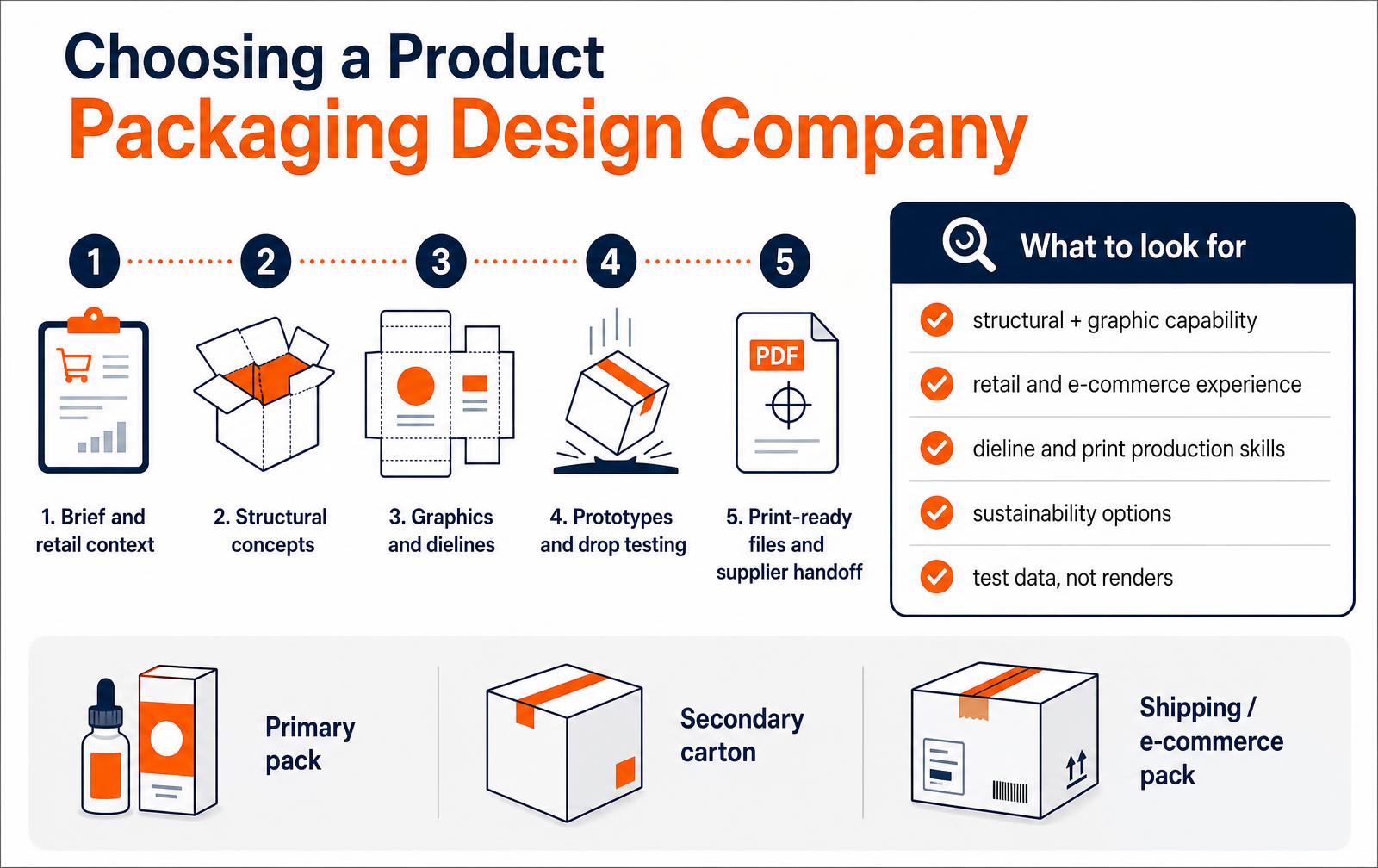
- Primary pack. Whatever touches the product — bottle, blister, tray, pouch. Driven by protection, dispensing and regulatory labelling.
- Secondary pack. The carton or clamshell the customer sees. This is the merchandising surface: brand, claims, barcode, size call-outs.
- Tertiary or e-commerce pack. The master case or the ships-in-own-container box. Judged on drop performance, dimensional weight and how little of it ends up in the bin.
A company that only does graphics will hand you beautiful artwork on a structure that fails a one-metre drop test or costs forty cents more per unit than it needs to. A company that only does structure will get the pack to shelf and lose the sale on it.
What packaging design work costs
Scope | Typical duration | Typical cost | Deliverable |
|---|---|---|---|
Graphics only, existing structure | 2-4 weeks | $2k-$8k | Artwork applied to a supplied dieline, print-ready |
Structural concept and dieline | 3-5 weeks | $4k-$15k | Custom carton or tray, CAD dieline, white samples |
Full pack system (structure + graphics) | 6-10 weeks | $12k-$40k | Primary, secondary and shipper, artwork, mock-ups |
Thermoform or moulded pack tooling | 6-12 weeks | $5k-$30k tooling | Production tool for trays, blisters or clamshells |
Transit and retail testing | 2-4 weeks | $2k-$10k | ISTA drop and vibration results, corrected design |
Ranges assume a single SKU family. Multi-flavour or multi-size lines add artwork variants rather than new structural work, which is why locking the structure first is always cheaper. If the product itself is still moving, see our prototype cost calculator before committing to packaging tooling.
Seven questions that separate real partners from render shops
- Can you show a dieline you released to a converter, not just a lifestyle render?
- Who owns the print files, and are they supplied with fonts, spot colours and bleeds resolved?
- How do you handle barcode placement, quiet zones and regulatory panels?
- What transit testing do you run, and will you correct the design if it fails?
- Have you designed for this channel — big-box shelf, club pack, or ships-in-own-container?
- Which converters have you worked with, and will you attend the press check?
- What is the target landed cost per pack, and how will you hit it?
Sequence the work so nothing gets redone
Fix the product dimensions and weight, choose the channel, then design the structure, then apply graphics, then test, then release print files. Reversing any two of those steps means paying twice. Packaging should start when the product design is frozen enough that its outside dimensions will not change — usually at the end of design for manufacturing, not after the first production run.
Turning a clinic project into a repeatable product process
Service-driven projects become products when the workflow is documented, not when the idea is.
Capture four artifacts at the end of any client build: the requirements document with each requirement traced to a test, the bill of materials with supplier lead times and minimum order quantities, the assembly and inspection instructions used on the floor, and the punch list of everything that went wrong. Those four documents are the difference between a one-off delivery and a repeatable line.
Cost the repeat before you promise it. A second build of the same design typically runs 40 to 60 percent of the first when tooling and fixtures already exist, but only if the design files, not just the prints, transfer cleanly.
Establish an as-built revision at delivery, freeze it, and route every later change through a written change order with a price and a schedule impact. Programs that skip the as-built freeze end up rebuilding documentation at the exact moment a customer wants volume, which is the most expensive time to do it.
Frequently asked questions
What do product packaging design companies actually deliver?
At minimum: a structural design with a CAD dieline, graphic artwork applied to that dieline, physical mock-ups or white samples, and print-ready production files with correct bleeds, spot colours and barcodes. Stronger firms add transit testing, converter sourcing and press-check attendance.
How much does product packaging design cost?
Graphics on an existing structure typically runs $2,000-$8,000. A full pack system with custom structure, artwork and mock-ups is commonly $12,000-$40,000, plus tooling of $5,000-$30,000 if the pack is thermoformed or moulded.
When should packaging design start?
Once the product's outer dimensions and weight are frozen, and before you commit to a retail launch date. Six to ten weeks of packaging work plus print lead time has to fit inside the window between first production parts and the buyer's on-shelf date.
Match the firm to the pack problem you actually have
Product packaging design companies are not interchangeable. A branding studio, a structural engineering house and a converter's in-house design desk solve different problems and price them very differently. Naming your problem precisely — shelf standout, drop-test failures, cost per unit, e-commerce damage rates, or a regulatory labelling deadline — narrows the shortlist faster than any portfolio review.
Firm type | Strongest at | Weakest at | Typical engagement |
|---|---|---|---|
Brand and graphics studio | Shelf identity, artwork systems, SKU families | Structure, drop performance, converter tolerances | $4k-$25k |
Structural packaging engineer | Dielines, protection, cube efficiency, testing | Brand storytelling and visual hierarchy | $8k-$40k |
Full-service packaging firm | Structure plus graphics as one release | Small single-SKU budgets | $15k-$60k |
Converter in-house design | Cheap, fast, optimised for their equipment | Objectivity — the design suits their machines | Often bundled with print order |
Product development firm | Packaging designed alongside the product itself | Pure retail brand work | Scoped within the programme |
Testing that has to happen before you buy print
Test | Standard | What it catches |
|---|---|---|
Drop test | ISTA 1A / ASTM D5276 | Corner and edge crush, insert failure |
Vibration | ISTA 3A / ASTM D999 | Abrasion, scuffed finishes, loosened closures |
Compression / stacking | ASTM D642 | Warehouse stack collapse over time |
Climate conditioning | ASTM D4332 | Board strength loss in humidity, adhesive failure |
E-commerce ship test | ISTA 6-Amazon.com (SIOC) | Damage in single-parcel shipment without overbox |
Retail shelf audit | In-store or planogram mock | Facings, legibility at 1 m, competitor contrast |
The cheapest possible moment to fail a drop test is on a white sample, before artwork exists and before the converter has cut a die. The most expensive moment is after 40,000 printed cartons are on a pallet.
Cost drivers per unit, ranked
- Material and board grade. Overspecified board is the single most common hidden cost; a structural review often removes 10-20% of pack cost with no protection loss.
- Number of colours and finishes. Each spot colour, foil, spot UV or soft-touch pass adds setup and per-unit cost. Photographic packs on uncoated stock behave badly and cost more to fix.
- Cube efficiency. Wasted air in a shipper is paid for on every parcel forever; a 15% cube reduction usually beats any material saving.
- Assembly labour. Hand-assembled inserts and tissue wraps look premium and quietly add cents per unit at every run.
- Run length and setup amortisation. Below about 5,000 units, setup dominates and digital print usually wins; above 25,000, offset or flexo takes over.
Files and rights to demand at handover
- Native structural CAD (ArtiosCAD or equivalent) plus a PDF dieline with the converter's tolerances applied.
- Print-ready artwork with fonts outlined, spot colours named, bleed and trap set to the converter's specification.
- A packaging specification sheet: board grade, coating, adhesive, closure method, finished and flat dimensions.
- Colour targets — physical drawdowns or approved proofs — not just on-screen values.
- Written IP assignment covering artwork, structure and any commissioned photography or illustration.
- Editable source for every artwork variant, so a flavour or size extension does not require a new engagement.
Sequence that avoids rework
Week | Activity | Gate to pass |
|---|---|---|
1-2 | Brief, channel decision, product dimensions frozen | Product will not change size or weight |
3-5 | Structural concepts, white samples, first drop test | Pack survives ISTA 1A |
6-8 | Graphics applied to approved dieline, mock-ups | Shelf legibility and compliance copy signed off |
9-10 | Ship testing on printed or simulated packs | No damage in ISTA 3A or 6-Amazon |
11-12 | Preflight, converter proofing, colour approval | Signed physical proof on the production substrate |
Twelve weeks plus print lead time is the realistic minimum for a new pack system. Compress it by running structure and graphics in parallel only after the dieline is frozen — never before, because every structural change invalidates the artwork underneath it.
More questions teams ask
Frequently asked questions
How do I choose between a branding studio and a structural packaging firm?
If your pack already ships without damage and the problem is shelf presence, a branding studio is right. If you are seeing damage, high freight cost per unit or converter pushback, start with structural engineering and apply graphics after the dieline is stable.
What testing should a packaging design company run before print?
At minimum a drop test to ISTA 1A on white samples, vibration and compression for palletised goods, and ISTA 6-Amazon for anything shipping as a single parcel. Climate conditioning matters for corrugated shipped through humid regions.
How much can better packaging reduce cost per unit?
Structural reviews commonly recover 10-20% of material cost through board downgrading and cube reduction, and freight savings from a smaller shipper often exceed the material saving. Both compound on every unit shipped for the life of the SKU.
Who owns the packaging design files?
Only whoever the contract says. Converter in-house design is frequently retained by the converter, which locks you to their print pricing. Require assignment of structure, artwork and photography, plus native editable files, before work starts.
When should packaging design begin?
As soon as the product's outer dimensions and weight are frozen and the sales channel is chosen. Twelve weeks of design and testing plus four to eight weeks of print lead time has to fit inside your launch date, and that window is not compressible by much. Work with LA NPDT: if you are moving from here to execution, start with our our product development process or talk to us about end-to-end product development .
Filed under:EducationInspirationMediaNews
Services related to this guide
- Product design servicesIndustrial design and CAD taken all the way to manufacturable files.
- Rapid prototypingWorking prototypes in days, from 3D printing to vacuum casting.
- Electronic design servicesSchematic, PCB layout, firmware and bring-up, through to production handoff.
- Product development examplesReal projects we designed, prototyped and shipped.