Digital Product Development Services: Scope, Cost and Timeline
Digital product development services span research, design, architecture, build and iteration. Here is what each stage delivers and what it costs.
February 11, 20206 min read

Written by Konstantin Dolgan, Ph.D., NPDP
Founder & CEO, Product Development Engineer
Published February 11, 2020Updated September 2, 2026
Digital product development services cover everything between a business idea and working software people use every day — research, interface design, architecture, build, QA and the release cadence that keeps it alive afterwards. The term gets stretched to mean anything from a landing page to a connected-device platform, so the first job is agreeing what is actually in scope.
What is included in digital product development services
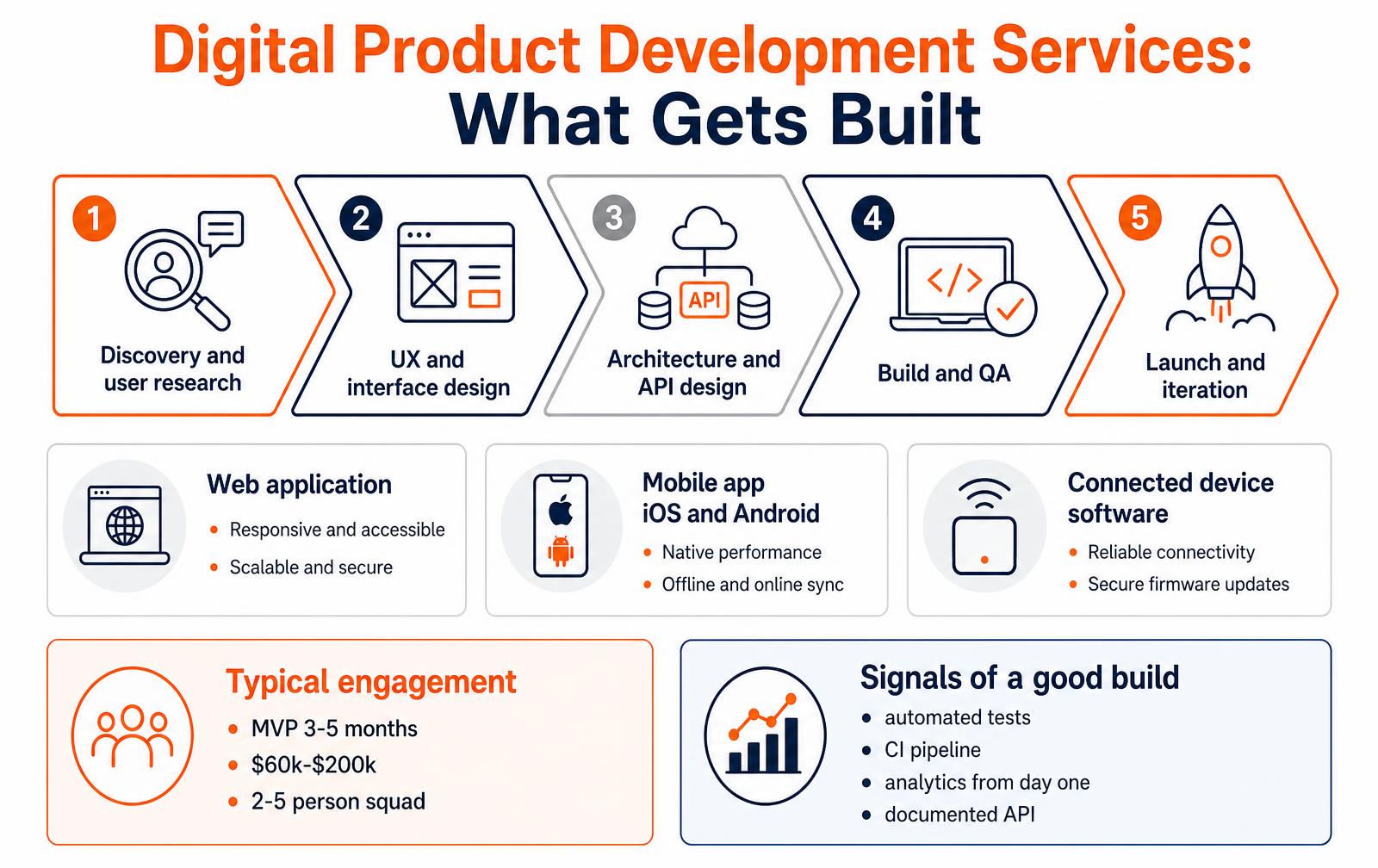
- Discovery and user research. Who the user is, what job they are hiring the product for, and which of your assumptions are actually risks.
- UX and interface design. Flows, wireframes, a component-based design system and clickable prototypes you can test before writing code.
- Architecture and API design. Data model, integrations, authentication, hosting and the decisions that are expensive to reverse later.
- Build and QA. Frontend, backend, automated tests, CI and code review — not just features, but features that keep working.
- Launch and iteration. Analytics, error monitoring, a release process and a backlog driven by what real users do.
What it costs and how long it takes
Scope | Timeline | Typical cost | What you get |
|---|---|---|---|
Discovery and prototype | 3-6 weeks | $8k-$30k | Requirements, flows, clickable prototype, estimate for the build |
MVP web application | 3-5 months | $60k-$150k | One core workflow, auth, admin, analytics, deployed and monitored |
MVP mobile app (iOS + Android) | 4-6 months | $80k-$200k | Cross-platform build, store submissions, backend and API |
Companion app for a connected device | 4-8 months | $90k-$250k | BLE or Wi-Fi pairing, firmware update path, cloud sync |
Ongoing product team | Monthly | $15k-$45k/month | A standing squad shipping on a fixed cadence |
The biggest cost driver is rarely the feature list — it is the number of unvalidated assumptions carried into the build. Every week of discovery that removes one typically saves several weeks of rework later.
When the digital product is attached to hardware
Connected products fail at the seams. Firmware, mobile app and cloud are usually built by three different groups on three different schedules, and the pairing flow — the first ninety seconds a customer spends with your product — is nobody's deliverable.
Assign one owner for the end-to-end experience, define the protocol and update path early, and test on real hardware from the first sprint.
Our electronics design and consulting teams run those tracks together for exactly this reason.
How to judge a digital product development partner
- They insist on a discovery phase before quoting the build
- You own the repository and the cloud accounts from day one
- Automated tests and CI are in the estimate, not an upsell
- They ship to a staging environment you can use every week
- They can name the metrics the product will be judged on after launch
Frequently asked questions
What are digital product development services?
They are end-to-end services that take a software product from idea to live release: user research, UX and interface design, technical architecture, engineering, QA, deployment and post-launch iteration. Unlike staff augmentation, the provider owns outcomes and delivery, not just hours.
How much does it cost to build an MVP?
A focused MVP web application typically costs $60,000-$150,000 over three to five months. A cross-platform mobile MVP runs $80,000-$200,000. Anything quoted dramatically below those ranges is usually a prototype rather than a product you can operate and support.
Do I need discovery if I already know what to build?
Yes, but it can be short. Even with a clear feature list, a two to three week discovery converts the list into flows, a data model and a realistic estimate. Teams that skip it usually pay the same money later in change requests.
How engagements are actually scoped
Most disagreements between a client and a digital product team are scope disagreements wearing a technical costume. The fix is to choose a contracting model that matches how much is genuinely unknown, then let the model change as the unknowns resolve — fixed price for a bounded discovery, time and materials or capped sprints for the build.
Model | Best when | Client risk | Vendor behaviour it encourages |
|---|---|---|---|
Fixed price | Scope is genuinely frozen and small | Change requests for everything | Defensive scoping, padded estimates |
Time and materials | Discovery, R&D, evolving products | Budget drift without governance | Transparency, but needs active steering |
Capped sprints | Known direction, unknown detail | Feature trade-offs mid-flight | Prioritisation discipline |
Dedicated team | Multi-quarter roadmaps | Paying for idle capacity | Continuity and deep domain knowledge |
What drives cost more than the feature list
Two products with identical feature lists can differ threefold in price. The drivers are almost always structural: integrations with systems you do not control, compliance regimes, real-time or offline behaviour, and the number of platforms that must ship simultaneously.
Driver | Low-cost version | High-cost version | Rough multiplier |
|---|---|---|---|
Platforms | Responsive web only | Web plus native iOS and Android | 1.8-2.5x |
Integrations | One well-documented REST API | Legacy ERP, custom protocols, no sandbox | 1.3-2x |
Compliance | None | HIPAA, SOC 2, or medical device software | 1.4-2x |
Realtime / offline | Request-response | Sync, conflict resolution, offline-first | 1.5-2x |
Design fidelity | Component library | Bespoke design system plus motion | 1.2-1.5x |
Data volume | Thousands of records | Millions, with analytics and search | 1.3-1.8x |
Team shape by stage
Staffing a build like a discovery, or a discovery like a build, wastes money in both directions. Discovery is small and senior; build is broader; hardening is narrow again. Expect the team to change shape at least twice across a six-month programme.
Stage | Typical team | Duration | Main output |
|---|---|---|---|
Discovery | Product lead, UX researcher, solution architect | 3-6 weeks | Validated scope, architecture, estimate |
Design | Product designer, UX writer, part-time architect | 3-8 weeks | Design system, key flows, prototype |
Build | 2-5 engineers, designer, QA, product lead | 3-6 months | Working releases every sprint |
Hardening | 2 engineers, QA, DevOps | 2-4 weeks | Performance, security, observability |
Handover / run | 1-2 engineers, support rotation | Ongoing | Documentation, SLAs, roadmap |
The connected-product seam
When software is attached to hardware, integration is where schedules die. Firmware, mobile and cloud each have their own release cadence, and the interfaces between them are usually agreed verbally and discovered to be wrong during the first field trial. Write the contracts down early: message schemas, provisioning flow, OTA update policy, error and retry behaviour, and what the device does when the network is gone.
- Freeze the device-to-cloud message schema in a versioned document before firmware and app teams branch apart.
- Define provisioning end to end — including how a user recovers from a failed pairing, which is the most common support ticket in connected products.
- Decide the OTA strategy before shipping units: staged rollout, rollback path, and what happens if power is lost mid-update.
- Specify offline behaviour explicitly; "it needs the internet" is a design decision, not a default.
- Run a joint hardware-in-the-loop integration week at the midpoint, not at the end.
- Instrument the device and the app with the same event names so field failures can be correlated.
Handover: what you should own on day one
The measure of a good engagement is how easily another team could take it over. Insist on that from the first sprint rather than requesting a handover package at the end, when the knowledge has already left the building.
- Repositories, cloud accounts, domains and app store listings in your organisation's name, not the vendor's.
- Infrastructure defined as code, with a documented path from empty account to running environment.
- A README that a competent engineer can follow to a local build in under an hour.
- Architecture decision records explaining why, not just diagrams showing what.
- Test suites that run in CI, with a stated coverage expectation for critical paths.
- Monitoring, alerting and log retention configured and pointed at your team's channels.
- A short runbook for the five failures most likely to wake someone up.
More questions teams ask
How do we keep a time-and-materials engagement from drifting?
Govern it with a fixed cadence rather than a fixed contract: a prioritised backlog, a burn report every sprint, and a standing decision meeting where the next two sprints are agreed. Drift comes from absent steering, not from the billing model.
Should design finish before development starts?
Only for the core flows. Designing everything up front produces artefacts that go stale before they are built. A design track running one to two sprints ahead of engineering keeps decisions fresh and lets real implementation feedback change the design.
What belongs in an MVP for a connected product?
The smallest set that lets a real user complete the core job on real hardware: provisioning, the primary control or monitoring loop, and one reliable feedback path. Analytics dashboards, social features and multi-user roles almost always belong in the release after launch.
How much should we budget for the first year after launch?
Plan on 15 to 25 percent of the original build cost per year for maintenance, dependency updates, platform changes and small improvements — more if the product is on mobile app stores, which force periodic work regardless of your roadmap.
Planning a digital product?
We scope discovery, design and build as one program — including the hardware side when your product has one.
Typical engagement shapes and what they cost
Engagement | Duration | Typical cost | Output |
|---|---|---|---|
Discovery sprint | 2-4 weeks | $8k-$30k | Validated problem statement, feature map, cost model |
MVP build | 8-16 weeks | $60k-$180k | Shippable core product, instrumented |
Scale-up retainer | Ongoing | $20k-$70k/mo | Roadmap delivery, reliability, integrations |
Connected-hardware companion app | 10-20 weeks | $80k-$250k | App, provisioning flow, OTA, cloud backend |
Where digital product budgets actually go
Cost driver | Share of a typical build | How to reduce it |
|---|---|---|
Backend and data model | 25-35% | Fix the schema in discovery; avoid speculative multi-tenancy |
Client applications | 25-35% | One platform first; add the second after retention is proven |
Integrations and third-party APIs | 10-20% | Confirm rate limits and sandbox access before scoping |
Device connectivity and provisioning | 10-25% (hardware only) | Choose a proven BLE or Wi-Fi stack over a custom protocol |
QA, release engineering, observability | 10-15% | Automate from week one — retrofitting costs more |
Connected-hardware pitfalls that break software schedules
- Provisioning is underestimated. Getting a device onto a stranger's home Wi-Fi is the single highest-support-cost flow in most connected products. Budget dedicated design and field testing for it.
- Firmware and app schedules are coupled. If the firmware API is not frozen, the app team rewrites integration code every sprint. Version the device API from the first prototype.
- OTA update capability is not optional. Shipping without it converts every field bug into a returns problem.
- Certification changes radios late. A module swap after FCC testing invalidates app-side assumptions about throughput and range.
- Cloud costs scale with telemetry, not users. Decide sampling rates and retention windows during discovery, not after the first bill.
How to scope handover so the work survives the agency
- Source in your own repositories from day one, with your own cloud accounts and billing.
- Infrastructure defined as code, not clicked into a console.
- A runbook covering deploys, rollbacks, secrets rotation and on-call escalation.
- Architecture decision records explaining why, not just what.
- A test suite that a new engineer can run locally in under ten minutes.
- Two weeks of paid overlap with your incoming internal team.
Frequently asked questions
Fixed price or time and materials? Fixed price fits well-defined, short phases such as discovery or a migration. Anything exploratory — new interaction models, device integration, machine learning — is more honestly priced as time and materials with a capped monthly spend.
How large should the team be? For most first builds, a product designer, two engineers and a fractional architect outperform a team of six. Add people only when a bottleneck is measured, not anticipated.
What should the first month produce? A working thin slice that touches every layer of the system — client, API, data store, deploy pipeline — even if the feature itself is trivial. It de-risks the architecture before feature pressure arrives.
Work with LA NPDT: if you are moving from here to execution, start with our our product development process or talk to us about end-to-end product development.
Filed under:EducationInspirationNews
Services related to this guide
- Product design servicesIndustrial design and CAD taken all the way to manufacturable files.
- Rapid prototypingWorking prototypes in days, from 3D printing to vacuum casting.
- Electronic design servicesSchematic, PCB layout, firmware and bring-up, through to production handoff.
- Product development examplesReal projects we designed, prototyped and shipped.