Mechanical Engineering Company: What to Look For Before You Hire One
What a mechanical engineering company delivers, how engagements are usually structured, what it costs, and the vetting questions that reveal whether a firm can take a design all the way to production.
February 23, 20166 min read

Written by Ralph Hill, Mechanical & electrical systems, 3D manufacturing
Prototyping Engineer
Published February 23, 2016Updated September 2, 2026
A mechanical engineering company designs, analyzes, prototypes and documents physical products and equipment — turning a concept into a manufacturable set of drawings, models and specifications a factory can build from. The difference between firms is rarely CAD skill. It is whether they have carried products through tooling, testing and production before, and whether they will still be reachable when the first article inspection goes wrong.
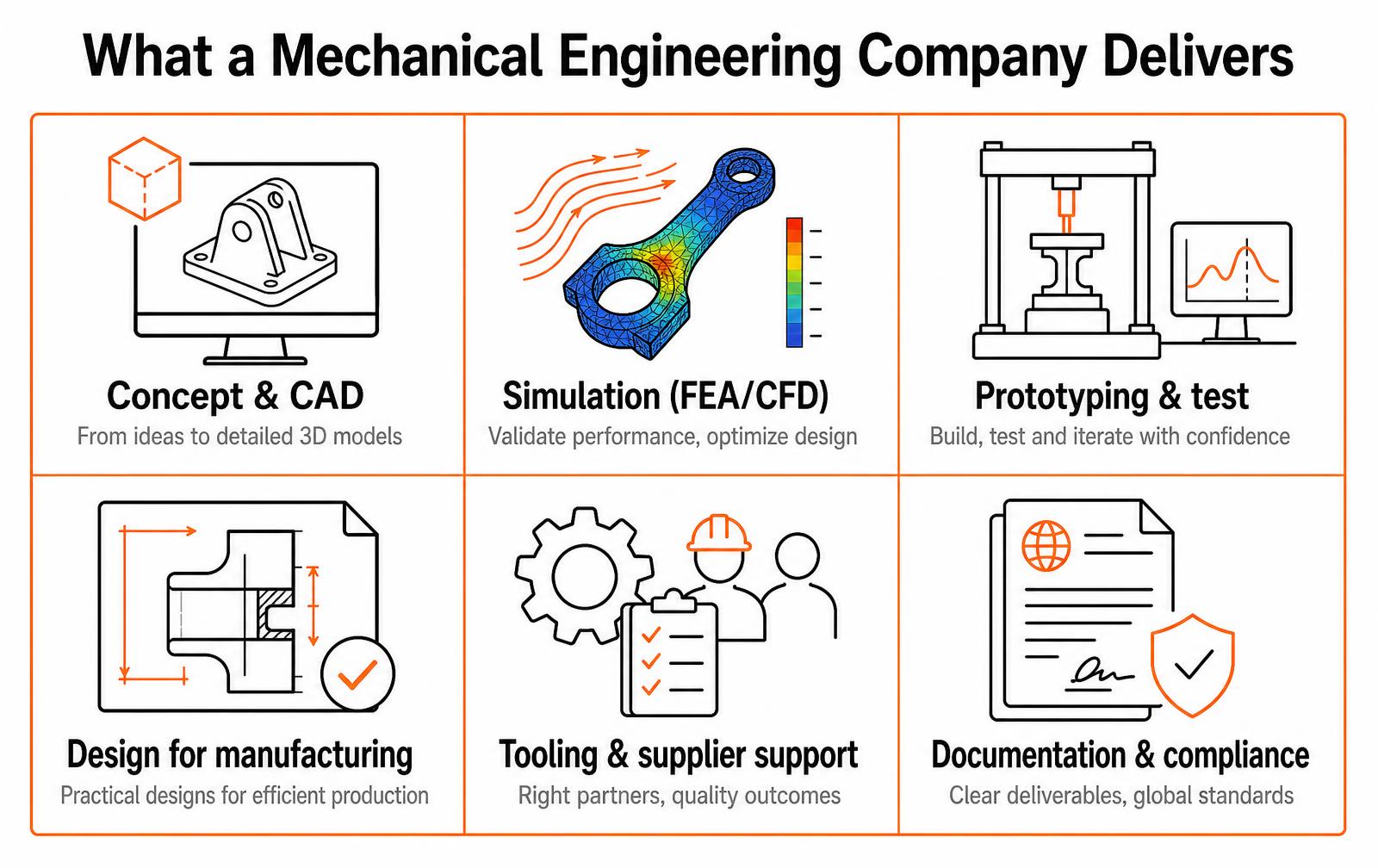
What a mechanical engineering company delivers
- Concept and CAD. Parametric 3D models and assemblies built so they can be changed later without collapsing — a real skill, and one that separates production work from student work.
- Simulation. FEA for structural and thermal behavior, CFD for flow. Used to eliminate obviously bad options before anything is cut.
- Prototyping and test. Looks-like and works-like builds, fixtures, and a test plan that ties back to the requirements.
- Design for manufacturing. Draft, wall thickness, tolerance stacks, fastening strategy and part consolidation, matched to the chosen process.
- Tooling and supplier support. Mold and fixture design, RFQ packages, first article review, and answering the factory's questions during ramp.
- Documentation and compliance. Drawings with GD&T, bills of material, assembly instructions and the evidence trail regulated markets require.
Why 3D printing skill is now table stakes
Ten years ago additive was a differentiator. Today it is a baseline expectation, and the reason is schedule: an engineer who can print a fit-check part overnight closes a design question the next morning instead of the following week. Firms without hands-on additive experience iterate on a machine-shop cadence, and that cadence shows up directly in your timeline and your invoice.
The deeper skill is knowing where additive stops. Printed parts have anisotropic strength, different tolerances and surface behavior than molded or machined ones, so a good engineer designs the printed prototype to answer a specific question while designing the production part for its real process. If additive is part of your plan, our guide to additive manufacturing technologies covers the process families in detail.
Engagement models and what they cost
Model | How it works | Typical range | Best when |
|---|---|---|---|
Hourly / time and materials | You pay for engineering hours as used | $95 - $200 per hour in the US | Scope is still moving or support is ongoing |
Fixed-price phase | A defined deliverable for a fixed fee | $8,000 - $60,000 per phase | Scope is clear: concept, DFM package, test plan |
Full program | Concept through production release | $60,000 - $500,000+ | One accountable owner from idea to factory |
Staff augmentation | A dedicated engineer inside your team | Monthly retainer | You have process and management, not capacity |
Offshore hourly rates are lower and can work well for defined, well-specified tasks. They work badly when the scope needs conversation, when the design has to be argued out with a supplier in your time zone, or when someone has to stand next to the tool during a trial run. Price the coordination, not just the hour.
Questions that separate good firms from expensive ones
- Show me a product you took to production. Renderings are easy. Ask for the part, the drawing package and the name of the factory that built it.
- Who actually does the work? Meet the engineer, not only the principal. Ask what else that person is assigned to during your program.
- What happens after release? Production questions arrive for months. Find out whether support is included, hourly or unavailable.
- Who owns the CAD? Native files and full IP assignment should be in the contract. Deliverables limited to STEP files are a lock-in strategy.
- How do you handle a failed test? The answer reveals whether they run a real verification loop or hope the first build works.
- What is out of scope? A firm that names its exclusions clearly is far safer than one that agrees to everything.
Red flags
Signal | Why it matters |
|---|---|
A fixed quote with no requirements review | They are guessing, and the change orders will follow |
No test plan in the proposal | Verification was not budgeted, so it will be skipped |
Portfolio is all renderings | The work may never have reached a factory floor |
Refusal to assign IP or hand over native CAD | You cannot move the program elsewhere later |
No questions about volume or target cost | DFM decisions are being made without the two inputs that drive them |
What a first engagement should look like
The safest way to hire a mechanical engineering company is to start with a bounded, paid piece of work that produces something you can evaluate. A discovery or feasibility phase — two to four weeks, a fixed fee, and a written deliverable — tells you more about a firm than any portfolio. You learn how they ask questions, whether they push back on your assumptions, and whether their documentation is something a factory could actually use.
Phase | Typical duration | What you should receive | Decision it enables |
|---|---|---|---|
Feasibility / discovery | 2–4 weeks | Requirements, risks, concept sketches, budget range | Whether to proceed at all |
Concept development | 3–6 weeks | Two or three concepts, trade-off study, rough BOM | Which direction to engineer |
Detailed design | 8–16 weeks | Full CAD, drawings, tolerance stack, analysis | Whether to cut tooling |
Prototype and test | 4–8 weeks | Working units, test report, revision list | Whether the design is ready |
Manufacturing support | Ongoing | Supplier quotes, DFM revisions, first-article review | Whether to release production |
Signals of real engineering depth
- They ask about volume and cost before drawing anything. Process selection follows volume, and any firm that skips it is designing blind.
- They produce tolerance stacks, not just pretty CAD. Parts that fit in the model and not in the factory are the most common expensive mistake.
- They own failures out loud. Ask what went wrong on a recent program and what changed as a result; a firm with no answer has not run enough programs.
- Their prototypes are instrumented. A prototype exists to answer a question, and the question should be written down before it is built.
- They know when to stop printing. Additive is fast for form and fit, misleading for strength, surface and long-term dimensional stability.
Costs a first-time client rarely budgets
The engineering fee is usually not the largest number in a hardware program. Plan for tooling, certification, first-article inspection and at least one design revision after prototype testing. A firm that quotes only its own hours without walking you through these downstream costs is either inexperienced or optimistic.
- Injection mold tooling: roughly $4,000 for a simple single-cavity aluminum tool to $60,000+ for a multi-cavity production steel tool.
- Certification: $8,000 to $40,000 depending on the marks required, plus retest after any change to the enclosure or supply.
- Prototype iterations: budget two or three cycles; the first prototype's purpose is to be wrong in a useful way.
- Pilot production: expect scrap and rework on the first run, and price the first articles accordingly.
Frequently asked questions
What does a mechanical engineering company do?
It designs and validates physical products and equipment: concept development, 3D CAD, structural and thermal simulation, prototyping and testing, design for manufacturing, tooling support, and the drawing and documentation package a factory needs to produce the part.
How much does mechanical engineering consulting cost?
US firms typically bill $95 to $200 per hour, with fixed-price phases commonly running $8,000 to $60,000 depending on complexity. A full program from concept to production release usually lands between $60,000 and several hundred thousand, driven mostly by the number of parts, the amount of testing and any regulatory requirements.
Should I hire a firm or an individual engineer?
An individual contractor is cheaper and fine for a bounded task inside a team that already has process. A firm is worth the premium when the product needs several disciplines — mechanical, electrical, industrial design, manufacturing — and when you need continuity if one person becomes unavailable mid-program.
Do I own the CAD files and the IP?
You should, and the contract must say so explicitly: full assignment of inventions and delivery of native CAD, not just neutral export formats. Without native files, moving the program to another firm or making a small change later means paying to rebuild the model.
How long does a typical product development program take?
For a moderately complex consumer or industrial product, four to nine months from concept to production-release drawings is realistic, plus eight to sixteen weeks for tooling. Regulated products such as medical devices take considerably longer because verification and documentation dominate the schedule.
Does a mechanical engineering company handle manufacturing too?
Most do not manufacture themselves but manage the suppliers who do: sourcing, RFQ packages, tooling review, first article inspection and production support. Ask specifically whether that support is included, because the handoff to the factory is where most programs lose time.
Judging engineering capability from a work sample
Portfolios show outcomes; work samples show method. When evaluating a mechanical engineering company, ask for a redacted deliverable package from a comparable program. What is present, and what is missing, tells you how the team will behave when your project hits its first hard problem.
What a strong deliverable package contains
Document | What it proves |
|---|---|
Requirements document with verification method | They design to defined targets |
Tolerance stack-up analysis | They understand assembly reality |
DFM review with supplier comments | They talk to manufacturers early |
Test protocol and results | They validate rather than assume |
Drawing set with GD&T | They can communicate to a machine shop |
Bill of materials with sourcing notes | They think about supply, not just design |
Design history or change log | They can defend decisions later |
A team that produces prototypes quickly but cannot show verification documentation is a prototyping shop, which may be exactly what you need — just not for a program headed to tooling and regulatory review.
Capability evaluation checklist
- Request a redacted deliverable package before signing.
- Check for tolerance analysis and test protocols specifically.
- Ask how they handle a failed test — the process, not the anecdote.
- Confirm in-house prototyping and its limits.
- Verify they can produce a manufacturing-ready drawing set.
Key takeaways
- Ask for a work sample package, not just a portfolio.
- Tolerance analysis and test protocols separate engineering from prototyping.
- Match the firm's depth to whether you are heading to tooling.
From the archive: 3D printing as a required skill
Need mechanical engineering depth on your program?
Work with LA NPDT: if you are moving from here to execution, start with our rapid prototyping services or talk to us about prototype design.
Services related to this guide
- Best prototyping companiesDevelopment firms, instant-quote bureaus and local shops — who fits which job.
- Free prototype cost calculatorFive to eight questions, an instant cost range for a first prototype.
- Prototype development companiesWhich firms take a sketch to a working prototype — and which only fabricate parts.
- Rapid prototypingWorking prototypes in days, from 3D printing to vacuum casting.