How to Develop New Product Ideas: 6 Tips That Actually Work
Good product ideas are found, not waited for. Here is the six-step method we use to source, screen, score and validate new product ideas before any money goes into tooling.
August 30, 20237 min read

Written by Konstantin Dolgan, Ph.D., NPDP
Founder & CEO, Product Development Engineer
Published August 30, 2023Updated September 2, 2026
Develop new product ideas by looking where problems already exist — customer complaints, your own workflow friction, adjacent industries and competitor weaknesses — then screening those ideas against demand, feasibility and fit before you fall in love with any of them. Ideas are not scarce. Ideas that survive contact with cost, manufacturing and a real buyer are.
Most teams get this backwards: they run a brainstorm, pick the idea with the most enthusiasm in the room, and spend the next nine months finding out whether anyone wanted it. The six steps below invert that. They front-load the search, make screening explicit, and put the cheapest possible validation before the expensive commitment.
1. Look where the problems are, not where the ideas are
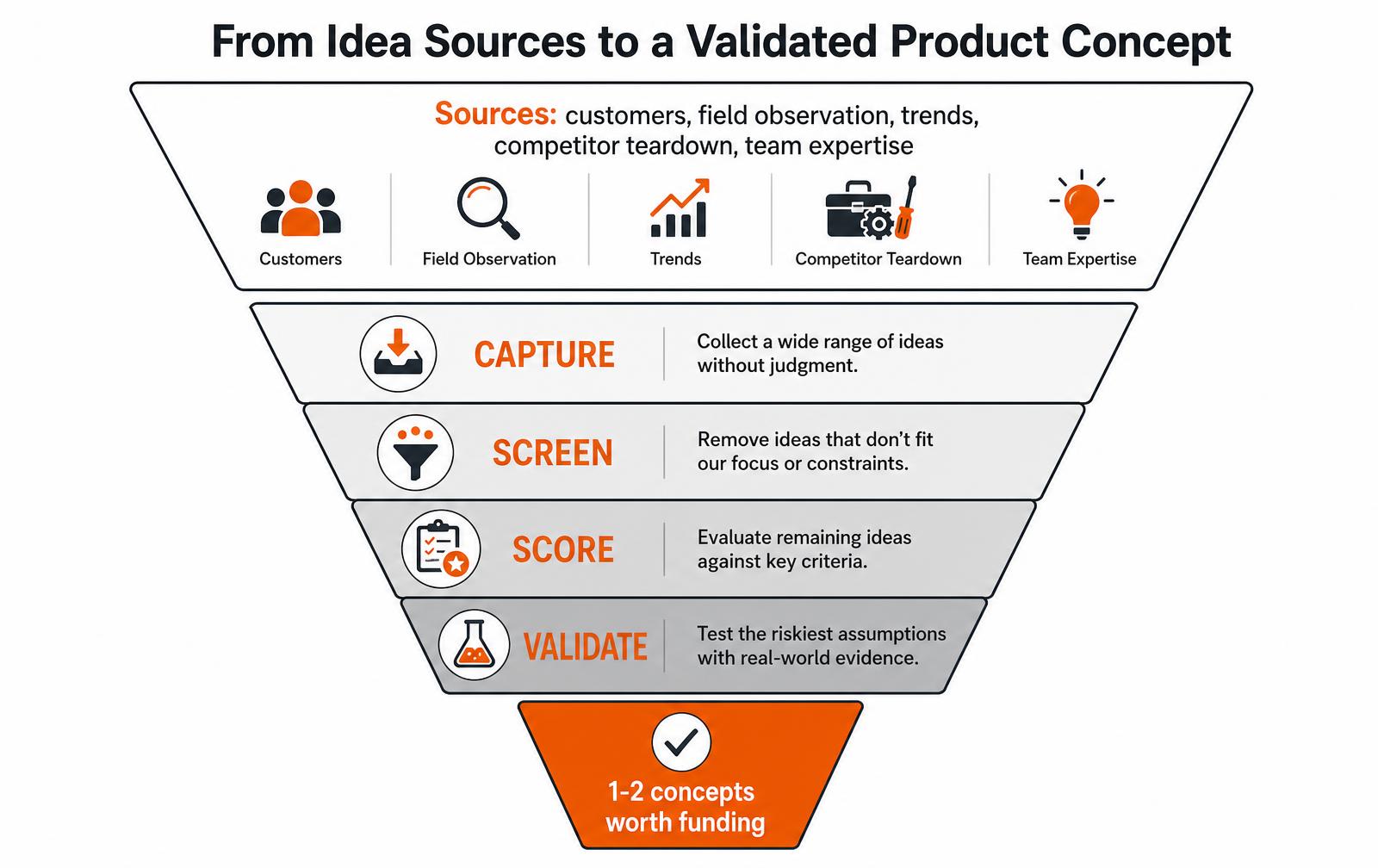
The reliable sources of new product ideas are all places where someone is already frustrated. Frustration is demand that has not been served yet, and it is measurable before you build anything.
Source | What to look for | How to mine it |
|---|---|---|
Existing customers | Workarounds, complaints, feature requests | Support tickets, sales call notes, 10 customer interviews |
Reviews of competitors | Repeated 2-3 star complaints | Read 100 reviews; tally the recurring failure modes |
Your own operations | Tasks your team hates doing | Shadow a workflow for a day and log every workaround |
Adjacent industries | Solutions that exist elsewhere but not here | Trade shows, patent databases, supplier catalogs |
Regulatory and material shifts | New rules or new materials creating openings | Standards updates, supplier technical bulletins |
Search demand | Problems people type into Google | Keyword tools; look for high-volume questions with weak answers |
Competitor review mining deserves special mention because it is free and almost nobody does it properly. One hundred reviews of the three best-selling products in your category, sorted into a tally of repeated complaints, will give you a ranked list of unmet needs in an afternoon. Those complaints are your product brief.
2. Observe real behavior instead of asking for opinions
People are unreliable narrators of their own behavior. Ask what they want and you get feature requests; watch what they do and you get problems. Field observation — sitting with a user while they perform the task your product would serve — surfaces the workarounds people no longer notice they are doing.
Look specifically for: tape, rubber bands and shims (a physical product is missing), spreadsheets bridging two systems (a software product is missing), steps done twice, and anything the user apologizes for. Each is a design brief written in the user's own behavior. This is the core of a structured product discovery process and it is far cheaper than building the wrong thing well.
3. Run idea sessions that produce quantity first, judgment second
Brainstorms fail for predictable reasons: the loudest person anchors the group, evaluation starts too early, and everyone converges on the safe option. Structure fixes most of it.
- Brief in advance. Send the problem statement and constraints 24 hours ahead so people arrive with ideas already formed.
- Write before speaking. Ten minutes of silent individual writing produces more distinct ideas than an hour of open discussion.
- Separate generation from judgment. No evaluation during generation. None. Set a quantity target — 50 ideas, not 5.
- Force variation. Ask for the cheapest version, the premium version, the version for a different customer, and the version a competitor would build.
- Combine, then cut. Cluster related ideas into themes, then narrow with the scoring model below rather than by vote.
Two techniques consistently produce the ideas nobody expected. SCAMPER — substitute, combine, adapt, modify, put to another use, eliminate, reverse — applied to an existing product forces variation beyond the obvious. And inversion: ask how you would make the product deliberately terrible, then examine whether any current design decisions are quietly doing that already.
The goal of an idea session is not the best idea. It is enough distinct ideas that the best one has a chance of being in the room.
4. Screen ruthlessly before you get attached
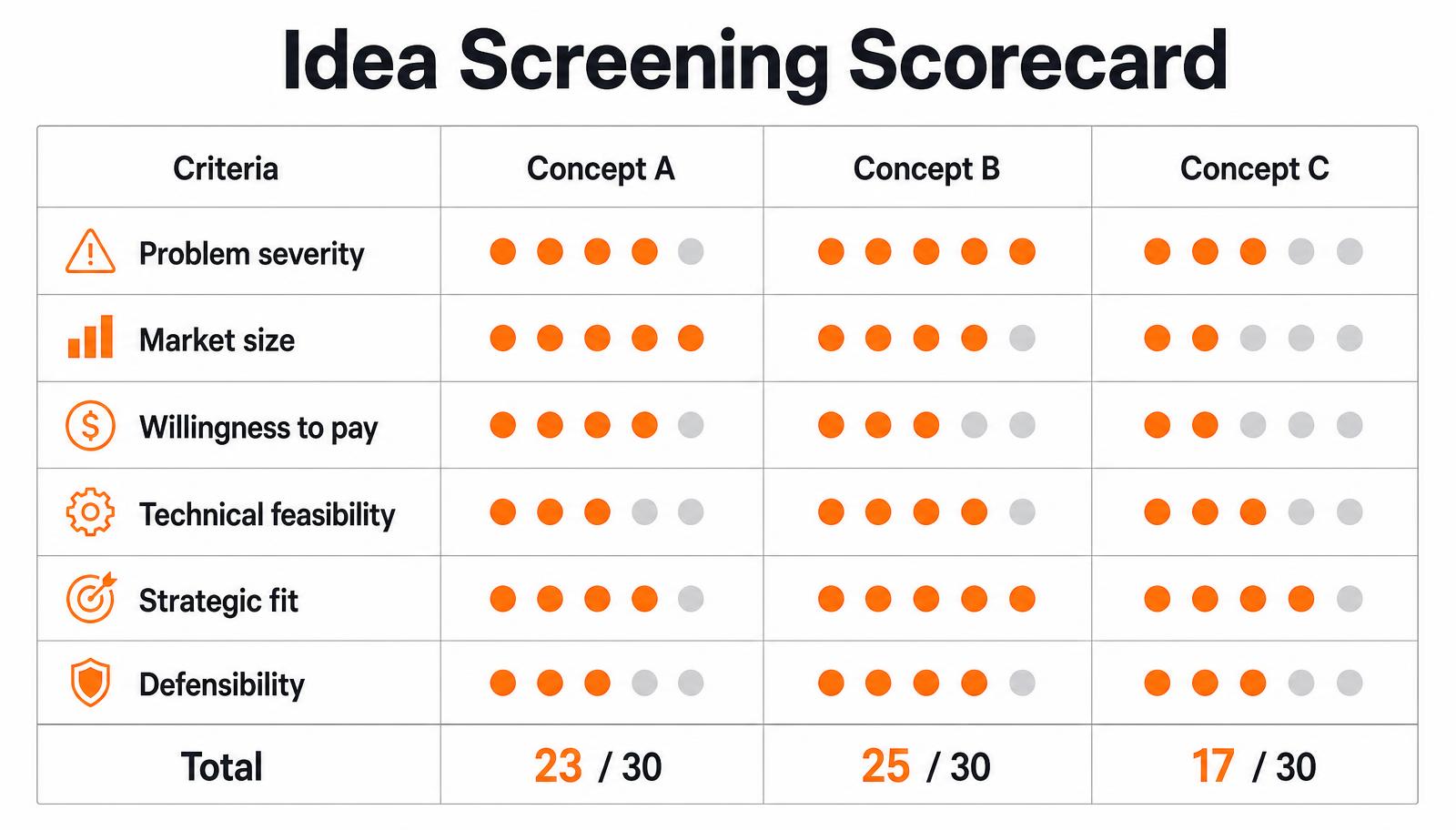
Screening is where a list of 50 becomes a list of 5. Do it with criteria agreed before the ideas were generated, so the process cannot be argued into protecting a favorite.
Criterion | Question | Weight |
|---|---|---|
Problem severity | How painful is the problem, and how often does it occur? | High |
Market size | How many people have it, and can we reach them? | High |
Willingness to pay | Are people already spending money on a worse solution? | High |
Technical feasibility | Can we build it with known technology at a viable cost? | Medium |
Strategic fit | Does it use our channels, brand and manufacturing? | Medium |
Defensibility | Is there IP, a supply advantage, or a brand moat? | Medium |
Time to market | Can it launch inside the window that matters? | Low to medium |
Score each surviving idea 1-5 on every criterion, multiply by weight, and rank. The number is not the decision — it is a way to make disagreement visible. When two people score "willingness to pay" 5 and 1, that gap is the most valuable thing in the room, and it usually points at the assumption you should test first.
A useful kill filter before scoring: any idea that would be blocked by a hard constraint gets removed immediately. Our guide to engineering design constraints covers the ten limits worth checking — cost, regulation, manufacturability and materials kill more concepts than weak demand does.
5. Validate the riskiest assumption for the least money
Every surviving idea rests on assumptions. Write them down, mark the one that would kill the idea if it were false, and design the cheapest experiment that tests it. Not the most rigorous experiment — the cheapest one that changes your mind.
Assumption type | Cheapest useful test | Typical cost | Time |
|---|---|---|---|
People want this | Landing page + ad spend, measure sign-ups | $300-$1,500 | 1-2 weeks |
People will pay this much | Pre-order or price-tiered survey with real checkout | $500-$2,000 | 2 weeks |
It can physically work | Functional rig, appearance ignored | $2,000-$15,000 | 2-6 weeks |
People can use it | Foam or 3D printed model, 5 user sessions | $500-$5,000 | 1-3 weeks |
It can be made at target cost | DFM review + quotes on the three costliest parts | $1,500-$5,000 | 1-2 weeks |
The order matters. Test desirability before feasibility when the market is unproven; test feasibility first when the technology is genuinely uncertain. Either way, a rapid prototype is usually cheaper than the meeting series that would otherwise be held to argue about it, and prototype costs at this stage are a fraction of tooling.
Research consistently shows that the majority of new consumer products underperform their launch targets — Harvard Business Review has covered the pattern extensively, and the common thread is not bad engineering but untested demand assumptions.
6. Turn the surviving idea into a brief, not a to-do list
An idea that passes screening and validation is still not a project. It becomes one when it is written as a brief: the user and their problem, the job the product must do, the measurable success criteria, the hard constraints, the target cost, and the assumptions that are still open.
- One-sentence statement of the user and the problem.
- The core job the product must do, in the user's language.
- Three to five measurable success criteria.
- Hard constraints: cost, regulatory, manufacturing, timeline.
- Evidence gathered so far, and what it does and does not prove.
- The next assumption to test and how it will be tested.
From there the path is conventional: concept design, then detailed design, prototyping, and low-volume manufacturing to prove the process before scaling. What makes it work is that the brief is grounded in something you actually observed and tested.
Common mistakes when developing product ideas
- Falling in love early. The first idea gets defended instead of tested; every later decision bends around it.
- Confusing novelty with value. New is not the same as needed. Plenty of successful products are ordinary things done noticeably better.
- Asking friends and family. They will say they love it. They are not your market and their enthusiasm is not data.
- Skipping cost until late. An idea that cannot hit a viable landed cost is not an idea, it is a hobby.
- Building the full product to test one assumption. Almost every critical question can be answered with a partial build.
- Treating a single brainstorm as a pipeline. Idea generation should be a standing habit with a running list, not an annual event.
A 30-day plan to develop your next product idea
- Days 1-5. Mine sources: 100 competitor reviews, 10 customer conversations, one workflow observation session. Log everything without filtering.
- Days 6-10. Cluster findings into problem statements. Run one structured idea session per top problem.
- Days 11-15. Score every idea against the weighted criteria. Cut to the top three.
- Days 16-25. Test the riskiest assumption for each survivor with the cheapest available experiment.
- Days 26-30. Write the brief for the one idea with the strongest evidence, including target cost and open questions.
From idea to something you can actually build
Developing new product ideas is a search problem followed by a screening problem. Look where problems already exist, generate widely, screen against criteria you agreed in advance, and spend the smallest amount that can prove you wrong.
When an idea survives that gauntlet, LA NPDT can take it the rest of the way — discovery, product design, prototyping and manufacturing, with the cost target treated as a design input from day one.
Have an idea you want stress-tested before you spend on tooling?
Work with LA NPDT: if you are moving from here to execution, start with our product discovery for inventors or talk to us about prior art search.
Frequently asked questions
How do you come up with new product ideas?
Start from problems rather than solutions. The most productive sources are customer complaints and support tickets, repeated 2-3 star reviews of competing products, workarounds you observe in real workflows, solutions borrowed from adjacent industries, and shifts in regulation or materials that open a gap. Collect widely first, then screen — quantity before judgment produces better final ideas than trying to think of the perfect one.
How do you know if a product idea is good?
A good idea scores well on three things at once: the problem is painful and frequent, enough reachable people have it, and some of them already spend money on a worse solution. Add feasibility and strategic fit as filters. If people are not currently paying anything to solve the problem, treat that as a warning sign rather than an untapped market.
How much does it cost to test a product idea?
A demand test — landing page plus modest ad spend — runs a few hundred to about $1,500. A usability test with a foam or 3D printed model runs $500 to $5,000. A functional proof-of-concept rig typically runs $2,000 to $15,000 depending on complexity. All of these are far cheaper than tooling, which is why the sequence matters.
What is the difference between idea generation and product development?
Idea generation produces and screens options; product development turns one selected option into a manufacturable product. The handoff between them is a written brief containing the user, the problem, measurable success criteria, hard constraints and a target cost. Skipping the brief is what causes development teams to build something technically correct that nobody asked for.
How many ideas do you need to get one good product?
Industry rules of thumb vary, but the pattern is consistent: dozens of raw ideas produce a handful worth screening, and only one or two survive validation. That is a healthy ratio, not a failure. The cost of killing an idea in week two is trivial; the cost of killing it after tooling is not.
Should I patent an idea before developing it?
An idea alone is generally not patentable — a specific implementation is. A common sequence is a prior art search first to check freedom to operate, then a provisional application once the concept is concrete enough to describe, then a full application as the design stabilizes. Talk to a patent attorney about timing; publishing or selling before filing can affect your rights.
Filed under:EducationInspiration
Services related to this guide
- Free trademark searchScreen a product name against the live USPTO register in seconds.
- Idea evaluationAn honest read on whether an idea is worth building.
- Product design servicesIndustrial design and CAD taken all the way to manufacturable files.
- Product development examplesReal projects we designed, prototyped and shipped.