Product Launch Phases: A 7-Step Framework That Works
The seven product launch phases for physical products, each with an owner, exit criteria and the failure mode it prevents.
August 31, 20168 min read

Written by Konstantin Dolgan, Ph.D., NPDP
Founder & CEO, Product Development Engineer
Published August 31, 2016Updated September 2, 2026
A product launch plan is the written sequence of decisions, readiness checks and coordinated activities that take a finished product from the end of development to available, supported and selling. It covers goals, audience, pricing, channel readiness, inventory, support and the measurement loop that follows — not just the announcement.
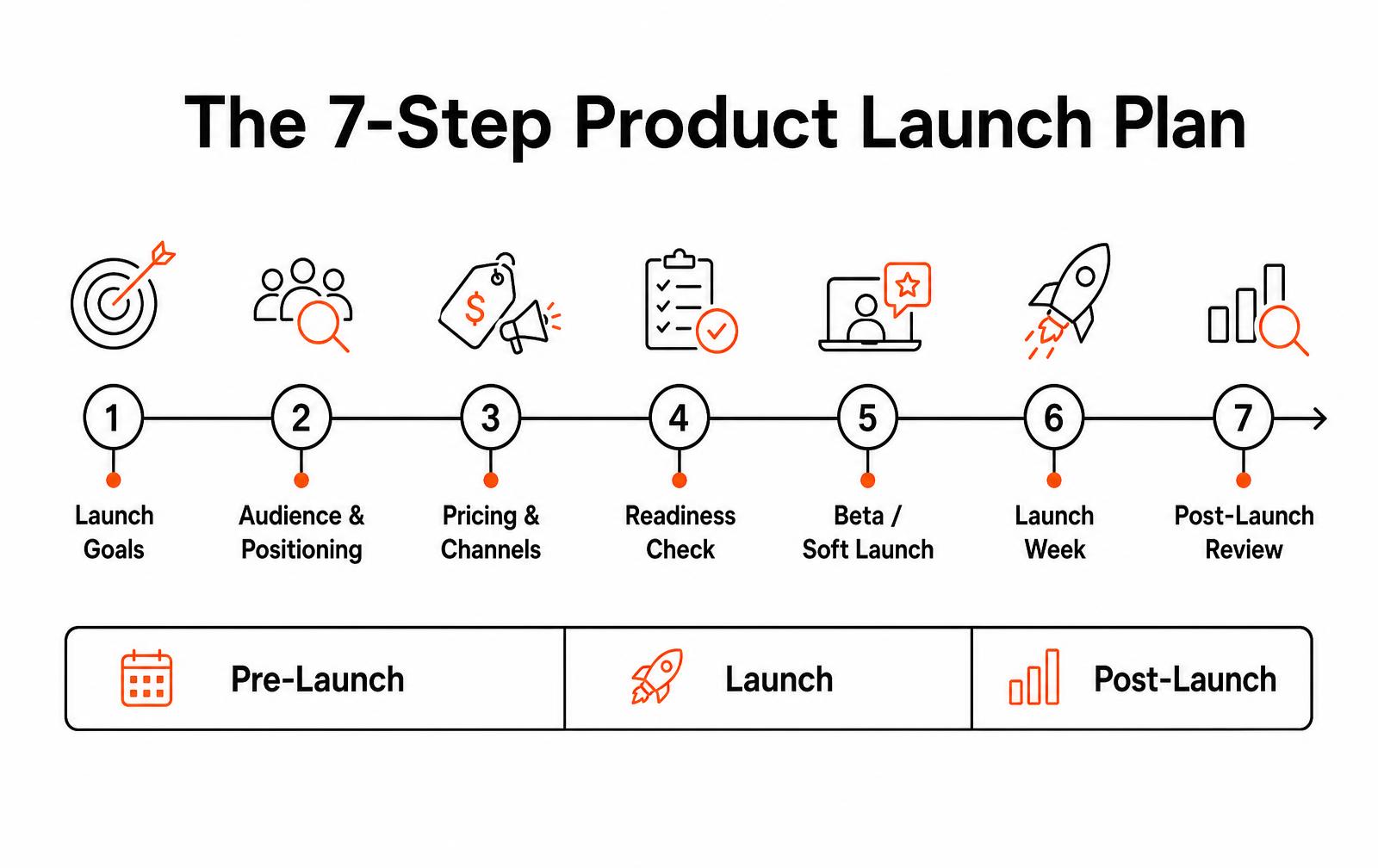
Most launches that go badly were not under-marketed. They shipped before the operations behind them were ready: no spare parts, no support content, a forecast the factory could not meet, or a price that collapsed the moment a retailer applied its margin. The plan below is built to catch those failures before customers do.
The 7 steps at a glance
# | Step | Owner | When |
|---|---|---|---|
1 | Define launch goals and success metrics | Leadership | 12 to 16 weeks out |
2 | Lock audience and positioning | Product and marketing | 10 to 14 weeks out |
3 | Set pricing and channel strategy | Commercial | 10 to 12 weeks out |
4 | Run the launch readiness check | Cross-functional | 6 to 8 weeks out |
5 | Beta or soft launch | Product and support | 4 to 6 weeks out |
6 | Launch week execution | Marketing and operations | Week 0 |
7 | Post-launch review and iteration | Everyone | Weeks 2 to 12 |
Step 1: Define launch goals and success metrics
A launch without a number is a press release. Decide before anything else what this launch is for — revenue, market entry, channel expansion, defending share, or validating a new category — and write the metric that proves it.
- Volume goal: units in the first 30, 90 and 180 days, tied to the production forecast.
- Revenue and margin goal: net of channel margin, returns and promotional spend.
- Quality goal: acceptable defect and return rate; define what triggers a stop-ship.
- Learning goal: the questions the first cohort of customers must answer for the roadmap.
Failure point: goals owned by marketing alone. If operations did not agree to the volume number, the forecast is fiction.
Step 2: Lock audience and positioning
Positioning is a decision about who you are willing to lose. Name the primary buyer, the alternative they are using today, and the single reason to switch. Everything downstream — packaging copy, product page, retailer sell sheet, support scripts — inherits from this one paragraph.
- Write the buyer in one sentence, specific enough to exclude people.
- Name the incumbent alternative, including 'do nothing'.
- State the one differentiator you will repeat everywhere.
- List three objections and the proof that answers each.
Test the positioning on people who have never seen the product. If they cannot repeat back what it does after ten seconds on the page, the shelf will not do better.
Step 3: Set pricing and channel strategy
Price is set by the channel, not the spreadsheet. A product sold through retail has to survive a 30 to 50 percent retail margin and often another 10 to 20 percent to a distributor, which is why landed cost usually needs to sit near 20 to 25 percent of intended shelf price. Work this out before the launch date, not after the first purchase order. Our guide to distribution strategy covers the channel math in detail.
Decision | What to lock before launch |
|---|---|
List price and MAP | Published price plus the minimum advertised price policy you will enforce |
Launch promotion | Discount depth, duration, and who funds it |
Channel mix | Which channels go live at launch and which come later |
Channel fill | Inventory required to stock each partner, and who finances it |
Returns terms | Restocking, RMA path, and the margin impact you have accepted |
Step 4: Run the launch readiness check
This is the gate that saves launches. Six to eight weeks out, walk every function through a written checklist and record a yes, a no, or a date. A single no with no date means the launch moves.
Area | Ready means |
|---|---|
Product | Design frozen, EVT/DVT/PVT complete, certifications issued in hand |
Supply | Confirmed production slot, components secured, first shipment dated |
Packaging | Final artwork approved, drop-tested, barcodes and compliance marks verified |
Channel | Listings built, images and copy loaded, partner sell sheets delivered |
Support | Manual, FAQ, troubleshooting tree, warranty policy and trained agents |
Service | Spare parts stocked, repair or replacement path defined |
Legal | Trademarks filed, warranty language reviewed, claims substantiated |
Measurement | Analytics, order tracking and quality reporting live before day one |
Failure point: treating certification and packaging as parallel low-risk tasks. Both routinely slip and both are hard blockers on shipping.
Step 5: Beta or soft launch
A limited release turns unknown risk into known risk while the volume is small enough to fix. Ship to a controlled group — one region, one retailer, one customer segment, or a direct pre-order cohort — and instrument it heavily.
- Aim for enough units to see real failure modes, typically 50 to 500 depending on category.
- Track unboxing, setup completion, first-week support contacts and early returns.
- Watch the questions support receives — each one is missing content, not a customer error.
- Define in advance what would delay the full launch, so the decision is not emotional.
Step 6: Launch week execution
Launch week is coordination, not creativity. Every asset should already exist; the work is sequencing and staffing.
- Confirm inventory is physically received at each fulfillment point before announcements go out.
- Turn listings live and verify pricing, images and shipping options on each channel yourself.
- Release owned media first — site, email list, existing customers — then paid and press.
- Staff support above normal levels for the first 72 hours.
- Hold a short daily standup with product, ops and support until volume stabilizes.
Keep one person empowered to pause the launch. The cost of a two-day delay is always lower than the cost of a recall.
Step 7: Post-launch review and iteration
The first ninety days generate the most valuable data the product will ever produce. Capture it deliberately rather than moving straight to the next program.
Signal | What it tells you | Act by |
|---|---|---|
Return reason codes | Which expectations the marketing set wrongly | Week 4 |
Support ticket themes | Missing documentation or a real design defect | Week 4 |
Sell-through rate by channel | Whether the channel mix was right | Week 8 |
Warranty and field failures | Design or process issues to correct in the next build | Week 12 |
Review sentiment | The words real buyers use — feed them back into positioning | Ongoing |
Feed the findings into the next production run and into the roadmap. If you are planning that next cycle now, start with the new product development process.
Frequently asked questions
What is a product launch plan?
A product launch plan is a written, cross-functional document that defines the goals, audience, pricing, channels, readiness criteria and post-launch measurement for bringing a product to market. It covers operations, support and supply as well as marketing, because most launch failures are operational rather than promotional.
What are the 7 steps of a product launch?
Define launch goals and metrics, lock audience and positioning, set pricing and channel strategy, run a launch readiness check, execute a beta or soft launch, run launch week, and complete a post-launch review with iteration.
How far in advance should you plan a product launch?
Begin the launch plan 12 to 16 weeks before the target ship date for a straightforward consumer product. Regulated products and retail launches need six months or more because certification, retailer onboarding windows and channel fill inventory all have long lead times.
What is a launch readiness checklist?
It is a gated review roughly six to eight weeks before launch covering product validation, certification, supply, packaging, channel listings, support content, spare parts, legal review and analytics. Each item gets a yes, a no, or a committed date; unresolved blockers move the launch date.
Should you do a soft launch first?
Usually yes for physical products. A limited release of 50 to 500 units exposes real failure modes, setup friction and support gaps while the volume is small enough to fix cheaply, and it validates the fulfillment path before a full-scale announcement.
How do you measure a product launch?
Track unit volume against forecast at 30, 90 and 180 days, net margin after channel and returns, defect and return rate, support contacts per unit sold, sell-through by channel, and review sentiment. Set these targets in step one so the review has something to compare against.
Who owns what across the launch phases
Launches fail on ownership more often than on strategy. Each product launch phase produces deliverables that belong to a specific function, and the handoffs between them are where things drop. Write the ownership grid at the start of the program and the weekly status meeting becomes short.
Responsibility grid by phase
Phase | Primary owner | Key deliverable | Handoff to |
|---|---|---|---|
Goals and metrics | Product lead | Written success criteria | Whole team |
Positioning | Marketing | Messaging and claim set | Legal and sales |
Pricing and channel | Commercial | Price list, margin model | Operations |
Readiness review | Program manager | Signed go/no-go record | Executive sponsor |
Soft launch | Product plus support | Defect and friction log | Engineering |
Launch week | Marketing plus operations | Live listings, stocked inventory | Support |
Post-launch review | Product lead | Decisions and next actions | Next program |
Pay attention to the claim set. Every marketing claim about performance, safety or compliance needs a document behind it, and reviewing that before the copy goes live is cheaper than pulling listings later.
Launch governance checklist
- One named owner per phase, agreed in writing.
- A single launch tracker visible to all functions.
- Substantiation on file for every performance or compliance claim.
- A weekly thirty-minute review with a fixed agenda, not a status recital.
- A post-launch review scheduled before launch, so it actually happens.
Key takeaways
- Assign one owner and one deliverable per launch phase.
- Substantiate every claim before copy goes live.
- Schedule the post-launch review in advance or it never occurs.
Planning a launch and want the phases run properly?
Product Launch Phases at a Glance
Most launches fail on sequencing, not effort. The seven phases below map to hard gates: each one has an exit criterion you can actually check before spending the next tranche of tooling or media budget.
| Phase | Primary output | Exit gate | Typical duration |
|---|---|---|---|
| 1. Opportunity framing | Job-to-be-done brief, target landed cost | Named buyer and price ceiling agreed | 2-4 weeks |
| 2. Concept and feasibility | Three concepts, risk register | Highest technical risk demonstrated on the bench | 3-6 weeks |
| 3. Engineering development | Functional prototype, DFM review | Design freeze signed by manufacturing | 8-16 weeks |
| 4. Validation and compliance | Test reports, certification files | All applicable standards passed | 4-10 weeks |
| 5. Tooling and pilot | First articles, pilot run | First-article pass rate above 95% | 8-14 weeks |
| 6. Commercial readiness | Packaging, channel listings, support docs | Fulfillment tested end to end | 4-8 weeks |
| 7. Launch and learn | Sell-through data, warranty telemetry | Return rate and reorder rate inside plan | Ongoing |
The Gate Checklist Teams Skip
- Landed cost, not unit cost. Include tooling amortization, freight, duty, packaging, and expected warranty reserve before you quote a wholesale price.
- Certification scope in writing. A single unlisted power supply or radio module can add ten weeks late in the schedule.
- Packaging drop testing. Parcel damage is the fastest way to turn a good product into a bad review.
- Spare and service plan. Decide which subassemblies are field-replaceable before tooling, not after the first returns arrive.
- Inventory tranche sizing. Order the smallest quantity that keeps per-unit cost tolerable while you learn real sell-through.
- Content ready before stock lands. Photography, manuals, and listing copy should be finished during pilot, not after.
What to Measure in the First 90 Days
| Metric | Why it matters | Healthy signal |
|---|---|---|
| Sell-through rate | Distinguishes channel fill from real demand | Steady weekly units after week three |
| Return rate | Surfaces usability and quality escapes early | Under 3% for durable goods |
| Support contacts per 100 units | Shows where the instructions fail | Declining trend week over week |
| Warranty claims by failure mode | Drives the first engineering change order | No single mode above 1% |
| Reorder or attach rate | Predicts whether volume tooling pays back | Rising with cohort age |
Treat the first production run as an instrumented experiment. The teams that win the second year are the ones that captured clean failure-mode data in the first quarter and folded it into a revision rather than defending the original design.
Frequently Asked Questions About Product Launch Phases
How long does a full product launch take?
For a moderately complex consumer or industrial device, plan on nine to eighteen months from opportunity framing to first shipment. The engineering work is rarely the long pole; tooling lead time, certification queues, and packaging development are what stretch the calendar. Programs that compress below nine months usually do so by reusing an existing platform, an existing enclosure, or an existing certified subsystem.
Which phase most often gets skipped?
Validation. Teams that have already seen a working prototype feel the product is finished, and they treat compliance testing as a formality to run in parallel with tooling. When a test fails, the mold is already cut, and the change costs both money and weeks. Finish validation before releasing tooling whenever the schedule allows it.
When should marketing get involved?
At phase one. The people who will have to sell the product should shape the claims the engineering team is trying to make true. Bringing them in at phase six produces launches where the product does something impressive that nobody knows how to describe, and where the photography and manuals arrive after inventory is already sitting in a warehouse.
What is the right first order quantity?
The smallest quantity your supplier will accept without a punitive per-unit premium. Real sell-through data is worth more than the savings from a larger run, and a second order placed eight weeks later almost always reflects a better product than the first.
Work with LA NPDT: if you are moving from here to execution, start with our new product marketing or talk to us about market research.
Filed under:Education
Tagged:BossierInnovationLouisianaMarketingMarketing PlanNew Product DevelopmentProduct DesignProduct DevelopmentProduct LaunchProduct MarketingPrototypingShreveport
Services related to this guide
- Product design servicesIndustrial design and CAD taken all the way to manufacturable files.
- Rapid prototypingWorking prototypes in days, from 3D printing to vacuum casting.
- Electronic design servicesSchematic, PCB layout, firmware and bring-up, through to production handoff.
- Product development examplesReal projects we designed, prototyped and shipped.