How to Accelerate Product Development: A Startup Guide
Acceleration comes from removing waiting, not rushing engineering. Here are the levers that compress a startup product development schedule, plus a 90-day plan.
February 13, 20247 min read

Written by Konstantin Dolgan, Ph.D., NPDP
Founder & CEO, Product Development Engineer
Published February 13, 2024Updated September 2, 2026
How to Accelerate Product Development: A Guide for Startups and Entrepreneurs
You accelerate product development by removing waiting, not by rushing work. In most startup schedules the engineering hours are a minority of the calendar. The majority is spent waiting on decisions, on quotes, on parts, on the next round of feedback and on rework caused by a requirement nobody wrote down. Teams that ship fast run phases in parallel, decide with prototypes instead of opinions, and freeze the requirements that drive tooling early.
This guide covers what acceleration actually means for a physical or connected product, where startup schedules leak weeks, the levers that compress a timeline without damaging quality, and a 90-day plan you can run against your own project. It is written from what we see across product development programs at LA NPDT, where the same handful of delays repeat in almost every first-time build.
What accelerating product development actually means
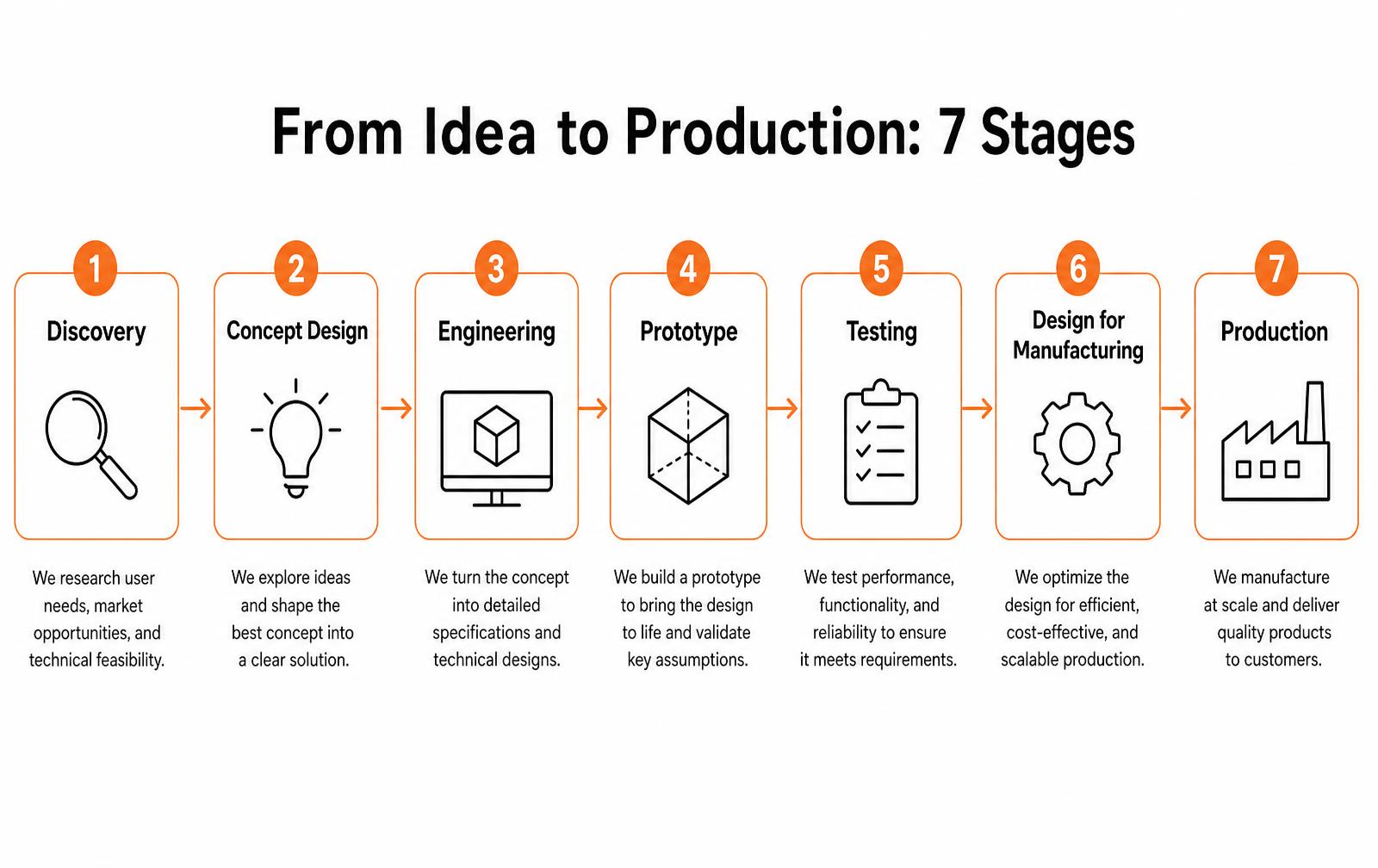
Acceleration is a schedule strategy, not a speed setting. The work still has to happen: someone still has to define requirements, draw the geometry, choose materials, run the tolerance stack, build and break prototypes and prepare the product for manufacturing. What changes is how those activities are sequenced, how quickly each one produces a decision, and how much rework the project absorbs later.
- Compression — running phases in parallel instead of end to end, so industrial design and engineering overlap rather than queue.
- Shorter loops — replacing week-long review cycles with same-week prototypes and decisions.
- Less rework — freezing the requirements that drive irreversible spend, so the third revision does not undo the first.
- Fewer handoffs — keeping design, engineering and prototyping under one roof so nothing waits in an inbox.
Most schedules do not fail because engineering was slow. They fail because a decision sat unanswered for eleven days.
Where startup schedules actually lose time
Before you try to move faster, find out where the calendar is going. In our experience the losses are remarkably consistent across consumer products, devices and equipment, and almost none of them are engineering throughput problems.
Where time is lost | Typical cost | How to remove it |
|---|---|---|
Undefined requirements | 2 to 8 weeks of rework | Write a one-page product requirements document before CAD starts |
Slow decision-making | 1 to 3 weeks per review cycle | Name a single decision-maker and a fixed 48-hour review window |
Sequential vendor handoffs | 3 to 6 weeks | Use one team for design, engineering and prototyping |
Waiting on quotes and parts | 1 to 4 weeks per round | Order long-lead components before the design is final |
Scope creep mid-engineering | 4 to 12 weeks | Park new ideas in a version 2 list, in writing |
Prototyping the wrong thing | 2 to 6 weeks | Define the question each prototype must answer before building it |
Lever 1: Freeze the decisions that drive irreversible spend
Not all requirements need to be locked at once. What must be locked early are the ones that drive tooling, certification and supply chain: overall size envelope, power source, primary material and manufacturing process, and the regulatory path. Change any of those after tooling is quoted and you restart weeks of work. Everything else — color, texture, packaging graphics, secondary features — can safely stay open.
- Write the requirements down. A verbal agreement is a future dispute with a schedule cost.
- Separate must-have from nice-to-have before engineering starts, not during.
- Record the assumptions behind each requirement so you know what to revisit if the market changes.
- Set a written change process: anything that alters the frozen list needs a schedule and budget impact estimate first.
Lever 2: Overlap design, engineering and prototyping
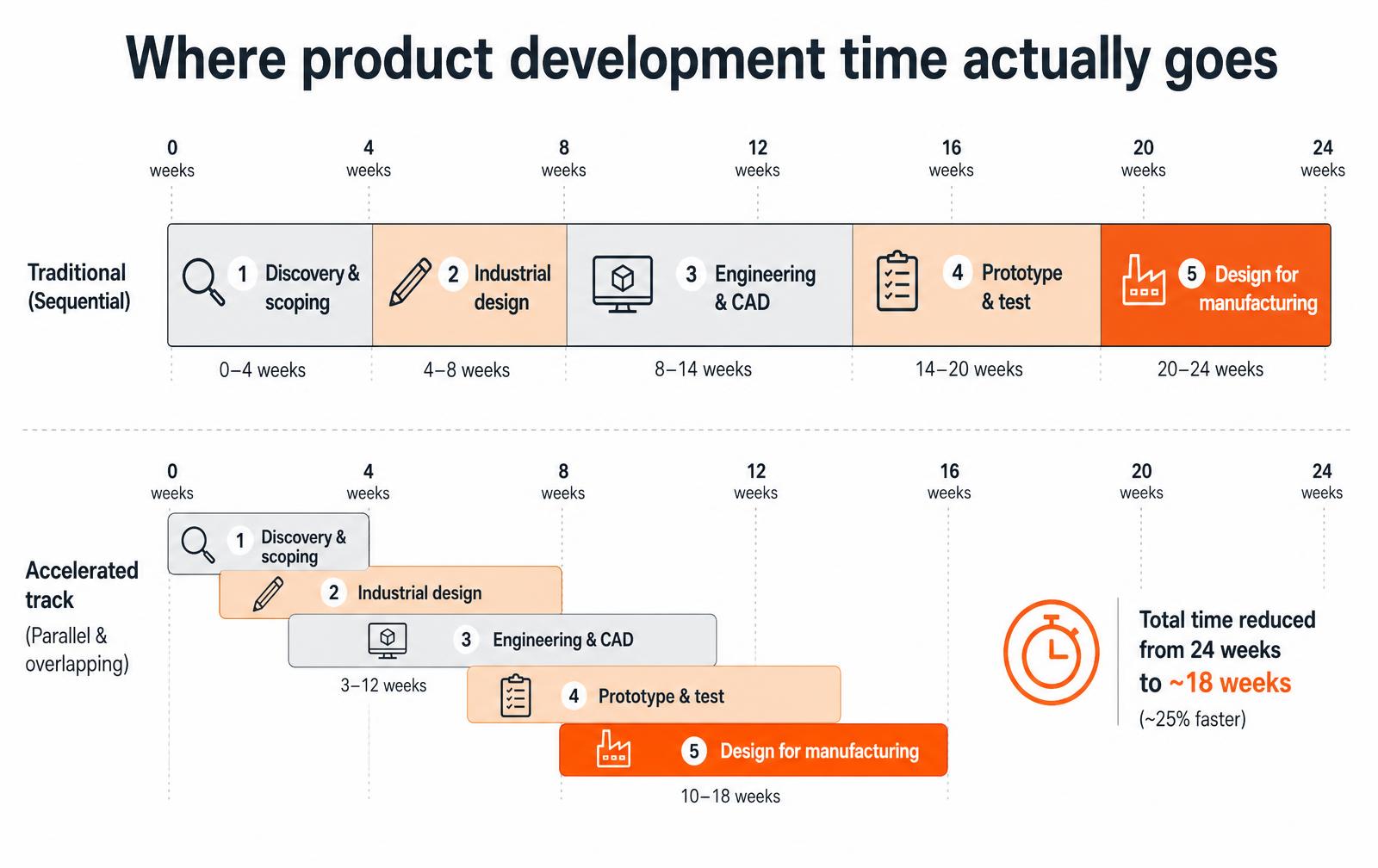
The classic sequence — research, then industrial design, then engineering, then prototyping — is easy to manage and slow to finish. In practice, engineering can start feasibility studies and component selection while form is still being explored, and prototyping can begin on subsystems long before the full assembly exists.
Phase | Sequential approach | Overlapped approach |
|---|---|---|
Discovery and requirements | Weeks 1 to 4 | Weeks 1 to 3 |
Industrial design | Weeks 4 to 8 | Weeks 2 to 7 |
Engineering and CAD | Weeks 8 to 14 | Weeks 5 to 13 |
Prototype and test | Weeks 14 to 20 | Weeks 9 to 17 |
Design for manufacturing | Weeks 20 to 24 | Weeks 14 to 19 |
Overlap has a cost: some work gets thrown away when an upstream decision changes. That trade is usually worth it, because a discarded bracket study costs days while a serialized schedule costs months. The discipline is knowing which overlaps are safe — geometry-independent work such as electronics architecture, firmware scaffolding, supplier research and certification planning can nearly always run in parallel.
Lever 3: Prototype to answer questions, not to impress
Every prototype should have a written question attached to it. The fidelity you need is whatever answers that question honestly and nothing more. Startups routinely spend four weeks on a looks-like, works-like model when a cardboard mock-up and a breadboard would have settled the same argument in two days.
Question you are asking | Right prototype | Typical turnaround |
|---|---|---|
Is the size and layout right? | Foam or cardboard mock-up | 1 to 3 days |
Does it feel good in the hand? | 3D printed shell, weighted | 3 to 7 days |
Does the mechanism work? | Functional subsystem rig | 1 to 2 weeks |
Will the electronics fit and behave? | Breadboard, then dev-board integration | 1 to 3 weeks |
Will investors and buyers respond? | Appearance model from final CAD | 2 to 3 weeks |
Can it be manufactured at target cost? | Pilot-run parts from production process | 4 to 8 weeks |
For a deeper walkthrough of fidelity levels and what each one costs, see our guides on how to make a prototype and how much a prototype costs to make.
Lever 4: Buy time back with long-lead planning
Lead time is the quietest schedule killer in hardware. Custom electronics components, motors, batteries, displays, seals, specialty resins and certification lab slots all have queues that do not care about your launch date. Identify every long-lead item during engineering, not at the end, and place orders or reservations while the surrounding design is still moving.
- Build a long-lead list in week one of engineering and refresh it weekly.
- Design around available parts wherever the design allows — a second-choice component in stock usually beats a first-choice component twelve weeks out.
- Reserve certification and test lab time before you need it; slots are often booked four to eight weeks ahead.
- Ask suppliers for lead times in writing, and add a buffer for the first order from a new vendor.
Lever 5: Shorten the feedback loop, not the work
A team that reviews weekly moves at most 52 decisions per year on a critical path. Two short, structured reviews a week doubles that with no additional engineering hours. The mechanics matter: a fixed slot, a named decision-maker, a written question list sent ahead, and a decision logged before the meeting ends.
Speed in product development is mostly a decision-latency problem wearing an engineering costume.
Lever 6: Reduce the number of parties involved
Every additional vendor adds an onboarding period, a translation layer and a place for accountability to disappear. A designer who hands sketches to an outside engineer who hands files to an outside prototype shop creates three review cycles where one team would have had a hallway conversation. When a project is under time pressure, consolidation is usually the single largest schedule lever available.
Model | Speed | Best for | Watch out for |
|---|---|---|---|
In-house team | Slow to start, fast once built | Funded companies with a product roadmap | Hiring takes months and fixed cost survives the project |
Multiple specialist vendors | Slowest end to end | Very specialized subsystems | Handoff gaps, finger-pointing, duplicated onboarding |
Single full-cycle partner | Fastest for a first product | Startups and corporate innovation teams | Verify the partner truly covers design, engineering and prototyping |
Hybrid: internal lead, external execution | Fast and controllable | Teams with a technical founder | Requires disciplined scope and one decision-maker |
What you should never accelerate
Some steps protect you from failures that cost far more than the weeks they save. Skipping them is not acceleration; it is deferred cost with interest.
- Safety and regulatory testing — a recall or a failed certification restarts far more than the schedule.
- Tolerance analysis before tooling — steel does not care that you were in a hurry.
- Design for manufacturing review — a part that cannot be molded is not finished, no matter how good it looks.
- Real user testing — feedback from actual users kills bad features earlier than any internal debate.
- IP filings before public disclosure — showing the product before filing can eliminate rights you cannot get back.
A 90-day acceleration plan
If your project is stalled, this is the structure we use to restart momentum. It works for a new program and for one that has already lost six months.
Window | Focus | What must exist at the end |
|---|---|---|
Days 1 to 14 | Requirements and constraints | One-page requirements doc, frozen envelope, regulatory path, long-lead list |
Days 15 to 35 | Concept and feasibility in parallel | Two to three viable concepts, feasibility notes, rough cost model, first crude mock-ups |
Days 36 to 60 | Engineering and subsystem prototypes | CAD for the chosen concept, subsystem rigs proving the risky parts, component orders placed |
Days 61 to 80 | Integrated prototype and testing | A working prototype answering the top three technical risks, test results written down |
Days 81 to 90 | DFM and next-phase plan | Manufacturing review, updated cost model, decision on tooling and pilot run |
Metrics that tell you whether you are actually faster
Track a small number of leading indicators rather than a Gantt chart nobody updates. If these move in the right direction, the launch date follows.
- Decision latency — average days between a question being raised and answered.
- Loop time — days from prototype request to prototype in hand.
- Rework ratio — share of engineering hours spent redoing completed work.
- Open risks closed per month — how many technical unknowns have been retired.
- Long-lead exposure — the longest lead time still sitting on the critical path.
Frequently asked questions
How long does it take to develop a new product?
A straightforward consumer product typically runs six to twelve months from concept to production-ready files, and a complex electromechanical or regulated device runs twelve to twenty-four months.
Accelerated programs with overlapped phases and a single team often land in the four to nine month range for the first category. The variables that move the number most are regulatory requirements, electronics complexity, tooling and how quickly the decision-maker responds.
What is the fastest way to get a product to market?
Narrow the first release to the smallest version that solves the core problem, freeze the requirements that drive tooling, run design and engineering in parallel with one accountable team, and use low-fidelity prototypes to settle arguments quickly. Speed comes from scope discipline and short feedback loops far more than from working longer hours.
Does accelerating product development reduce quality?
Not when you compress waiting rather than engineering. Quality drops when teams skip tolerance analysis, design for manufacturing, safety testing or user validation. Removing decision delays, handoffs and duplicated onboarding shortens the calendar without touching the technical rigor that protects the product.
Should a startup hire in-house engineers or outsource product development?
For a first product, an experienced outside team is almost always faster and cheaper, because hiring a balanced design and engineering team takes months and leaves fixed cost after launch. Building in-house makes sense once you have a validated product line and a roadmap that keeps a full team busy. Many companies use a hybrid: a technical lead internally, execution with a full-cycle partner.
How much does it cost to speed up development?
Overlapping phases and shortening decision loops usually cost nothing; they are process changes. Real costs appear when you pay expedite fees on parts, run parallel design paths as insurance, or buy soft tooling to bridge to production. Those are worth it when a launch window, a trade show or an investor milestone has real financial value attached.
What slows down hardware startups the most?
Changing requirements after engineering has begun, followed closely by long-lead components and slow internal decisions. All three are manageable: write requirements down and control changes, identify long-lead items in the first weeks, and give one person the authority to decide within a fixed window.
Want a faster path for your product?
LA NPDT runs design, engineering and prototyping under one roof, which removes the handoffs that create most of the delay in a startup schedule. If you want a realistic timeline for your product — including what can safely overlap and what cannot — start with a consultation or send us your project details .
The 7-Step New Product Development Process. How Long Does It Take to Build a Prototype?. How Much Does a Prototype Cost to Make?.
10 Engineering Design Constraints You Cannot Ignore Work with LA NPDT: if you are moving from here to execution, start with our our product development process or talk to us about end-to-end product development .
Filed under:EducationInspiration
Services related to this guide
- Product design servicesIndustrial design and CAD taken all the way to manufacturable files.
- Rapid prototypingWorking prototypes in days, from 3D printing to vacuum casting.
- Electronic design servicesSchematic, PCB layout, firmware and bring-up, through to production handoff.
- Product development examplesReal projects we designed, prototyped and shipped.