Pre-Seed vs Seed Funding: What Each Round Expects From Hardware
Pre-seed vs seed funding for hardware teams - check sizes, dilution, and the prototype and traction milestones each round expects.
April 21, 20174 min read

Written by Ralph Hill, Mechanical & electrical systems, 3D manufacturing
Prototyping Engineer
Published April 21, 2017Updated September 2, 2026
Every funding stage buys one thing: the removal of a specific risk. Founders who raise against the next milestone rather than the next payroll get better terms and shorter processes. That is doubly true in hardware, where each round has to cover a tooling or inventory step that software companies never face.
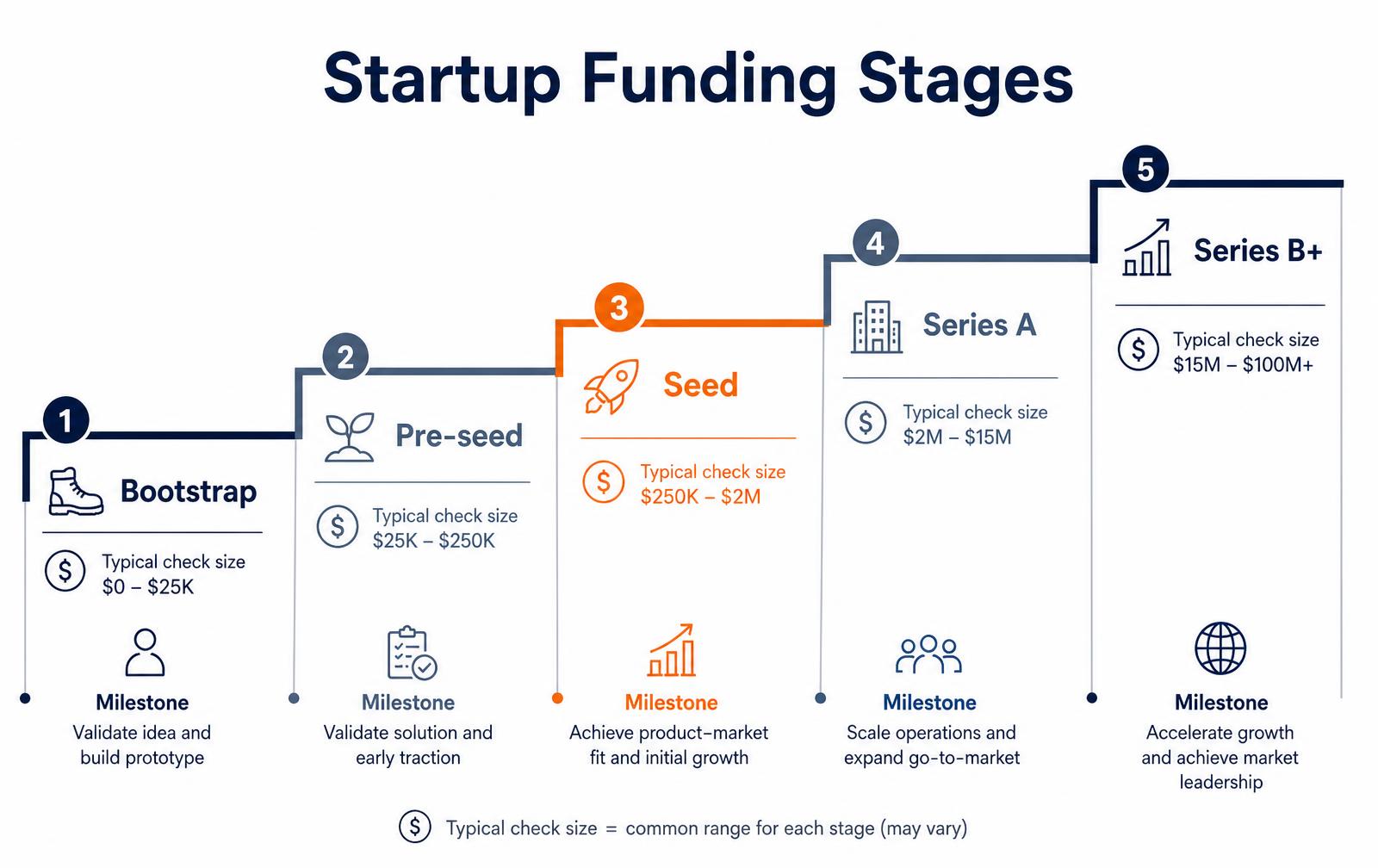
The stages at a glance
Stage | Typical raise | Typical dilution | Milestone it buys |
|---|---|---|---|
Bootstrap | $0 - $25K | 0% | Working prototype, first customer conversations |
Pre-seed | $25K - $250K | 5 - 10% | Validated solution, design for manufacture started |
Seed | $250K - $2M | 15 - 25% | Tooling, certification, first production run |
Series A | $2M - $15M | 15 - 25% | Repeatable sales, scaled manufacturing |
Series B+ | $15M - $100M+ | 10 - 20% | Category expansion, international distribution |
What bootstrapping actually gets you
- Control and pricing power. No board, no liquidation preference, no forced exit timeline.
- Better round terms later. A funded prototype and pre-orders move valuation more than any deck.
- Discipline. Spending your own money tends to produce a smaller, shippable version one.
- The limit. Tooling and a first production run rarely fit inside a bootstrap budget - $20K to $80K of steel and a $50K minimum order eventually forces the decision.
What investors look for at each stage
Stage | Evidence expected | Common reason for a pass |
|---|---|---|
Pre-seed | Functional prototype, founder-market fit | Idea-stage, no build |
Seed | Concept test data, DFM complete, quoted BOM | Cost of goods leaves no margin |
Series A | $1M+ run rate or signed POs, repeatable channel | One-off sales, no channel |
Series B | Unit economics positive, scalable supply chain | Margins that do not improve with volume |
How much to raise
Take the cost of the next milestone, add the runway to prove it works, add 30%, then add six months for the raise itself. For a consumer hardware product moving from prototype to first production, that is typically $400,000 to $1,200,000 - engineering and DFM, tooling, certification, a first order and the working capital to sit on inventory for 90 days.
Non-dilutive options worth using first
- Pre-orders and crowdfunding. Validates demand and funds tooling - but treat the campaign total as revenue with a delivery obligation, not as capital.
- SBIR/STTR and state innovation grants. Slow, non-dilutive, and strong signal for later rounds.
- Purchase order and inventory financing. Once you have signed POs, this is far cheaper than equity.
- Revenue from services. Consulting income while the product matures is unglamorous and highly effective.
Related reading: how product development firms work, concept testing and get a development quote.
Frequently asked questions
What are the startup funding stages?
Bootstrap, pre-seed, seed, Series A and Series B and beyond. Each stage raises against a specific milestone - prototype, validated solution, first production, repeatable sales, then scale.
How much equity do you give up per round?
Typically 5-10% at pre-seed, 15-25% at seed and another 15-25% at Series A. Founders who reach Series A usually retain 40-60% collectively before the option pool.
Should a hardware startup bootstrap or raise?
Bootstrap through prototype and concept validation - it is cheap and it raises your valuation. Raise before tooling and the first production run, since those costs are lumpy, unavoidable and poorly suited to revenue funding.
How long does a seed round take?
Three to six months from first meeting to money in the bank. Start the process when you have six to nine months of runway left, not three.
Hardware rounds are milestone purchases, not calendar events
The pre-seed versus seed question is not about how much money you can raise; it is about which risk you have already retired. Software teams can raise on traction alone. Hardware teams raise against physical evidence: a prototype that works in a stranger's hands, a bill of materials that survives a quote cycle, a tool that produces parts within tolerance. Every dollar you take before the matching evidence exists is priced against your worst assumption.
What each round buys in a hardware programme
Round | Typical raise | Evidence expected before | What the money buys |
|---|---|---|---|
Bootstrap | $0-$25k | A sketch and a customer conversation | Breadboard, mockups, first user interviews |
Pre-seed | $25k-$250k | Working functional prototype | Design for manufacture, EVT build, cost model |
Seed | $250k-$2M | DVT parts, quoted BOM, LOIs or pre-orders | Tooling, certification, first production run |
Series A | $2M-$12M | Shipped units, repeatable channel, unit margin | Volume manufacturing, inventory, sales team |
Where the money actually goes
Spend line | Pre-seed typical | Seed typical | Notes |
|---|---|---|---|
Engineering (mech, EE, firmware) | $40k-$140k | $150k-$600k | Largest single line in both rounds |
Prototype builds | $8k-$35k | $40k-$120k | EVT/DVT/PVT builds compound quickly |
Injection tooling | Rarely | $25k-$250k | Per-cavity cost scales with part count and finish |
Certification (FCC, CE, UL, safety) | $0-$10k pre-scan | $25k-$120k | Medical and battery products sit at the top |
First production run | No | $60k-$400k | Cash-out before revenue; the classic seed killer |
Founder salaries | Minimal | $120k-$300k | Investors expect founders to be paid enough to focus |
The pattern that kills hardware startups is raising a seed sized for engineering and discovering that tooling plus first production plus certification exceeds the entire round. Model the cash trough — the period where you have paid for inventory but not yet been paid by customers — before you set the raise number.
Dilution math founders should run before the pitch
Stage | Raise | Post-money | Dilution | Founder stake after |
|---|---|---|---|---|
Start | - | - | - | 100% |
Pre-seed | $150k | $1.5M | 10% | 90% |
Seed | $1.2M | $6M | 20% | 72% |
Option pool | - | - | 10% | 65% |
Series A | $5M | $25M | 20% | 52% |
Two structural traps distort this table. Uncapped or high-discount SAFEs stacked across a long pre-seed convert together at the priced round and can double the dilution founders expected. And an option pool demanded pre-money is paid for entirely by existing shareholders — negotiate its size against a real hiring plan, not a round number.
Non-dilutive capital worth exhausting first
- Customer development contracts. A pilot customer paying for a tailored unit funds engineering and proves demand simultaneously — the strongest signal in a seed deck.
- SBIR/STTR and state innovation grants. Slow and paperwork-heavy, but non-dilutive six-figure sums that investors read as third-party validation.
- Crowdfunding pre-orders. Funds tooling and validates price, but it is revenue with a delivery obligation; budget fulfilment, returns and support before counting it as capital.
- Equipment and tooling finance. Tooling is a hard asset; some lenders will finance it against purchase orders rather than equity.
- R&D tax credits. In the US these can offset payroll tax for qualifying early-stage companies — real cash, commonly left unclaimed.
What makes hardware investors pass
Stage | Most common pass reason | The fix |
|---|---|---|
Pre-seed | No working artefact, only renders | Build the ugly functional prototype first |
Pre-seed | Team has never manufactured anything | Add an advisor or partner with production scars |
Seed | BOM cost implies a negative gross margin | Re-cost with real quotes and design out the top three cost drivers |
Seed | No certification path identified | Name the standards, the lab and the budget |
Seed | Demand evidence is anecdotal | Convert interest into LOIs, deposits or a paid pilot |
Series A | Unit economics improve only at implausible volume | Show the cost curve with quoted price breaks, not a straight line |
A raise timeline that does not run you out of cash
- Start the raise with six to nine months of runway, never three — desperation is visible in terms.
- Allow eight to twelve weeks of meetings for pre-seed and twelve to twenty for seed, plus four to six weeks of diligence and paperwork.
- Prepare the data room before the first meeting: BOM, cost model, test data, IP filings, cap table, and a bill-of-process for manufacturing.
- Run the process in parallel, not sequentially; a term sheet with no competing interest is a term sheet you will accept on their terms.
- Keep building through the raise. A prototype milestone hit mid-process reprices the round more effectively than any deck edit.
More questions teams ask
Frequently asked questions
What is the difference between pre-seed and seed funding?
Pre-seed typically raises $25k-$250k against a working prototype and funds design for manufacture and early builds. Seed typically raises $250k-$2M against validated design and demand evidence, and funds tooling, certification and the first production run.
Do I need revenue to raise a seed round for hardware?
Not usually revenue, but you do need demand evidence: letters of intent, paid pilots, distributor commitments or pre-orders. For hardware, a quoted bill of materials with a credible gross margin often carries as much weight as early revenue.
How much dilution should I expect across pre-seed and seed?
Roughly 5-10% at pre-seed and 15-25% at seed, plus a 10% option pool commonly created at the priced round. Founders reaching Series A typically hold 45-60% collectively before that round's dilution.
Should hardware startups use SAFEs or priced rounds?
SAFEs are fine for a single small pre-seed. Stacking several over eighteen months with different caps creates dilution surprises at conversion. Model the fully converted cap table before signing the second SAFE, not the fourth.
How long should the money last?
Fund the next milestone plus the time to prove it plus six months to raise the following round — commonly eighteen months of runway. A twelve-month round in hardware means starting the next raise before the tooling has produced a good part.
Work with LA NPDT: if you are moving from here to execution, start with our product development consulting or talk to us about end-to-end product development.
Filed under:Education
Tagged:BootstrappingBudgetCustomerDallasDesignDiyFinanceLafayetteLake CharlesLouisianaNew OrleansNew Product DevelopmentProduct DesignProduct DevelopmentPrototypeSavingsShreveportStartupTexas
Services related to this guide
- Product design servicesIndustrial design and CAD taken all the way to manufacturable files.
- Rapid prototypingWorking prototypes in days, from 3D printing to vacuum casting.
- Electronic design servicesSchematic, PCB layout, firmware and bring-up, through to production handoff.
- Product development examplesReal projects we designed, prototyped and shipped.