From Product Concept to Validated Prototype: 5 Stages
Most concepts fail on sequence, not inspiration. Here is the five-stage path from idea to manufacturable product, with realistic costs and timelines.
August 25, 20236 min read

Written by Konstantin Dolgan, Ph.D., NPDP
Founder & CEO, Product Development Engineer
Published August 25, 2023Updated October 17, 2026
Turning a product concept into evidence means defining the problem, validating demand, creating design intent and prototyping the assumptions most likely to fail. Most concepts do not fail because the idea was bad. They fail because nobody tested the assumptions underneath it before money went into tooling. If your design is already defined and you need the factory-ready sequence, use our guide to turning a design into a manufactured product.
Published research on new product performance puts commercial failure rates between roughly 35% and 48% of launched products, not the 80% figure repeated online (Journal of Product Innovation Management). The difference between the products that survive and the ones that do not is rarely inspiration. It is sequence: what you validate, in what order, and what you refuse to build until the previous answer comes back.
Stage 1: Define the concept precisely enough to be wrong
A concept you cannot disprove is not a concept, it is a mood. Before anything is drawn, write down who the user is, the specific problem they have today, what they do instead right now, and what measurable improvement your product delivers. If you cannot fill in that last blank with a number — minutes saved, dollars avoided, failures prevented — you are not ready to spend money on design.
Element | Weak version | Strong version |
|---|---|---|
User | Homeowners | Homeowners with detached garages in cold climates |
Problem | Storage is messy | Tools rust over winter, replaced every 3 to 4 years |
Alternative today | Nothing available | Plastic bins plus a dehumidifier, about $180 and constant refilling |
Improvement | Better experience | Keeps humidity under 45% for a season with no refills |
Price signal | People will pay | Comparable products sell for $120 to $200 on retail shelves |
A concept statement should be specific enough that a stranger could prove you wrong in a week.
Stage 2: Validate demand before you validate the design
Validation at this stage is cheap and mostly conversational. Twelve to twenty structured interviews with people who actually have the problem will tell you more than any survey. Ask what they did the last time the problem occurred, what they spent, and what they would have to give up to switch. Enthusiasm is not evidence; behavior is.
- Problem interviews. Ten to twenty conversations, focused on past behavior rather than hypothetical purchase intent.
- Competitive teardown. Buy the three closest alternatives, use them and list what they get wrong.
- Price anchoring. Establish the shelf price band your category already supports before you design to a cost.
- Channel reality check. Identify where this product would actually be sold and what margin that channel requires.
- Regulatory scan. Confirm early whether certification, FCC testing or safety standards apply — they change both schedule and cost.
For a structured approach to this stage, see our guide to market research for a new product and our product discovery process.
Stage 3: Turn the concept into a design intent, not a rendering
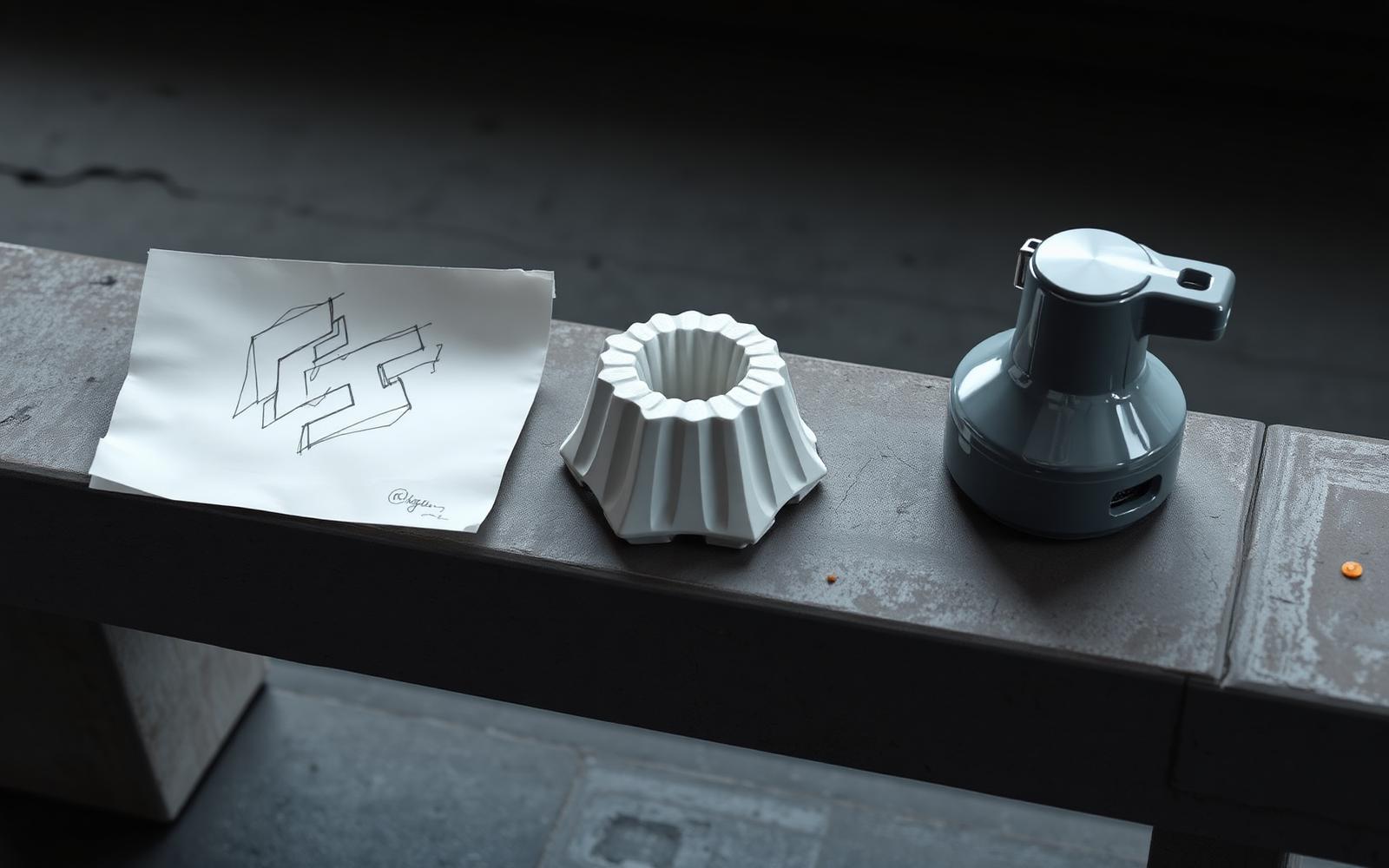
Beautiful renderings sell nothing to a factory. What moves a concept forward is a design intent document: required functions, environmental conditions, target cost, size and weight envelope, user interactions, materials under consideration and the constraints you refuse to violate. Industrial design and engineering then work against that document instead of against opinions.
Deliverable | What it proves | Typical range |
|---|---|---|
Concept sketches and ideation | Direction and form language | $1,500 to $6,000 |
Industrial design and CMF | Look, feel, ergonomics and finish | $5,000 to $25,000 |
Mechanical engineering / CAD | That it can actually be built | $8,000 to $60,000 |
Electronics and firmware | That the function works reliably | $15,000 to $150,000 |
Design for manufacturing review | That unit cost holds at volume | $3,000 to $15,000 |
Ranges vary widely with complexity and regulation. What stays constant is the order: nobody should be paying for tooling-ready CAD before the function has been demonstrated in a prototype.
Stage 4: Prototype to answer questions, not to impress
Every prototype should have a written question attached to it. An appearance model answers whether people want it on a shelf. A functional rig answers whether the mechanism survives 10,000 cycles. A looks-like works-like unit answers whether both can coexist in one enclosure at the target cost. Building one prototype that tries to answer all three is the most reliable way to waste a quarter.
Prototype type | Question it answers | When to build it |
|---|---|---|
Appearance model | Does it read as desirable and premium? | Before user testing and investor conversations |
Functional rig | Does the core mechanism or circuit work? | As early as possible, ugly is fine |
Looks-like works-like | Can form and function coexist at cost? | Before tooling quotes |
Pre-production unit | Does the factory process hold tolerance? | After tooling, before mass production |
Practical detail on this stage lives in how to make a prototype, what prototypes cost and choosing prototype materials.
Stage 5: Launch as a supply chain problem, not a marketing event
By launch, the risks have shifted. The design is frozen; what can still ruin the year is a supplier who misses a date, a certification that fails on the second attempt, or packaging that arrives three weeks after the units. Build the launch backwards from the retail or shipping date and hold a contingency of four to eight weeks for the certification and first-article inspection cycle.
- Freeze the design and issue a change-control process — every late change resets the schedule.
- Complete first-article inspection against a documented specification before authorizing full production.
- Finish certification testing early; failures cost weeks, not days.
- Order packaging and inserts on the same timeline as the product, not after it.
- Plan the second production run before the first one sells out.
Why concepts fail, and what it looks like in advance
Failure mode | Early warning sign | Correction |
|---|---|---|
No real demand | Interviews produce compliments, not stories of past spending | Return to problem interviews before spending on design |
Cost overrun at volume | Unit cost estimated after the design was locked | Set a target cost in the design intent and review it at every gate |
Endless iteration | No written question attached to each prototype | One prototype, one question, one decision |
Certification surprise | Standards researched after the enclosure was tooled | Regulatory scan during validation, not after |
Channel mismatch | Retail margin discovered after pricing was set | Model channel margin before setting target cost |
A realistic timeline for a physical product
Phase | Typical duration | Gate to pass |
|---|---|---|
Concept definition and validation | 3 to 8 weeks | Documented demand and price band |
Industrial design | 4 to 10 weeks | Approved form and user interaction |
Engineering and prototyping | 10 to 24 weeks | Working unit meeting the specification |
Design for manufacturing and tooling | 8 to 16 weeks | Unit cost confirmed by supplier quote |
Certification and pilot run | 6 to 12 weeks | Passing test reports and first-article approval |
Twelve to eighteen months from concept to shelf is normal for a moderately complex consumer product. Programs that beat that number usually did the validation work before the clock started, not faster engineering.
What it costs to turn a design into a real product
A simple mechanical consumer product moving from a validated concept to production-ready files usually lands between $25,000 and $75,000 and takes six to twelve months. Add electronics and firmware and the range roughly doubles.
Add a regulated pathway - medical, juvenile products, anything with a battery shipped by air - and testing and certification alone can add $15,000 to $60,000 before a single unit is sold.
Those are development numbers only; tooling and first production are a separate line and typically arrive later than founders expect.
Product type | Concept to production files | Typical duration |
|---|---|---|
Simple mechanical / housewares | $25,000 to $75,000 | 6 to 12 months |
Connected consumer device | $60,000 to $180,000 | 9 to 18 months |
Class I medical device | $80,000 to $250,000 | 12 to 24 months |
Industrial equipment | $100,000 to $400,000 | 12 to 30 months |
Ranges widen with part count, regulation and how many assumptions were left untested at the concept stage. For a phase-by-phase view of where the money goes, see our new product development cost breakdown.
The single largest variable in that table is not complexity, it is how much was assumed rather than tested before engineering began. Programs that spend a few thousand dollars killing bad assumptions in the first two months land near the bottom of their range.
Programs that skip straight to CAD because the idea felt obvious pay for the same lessons later, in tooling changes that cost twenty times more than a sketch revision would have. Concept work is the cheapest place to be wrong, and being wrong there on purpose is what keeps the rest of the budget intact.
Take the concept to the next gate
LA NPDT runs concepts through validation, design, engineering and prototyping under one roof, so each stage is scoped against the question it needs to answer. Bring us a sketch or a half-finished CAD file and we will tell you what needs proving next.
Have a concept you want turned into a manufacturable product?
Work with LA NPDT: if you are moving from here to execution, start with our product design services or talk to us about industrial design and development.
Frequently asked questions
How do I turn a concept design into a real product?
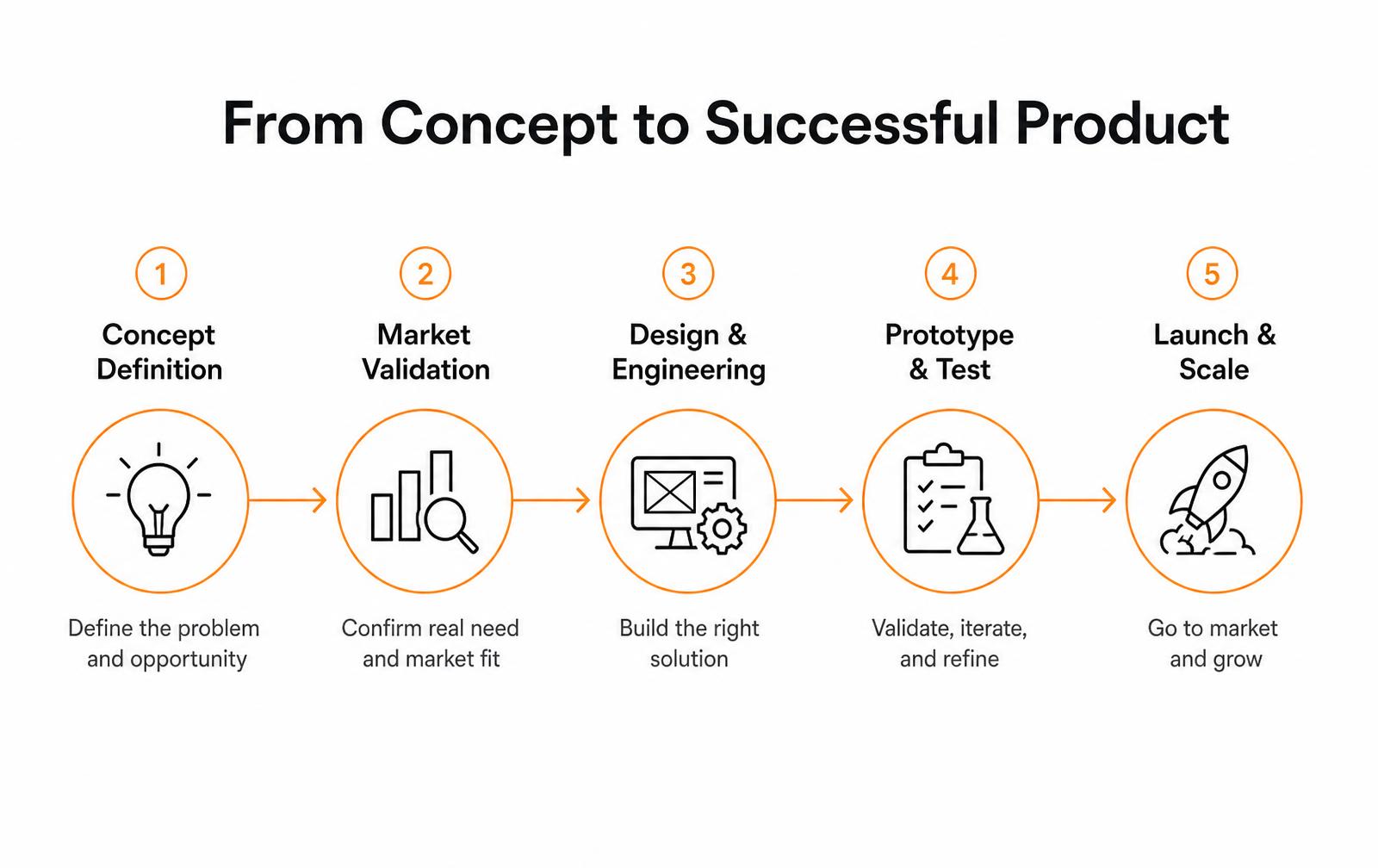
Work in five stages: define the concept precisely enough to be disproven, validate demand through interviews and competitive teardowns, convert the concept into a design intent document, prototype in stages where each build answers one written question, then treat launch as a supply chain and certification problem. Each stage exists to remove a specific assumption before the next stage makes it expensive.
What percentage of new products fail?
Published research places commercial failure of launched products at roughly 35% to 48%, not the frequently repeated 80% or 95% figures. Failure concentrates in products that were never validated with real buyers, that locked a design before establishing a target cost, or that discovered certification and channel requirements after the design was frozen.
How much does it cost to develop a concept into a product?
A simple consumer product typically runs $30,000 to $120,000 through validated prototypes, with tooling adding $10,000 to $100,000 depending on part count and complexity. Connected or regulated products commonly exceed $250,000 once electronics, firmware and certification are included. The largest cost swing is the number of design iterations, which validation work earlier in the process reduces.
Should I patent my concept before developing it?
If patentability matters, file a provisional patent application before broad disclosure. It establishes a filing date for twelve months while you validate and develop, and it costs a fraction of a full utility filing. Use mutual NDAs with suppliers and partners regardless, and make sure development contracts assign design files and IP to you in writing.
How long does it take to go from concept to market?
Twelve to eighteen months is typical for a moderately complex physical product: roughly two months of validation, two to three months of industrial design, three to six months of engineering and prototyping, three to four months for tooling and design for manufacturing, and two to three months for certification and a pilot run. Regulated products such as medical devices take considerably longer.
Filed under:EducationInspirationWords
Services related to this guide
- Product design servicesIndustrial design and CAD taken all the way to manufacturable files.
- Best industrial design firmsWhich studios take an idea from form to manufacturable hardware, and what they charge.
- Prototype designLooks-like, works-like or pre-production: what each proves and what it costs.
- Product development examplesReal projects we designed, prototyped and shipped.