Medical Device Verification and Validation: Stages, Costs and Design Controls
Medical device verification and validation explained: design inputs, V&V protocols, human factors, biocompatibility and design-control documentation.
April 3, 20205 min read

Written by Konstantin Dolgan, Ph.D., NPDP
Founder & CEO, Product Development Engineer
Published April 3, 2020Updated September 2, 2026
Medical device prototyping is the same engineering as any other prototype, plus a paper trail that has to hold up years later. When our team designed and built the UpShield face shield during the 2020 PPE shortage, the parts were printed in days - the work that mattered was material selection, cleanability and documenting why each decision was safe. Every medical program runs on that same balance of speed and evidence.
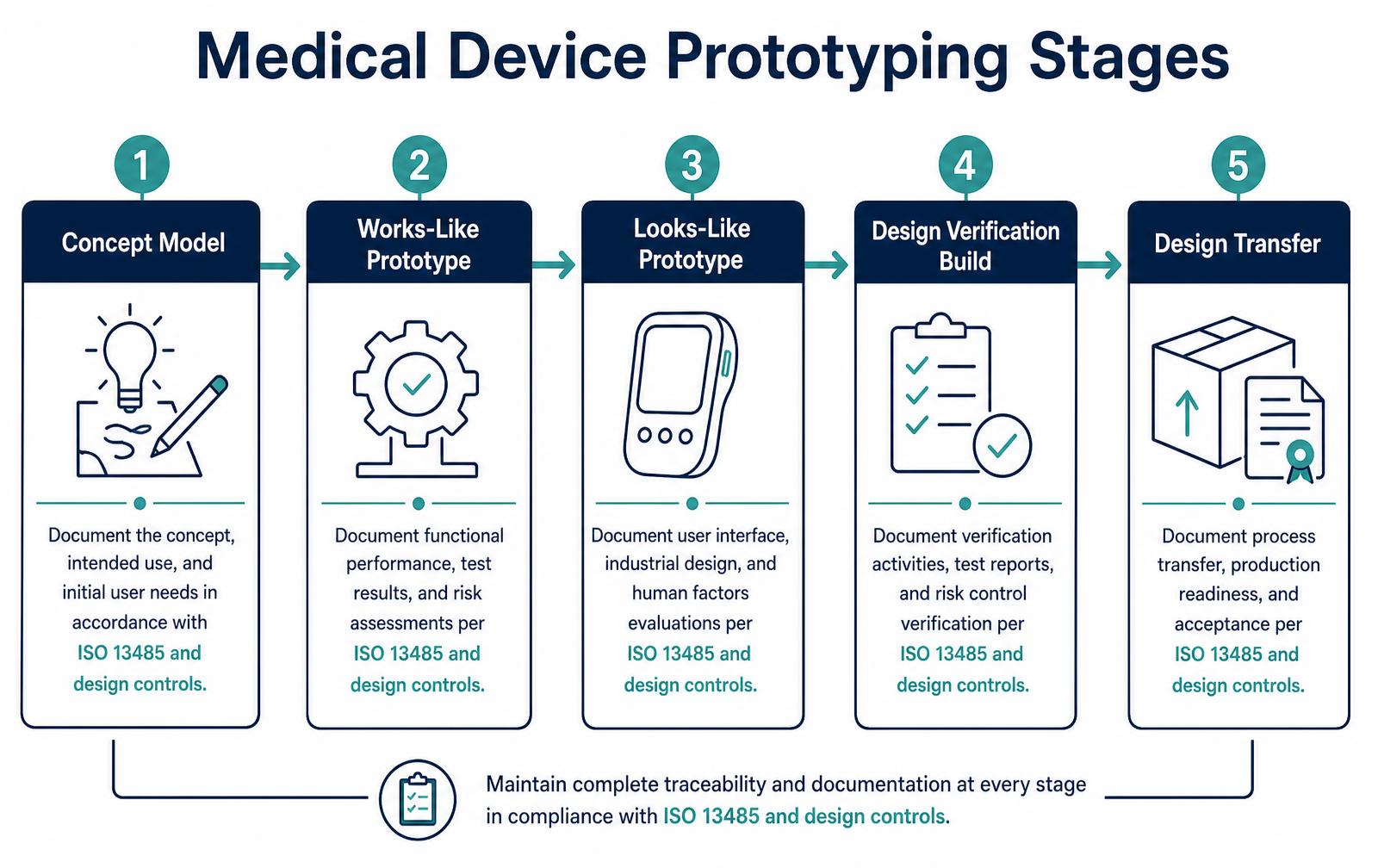
The five prototype stages
- Concept model. Cheap printed geometry used to argue about form, size and intended use with clinicians before anything is committed.
- Works-like prototype. Proves the mechanism, fluidics or electronics. Rarely looks like the product and does not have to.
- Looks-like prototype. Human factors, labeling and industrial design. This is the unit used in formative usability studies.
- Design verification build. Production-intent materials and processes, built to a controlled drawing package and used for bench, biocompatibility and electrical safety testing.
- Design transfer build. Made on production tooling and fixtures by manufacturing personnel following the released work instructions.
What medical device prototyping costs
Stage | Duration | Typical cost |
|---|---|---|
Concept models | 1-2 weeks | $2k-$8k |
Works-like prototype | 4-8 weeks | $25k-$90k |
Looks-like prototype and human factors | 3-6 weeks | $18k-$60k |
Verification build and testing | 8-16 weeks | $60k-$250k |
Biocompatibility (ISO 10993 subset) | 6-12 weeks | $15k-$60k |
Electrical safety and EMC (IEC 60601) | 4-8 weeks | $25k-$70k |
Materials and processes that survive review
Prototype materials should be chosen with the final material in mind. Printed photopolymers are excellent for form and usability work but are almost never acceptable for patient-contacting verification units.
Machined or molded medical-grade polycarbonate, PEEK, ABS, silicone and 316L stainless give you parts that can be cleaned, sterilized and tested against the same standards the production device will face.
If a prototype will touch a patient in a study, plan for a documented material with a master file, not whatever resin was loaded that week.
Function | Prototype material | Production material |
|---|---|---|
Housing | SLA resin or machined ABS | Molded PC/ABS or PC |
Patient-contact part | Machined medical PC | Molded medical-grade PC or PP |
Seal or grip | Cast urethane | LSR silicone |
Structural / surgical | Machined 6061 | Machined or MIM 316L, Ti-6Al-4V |
Sterilizable instrument | Machined PEEK | Machined PEEK or metal |
Design controls without slowing the build down
Design controls (21 CFR 820.30, ISO 13485) do not require you to stop iterating - they require you to know which build you are talking about.
In practice that means a revision-controlled drawing package per build, a risk file (ISO 14971) updated whenever the design changes, a design history file that captures why alternatives were rejected, and traceability from user needs through requirements to the test that verified each one.
Teams that start this at the works-like stage ship faster than teams that reconstruct it before submission.
Lessons from a two-week build: the UpShield
During the COVID-19 PPE shortage our team designed the UpShield, a secondary barrier worn over existing protective gear, and moved it from sketch to distributed parts in weeks.
Three things made that speed possible: a geometry deliberately designed for one manufacturing process, a material chosen for cleanability before aesthetics, and a small team that documented each revision as it printed rather than afterward. Those habits transfer directly to a regulated device program.
Verification versus validation, in practice
Verification asks whether the device meets its design inputs; validation asks whether it meets user needs in the intended environment. Teams conflate them and then discover, late, that a device passing every bench test still fails a usability study.
Plan both as separate protocols with separate acceptance criteria, separate sample sizes and separate reports. Verification can run on production-equivalent units built with production tooling; validation needs the real use environment, real users and the real labeling and instructions the customer will receive.
Activity | Question answered | Typical evidence | Typical cost |
|---|---|---|---|
Design verification | Does it meet the spec? | Bench test reports, dimensional data | $15,000-$60,000 |
Biocompatibility | Is patient contact safe? | ISO 10993 test panel | $10,000-$45,000 |
Electrical safety and EMC | Is it safe and compatible? | IEC 60601 reports | $18,000-$50,000 |
Usability / human factors | Can users use it safely? | IEC 62366 formative and summative studies | $20,000-$70,000 |
Design validation | Does it meet user needs? | Simulated or clinical use data | $25,000-$120,000 |
Design control habits that keep the file audit-ready
- Write design inputs as testable statements; a requirement you cannot measure cannot be verified.
- Maintain a live traceability matrix from input to output to verification evidence.
- Record design reviews with attendees, decisions and open actions, not just a signature.
- Freeze the configuration before verification and log every change afterward.
- Keep risk management (ISO 14971) synchronized with test results, not written at the end.
- Archive raw test data, not only summary reports.
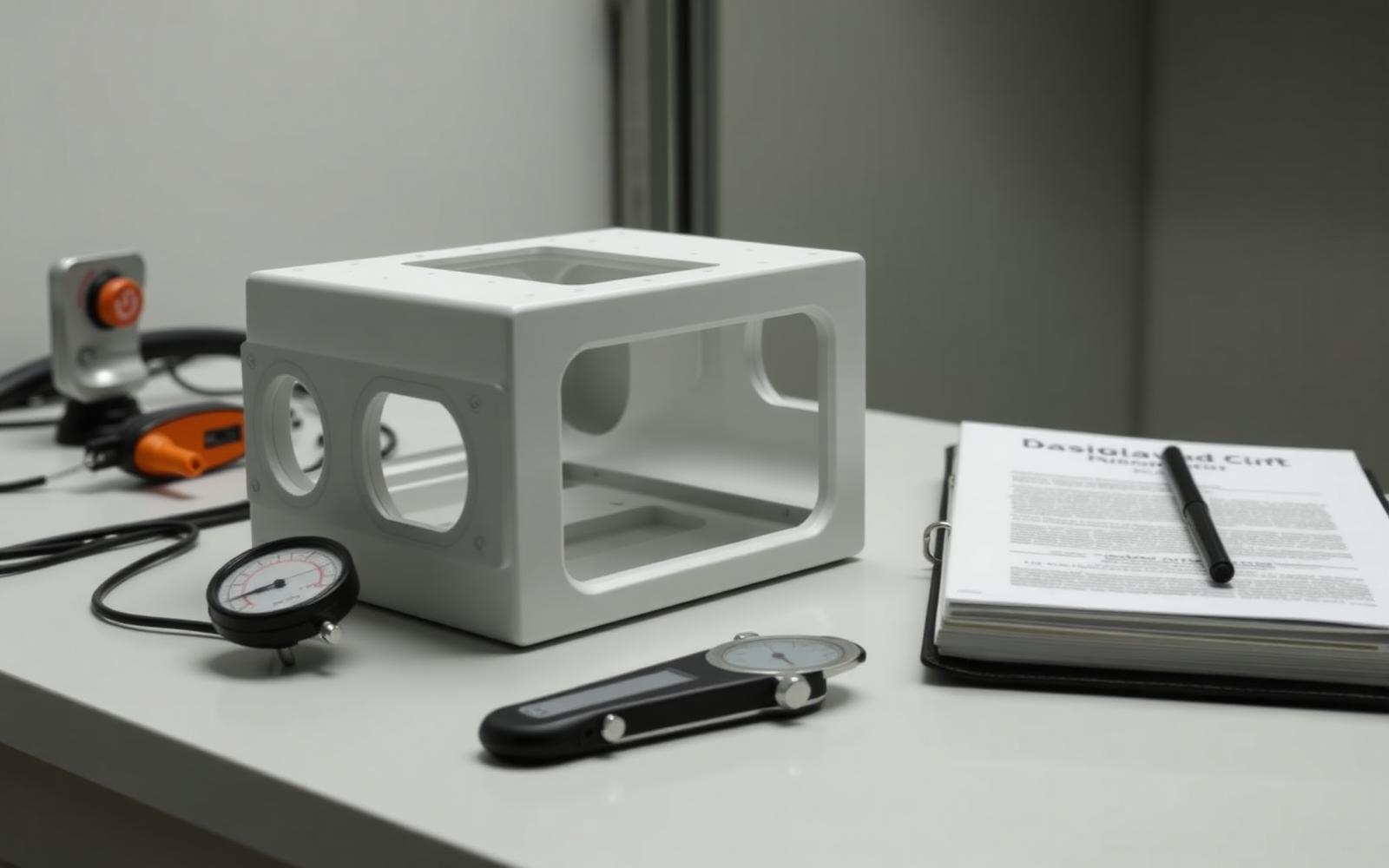
Planning verification sample sizes and timelines
Sample size is a statistics question with a schedule consequence. Attribute tests (pass/fail) with a 95% confidence and 95% reliability target need 59 consecutive passing units; variable data with a known distribution can reach the same confidence with far fewer. Choosing variable measurement wherever possible is often the single biggest lever on verification cost, because it reduces both unit count and test hours.
Build the timeline backwards from the submission date and add explicit float for retest. Laboratories quote queue time separately from test time, and a failed EMC scan usually means a design change, a new build and a new queue slot. Teams that plan a single sequential path through testing are the ones that miss dates; teams that pre-book a retest window rarely do.
Test category | Typical units required | Test duration | Retest risk |
|---|---|---|---|
Mechanical durability | 10-30 | 1-3 weeks | Medium |
Electrical safety (60601) | 3-6 | 3-6 weeks | High |
EMC emissions and immunity | 2-4 | 2-4 weeks | High |
Biocompatibility | Material coupons | 4-8 weeks | Low |
Summative usability | 15+ per user group | 2-4 weeks | Medium |
Verification and validation: different questions, different evidence
Verification asks whether you built the device to the specification. Validation asks whether the specification was the right one for the user and the use environment. Regulators expect both, documented separately, with traceability back to design inputs.
Activity | Question answered | Typical evidence | Typical duration |
|---|---|---|---|
Design verification testing | Does the output meet the input spec? | Test protocols, reports, pass/fail against acceptance criteria | 6-16 weeks |
Biocompatibility (ISO 10993) | Is patient contact safe? | Cytotoxicity, sensitization, irritation reports | 8-20 weeks |
Electrical safety and EMC (IEC 60601) | Is it safe and immune in clinical use? | Accredited lab test report | 6-12 weeks |
Software verification (IEC 62304) | Does software meet its requirements at its safety class? | Unit, integration, system test records | Parallel with design |
Usability validation (IEC 62366) | Can the intended user use it safely? | Human factors validation study with 15+ users per group | 8-14 weeks |
Design validation / clinical | Does it meet user needs in the real environment? | Simulated-use or clinical evaluation report | 10-30 weeks |
Sequence matters. Running usability validation before the design is frozen produces evidence that no longer applies to the shipped device, and repeating a human factors study is a six-figure mistake.
Planning protocols and sample sizes before you build units
The most common V&V delay is discovering, mid-test, that the sample size or the acceptance criterion was never justified. Write the plan first and have it reviewed by someone who will not run the test.
- Justify every sample size statistically. Attribute testing commonly uses 29 samples for 95/90 reliability-confidence; variable data needs far fewer, with a documented tolerance interval.
- Test production-equivalent units. Verification on prototype-tooled parts is rework waiting to happen; final tooling, final process, final supplier.
- Define acceptance criteria before running the test. Criteria written after data exists are an audit finding.
- Plan for failure. Budget one repeat cycle per major test; first-pass success on all V&V is rare.
- Keep the traceability matrix current. Every user need to a design input, every input to an output, every output to a verification record.
- Capture the DHF as you go. Reconstructing a design history file after the fact costs more than maintaining it and rarely survives an audit cleanly.
Front-loading protocol review typically adds two weeks to the schedule and removes two to four months of repeat testing later - the best return available anywhere in a device program.
Key takeaways
- Verification proves the spec; validation proves the user need.
- Traceability from input to evidence is what makes a design file auditable.
- Freeze configuration before verification and log every later change.
- Usability studies catch failures that bench testing never will.
We design, prototype and document devices under ISO 13485-aligned design controls, from concept model to verification build.
Work with LA NPDT: if you are moving from here to execution, start with our medical device development or talk to us about medical device prototyping.
Frequently asked questions
How much does a medical device prototype cost?
A concept model costs $2,000 to $8,000. A functional works-like prototype typically runs $25,000 to $90,000, and a production-intent verification build with testing reaches $60,000 to $250,000 depending on device class and electronics content.
Can 3D printed parts be used in a medical device?
Yes for concept, usability and non-patient-contacting fixtures, and increasingly for production in printed titanium and PEEK. Standard prototyping resins are generally not suitable for patient contact or sterilization without documented biocompatibility data.
When do design controls start?
Formally at design input, but practically as soon as a prototype informs a design decision. Keeping revision control and a risk file from the first functional build avoids reconstructing the design history file before submission.
Filed under:3DInspirationMediaNews
Services related to this guide
- Product design servicesIndustrial design and CAD taken all the way to manufacturable files.
- Rapid prototypingWorking prototypes in days, from 3D printing to vacuum casting.
- Electronic design servicesSchematic, PCB layout, firmware and bring-up, through to production handoff.
- Product development examplesReal projects we designed, prototyped and shipped.