
Creating Successful Marketing Strategy to Launch A New Product
A step-by-step marketing strategy for launching a new product — research, positioning, goals, channel economics, a 12-week calendar and the metrics that tell you it worked.
June 29, 20237 min read

Written by Yelena Rymbayeva, MPhil Communication & Media Studies, BTech Quality Control
Marketing & Product Leader, Technology Commercialization
Published June 29, 2023Updated September 2, 2026
Creating a Successful Marketing Strategy to Launch a New Product
A marketing strategy for a new product is the written plan that connects one specific audience, one clear promise, and the channels that reach them, to a launch date and a set of numbers you agree to measure. Build it in five steps: research the buyer, write the positioning, set the launch goals, choose two or three channels you can execute well, and instrument the results before launch day.
Most launches fail on the marketing side long before the product is at fault. The product is finished, the website goes up, and then someone asks who exactly is supposed to buy this. This guide walks through the plan in order, with the timelines, the channel economics and the metrics worth tracking — and the questions we ask every client before their product ships.
Step 1: Research the market before you write anything
You cannot write a message until you know who is receiving it. Market research for a launch does not require a six-figure study — it requires twenty conversations with people who resemble your buyer, a competitive teardown, and honest pricing comparison.
- Who has this problem badly enough to pay? Name a segment narrow enough to reach with a single ad set.
- What do they use today? The alternative is usually a competitor, a workaround, or doing nothing — plan against all three.
- Where do they already look for answers? That list becomes your channel shortlist.
- What price feels obvious to them? Price resistance discovered after launch is expensive to fix.
- What would make them tell someone else? That sentence is usually your positioning.
This is the same groundwork our product discovery process covers before engineering starts. If you skipped it during development, do it now — it is cheaper than a launch aimed at nobody.
Step 2: Write positioning that survives a hallway test
Positioning is one sentence: for [audience] who [problem], [product] is the [category] that [unique benefit], unlike [alternative]. If a stranger cannot repeat the gist after hearing it once, it is not ready.
Weak claim | Why it fails | Stronger version |
|---|---|---|
Innovative, high-quality design | Every competitor says it | Fits in a standard cup holder, unlike every other cooler this size |
Made for busy professionals | Not a segment, a mood | Made for nurses working 12-hour shifts |
The best value on the market | Invites price comparison | Half the cost per use of disposable alternatives |
Powered by advanced technology | Feature, not benefit | Reads accurately in one second instead of thirty |

Step 3: Set launch goals you can actually count
"Build awareness" is not a goal. Pick numbers with dates attached, and decide in advance what result means keep going, adjust, or stop.
Goal type | Example target | How it is measured |
|---|---|---|
Demand signal (pre-launch) | 2,000 waitlist emails in 8 weeks | Signup form conversions |
Launch-week revenue | 300 units in the first 14 days | Store orders |
Acquisition efficiency | Customer acquisition cost under $28 | Ad spend divided by new customers |
Proof | 50 verified reviews in 60 days | Review platform count |
Retention | 30% repeat purchase within 90 days | Cohort report |
Step 4: Choose channels you can execute, not all of them
A first launch run by a small team can execute two or three channels properly. Five channels run badly beats none, but loses to two run well.
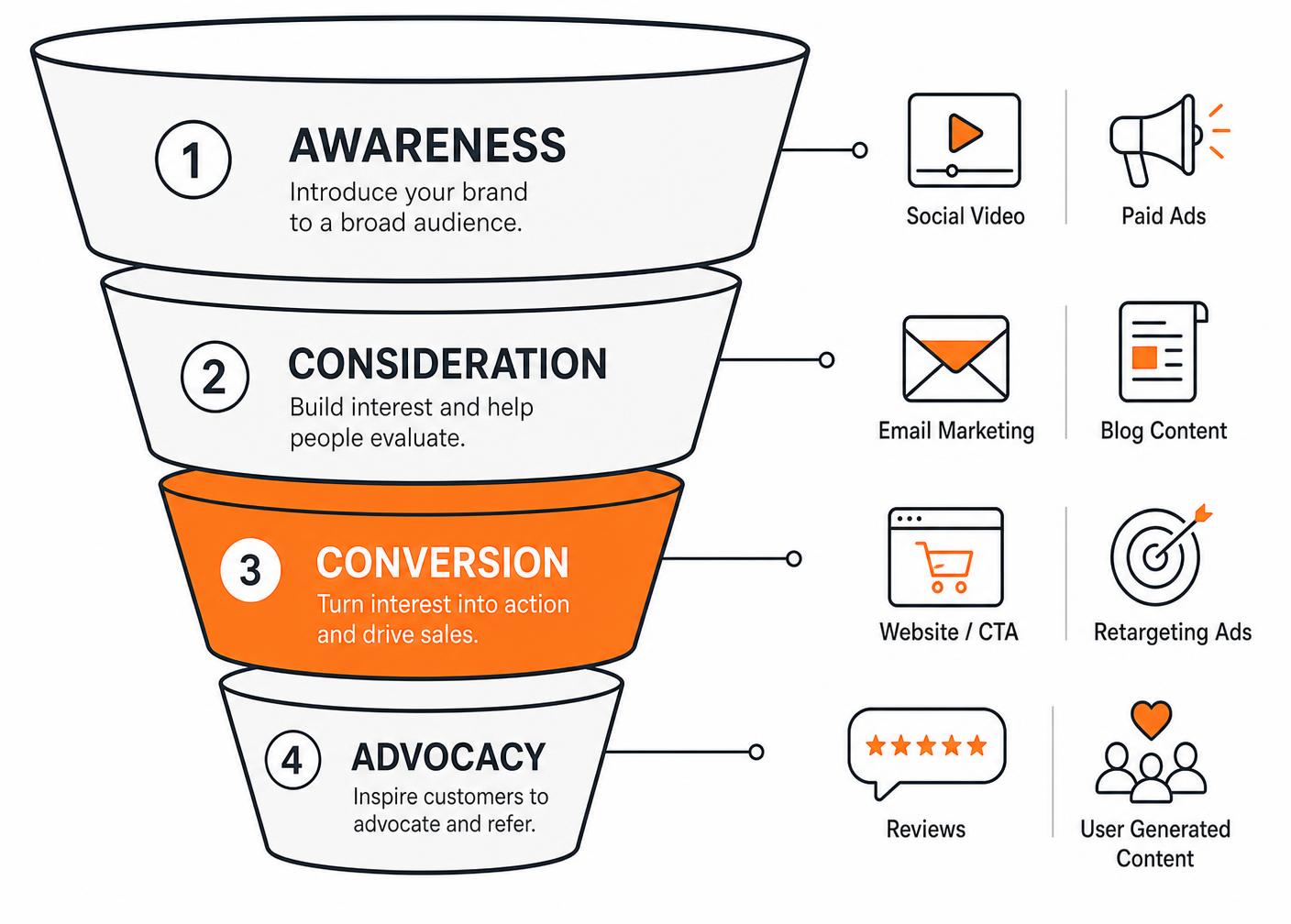
Channel | Best for | Realistic lead time | Watch out for |
|---|---|---|---|
Short-form social video | Awareness for visual consumer products | 2-4 weeks of content build | Volume required; one video is not a channel |
Email / waitlist | Converting people who already care | Start 8-12 weeks pre-launch | Nothing to send if you start late |
Creator partnerships | Trust and demonstration | 4-8 weeks to book and ship samples | Audience fit matters more than follower count |
Paid search | Capturing existing demand | 1-2 weeks | Only works if people search for the category |
Paid social | Scaling a proven message | 2 weeks after creative exists | Burns budget fast without tested creative |
PR and media | Credibility and backlinks | 6-10 weeks of lead time | Journalists need the story before launch, not after |
SEO and content | Compounding demand | 3-9 months to results | Not a launch channel; start it anyway |
Retail and marketplace | Distribution and discovery | 3-6 months for buyer cycles | Margin, packaging and MOQ requirements |
Awareness is the easy half. Most launch budgets die producing attention that had nowhere to convert.
Step 5: Build the launch calendar backwards from the ship date
Timing | What happens |
|---|---|
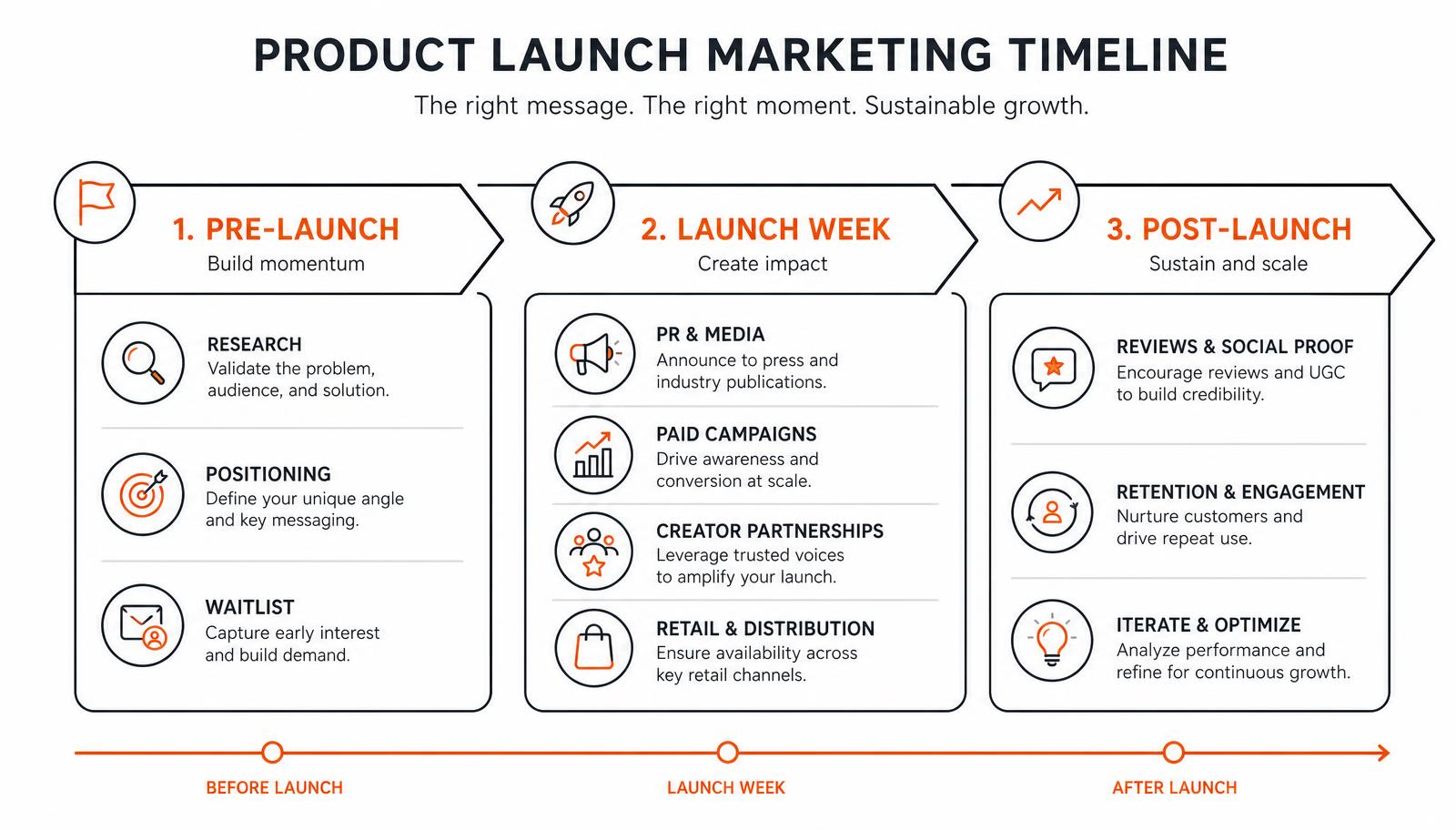
12 weeks out | Positioning locked, photography and video planned, press list built |
8 weeks out | Waitlist live, content production begins, creator outreach starts |
6 weeks out | Media embargoed pitches sent, packaging and listings finalized |
4 weeks out | Landing page, analytics, email flows and ad accounts tested end to end |
2 weeks out | Teaser content, creator samples shipped, retail assets delivered |
Launch week | Announcement, PR, paid switched on, daily metric review |
Weeks 2-8 | Review generation, retargeting, message testing, first iteration |
Measure the right things after launch
- Conversion rate by channel, not just traffic — traffic that never buys is a cost, not a result.
- Cost per acquired customer versus first-order margin. If acquisition costs more than the margin, scale nothing until the message improves.
- Message-level results. Test claims against each other; the winning claim usually belongs on the packaging too.
- Review velocity and sentiment. Early reviews shape every later buyer's decision.
- Repeat purchase and referral. The number that decides whether the business exists in year two.
The U.S. Small Business Administration marketing guide is a solid free reference for structuring the budget side of this, especially for first-time founders.
Five mistakes that sink new product launches
- Starting marketing after the product is finished. Demand takes as long to build as tooling does.
- Talking to everyone. A message aimed at the whole market persuades nobody in it.
- Leading with features. Buyers purchase outcomes; specifications only justify the decision afterwards.
- No proof. Reviews, demonstrations and third-party validation do more than adjectives.
- One-day thinking. A launch is a quarter, not a Tuesday. Budget for the eight weeks after the announcement.
Frequently asked questions
What are the marketing strategies for launching a new product?
The core strategies are audience research, clear positioning against a named alternative, a pre-launch waitlist, creator or influencer proof, PR with a real story angle, paid acquisition once the message is tested, and a review-generation plan for the first 60 days. Choose two or three you can execute well rather than attempting all of them.
What are the 4 Ps of product marketing?
Product, price, place and promotion — E. Jerome McCarthy's 1960 framework. Product is what you sell and how it is differentiated, price is the amount and the model, place is where it is bought, and promotion is how buyers learn about it. Launch plans that fail usually did all of their thinking in the promotion box.
How long before launch should marketing start?
Twelve weeks minimum for a consumer product, and earlier if PR or retail buyers are involved, since both work on long lead cycles. Waitlist building should start eight to twelve weeks out so launch week has an audience to announce to rather than an empty inbox.
How much should a new product launch budget be?
A common working range for a first consumer product is 10-20% of projected first-year revenue, weighted heavily toward the launch quarter. Smaller launches can start at a few thousand dollars in paid testing plus content production, provided the positioning is sharp enough that the ads do not have to work miracles.
How do I know if my launch worked?
Compare acquisition cost against first-order margin, and repeat-purchase rate at 90 days against your plan. Launch-week revenue is a headline; those two numbers tell you whether the product has a business behind it.
Where to go from here
A marketing strategy is only as strong as the product definition underneath it. If the positioning work above surfaces questions you cannot answer — who exactly this is for, what it beats, what it should cost — those are development questions, not marketing ones. Our product development consulting team works through them with founders before launch budgets get spent.
Budgeting a product launch marketing strategy
A product launch marketing strategy without a budget allocation is a wish list. Splitting the budget across the phases of a launch — and holding some back — is what separates campaigns that can respond to early signals from those that spend everything in week one and go quiet.
Suggested budget allocation
Phase | Share of budget | Primary purpose |
|---|---|---|
Pre-launch content and assets | 20% | Photography, video, site, messaging |
Audience building | 15% | Email list, community, early access |
Launch window paid media | 25% | Concentrated visibility |
Reviews and seeding | 10% | Third-party credibility |
Sustained post-launch | 20% | Compounding demand after the spike |
Reserve | 10% | Respond to what actually works |
Hold the reserve deliberately. The most valuable information in a launch arrives in the first two weeks, and the teams that win are the ones with budget left to double down on the channel that unexpectedly worked.
Launch budget checklist
- Allocate by phase before committing to any channel.
- Keep a reserve of at least ten percent unallocated.
- Track cost per acquisition by channel from day one.
- Budget for sustained spend, not just the launch spike.
- Set a kill rule for channels that underperform after a fair test.
Key takeaways
- Allocate launch budget by phase, not by channel enthusiasm.
- Hold a reserve to amplify whatever unexpectedly works.
- Plan sustained post-launch spend; the spike alone does not build a business.
A 12-week marketing plan for a new product launch
A marketing plan for a new product launch is a calendar with owners attached, not a slide of tactics. Twelve weeks is the shortest window in which a small team can build assets, seed an audience and still hold a reserve for what the first week teaches. Anything shorter and the launch becomes an announcement to people who have never heard of the product.
Week | Focus | Owner | Done means |
|---|---|---|---|
12-10 | Audience research and positioning lock | Founder | One-sentence positioning approved, one named alternative |
9-7 | Asset production: photography, video, landing page | Marketing | Page live behind a waitlist form |
6-4 | Audience seeding: email list, community, press outreach | Marketing | 500+ waitlist signups, 10 press contacts warmed |
3-1 | Retail and fulfillment readiness, paid campaign staged | Ops | Inventory confirmed, ads approved but paused |
0 | Launch week execution | All | Send, publish, monitor daily |
+1 to +4 | Read results and reallocate the reserve | Founder | Cost per order and conversion rate by channel known |
Launch readiness checklist
- Positioning sentence written, tested on five strangers, and unchanged for two weeks.
- Landing page live with a working email capture and analytics verified.
- Product photography and at least one 30-second demo video completed.
- Inventory quantity and replenishment lead time confirmed in writing.
- Shipping costs, returns policy and support inbox live before launch day.
- Two channels chosen and staffed; everything else deliberately deferred.
- At least ten percent of the budget unspent and reserved for week two.
The reserve matters more than the plan. Launch week produces the only real data the team has ever had about which message converts and which channel pays. A plan that has spent every dollar by day three cannot act on it, which is how good products end up with a mediocre first quarter.
Key takeaways
- Start the launch plan twelve weeks before ship, not after.
- Each phase needs an owner and a binary completion test.
- Two well-run channels outperform five half-run ones.
- Hold a reserve so week-one results can change the spend.
More questions about launch planning
Frequently asked questions
What belongs in a marketing plan for a new product launch?
Six things: a named audience, a positioning sentence measured against one specific alternative, countable goals with dates, two channels the team can genuinely staff, a twelve-week calendar with owners, and a budget split by phase with a reserve. Anything beyond those six is usually decoration, and anything missing from them tends to surface as a problem in launch week.
How early should a waitlist open?
Six to eight weeks before ship, once photography exists and the landing page can explain the product without an apology. Opening earlier collects addresses that go cold; opening later leaves no time to learn which message drives signups, which is the cheapest test available before spending on paid media.
What should the launch-week reserve be spent on?
Whatever the first seven days prove works. In practice that is usually more spend behind the single channel with the lowest cost per order, a second round of the creative that outperformed, or restocking inventory on the variant that sold out. Deciding in advance what the reserve is for defeats the purpose of holding it. Work with LA NPDT: if you are moving from here to execution, start with our new product marketing or talk to us about market research .
Filed under:EducationInspirationWords
Services related to this guide
- Product design servicesIndustrial design and CAD taken all the way to manufacturable files.
- Rapid prototypingWorking prototypes in days, from 3D printing to vacuum casting.
- Electronic design servicesSchematic, PCB layout, firmware and bring-up, through to production handoff.
- Product development examplesReal projects we designed, prototyped and shipped.