Product Discovery Workshop: Agenda, Deliverables and Costs
How product discovery turns an idea into a validated, buildable concept - the four phases, their deliverables, and what a discovery engagement costs.
May 17, 20225 min read

Written by Konstantin Dolgan, Ph.D., NPDP
Founder & CEO, Product Development Engineer
Published May 17, 2022Updated September 2, 2026
Product Discovery Process: Steps, Deliverables and Costs
Most failed hardware products were engineered flawlessly - they simply answered a question nobody was asking. The product discovery process exists to find that out in weeks and for thousands of dollars, instead of in a year and for hundreds of thousands. It ends with a concept you can cost, build and sell, plus written evidence of why it is the right one.
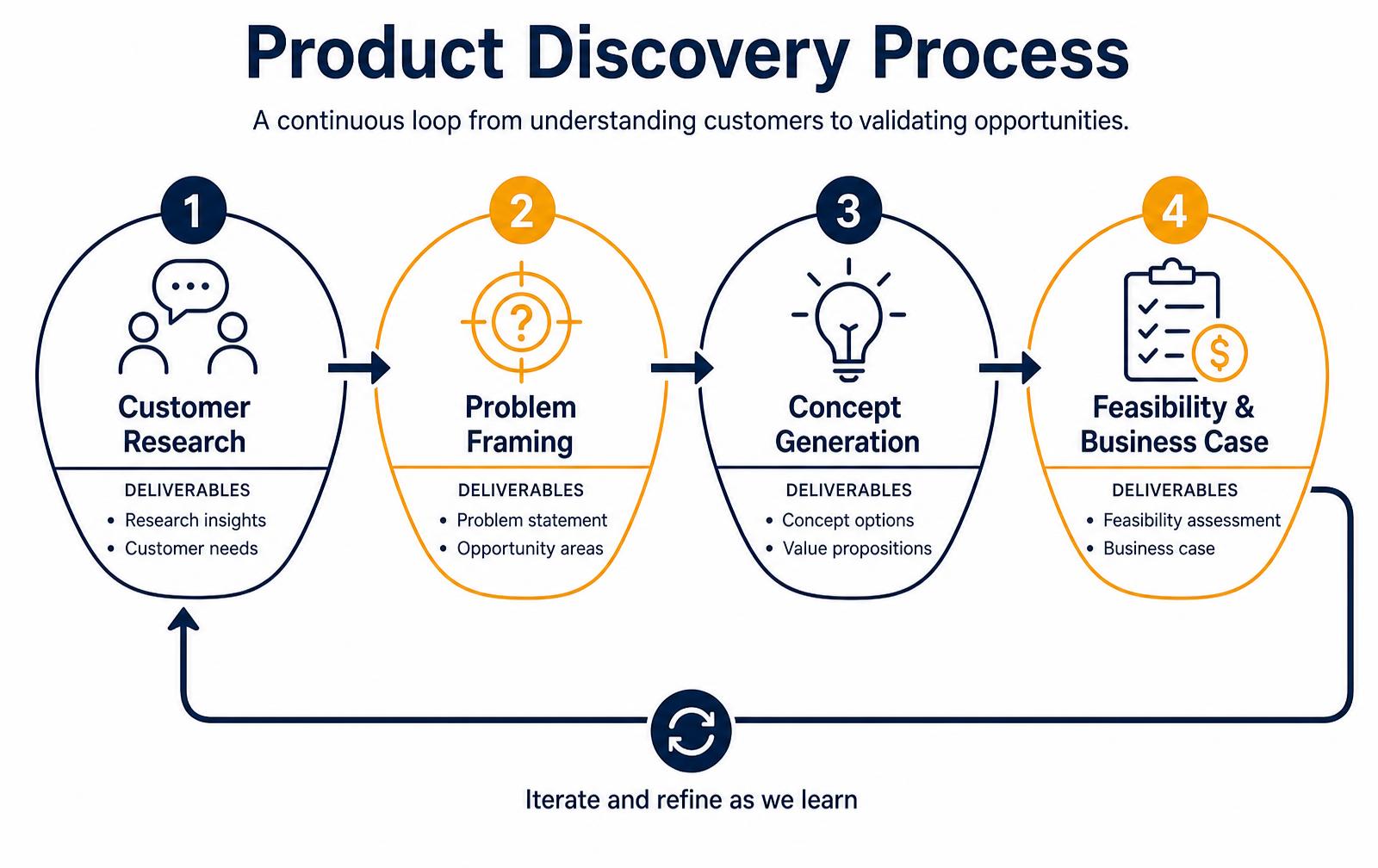
Phase 1: Customer research
Discovery starts with people, not CAD. Fifteen to twenty structured interviews with the actual buyer and the actual user surface the workarounds they already use, what they pay today, and which frustrations they will not tolerate.
When a musician told us their gear failed on the third night of a tour, that single detail reframed the whole product from a feature question into a durability question. Pair interviews with observation - what people do rarely matches what they say.
Phase 2: Problem framing
Research output becomes a written problem statement: who has the problem, how often, what it costs them, and what a good outcome looks like in measurable terms. This is also where you set the constraints that will govern every later decision - target price, size envelope, regulatory environment, distribution channel.
A frame that says touring musicians need a mic mount that survives 200 setups a year and retails under $80 is engineerable. A better mic mount is not.
Phase 3: Concept generation
- Generate 15-30 rough concepts before evaluating any of them - quantity first, judgment second.
- Cluster them into three or four genuinely different approaches, not four versions of the same idea.
- Sketch, block model or print the top concepts so people react to objects rather than descriptions.
- Score against the frame: cost, feasibility, differentiation, IP position and channel fit.
- Kill concepts explicitly and write down why - that record prevents relitigating the same debate in month six.
Phase 4: Feasibility and business case
The last phase makes the surviving concept accountable to arithmetic: a preliminary bill of materials, a manufacturing route with realistic tooling costs, a landed cost estimate, a retail price with channel margin, and a break-even quantity. If those numbers do not close, the time to know is now - either the concept changes, the price changes, or the program stops before the expensive part begins.
Phase | Duration | Deliverables | Typical cost |
|---|---|---|---|
Customer research | 2-3 weeks | Interview findings, personas, competitive teardown | $6k-$18k |
Problem framing | 1 week | Problem statement, requirements, constraints | $3k-$8k |
Concept generation | 2-3 weeks | Concept set, sketch models, selection matrix | $8k-$25k |
Feasibility and business case | 2-3 weeks | Preliminary BOM, manufacturing plan, cost model | $8k-$22k |
What discovery should leave you with
- A validated problem statement backed by named interviews, not assumptions.
- One selected concept plus the documented reasons the alternatives lost.
- A preliminary BOM and landed-cost estimate accurate within roughly 25%.
- A manufacturing route and tooling budget for the chosen concept.
- A prioritized risk list naming what could still kill the program.
- A development plan and budget for the engineering phase that follows.
Related reading: our product discovery service and how to size a market with TAM, SAM and SOM.
Frequently asked questions
What is the product discovery process?
Product discovery is the structured phase before engineering in which a team researches customers, frames the problem, generates and screens concepts, and validates feasibility and business viability - producing a selected concept with a preliminary cost model.
How long does product discovery take?
A focused hardware discovery engagement runs six to ten weeks. Simple accessories can compress to three or four weeks; regulated or multi-stakeholder products often need twelve.
How much does product discovery cost?
Most discovery engagements fall between $25,000 and $70,000 depending on research depth and the number of concepts carried into feasibility - typically 5 to 10 percent of the total development budget.
Interviews that produce evidence, not encouragement
Discovery fails quietly when interviews collect enthusiasm instead of behaviour. People are generous about hypothetical products and unreliable about hypothetical purchases. Structure the conversation around what the person did last time they faced the problem — what they bought, what it cost, what they improvised — and the answers become usable evidence.
Ask this | Not this | Why it matters |
|---|---|---|
Walk me through the last time this happened. | Would you use a product that… | Recalled behaviour beats predicted behaviour |
What did you do instead? | Do you like this idea? | The workaround defines the real competitor |
What did that cost you in time or money? | How much would you pay? | Cost of the status quo anchors value |
Who else had to approve it? | Are you the decision maker? | Reveals the real buying unit |
What made you stop looking for a solution? | What features do you want? | Surfaces the abandonment trigger |
Fifteen to twenty interviews with the actual buyer and the actual user — often different people — is usually enough to reach saturation, the point where new conversations stop producing new problem statements. If interview twenty is still surprising you, the segment is too broad.
Sizing the opportunity without a spreadsheet fantasy
Top-down market numbers pulled from industry reports are almost never decision-grade. Build the estimate from the bottom: a countable number of buyers, a defensible attach rate, a price you have evidence for, and a replacement cycle. Then state the assumption that, if wrong, breaks the case — because that is the assumption discovery should test next.
Input | Where the number comes from | Sanity check |
|---|---|---|
Reachable buyers | Trade association counts, licence registries, distributor lists | Can you name 20 of them? |
Attach rate | Comparable product adoption, interview intent discounted 3-5x | Would you bet on it at half the value? |
Price point | Cost of the workaround, competitor pricing, interview reactions | Does gross margin clear 45% at that price? |
Replacement cycle | Wear data, consumable rate, category norms | Does the model survive a 2x longer cycle? |
Channel cost | Distributor margin, marketplace fees, CAC estimates | Is there margin left for the channel? |
Screening concepts with a matrix you actually weight
Concept screening degenerates into advocacy unless the criteria and their weights are fixed before scoring. Score against the reference — usually the current workaround — and require the winning concept to beat it decisively on the two criteria you weighted highest, not to win narrowly on the average.
Criterion | Suggested weight | Score 1 | Score 5 |
|---|---|---|---|
Solves the validated problem | 30% | Partially, with training | Completely, unaided |
Technical feasibility with known technology | 20% | Requires research | Off-the-shelf components |
Landed cost vs. target | 20% | Over target by 50%+ | At or under target |
Regulatory and certification path | 15% | Novel, unclear route | Well-trodden, self-certifiable |
Differentiation and defensibility | 15% | Easily copied | Protected or hard to replicate |
Feasibility gates and kill criteria
The purpose of discovery is not to approve the product; it is to make the decision cheap. Define the kill criteria in writing at kickoff, when nobody is emotionally invested, and hold to them. A discovery that never kills anything is a formality, and the organisation learns to treat it as one.
Gate | Question | Kill if | Typical spend to reach it |
|---|---|---|---|
Problem | Is the problem frequent and costly? | Under a third of interviewees recall a recent instance | $8k-$15k |
Solution | Does a concept beat the workaround decisively? | No concept clears the reference on weighted score | $10k-$25k |
Technical | Can it be built with known technology? | Core function needs unproven research | $10k-$30k |
Economic | Does the unit economics work at realistic volume? | Gross margin under 35% at forecast volume | $5k-$15k |
Regulatory | Is the compliance path affordable? | Certification exceeds the first-year margin pool | $3k-$10k |
What a discovery report should contain
- A one-page problem statement naming the segment, the frequency and the cost of the status quo.
- Interview evidence — anonymised quotes tied to claims, not a summary of impressions.
- A bottom-up opportunity model with every assumption exposed and the fragile one flagged.
- Three evaluated concepts with the screening matrix and the reasoning behind the weights.
- A preliminary bill of materials with cost ranges and the parts that carry the most uncertainty.
- A regulatory scope note listing applicable standards, likely test costs and timelines.
- A development plan with a phased budget and the decision points where it can be stopped.
- An explicit recommendation: proceed, proceed with a narrowed scope, or stop — with the reason.
Common ways discovery gets wasted
The most expensive discovery failure is a good report that changes nothing because the decision had already been made. The second most expensive is research done by the people who will build the product, since it is difficult to disprove a concept you have already begun designing. Separate the roles, or at least separate the sessions.
- Interviewing enthusiasts and early adopters exclusively — they forgive problems the mainstream buyer will not.
- Showing a concept in the first ten minutes, which converts the interview from research into a sales pitch.
- Confusing feature requests with problem statements; users describe solutions when asked about needs.
- Skipping the buyer when the buyer is not the user — a decisive failure in B2B and clinical products.
- Treating the report as the deliverable rather than the decision it enables.
More questions teams ask
Frequently asked questions
Can discovery run in parallel with early engineering?
Partially. Feasibility spikes and long-lead technical de-risking can run alongside customer research, and often should. What cannot run in parallel is detailed design, because it converts open questions into sunk cost before the evidence arrives.
How do we know when to stop interviewing?
When two or three consecutive interviews produce no new problem statements, no new workarounds and no new purchase criteria. That saturation point usually arrives between interview twelve and twenty for a well-defined segment.
What if we cannot get access to the target users?
Access difficulty is itself a finding — it usually predicts an equally difficult sales motion. Route around it with distributors, trade groups, service technicians and recruitment panels, but treat a segment you cannot reach for research as a segment you cannot reach for revenue.
Does discovery apply to a product we already sell?
Yes, and it is often cheaper and more accurate, because you can interview real customers about real behaviour and validate against sales and warranty data instead of estimates. Work with LA NPDT: if you are moving from here to execution, start with our our product development process or talk to us about end-to-end product development .
Filed under:InspirationWords
Services related to this guide
- Product design servicesIndustrial design and CAD taken all the way to manufacturable files.
- Rapid prototypingWorking prototypes in days, from 3D printing to vacuum casting.
- Electronic design servicesSchematic, PCB layout, firmware and bring-up, through to production handoff.
- Product development examplesReal projects we designed, prototyped and shipped.