Importance of Developing Products During a Recession
A recession is a tough and challenging time for any business. Developing products might be a solution to staying busy.
November 24, 20228 min read

Written by Konstantin Dolgan, Ph.D., NPDP
Founder & CEO, Product Development Engineer
Published November 24, 2022Updated September 2, 2026
Recession is toughest on small companies. According to Investopedia, while small and large businesses face the same recession risks, the lack of scale makes small businesses more vulnerable. Investopedia offers more details on the impact of recessions on businesses in the article and the effects on developing products.
Therefore, small businesses have to be precise in handling recession. Instead of waiting till after the recession, every business ought to grow during the recession. It is time to invest in your business and start implementing new ideas.
That is why this article will show you several important details about the recession. Also, you will find the importance of product develpoment during the recession. Lastly, you will find some Product develpoment essentials your business can use.
What is Recession
How Does It Affect Businesses During a Recession?
A recession is considered a prolonged economic shrinkage. It is often marked by successive quarterly declines in GDP. It is the period when there is lesser demand for products and product developmen.
To match declining demand, most businesses lay off their staff to cut down their cost of production. Alternatively, companies move to reduce the wages of their employees. Manufacturing companies could even close down their plans and discontinue poorly performing products.
Another major effect of recession is that it stifles product innovation. Again, the reason is that there is reduced access to credit. Hence, credit constraints may hamper marketing strategies.
Most businesses do not consider that such a time is best for investing. For instance, companies that do not lay off their employees during a recession benefit the most. They tend to perform better after the recession’s downturn ends.
In summary, a recession shows that some things are broken in the economy. Also, it encourages some businesses to fix broken pieces in their system.
Why you should develop new products
during the Recession
Innovation is vital to success in business. Therefore, developing new products is the best way to ride out the recession.
Bill Hewlett, one of HP’s founders, once remarked on innovation during hard times. He said investing in new product innovation and expanding the product catalog is one of the most difficult things to do during hard times but also the most important.
New products are called the lifeblood of a company. Hence, the time a patient needs more blood is not when they are healthy. Instead, there should be a lifeblood supply when there is a continued economic downtrend, as often seen in surgery.
It is a fact that people spend less during the recession. Hence, most companies would decide it is not worth innovating during these bad times. However, such decisions help separate recession winners from losers or weak from the strong.
What do others say?
According to McKinsey, a firm dedicated to accelerating sustainable and inclusive growth, investing in innovation is good for a company. Historically, companies that innovate during a recession outperform their counterparts by more than 30% during recovery. The COVID-19 recession was used as a case study in the article.
Companies that adjust to market conditions during a recession may not find the opportunity to survive. In fact, they will lose ways to position themselves for great success.
For instance, continuing to innovate helps a company find a way to introduce more economical solutions to their customers. Also, they can maintain or even grow their market share.
In addition, these companies have a good probability of coming up with reusable substitutes for their disposable products. Such businesses can also develop new distribution channels. With new business models, they can even develop radical innovations that will make other products in the market obsolete.
Another importance of developing a new product during a recession is that it can be a source of funding. There are a lot of grants available for companies developing new products. Hence, it makes raising funding from angel investors and venture capitalists simpler.
Recession is a great time to engage your team and keep them motivated. By picking a new product to develop, you make it less possible for your team to be demotivated. Instead, they will feel more purposeful and motivated to do more for your company.
Recessions do not last long and are always followed by longer periods of growth and prosperity. Hence, it is a good time to position your business for success. The bigger the risk, the bigger the potential rewards.
Essentials for Product Development During Recession
Every idea has to satisfy the customer’s most pressing needs. Because a recession is marked by low cash flow, activating consumer-centric innovation plans is essential.
The first innovation essential is accepting the importance of an idea ladened business model. Hence, innovating has to be your survival tactic for business growth and helping customers.
Then, you have to find market and technology insight offering the best value proposition. This value proposition is what distinguishes your business from existing alternatives.
Lastly, it would be best if you used a product develipment model with scalable profit sources and rewards for your people. A good product development approach is to capitalize on external networks and rapid prototy.
Hottest Questions on the Importance of Developing Products During Recession
Find below some of the regularly asked questions about innovating during the recession.
How can a business be recession-proof?
Capital is the first means of making a business recession-proof. And it would be best if you secured this capital before it is needed. Also, you have to prioritize customer service and provide their most pressing needs.
What should small businesses do in a recession?
Small businesses should build an agile workforce during a recession. This agile workforce must prioritize innovation and creativity. Hence, small businesses should prioritize product develpoment.
What would you take advantage of during a recession?
It would be best if you took advantage of lowering your average cost. Cost is the biggest hindrance to demand during a recession. It would also help if you watched out for lower interest rates that you can use to fund your innovations.
What is meant by rapid prototyping?
Prototyping is the proof-of-concept during the product development process. And there are four prototyping methods: parallel, competitive, iterative, and rapid. Now, rapid prototy is a quick fabrication from CAD design without manufacturing processes.
Conclusion
Recession is a key part of every economy. For instance, it balances everyday costs. High unemployment makes companies increase their prices, and high unemployment also reduces prices.
Furthermore, you can be one of the few beneficiaries of the recession. What you need to stay ahead of the curve is product developmen. It is the lifeblood of every company.
In addition, you need innovation to motivate your employees. New engagement and rewards make employees better inspired to work.
LA NPDT is a prototyping company focused on transforming product ideas into business ventures. We have a cross-functional team of engineers, designers, marketers, and manufacturing specialists.
Some of our services include optimizing product designs for manufacturing, creating marketing materials (packaging, websites, renderings), and more. Contact us today on our website Lanpdt: schedule consultation la npdt or call directly at 318-243-5789.
Product Development During a Recession
Strategy | Benefit |
|---|---|
Invest in innovation | Outperform counterparts by over 30% during recovery |
Introduce economical solutions | Maintain or grow market share |
Develop reusable substitutes | Address new market needs |
Create new distribution channels | Expand market reach |
Engage team with new projects | Keep employees motivated and purposeful |
What makes a product recession proof
Recession proof products share one trait: the buyer treats them as a cost of operating rather than a discretionary purchase. That covers replacement parts, consumables tied to installed equipment, products that lower an operating cost with a payback under twelve months, safety and compliance items, and repair-oriented goods. Everything else — premium, aspirational, upgrade-cycle categories — compresses hard and recovers late.
This is a design constraint, not a marketing angle. If the product is being developed into a downturn, the value proposition has to be arithmetic the buyer can do in one line: this replaces a $40/month expense, or this avoids a $3,000 failure.
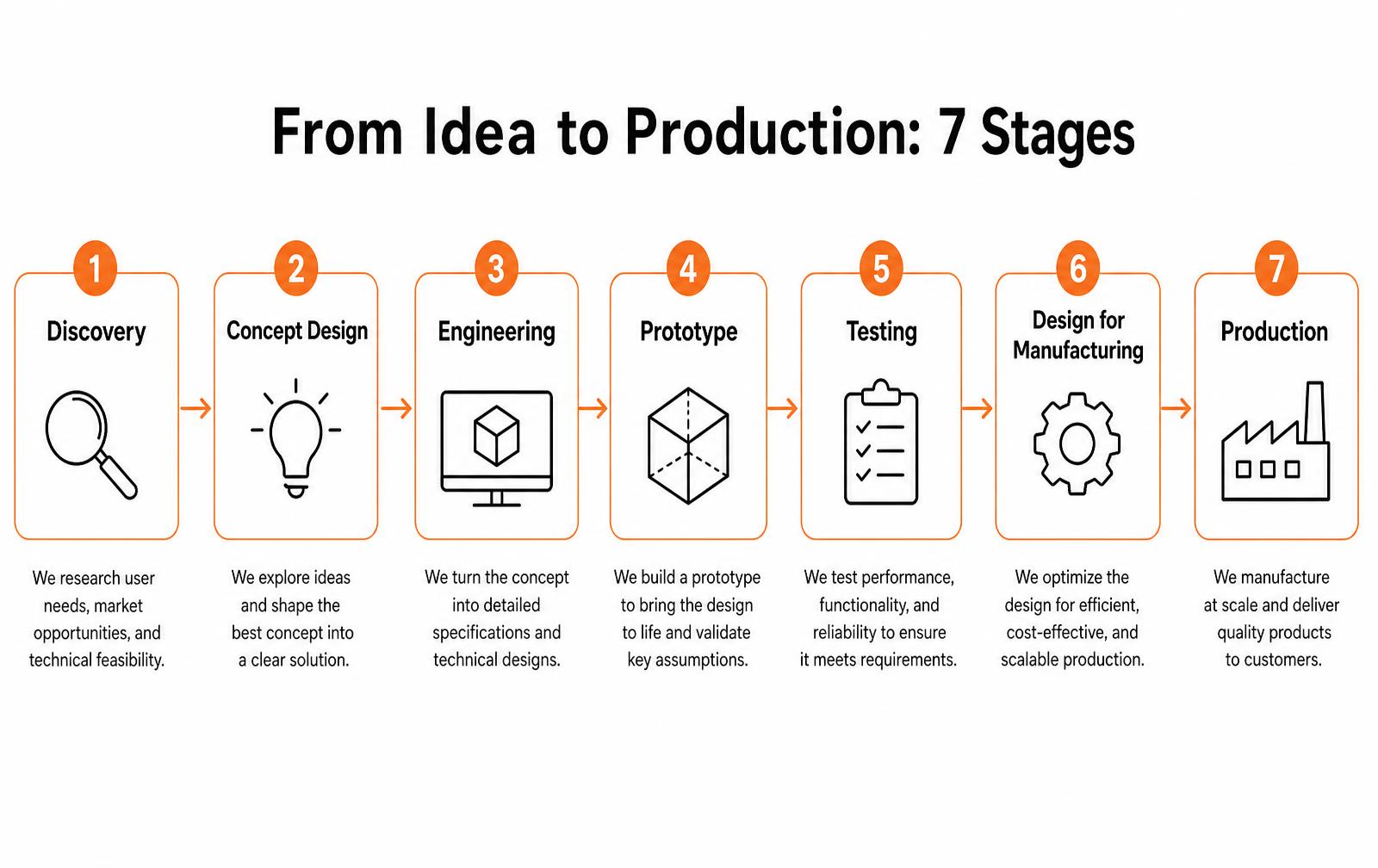
Products whose justification requires a story about lifestyle will be deferred. Framing that arithmetic is part of requirements work, which is why we push it into the front half of the product development process rather than into the launch brief.
Which categories hold up, and what to change in each
Category | Downturn demand | Design implication | Pricing move |
|---|---|---|---|
Consumables and replacement parts | Stable to up | Protect compatibility; never orphan the installed base | Hold price, add multi-pack |
Cost-reduction equipment | Up, with longer sales cycle | Instrument the payback; make savings measurable | Lead with payback period, not price |
Safety and compliance products | Stable | Certification is the moat — budget for it properly | Hold price; bundle documentation |
Repair, service and retrofit kits | Up | Design for field service and partial replacement | Tiered kits by failure mode |
Premium discretionary goods | Down 20-40% | Cut variants; delay tooling for the halo model | Introduce a stripped entry SKU |
Capital equipment | Down, decisions deferred | Modularity so buyers can start small | Offer subscription or staged purchase |
How to restructure a development budget without stopping
The instinct in a downturn is to halt development. The evidence runs the other way: firms that keep investing through a contraction consistently outgrow their peers through the recovery, because launch slots open up as competitors go quiet and engineering capacity gets cheaper. The realistic move is not to spend the same money, but to spend it in smaller, reversible increments — shorter phases, harder gates, more prototypes and less tooling.
- Shorten gates from quarterly to monthly so a bad program dies after $30k rather than $300k.
- Move spend from tooling to prototypes: soft tooling or CNC-machined parts for the first 200-500 units buys market evidence before steel.
- Kill variants early. Three SKUs at launch triples tooling and inventory for a market that is buying one.
- Requote the BOM every quarter; component pricing and lead times move faster in a downturn than in a stable market.
- Prioritize programs with a payback story for the buyer, and defer programs justified by aspiration.
- Use fixed-scope external engagements instead of headcount so cost tracks the program rather than the calendar.
- Hold a cash reserve equal to one tooling round; the most common downturn failure is running out of money between tooling and first shipment.
The timing argument is the strongest one. Hardware programs take nine to eighteen months from concept to shipment, which means a program started in the trough ships into the recovery — with a clear field, because the companies that paused are still in concept when demand returns.
Companies that treat downturns as build windows tend to enter recovery with a launched product and a tooled supply chain, and the gap is very hard for a late competitor to close.
If capacity rather than conviction is the constraint, that is exactly what an external product development consulting engagement is for, and our portfolio shows programs that ran on that pattern.
Frequently asked questions
What products are recession proof?
Consumables tied to installed equipment, replacement and repair parts, safety and compliance products, and equipment with a demonstrable payback under about twelve months. The common factor is that the buyer treats the purchase as a cost of operating rather than an upgrade, so the spend survives budget cuts.
Should a company stop product development during a recession?
Not stop — restructure. Shorten gates, shift money from tooling to prototypes, cut launch variants and requote the bill of materials quarterly. Programs started in a downturn typically ship into the recovery against fewer competitors, which is why firms that keep investing through contractions tend to outgrow those that pause.
How should a downturn change product pricing?
Lead with payback rather than price where the product saves an operating cost, and add an entry-level SKU rather than discounting the flagship. Broad discounting resets a price expectation that is hard to raise afterwards, while a stripped variant captures constrained buyers without damaging the main line's margin.
How long does it take to launch a product started during a recession?
For most consumer or light industrial hardware, nine to eighteen months from concept to first shipment, depending on certification and tooling. That timeline is the strategic point: a program funded during the trough is arriving on shelves as demand recovers, and competitors who paused are then a full development cycle behind.
Filed under:EducationInspirationWords
Services related to this guide
- Product design servicesIndustrial design and CAD taken all the way to manufacturable files.
- Rapid prototypingWorking prototypes in days, from 3D printing to vacuum casting.
- Electronic design servicesSchematic, PCB layout, firmware and bring-up, through to production handoff.
- Product development examplesReal projects we designed, prototyped and shipped.