Product Development Consultant: When You Need One and What They Cost
A product development consultant sells judgment, not deliverables. Here is when that is worth paying for and what it costs.
September 6, 20197 min read

Written by Konstantin Dolgan, Ph.D., NPDP
Founder & CEO, Product Development Engineer
Published September 6, 2019Updated September 2, 2026
A product development consultant sells judgment, not deliverables. You hire one when the expensive question is what should we do rather than who will build it — before committing to a design direction, a factory, a budget, or a rescue of a program that has already stalled.
Five engagements that justify a consultant
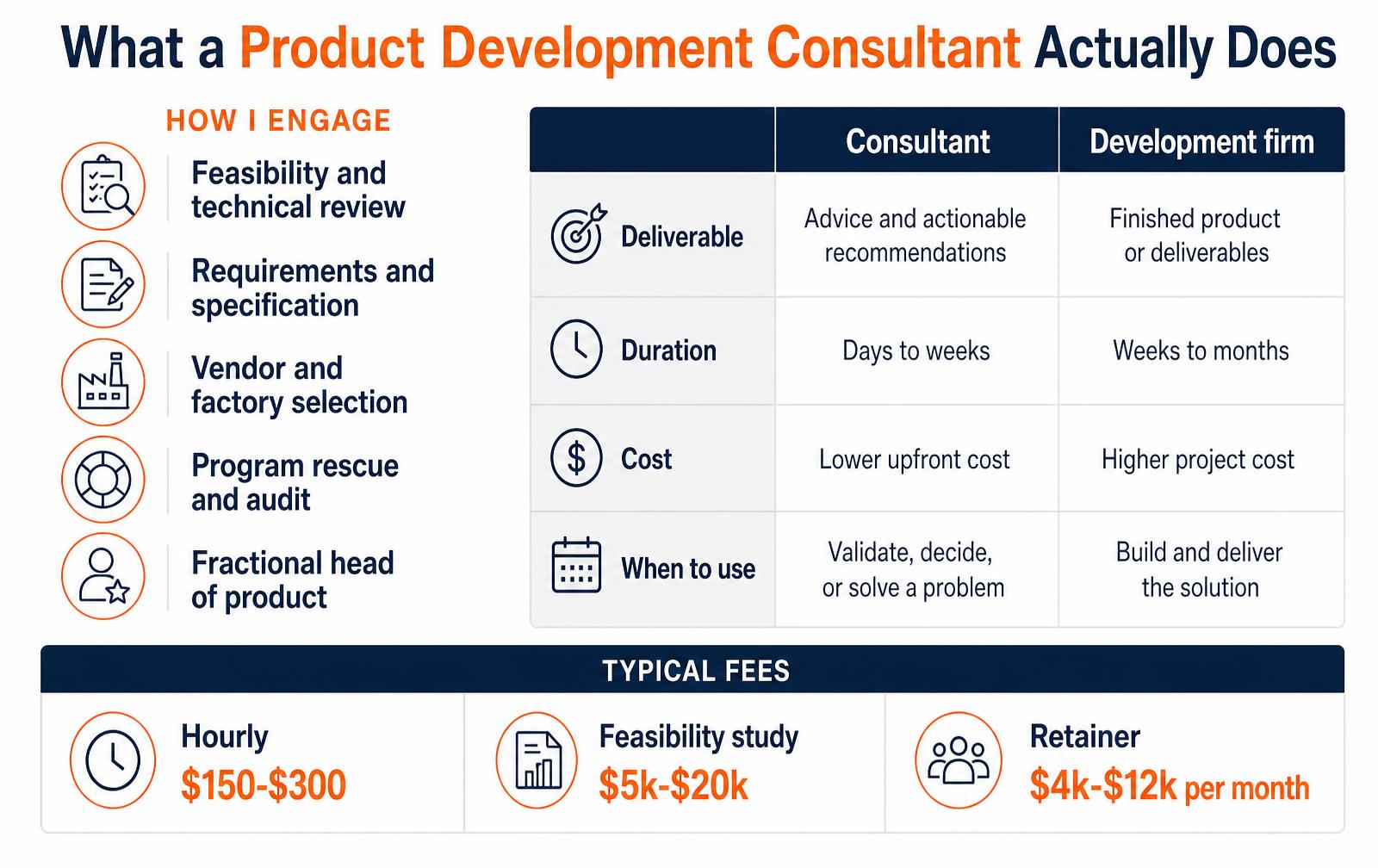
- Feasibility and technical review. Can this be built, at what cost, with what risks — before you raise or spend serious money.
- Requirements and specification. Turning a pitch deck into a document engineers and factories can quote against.
- Vendor and factory selection. Shortlisting, auditing and negotiating with manufacturers who will otherwise quote you as a first-timer.
- Program rescue and audit. Finding out why month nine looks like month three, and what to salvage.
- Fractional head of product or engineering. Senior oversight a few days a month when the full-time hire is not yet justified.
What a product development consultant costs
Engagement | Duration | Typical fee | What you walk away with |
|---|---|---|---|
Advisory call or technical review | 2-4 hours | $300-$1,200 | A candid read on feasibility and the biggest risks |
Feasibility study | 2-4 weeks | $5k-$20k | Technical approach, risk register, cost and schedule estimate |
Requirements and specification | 3-5 weeks | $8k-$25k | A spec you can send to vendors and compare quotes against |
Manufacturing sourcing support | 4-8 weeks | $10k-$35k | Shortlist, audits, quotes normalised, negotiated terms |
Fractional leadership retainer | Monthly | $4k-$12k/month | Ongoing oversight, gate reviews, vendor management |
Hourly rates for genuinely experienced consultants run $150-$300. Anything materially below that usually buys enthusiasm rather than scar tissue, and scar tissue is the entire product being sold.
Consultant or development firm?
A consultant tells you what to build and how to run it; a development firm builds it. The two are not exclusive — the cleanest sequence is a short paid discovery that produces requirements and a budget, then a build phase with the same team or a different one, with the requirements document as the contract. Our product development consulting engagements are structured exactly that way, and you are free to take the output elsewhere.
How to get value out of the engagement
- Write down the decision you need to make before the first call; vague briefs produce vague invoices
- Share the bad news early — the failed prototype, the quote you cannot afford, the co-founder disagreement
- Ask for a written deliverable, even for short engagements, so the advice survives the meeting
- Agree in advance whether the consultant may also bid on the build work
- Set a review date to check whether the recommendations were actually implemented
Consultant rates and what the money buys
Level | Rate | Where they add value | Where they waste your budget |
|---|---|---|---|
Independent specialist | $100-$200/hr | One deep problem: RF, injection molding, compliance | Running a whole program alone |
Boutique firm | $135-$225/hr | Concept through production-ready design | Very small scoped tasks |
Full-service consultancy | $150-$275/hr | Multi-discipline programs with factory transfer | Early exploratory work |
Offshore team | $35-$85/hr | Well-specified execution work | Ambiguous scope and novel design |
When to bring one in
- You have a target cost but no BOM model that proves you can hit it.
- Your prototype works but no one can say how it will be made at volume.
- A certification requirement appeared and no one on the team has passed one before.
- Your factory keeps sending change requests you cannot evaluate.
- You need an outside opinion before a funding milestone, where an honest kill call saves months.
What a discovery engagement produces
Discovery is worth paying for only when it ends in artifacts you can act on.
The useful set is small and specific: a written problem statement that names the user and the job to be done, a requirements document separating must-have from nice-to-have with a measurable acceptance criterion for each, a technical feasibility assessment that identifies the two or three things most likely to break, a preliminary bill of materials with target costs, and a risk register with an owner and a mitigation for every item. A slide deck summarizing opinions is not discovery output; it is a meeting artifact.
The requirements document does the heaviest lifting. Every line should be testable. "Long battery life" is not a requirement; "14 days of runtime at one transmission per minute at 25 degrees C" is, because an engineer can size a cell against it and a test can prove it. Teams that skip this step do not avoid the work, they defer it to the middle of engineering where changing a requirement invalidates completed design.
Expect discovery to reduce your option space, not expand it. If you finish with more directions than you started with, the phase did not do its job.
How long discovery should take
For most physical products, discovery runs three to eight weeks. Under three weeks you are usually confirming what you already believed; past eight weeks you are typically avoiding a decision that the available evidence already supports.
Complexity moves the number: a mechanical accessory can be understood in three weeks, a connected device with a regulatory path and a cost target rarely can, and a medical or industrial product with formal requirements traceability legitimately takes longer.
Structure the phase around the riskiest unknown rather than around a calendar. If the whole product depends on whether a sensor can resolve a signal in real conditions, build the crude rig that answers that in week one, because every other answer is contingent on it. Sequencing discovery by risk instead of by discipline is the single largest determinant of whether the phase pays for itself.
Set an explicit end condition at kickoff: the specific questions that must be answered for the program to proceed. Without one, discovery expands to fill whatever budget exists.
- Week 1: attack the riskiest technical unknown with the cheapest possible test rig.
- Weeks 2-3: user and market inputs converted into measurable requirements.
- Weeks 3-5: concept directions with preliminary BOM and cost targets attached.
- Weeks 5-8: feasibility conclusions, risk register, and a go / no-go recommendation with reasons.
Our product discovery service is scoped this way, and the output feeds directly into end-to-end development or a standalone engineering engagement if you already have a design partner.
Common ways discovery goes wrong
The most common failure is research that never touches the product. Interviews, surveys and competitive scans are useful, but if none of them change a dimension, a component choice or a cost target, they were entertainment. Insist that every research finding map to a requirement or be discarded.
The second failure is anchoring on the founder's existing concept. If the phase begins with an agreed solution, discovery becomes justification and the risks that would have killed the concept surface during tooling instead. A useful discovery has explicit permission to conclude that the idea should change shape.
The third is deferring cost. Teams often treat cost as an engineering problem to solve later, but the landed cost of a product is largely decided by architecture, part count and process choice, all of which are set during discovery. A preliminary BOM built in week four with rough supplier quotes is imprecise and still more valuable than a precise one built after the design is frozen, because at week four the number can still change the design.
Who should be in the room
Discovery fails quietly when the wrong people attend. You need someone who can commit budget, because otherwise every conclusion becomes a recommendation nobody acts on. You need the engineer who will actually build the thing, not a manager relaying their opinions second hand.
You need whoever owns the commercial target, since a cost ceiling discovered late invalidates architecture decisions made early. Three or four decision-makers is the right size; a standing meeting of twelve produces consensus documents and no decisions.
Give the phase a single accountable owner on your side who can answer questions within a day. Discovery is dense with small clarifications, and a program that waits a week for each one stretches a five-week phase into ten without producing anything additional. Fast, imperfect answers from an empowered owner beat perfect ones that arrive after the question stopped mattering.
Frequently asked questions
What does a product development consultant do?
They assess feasibility, define requirements, choose the technical approach, select and manage vendors or factories, and provide senior oversight at project gates. The output is decisions and documents — specifications, risk registers, budgets and sourcing recommendations — rather than finished CAD or firmware.
How much does a product development consultant charge?
Typically $150-$300 per hour, $5,000-$20,000 for a feasibility study, and $4,000-$12,000 per month for a fractional leadership retainer. Sourcing and vendor selection support usually falls between $10,000 and $35,000 depending on how many factories are audited.
When should I hire a consultant instead of a development firm?
Hire a consultant when the question is strategic — is this buildable, what should it cost, which factory, why has the project stalled. Hire a development firm once the requirements are clear and the work to be done is design and engineering.
Writing a brief a product development consultant can price
Most inflated consulting quotes are a response to vague briefs. A product development consultant prices uncertainty, so the more precisely you state what you know and what you need decided, the tighter and more comparable the proposals you receive.
What a good brief contains
Section | What to include |
|---|---|
Objective | The decision you need to reach, not the tasks |
Current state | What exists: sketches, CAD, prototypes, test data |
Constraints | Budget, target cost, timeline, regulatory scope |
Volume and market | Annual units and target price |
Success criteria | What the deliverable must let you do next |
Known unknowns | The questions you already know you cannot answer |
Timeline | Decision dates that cannot move |
Commercials | Budget range and preferred engagement structure |
Include a budget range. Withholding it does not produce lower prices; it produces proposals scoped for a different project than the one you can fund, and a second round of revisions.
Brief checklist
- State the decision you need made, not the activity you want performed.
- Share existing files, tests and failures honestly.
- Give a real budget range and immovable dates.
- Ask for a phased proposal with a small first phase.
- Send the identical brief to every firm you approach.
Key takeaways
- Consultants price uncertainty; a precise brief lowers the quote.
- Share a real budget range to get comparable, fundable proposals.
- Ask for a small first phase before a full commitment.
Need a discovery engagement that ends in a clear decision?
Work with LA NPDT: if you are moving from here to execution, start with our our product development process or talk to us about end-to-end product development.
Services related to this guide
- Product design servicesIndustrial design and CAD taken all the way to manufacturable files.
- Rapid prototypingWorking prototypes in days, from 3D printing to vacuum casting.
- Electronic design servicesSchematic, PCB layout, firmware and bring-up, through to production handoff.
- Product development examplesReal projects we designed, prototyped and shipped.