
Trademark Registration Process: A Step-by-Step Guide for Product Companies
A trademark protects the name and logo customers buy by. Here is the USPTO registration process end to end, with realistic costs, timelines and the mistakes that get applications refused.
June 27, 20185 min read

Written by Yelena Rymbayeva, MPhil Communication & Media Studies, BTech Quality Control
Marketing & Product Leader, Technology Commercialization
Published June 27, 2018Updated September 2, 2026
The trademark registration process turns a brand name, logo or slogan you already use into a federally protected asset, through five steps: clearance search, application, examination, publication and registration. It normally takes eight to eighteen months and is one of the cheapest pieces of intellectual property a product company can own.
We went through it for the LA NPDT mark ourselves, and the walkthrough below reflects what the process actually looks like from the applicant's side.
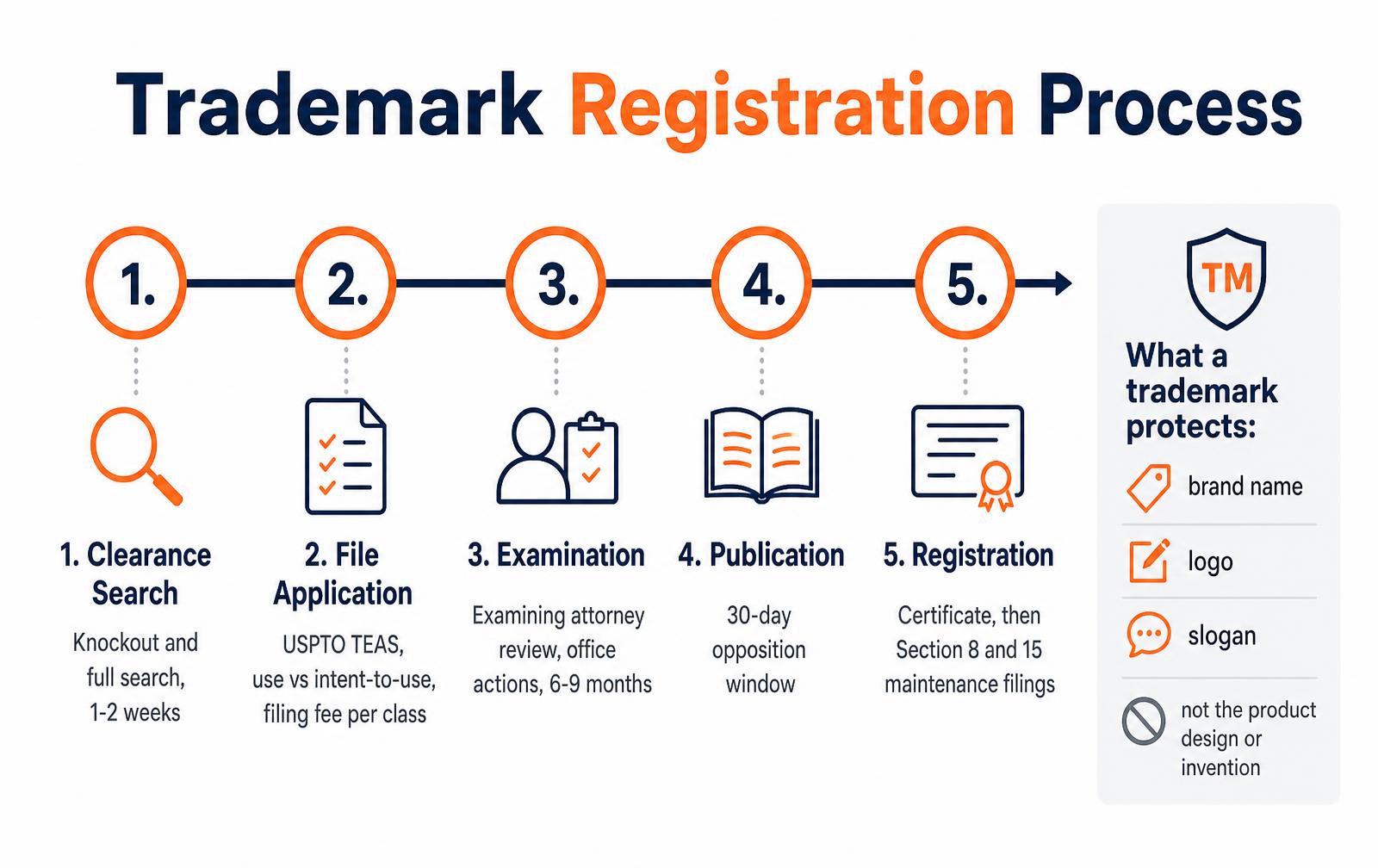
What a trademark actually protects
Right | Protects | Term |
|---|---|---|
Trademark | Brand name, logo, slogan, and other source identifiers | Indefinite, with maintenance filings |
Utility patent | How an invention works | About 20 years from filing |
Design patent | The ornamental appearance of a product | 15 years from grant |
Copyright | Original creative works: manuals, artwork, software | Life plus 70 years, generally |
Trade secret | Confidential information that has value from being secret | As long as it stays secret |
This distinction trips up most first-time founders. A trademark will not stop a competitor from copying your product; that is patent territory. It stops them from selling their version under a name customers would confuse with yours — which, once you have spent money on marketing, is often the more valuable protection.
Step 1: Clearance search
Start with our free US trademark search, which queries the USPTO's public trademark database, then widen the search to state registrations, business names, domains and ordinary web use, because unregistered common-law rights can still block you.
You are not only looking for identical marks: examiners refuse applications for a likelihood of confusion, which covers similar spellings, sounds and meanings in related goods or services. A refusal costs you the filing fee and months of calendar; an hour of searching costs neither.
Distinctiveness decides how defensible a name is. Invented words are the strongest, arbitrary words applied to unrelated goods are next, suggestive names are workable, descriptive names are weak and generic names are unregistrable. Choosing a name that literally describes what the product does feels clear in marketing and is the most common reason a mark cannot be protected.
Step 2: File the application
- Choose a filing basis. File in use if the mark is already used in commerce, or intent-to-use if you plan to launch; intent-to-use requires a later statement of use plus its own fee.
- Pick the right classes. Fees are charged per class of goods or services, so covering both a physical product and a software service costs two class fees.
- Decide standard character or design mark. Standard character protects the words in any font; a design mark protects the stylized logo. Many companies eventually file both.
- Provide a proper specimen. For goods, that means the mark on the product, its packaging or point-of-sale display — not a mock-up, business card or brochure.
Steps 3 to 5: Examination, publication, registration
An examining attorney reviews the application several months after filing. If something is wrong — a conflicting mark, a vague description of goods, a bad specimen — you receive an office action and have a deadline to respond.
Once the examiner approves, the mark publishes for a 30-day opposition period during which third parties can object. If nobody does, a use-based application registers; an intent-to-use application receives a notice of allowance and registers after you file the statement of use.
Registration is not the end. Maintenance filings between the fifth and sixth years, again at ten years and every ten years thereafter keep it alive, and letting a deadline pass cancels the registration.
Cost and timeline
Item | Typical cost | Timing |
|---|---|---|
Clearance search | Free to do yourself; a few hundred to low thousands for a full legal search | Week 1-2 |
USPTO filing fee | A few hundred dollars per class, set by the USPTO | At filing |
Attorney preparation and filing | Roughly $500-$1,500 per class if you use counsel | At filing |
Office action response | $0 if none; several hundred to a few thousand if substantive | Month 6-12 |
Registration and maintenance | Statement of use and later Section 8 and 9 filings | Month 12-18, then years 5-6 and 10 |
Fees change, so confirm current amounts on the USPTO website. Note also that foreign-domiciled applicants are required to be represented by a US-licensed attorney.
Timeline, fees and the common refusals
A US trademark application is not slow because of paperwork; it is slow because of the queue and the opposition period. Filing to registration typically runs twelve to eighteen months for an application that faces no objection, and longer if an examining attorney issues an office action.
Planning a product launch around a registration date is a mistake — launch on common-law rights and the pending application, and treat registration as the milestone that strengthens enforcement later.

Stage | Typical duration | Typical cost (US) |
|---|---|---|
Clearance search and opinion | 1 - 3 weeks | $500 - $2,500 |
Filing (per class) | Same day | $350 government fee plus $500 - $1,500 counsel |
Examination wait | 6 - 10 months | - |
Office action response, if any | 2 - 6 weeks of work | $500 - $3,000 |
Publication and opposition window | 30 days | - |
Registration certificate | 2 - 4 months after publication | - |
Maintenance filings | Years 5-6, then every 10 | $325+ per class |
Why applications get refused
- Likelihood of confusion with an existing mark in a related class — by far the most common refusal.
- Merely descriptive marks that describe the goods rather than distinguish them.
- Specimen problems: mock-ups, renderings and invoices are not acceptable proof of use in commerce.
- Wrong classes or an over-broad goods description that invites objection.
- Geographic or surname significance, which needs evidence of acquired distinctiveness.
Key takeaways
- Budget twelve to eighteen months from filing to registration on a clean application.
- Clearance search first: distinctive names cost far less to register and defend than descriptive ones.
- File intent-to-use before launch, then submit a real specimen showing the mark on the goods.
- Diary the year 5-6 maintenance filing; missed renewals cancel registrations.
Frequently asked questions
How long does trademark registration take?
Usually eight to eighteen months for a straightforward, use-based application. Initial examination alone commonly takes several months, and each office action or an intent-to-use statement of use adds more. Nothing about the process is fast, which is why filing early matters.
Do you need a lawyer to register a trademark?
US-based applicants may file on their own, and foreign-domiciled applicants must use a US-licensed attorney. Self-filing is realistic for a distinctive name in a single class with a clean search; an attorney earns their fee when the search is ambiguous, the goods span several classes, or an office action arrives.
What is the difference between the TM symbol and the R symbol?
TM can be used by anyone claiming rights in an unregistered mark. The circled R may only be used after federal registration issues, and using it before then is improper and can hurt your case.
Should you trademark a name before launching a product?
At minimum, run a free trademark search before spending money on packaging, tooling with a molded-in logo, or a domain and marketing campaign. Then file intent-to-use so your priority date is early. Renaming after launch is far more expensive than filing early.
After registration: maintenance and enforcement
A registration is not permanent unless you feed it. US marks require proof of continued use at set intervals, and missing a window cancels the registration outright — no grace beyond the paid extension. Enforcement matters just as much: rights weaken when a owner tolerates confusingly similar use, so a simple watch and response routine protects the asset you paid to create.
Post-registration deadlines (US)
Filing | When due | Purpose | Consequence of missing |
|---|---|---|---|
Section 8 declaration | Between years 5 and 6 | Prove continued use | Registration cancelled |
Section 15 (optional) | After 5 years of use | Incontestability | Weaker enforcement position |
Section 8 + 9 renewal | Years 9-10, then every 10 | Use proof plus renewal | Registration expires |
Specimen updates | With each filing | Show mark as used in commerce | Refusal, office action |
Keep dated evidence of use as you go — packaging photos, product listings and invoices with the mark visible — rather than reconstructing it years later. Foreign filings run on their own calendars, and the Madrid Protocol route ties dependent registrations to the home mark for the first five years.
A practical enforcement routine
- Set a quarterly search of the trademark register and marketplaces for similar marks.
- Use platform brand registries (Amazon, Shopify, Etsy) to remove copycat listings quickly.
- Send a proportionate first letter; aggressive demands against small users create bad publicity.
- Record the registration with customs to block infringing imports.
- Log every enforcement action; a consistent record strengthens later disputes.
Key takeaways
- Missing the year 5-6 declaration cancels a registration outright.
- Collect dated proof of use continuously, not at filing time.
- Consistent, proportionate enforcement is what keeps a mark strong.
Clearance search: what to verify before you file
Stage | Typical duration | What determines the outcome |
|---|---|---|
Clearance search | 1-2 weeks | Similarity in sight, sound, and meaning within your goods class |
Application filing | 1 day | Correct class, accurate goods description, use vs. intent-to-use basis |
Examination wait | 6-9 months | Queue depth at the office |
Office action response | Up to 3 months allowed | Quality of the distinctiveness or coexistence argument |
Publication for opposition | 30 days | Whether a competitor is watching your class |
Registration or statement of use | 2-4 months | Proof of use in commerce with real product packaging |
Working on something like this?
LA NPDT takes products from concept through engineering, prototyping and production. Tell us where your project stands and we will tell you what it takes.
From the archive
Work with LA NPDT: if you are moving from here to execution, start with our our product development process or talk to us about end-to-end product development.
Services related to this guide
- Free trademark searchScreen a product name against the live USPTO register in seconds.
- Idea evaluationAn honest read on whether an idea is worth building.
- Product design servicesIndustrial design and CAD taken all the way to manufacturable files.
- Product development examplesReal projects we designed, prototyped and shipped.