From Ideation to Production: A Practical Guide to Developing a Physical Product
Seven stages take a physical product from sketch to shelf, each removing one class of risk. Here are the timelines, costs and exit criteria for every one of them.
August 10, 20264 min read
Getting a physical product from sketch to shelf takes seven distinct stages, and each one exists to kill a specific risk before it becomes expensive. Programs that run late almost always skipped a stage rather than executed one badly.
Moving from ideation to production runs through seven stages, and each one exists to kill a specific risk before it becomes expensive. This guide walks the new product development process steps with the decision each protects, realistic timelines and costs for a first product, the deliverables that let you move on, and the mistakes that most often send teams backwards.
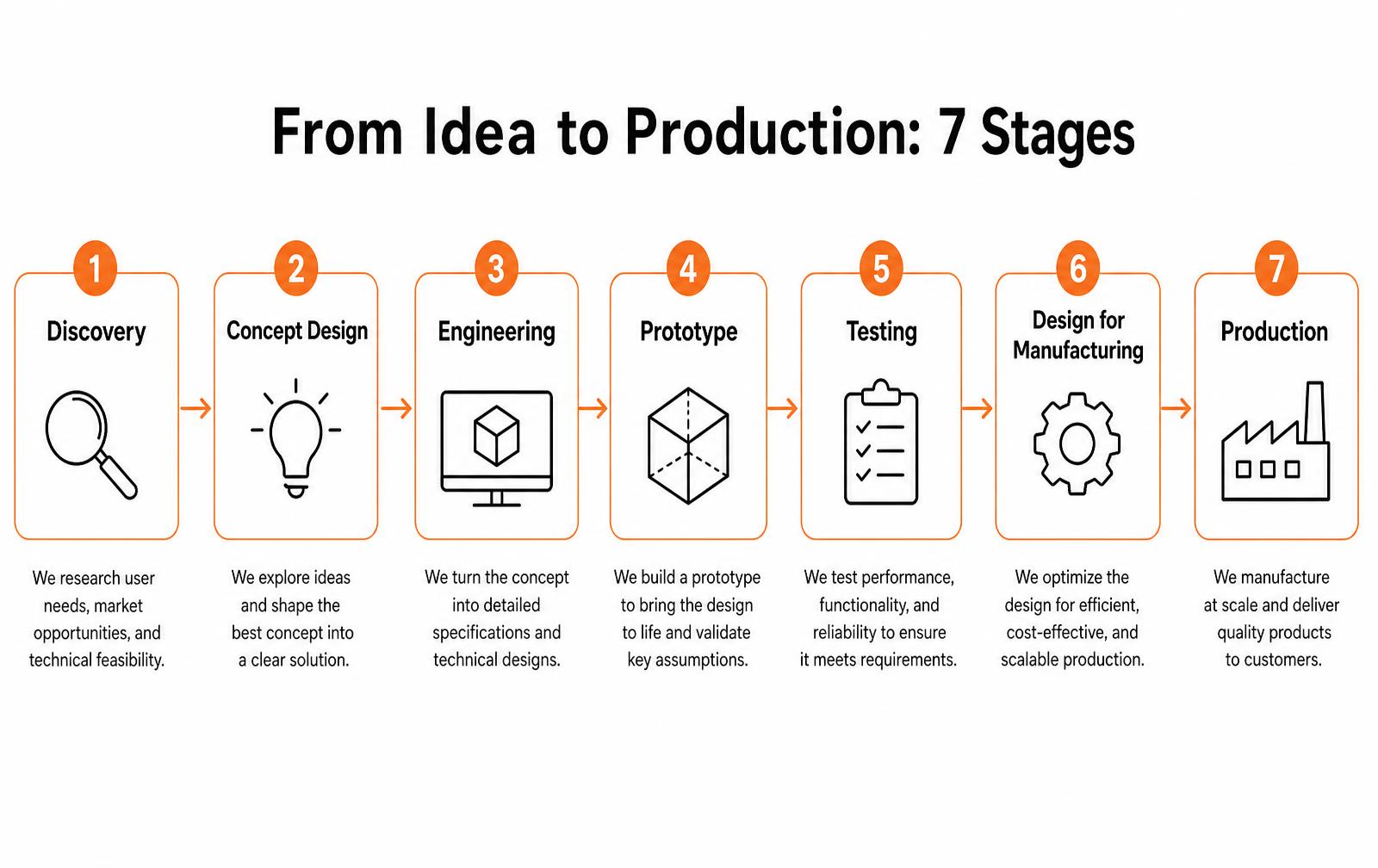
The seven stages at a glance
Stage | Risk it removes | Typical duration | Typical cost (first product) |
|---|---|---|---|
Discovery | Building something nobody wants | 2-6 weeks | $5k-$20k |
Concept design | Committing to the wrong form or architecture | 3-6 weeks | $8k-$30k |
Engineering | A design that cannot be made or certified | 6-16 weeks | $25k-$120k |
Prototyping | Assumptions that only fail in the physical world | 3-8 weeks | $5k-$60k |
Testing and validation | Field failures and compliance rejections | 4-12 weeks | $10k-$80k |
Design for manufacturing | Unit cost and yield surprises at scale | 3-8 weeks | $10k-$50k |
Production | Quality drift and supply interruption | 8-20 weeks to first run | Tooling $10k-$250k+ |
Ranges are wide because complexity dominates. A moulded consumer accessory sits near the bottom of every row; a connected device with a battery, radio and regulatory pathway sits near the top and often above it.
Stage 1: Discovery
Discovery converts an idea into requirements. You are looking for the customer's current workaround, what it costs them, the constraints the product must live inside, and whether an existing solution already wins on price. The deliverable is a requirements document with acceptance criteria and a named target user.
- Exit criteria: a written problem statement, 15+ customer conversations, a competitive teardown, and target unit cost and price.
- Common mistake: starting CAD before anyone has stated what the product must measurably do.
Stage 2: Concept design
Concept design explores several architectures rather than refining one. Cheap divergence here is the highest-return activity in the whole program — a second concept costs days and can remove a mechanism, a moulding step or a whole subassembly. The deliverable is two or three developed concepts with a documented selection rationale.
- Exit criteria: a chosen architecture, rough BOM, sketch models or renders, and a first cost estimate.
- Common mistake: converging on the first idea because it is already drawn.
Stage 3: Engineering
Engineering turns the concept into a buildable design: parametric CAD, tolerance analysis, material selection, electronics schematic and layout, firmware architecture, and the compliance pathway. This is the longest stage and the one where scope changes hurt most.
- Exit criteria: released CAD and drawings, complete BOM with sourced parts, and a written test plan.
- Common mistake: deferring the regulatory pathway; certification requirements often change the enclosure, the battery or the radio.
Stage 4: Prototyping
Build the cheapest artefact that answers the current question. Looks-like models test reaction and fit; works-like rigs test mechanism, thermals and power; only later does a looks-and-works-like unit make sense. Our rapid prototyping guide covers process selection and cost in depth.
- Exit criteria: every high-risk assumption tested in hardware at least once.
- Common mistake: one expensive prototype that mixes all questions together, so a single failure invalidates the whole build.
Stage 5: Testing and validation
Test type | What it proves | When to run it |
|---|---|---|
Functional and performance | The product meets its written spec | On every engineering prototype |
Environmental and durability | It survives drop, temperature, humidity, cycling | Before tooling |
Usability | Real users succeed unaided | On a looks-and-works-like unit |
Pre-compliance (EMC, safety) | Certification will pass | Before design freeze |
Formal certification | Legal right to sell | On production-intent units |
Pre-compliance testing is the cheapest insurance in hardware. A half-day at a test house before freezing the design routinely prevents a tooling change that costs twenty times as much.
Stage 6: Design for manufacturing
DFM adapts a working design to a specific process and factory: draft angles, wall thickness, part consolidation, fastener strategy, tolerance stack-ups, and assembly sequence. It is the stage that decides unit cost, and it must happen with the chosen manufacturer, not before one is chosen. See our DFM guide for the detail.
Unit cost is not negotiated at the factory. It is designed in three stages earlier, and DFM is the last place it can be changed cheaply.
Stage 7: Production
- Tooling and first articles. Expect two to three tool iterations before parts are accepted.
- Pilot run. A small run at production intent surfaces assembly and fixture problems while they are still cheap.
- Inspection plan. Define what is measured, how often, and what a reject looks like before the line starts.
- Ramp. Scale once yield is stable, not once orders arrive.
- See what breaks between prototype and pilot production for the failure patterns.
How long does the whole thing take?
Product type | Idea to first production run |
|---|---|
Simple moulded accessory | 6-9 months |
Mechanical consumer product | 9-14 months |
Connected electronic device | 12-20 months |
Medical or regulated device | 18-36 months |
The largest schedule variable is not engineering speed. It is decision latency — how long a program waits for a founder, an investor or a partner to approve moving to the next stage.
Frequently asked questions
What are the stages of new product development?
Discovery, concept design, engineering, prototyping, testing and validation, design for manufacturing, and production. Each stage exists to retire a specific risk — market risk first, then architectural, technical, physical, regulatory, cost and finally quality risk. The order matters because each stage makes the next one cheaper to run.
How much does it cost to develop a physical product?
A straightforward moulded consumer product typically runs $60,000-$150,000 in development plus $15,000-$60,000 in tooling. A connected electronic device more often lands between $200,000 and $600,000 including certification. Tooling is separate from development and scales with part count, cavity count and material.
How long does it take to bring a product from idea to market?
Six to nine months for a simple accessory, nine to fourteen for a mechanical consumer product, twelve to twenty for a connected device, and eighteen months or more for anything regulated. Most overruns come from decision delays and from skipping validation, which forces a return to engineering after tooling has already been cut.
Can any stage safely be skipped?
Stages can be compressed but not removed. On a low-risk product, discovery may be two weeks of interviews and concept design a single afternoon of sketching. What cannot be skipped is the exit criterion — some evidence that the risk of that stage has been retired before spending money on the next one.
When should I involve a manufacturer?
Shortlist manufacturers during engineering and engage one before design for manufacturing begins. DFM is process- and factory-specific: draft angles, gate locations and tolerances depend on their equipment. Choosing a factory after the design is frozen almost always means paying to change the design anyway.
Services related to this guide
- Low-volume manufacturingFirst production runs without full injection-mould tooling.
- Best product development companiesHow the leading US firms compare, and which one fits your stage and budget.
- Product design servicesIndustrial design and CAD taken all the way to manufacturable files.
- Order a prototypeSend a part or an idea and get a build quote back.