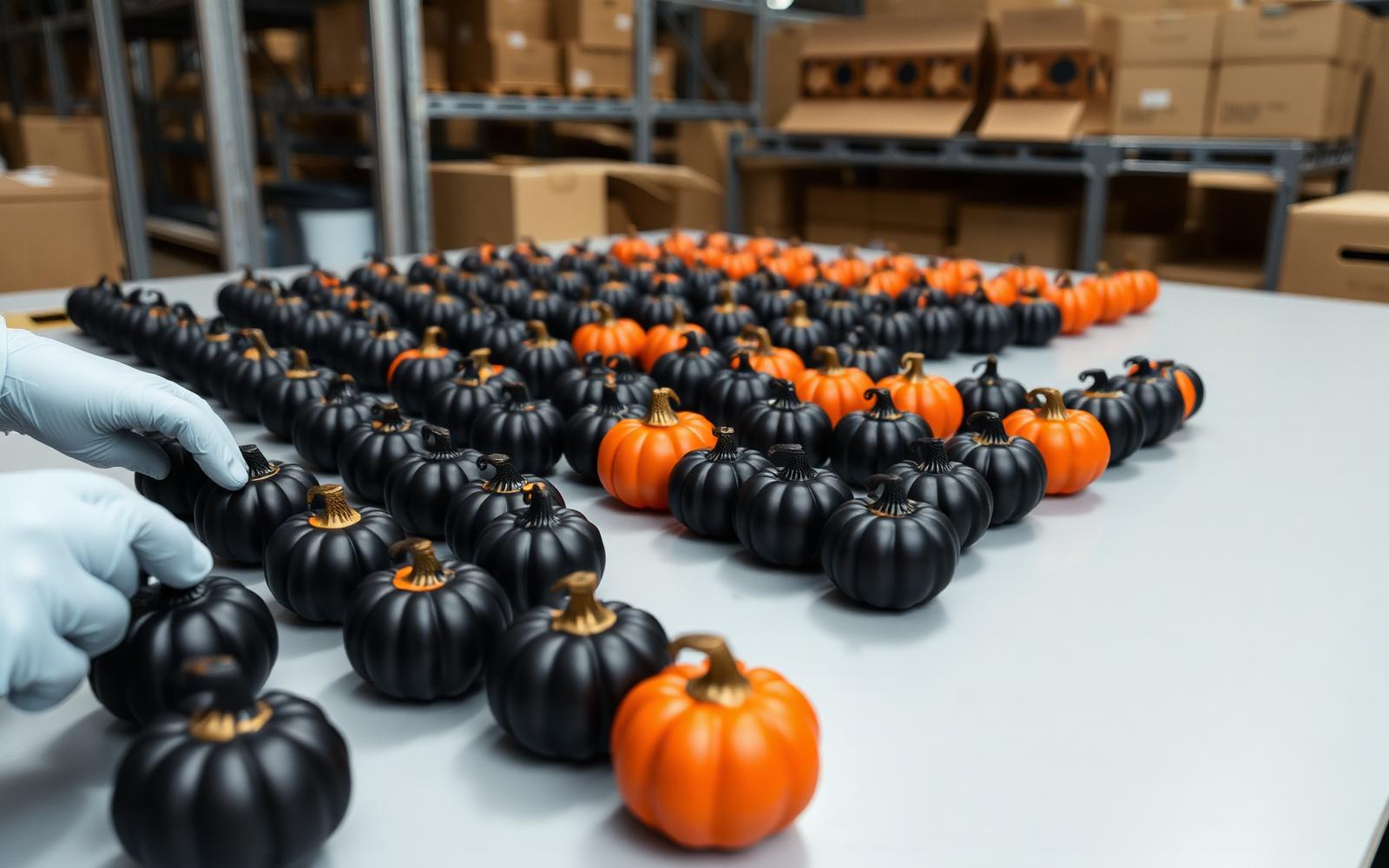
Halloween Products: How Seasonal Items Get Designed and Shipped
Halloween products live or die on a calendar. Here is the twelve-month development schedule, the safety testing seasonal items need, and where the margin actually comes from.
October 30, 20188 min read

Written by Konstantin Dolgan, Ph.D., NPDP
Founder & CEO, Product Development Engineer
Published October 30, 2018Updated September 2, 2026
Halloween products are one of the hardest categories in consumer hardware, not because the products are complex, but because the deadline cannot move. A costume, animatronic prop or novelty light either sits on a shelf in September or it waits a full year and loses a year of cash. That single constraint drives the whole development schedule backwards from October, and it changes how you make every design, tooling and sourcing decision along the way.
The calendar rules everything
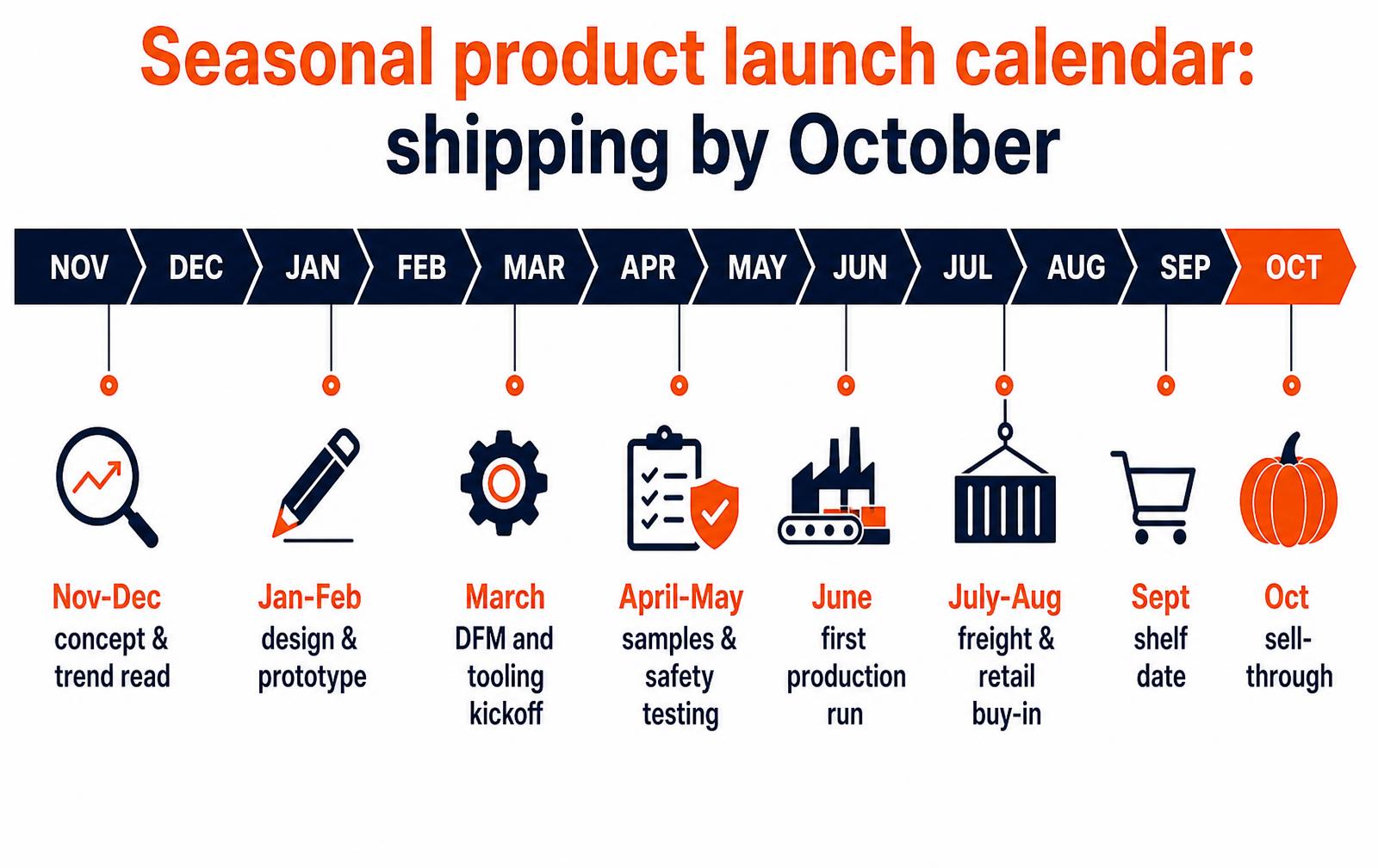
Retail buyers for seasonal categories review lines roughly six to nine months before the season, which means a product intended for October shelves is being shown in the first half of the year and tooled shortly after. Work backwards: a September shelf date implies a summer freight window, an early-summer production run, spring samples and testing, and a tooling kickoff in early spring. Anything that slips in March quietly deletes the whole season.
The four kinds of Halloween product, and what each one costs you
Type | Examples | Development effort | Main risk |
|---|---|---|---|
Soft goods | Costumes, masks, textile decor | Pattern making, fabric sourcing, sizing | Flammability testing and fit returns |
Molded novelty | Props, buckets, figurines | Tooling design, molded part cost | Tool lead time missing the season |
Electronic decor | Lights, sound props, motion-triggered items | Electronics, firmware, safety certification | Certification and battery compliance |
Animatronics | Motorized figures and large yard props | Mechanism design, durability, packaging volume | Mechanism reliability and freight cube |
The cheapest thing a seasonal team can do is choose the category deliberately. A molded prop with one tool and no electronics can be developed inside a season; an animatronic with a custom mechanism and a certification path usually cannot, and should be aimed at the following year from the start.
Safety is not optional in this category
- Children's products carry the strictest rules. In the US that means CPSIA requirements, third-party testing by an accepted lab and a children's product certificate, plus tracking labels.
- Costumes must meet flammability requirements, and masks need vision and breathing considerations that are easy to miss on a sample that nobody wore for an hour.
- Small parts and cords are the classic recall causes. Design them out rather than warning about them.
- Button cell batteries need secured compartments under current US requirements; a screw-secured door and warning marking are the baseline.
- Anything that plugs in or emits light or sound adds electrical safety and, in some cases, radio certification to the schedule.
Testing is not a formality at the end. Book lab slots when you order tooling, because a failed test in July with no time to remold is how a whole season turns into unsellable inventory.
Where the margin actually comes from
Seasonal margin is made in three places: unit cost at a volume you can actually sell, freight efficiency (a bulky prop that wastes pallet cube can lose more to shipping than to materials), and sell-through before the discount cliff. Unsold Halloween stock is worth a fraction of its cost by November 1, so a conservative first run with a fast reorder path usually beats an ambitious single order.
- Design for flat pack or nesting. Volume is freight cost; a prop that collapses ships for far less.
- Reuse a platform across years. One motor and control board can carry several seasons of different skins.
- Plan the markdown. Model the season with a realistic share sold at full price and the rest discounted.
- Keep tooling simple. A single-cavity tool that arrives on time beats a clever multi-cavity tool that arrives in August.
The seasonal calendar runs a year ahead
A Halloween item on a shelf in October was quoted the previous November, tooled in the spring and shipped in July. Seasonal products live or die on that calendar because the sell-through window is roughly three weeks and there is no second chance: unsold inventory becomes clearance stock or storage cost for eleven months.
That compresses every engineering decision. There is time for one tooling iteration, not three, so design for manufacture happens before the tool is cut rather than after the first shots come back.
Month | Activity | Why the date is fixed |
|---|---|---|
Nov - Dec | Concept, costing, retailer pitch | Buyers plan the following season now |
Jan - Feb | Design freeze and tooling kickoff | Steel takes 6-10 weeks plus trials |
Mar - Apr | Tool trials, safety testing, packaging artwork | Test labs queue up before peak |
May - Jun | Production run | Factory capacity fills ahead of peak season |
Jul - Aug | Ocean freight and receiving | Transit plus customs plus DC processing |
Sep | On shelf | Sell-through starts weeks before the holiday |
Compliance items that catch seasonal products
- Toy safety. Anything a child may use is treated as a toy: small parts, sharp edges, and mechanical testing under ASTM F963 or EN 71 depending on market.
- Flammability. Costumes and textiles carry specific flammability requirements, and a disclaimer on the label is not a defence if the product plainly is a costume.
- Batteries and LEDs. Button cells need secured compartments; shipping lithium cells adds documentation.
- Chemical content. Lead, phthalates and heavy metals in decorative paints are routine failure points on low-cost seasonal goods.
- Labelling. Age grading, country of origin and tracking labels must be on the product, not just the carton.
Key takeaways
- Seasonal programmes start about eleven months before the shelf date; there is room for one tooling iteration.
- A three-week sell-through window makes over-ordering more expensive than under-ordering for most SKUs.
- Assume toy-safety and flammability testing applies until a lab says otherwise.
- Lock artwork with the design freeze; late graphic changes routinely miss the vessel.
The seasonal calendar that decides everything
Seasonal products live and die by the ship date. Halloween product on a US shelf in September means the container left Asia in June, which means production started in April, which means tooling was approved in January. Miss one link and the product sells at clearance a year later, if at all.
Milestone | Timing for an October sell-through | Slip consequence |
|---|---|---|
Concept and line review | Prior August–October | Retailer slot lost for the year |
Design freeze | Prior November | Tooling starts late |
Tooling complete, T1 approved | January–February | Compresses safety testing |
Safety and compliance testing | February–March | Cannot ship without reports |
Mass production | April–May | Factory capacity contested |
Ocean freight | June–July | Air freight erases margin |
In-store | Late August–September | Sell-through window is ~5 weeks |
Compliance items that catch seasonal products
- Costumes and decorations near flame: 16 CFR 1500.44 and 1610 flammability requirements.
- Anything marketed to children falls under ASTM F963 and CPSIA lead and phthalate limits.
- Battery-lit props need accessible-battery and button-cell warnings under Reese's Law.
- Masks require field-of-vision and ventilation considerations, plus a small-parts assessment on accessories.
- Cosmetic face paints are regulated as cosmetics, not toys, with a separate ingredient path.
Designing for a five-week sell-through
Seasonal economics reward simple, cheap-to-tool designs with high shelf impact and forgiving tolerances. A product that needs two side actions and a painted second color to look good on shelf is fighting the category. The strongest seasonal designs reuse a base tool across several skins, letting graphics and color carry the novelty while the mold cost amortizes over multiple SKUs and multiple years.
Design choice | Seasonal impact |
|---|---|
Molded-in color over painting | Removes a test path and a cost line |
Shared base tool, multiple decos | Amortizes tooling across SKUs |
Flat-pack or nested packaging | Cuts container cost, which is real margin |
Non-electronic novelty | Skips battery compliance entirely |
Modest tolerance callouts | Protects yield when production is rushed |
Inventory risk and what to do with leftovers
Unlike evergreen products, seasonal overstock has almost no salvage value in the same quarter. Conservative first-year quantities with a repeat order option, evergreen-able designs that can be recolored for another holiday, and packaging that stores flat all reduce the downside. Retail buyers respect a supplier who can restock in-season more than one who guessed high and discounts in November.
We help seasonal brands compress this calendar — see design and development services.
The seasonal calendar that actually governs Halloween products
Halloween is a fixed-date business, and the date is not October 31 — it is the retailer's set date, which for most national chains falls in the first half of September. Work backwards from that and the whole program compresses.
Tooling has to be signed off before Chinese New Year in most years, because a two-week factory shutdown lands squarely in the window where you would otherwise be running first-article samples.
Miss the sign-off and you are not late by two weeks; you are late by a season, and a season-late Halloween product is inventory you carry for eleven months.
Milestone | Target month | Why it is the hard stop |
|---|---|---|
Concept and cost target locked | October–November (prior year) | Buyers review line plans while the current season is still on shelf |
Engineering and DFM complete | December | Leaves room for tooling before factory shutdown |
Tooling kickoff | January | T1 samples need six to ten weeks after steel is cut |
First article and safety testing | March–April | Failed testing needs a revision loop, not a rush waiver |
Purchase order and production | May–June | Capacity is booked earliest for seasonal categories |
Ocean freight departure | July | Transit plus port and DC handling runs five to eight weeks |
Retail set | Early September | Sell-through effectively ends October 31 |
Design constraints unique to seasonal product
Seasonal goods are cost-driven in a way that year-round products rarely are. A Halloween item sells at a price the shopper decided on before they picked it up, which means the landed cost target is set before the design starts and everything else negotiates against it.
That pushes designs toward single-material parts, minimal fastener counts, snap fits over screws, and decoration that happens in the mold rather than in a secondary operation. Every secondary operation you remove is both cost and schedule risk you remove.
- Design to one shot. Multi-shot and overmolded parts double tooling lead time; texture and in-mold labels get most of the visual effect for none of the schedule.
- Assume the cheapest battery available. Coin cells and AA are stocked everywhere; anything else adds a certification and sourcing dependency to a fixed-date program.
- Keep the light and sound module common. One qualified electronics module across several SKUs spreads certification cost and protects the schedule when one SKU slips.
- Package for the pallet, not the photo. Cube efficiency drives freight cost, and freight is a larger share of landed cost on seasonal goods than most founders expect.
- Design the display, not just the product. Many seasonal SKUs sell out of a pre-packed floor display; the display is tooling and lead time of its own.
Safety and compliance you cannot skip
A large share of Halloween product reads as a children's product to regulators, and that classification carries real requirements: CPSIA lead and phthalate limits, ASTM F963 mechanical and small-parts testing, flammability testing for costumes and fabric accessories, and secured battery compartments for anything with a coin cell.
Retailers add their own vendor testing protocols on top and will hold a purchase order until the certificates are in the portal. Book third-party lab capacity in March — labs are queued solid by early summer for exactly this reason.
What happens to the SKU after October 31
The economics of a seasonal item are decided in the last ten days of its selling window. Retailers mark down aggressively from November 1, and anything left in the distribution center becomes a carrying cost that eats the margin the program was built on.
The teams that make money on Halloween product plan the exit as deliberately as the launch: they size the production run to a sell-through target rather than an optimistic forecast, they negotiate whether unsold units return to the vendor before the purchase order is signed, and they design at least part of the line to be non-dated so it can be re-run next season without new tooling.
- Amortize tooling across seasons. A mold that only pays back in one October is a bad mold; design the base part to carry a different decoration next year.
- Size the run to sell-through, not to the forecast. A second run is rarely possible mid-season, so most teams over-order — plan the reorder trigger instead.
- Agree markdown and return terms in writing. Who owns unsold inventory is the single largest swing in program profit.
- Capture the post-season debrief while it is fresh. Sell-through by SKU, returns, and retailer feedback in November set next year's line plan in December.
Treated that way, Halloween stops being a gamble on one October and becomes a repeatable annual program: one tooling investment, a decoration change each year, and a schedule everyone already knows how to run.
From the archive
Work with LA NPDT: if you are moving from here to execution, start with our our product development process or talk to us about end-to-end product development.
Frequently asked questions
How long does it take to develop a Halloween product?
Plan on nine to twelve months from concept to shelf for a molded or electronic item, because tooling, safety testing and ocean freight each consume weeks that cannot be compressed. Simple soft goods or printed items can sometimes be done in four to six months.
When do retailers buy Halloween products?
Most seasonal line reviews happen six to nine months ahead, so a product for this October is typically presented in the winter or spring with samples in hand. If you are pitching in August, you are pitching for next year.
What testing do Halloween costumes and props need?
Children's items generally require third-party CPSIA testing including lead and phthalate limits, small-parts and mechanical hazard assessment, and a children's product certificate. Costumes add flammability requirements, and electrical or battery-powered decor adds electrical safety and battery compartment requirements.
Is a seasonal product a good first product for a new company?
It can be, because demand is concentrated and easy to observe, but the fixed deadline is unforgiving and unsold inventory has almost no residual value. If it is your first product, choose a simple construction, order conservatively and keep a reorder path open rather than betting the company on one container. Prototype cost calculator. Design for manufacturing. Low-volume manufacturing. Industrial product design
Filed under:EducationInspiration
Services related to this guide
- Product design servicesIndustrial design and CAD taken all the way to manufacturable files.
- Rapid prototypingWorking prototypes in days, from 3D printing to vacuum casting.
- Electronic design servicesSchematic, PCB layout, firmware and bring-up, through to production handoff.
- Product development examplesReal projects we designed, prototyped and shipped.