3D Printing Materials Comparison: FDM, SLA, SLS and MJF
Compare 3D printing materials and processes, what to include in an RFQ, how per-part pricing is built, and when to switch from printing to machining or tooling.
January 22, 20167 min read

Written by Ralph Hill, Mechanical & electrical systems, 3D manufacturing
Prototyping Engineer
Published January 22, 2016Updated September 2, 2026
Most bad 3D printing quotes are caused by bad requests. A service bureau can only price what you tell it: the process, the material, the tolerances that matter and the finish you expect. Send an STL with no notes and you will get the cheapest interpretation of your part - which is rarely the one you wanted.
Process selection
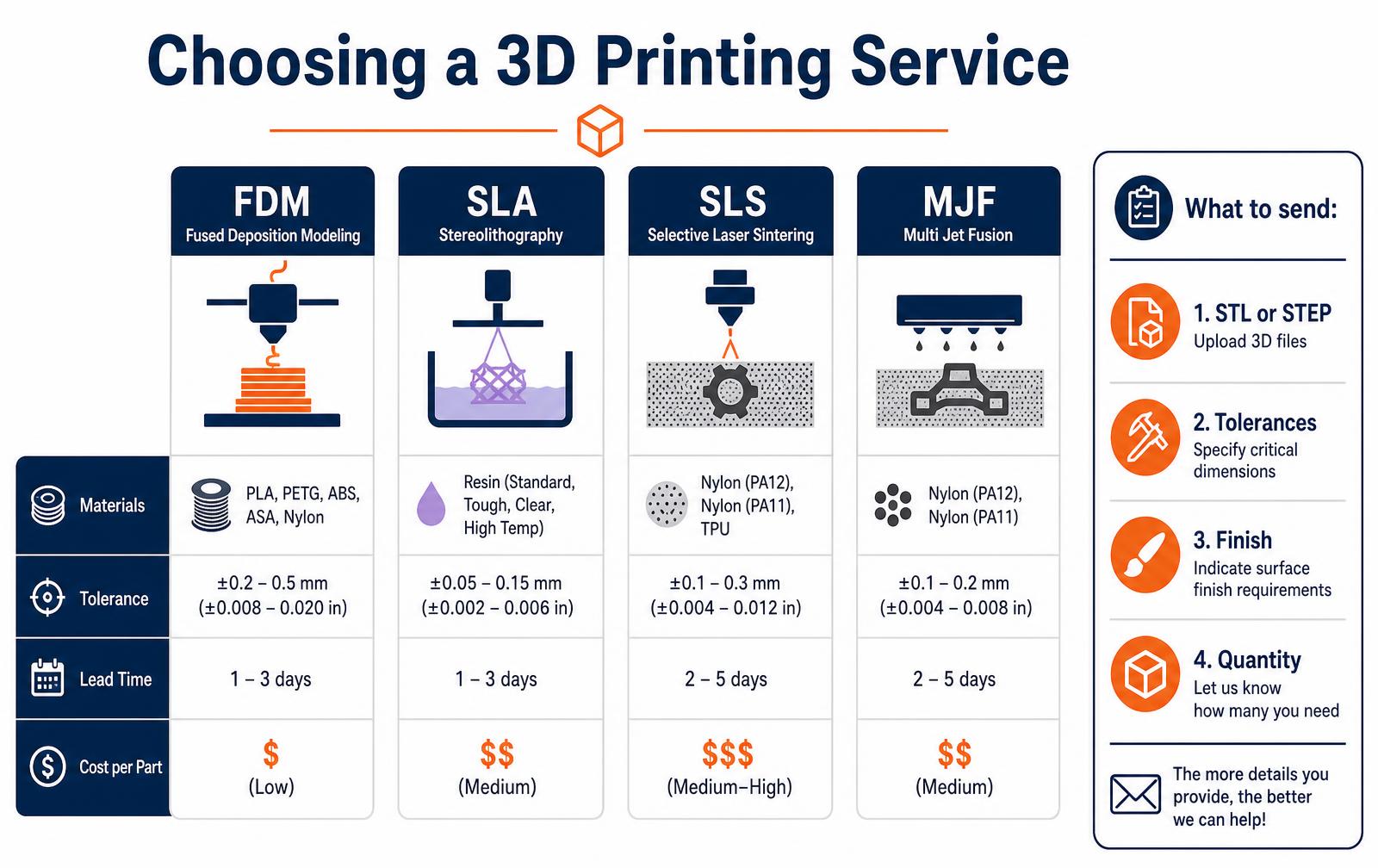
Process | Materials | Tolerance | Lead time | Cost per part |
|---|---|---|---|---|
FDM | PLA, PETG, ABS, ASA, nylon | ±0.2-0.5 mm | 1-3 days | Low |
SLA | Standard, tough, clear, high-temp resin | ±0.05-0.15 mm | 1-3 days | Medium |
SLS | Nylon PA11 / PA12, TPU | ±0.1-0.3 mm | 2-5 days | Medium-high |
MJF | Nylon PA12, PA11, TPU | ±0.1-0.2 mm | 2-5 days | Medium |
What to send with an RFQ
- Geometry. STEP for engineering intent, STL or 3MF for the print itself. Send both when tolerances matter.
- Critical dimensions. A dimensioned PDF marking the two or three features that actually have to hold size.
- Material and process. Name them, or state the functional requirement and let the bureau propose.
- Finish. As-printed, bead blasted, dyed, vapor smoothed or painted to a color standard.
- Quantity and dates. Quantity changes the unit price more than anything else on this list.
How pricing is built
Driver | Effect on price |
|---|---|
Part volume and bounding box | Machine time and material - the largest single factor |
Nesting efficiency (SLS / MJF) | Parts that pack well into a build share overhead and get cheaper |
Support and post-processing | Manual labor; complex overhangs cost more to clean than to print |
Finish level | Dye, smoothing or paint can double a low-cost part |
Quantity | Setup amortizes; expect 20-45% off unit price by 25-50 parts |
Vetting a service bureau
- Do they return a DFM note, or just a price? A bureau that flags thin walls is worth more than one that is 10% cheaper.
- Can they hold and report tolerances, with an inspection report on request?
- Do they run ISO 9001 or AS9100 if your part is regulated or safety-relevant?
- Do they own the machines, or broker the job to a third party you cannot audit?
- Will they sign an NDA before you upload the geometry?
When printing is no longer right
Once you need real resin properties, tight repeatability or hundreds of units, compare against CNC machining and bridge tooling. Around 250-500 parts, an aluminum bridge tool usually beats printing on unit cost and always beats it on material fidelity. Related: rapid prototyping with 3D printing and CNC machining services.
Material properties side by side
Material | Process | Tensile strength | Heat deflection | Best use | Cost per part |
|---|---|---|---|---|---|
PLA | FDM | 50 MPa | 55 C | Form models, fixtures | $ |
ABS / ASA | FDM | 40 MPa | 95 C | Functional housings, outdoor | $ |
Nylon 12 (PA12) | SLS / MJF | 48 MPa | 170 C | Living hinges, clips, ducts | $$ |
Glass-filled nylon | SLS / MJF | 55 MPa | 180 C | Brackets, load-bearing parts | $$$ |
Standard resin | SLA | 60 MPa | 65 C | Cosmetic masters, show models | $$ |
Tough / ABS-like resin | SLA | 45 MPa | 75 C | Snap fits, press-fit tests | $$ |
Polypropylene-like | SLS / MJF | 30 MPa | 100 C | Chemical resistance, flexure | $$$ |
Picking the process in one pass
- Cosmetic review model? SLA, then prime and paint. Layer lines disappear with minimal sanding.
- Functional test that must survive drops or clips? SLS or MJF nylon, printed with no support witness marks.
- Quick fit check on a big part? FDM overnight in PLA; accuracy is fine for interference checks.
- Anything near heat, sunlight or solvents? Avoid PLA and standard resin entirely.
- Bridge production under 500 units? MJF nylon usually beats a soft tool on total cost and lead time.
Matching the process to the part
Material choice only matters once the process is right. Fused deposition modeling is cheap, fast and anisotropic, so parts are meaningfully weaker across layer lines and should be oriented with load direction in mind.
Stereolithography and DLP resins give fine detail and smooth surfaces at the cost of brittleness and UV sensitivity, which makes them excellent for appearance models and poor for functional parts left in sunlight.
Selective laser sintering produces isotropic nylon parts with no support structures, which is why it dominates functional prototyping of clips, housings and living hinges.
Orientation is a design decision, not a print setting. A snap fit printed with the beam parallel to the layers will hold; the same feature printed across layers will snap on first assembly. Deciding orientation early lets you place features so the strong axis aligns with load, and it determines where support marks land on cosmetic surfaces.
Tolerances differ by an order of magnitude across these processes. Plan on roughly plus or minus 0.5 percent with a floor near 0.2 mm on FDM, considerably tighter on resin, and design clearance features rather than press fits until you have measured your specific machine.
When printed parts should become molded parts
Printing scales linearly: the thousandth part costs what the first one did. Molding scales the other way, with a large fixed tooling cost and a small piece price.
The cross-over for a typical small enclosure sits somewhere between five hundred and two thousand units, moving with part size, tool complexity and how many cavities you can justify. Below that band, printing wins outright.
Above it, continuing to print is usually a cash-flow decision rather than a cost decision, and it is a legitimate one when tooling capital is scarce.
There is a middle path many teams miss. Bridge tooling in aluminum costs a fraction of a hardened steel tool, delivers in two to three weeks, and produces a few thousand real molded parts in the production resin. It lets you launch, learn and validate demand before committing to a tool that has to last a million shots.
Whichever route you take, design for the end process from the start. A printed part with uniform wall thickness, draft and no undercuts converts to molding cleanly; one designed with printing's freedom has to be redrawn.
- Under ~500 units: print, in the closest material analogue to the production resin.
- 500-2,000: evaluate aluminum bridge tooling against continued printing.
- Above 2,000: production tooling, with cavity count set by annual volume.
- Always: uniform walls, 1-2 degrees of draft, no undercuts you cannot justify.
We run this transition regularly through rapid prototyping, low volume manufacturing and 3D printing services, keeping one CAD model that stays valid from first print to first shot.
Post-processing and finishing realities
Print time is rarely the expensive part; finishing is. Support removal, sanding, vapor smoothing, priming and painting can easily exceed machine cost for a cosmetic part, and the labor does not drop with quantity. If you need twenty painted appearance models, price the finishing separately before assuming printing is the cheap option.
Functional parts have their own post-processing needs. Resin parts must be washed and properly UV cured or they will remain soft and keep changing dimension for days. Nylon SLS parts are porous and absorb moisture, which shifts both dimensions and electrical behavior, so seal them if they matter.
Threaded features are more reliable as heat-set inserts than as printed threads, and designing the insert boss correctly at the start avoids drilling every part by hand later.
In-house printer or service bureau
An in-house desktop machine earns its cost quickly if you iterate daily, because the value is turnaround rather than price per part. Printing a fixture at 5pm and testing it at 8am the next morning changes how a team works. The hidden costs are real though: someone has to maintain the machine, dial in profiles, manage failed prints and keep material dry, and that person is usually your best engineer spending an afternoon a week on it.
Service bureaus make sense when you need process breadth or production-grade quality. No small team justifies owning SLS, resin and FDM machines plus finishing equipment, and a bureau gives you all of them with calibrated output and no maintenance burden. The practical setup for most hardware teams is both: a desktop FDM machine for fixtures, checks and rough form studies, and a bureau for anything a customer, an investor or a test protocol will see.
Frequently asked questions
How much do 3D printing services cost?
Small FDM parts start around $15-$50, SLA parts $40-$200, and SLS or MJF nylon parts $60-$400 depending on size and finish. Most bureaus apply a $75-$150 minimum order.
What file format do 3D printing services need?
STL or 3MF for printing, plus a STEP file and a dimensioned drawing when tolerances, threads or press fits matter. Include units and scale explicitly.
Which 3D printing service is best for functional parts?
SLS or MJF in nylon. Both give isotropic-enough strength, no support marks and tolerances near ±0.1-0.2 mm, which is why they dominate functional prototyping and low-volume production.
Material selection beyond the process choice
A 3D printing materials comparison usually stops at process. In practice, the material grade within a process matters as much as the process itself: two SLA resins can behave completely differently under heat or sunlight, and picking the wrong grade produces parts that pass inspection and fail in the field.
Material grades and where they fit
Material | Process | Strength | Notable limit | Best use |
|---|---|---|---|---|
PLA | FDM | Moderate | Softens near 60 C | Concept models |
ABS / ASA | FDM | Good | Warping, fumes | Functional, outdoor (ASA) |
Nylon (PA12) | SLS / MJF | High | Absorbs moisture | End-use functional parts |
Glass-filled nylon | SLS / MJF | Very high | Brittle in thin sections | Brackets, fixtures |
Standard resin | SLA | Low | UV degradation | Appearance models |
Tough / engineering resin | SLA | Moderate | Limited heat resistance | Snap-fit test parts |
High-temp resin | SLA | Moderate | Brittle | Thermal test fixtures |
TPU | FDM / MJF | Elastic | Dimensional variation | Seals, grips, bumpers |
When a printed part is going into a functional test, request the material datasheet and the print orientation used. Anisotropy means the same part can be twice as strong in one direction, and test results without orientation data are not repeatable.
Material selection checklist
- Specify material grade, not just process, on every order.
- Record print orientation for any part used in testing.
- Check heat and UV limits against the real use environment.
- Dry nylon parts before precision measurement.
- Verify surface finish requirements before quoting.
Key takeaways
- Material grade within a process matters as much as the process.
- Anisotropy makes print orientation part of the test record.
- Check heat and UV limits against the actual use environment.
Need prototype parts in the right material?
Process and Material Selection Table
| Process | Common materials | Typical tolerance | Best use | Main limitation |
|---|---|---|---|---|
| FDM | PLA, PETG, ABS, ASA, nylon | 0.3 mm | Fixtures, form studies, large parts | Visible layer lines, weak Z axis |
| SLA / DLP | Standard, tough, high-temp, castable resins | 0.1 mm | Fine detail, appearance models | UV aging, brittle over time |
| SLS | PA12, PA11, glass-filled nylon | 0.2 mm | Functional parts, living hinges, snap fits | Grainy finish, porous surface |
| MJF | PA12, PA12GB, TPU | 0.2 mm | Short-run production, isotropic strength | Gray part color, limited palette |
Choosing by Requirement, Not by Printer
- Needs to survive a drop test: SLS or MJF nylon, never standard resin.
- Needs a crisp cosmetic surface: SLA with light sanding and primer.
- Needs to hold threads: nylon with heat-set inserts, or FDM with molded-in bosses.
- Needs heat resistance above 80 C: high-temp resin, ASA, or filled nylon.
- Needs flexibility: TPU on MJF or FDM, sized for the durometer you actually want.
- Needs to be a bridge to injection molding: MJF, because the isotropic behavior is closest to a molded part.
Cost Drivers Worth Knowing
Powder processes price on packed volume, so nesting many small parts in one build is dramatically cheaper per unit than printing them one at a time. Resin processes price on height, so orienting a tall part flat can cut the bill in half. FDM prices mostly on time, which means infill and layer height are the levers.
Post-processing is the hidden line item: dyeing, vapor smoothing, and painting can exceed the print cost on cosmetic parts, and should be quoted before the design is finalized rather than after.
For anything beyond about 500 units, run the comparison against soft tooling. A simple aluminum mold often pays back faster than teams expect, and it changes the material conversation entirely because you regain access to the full catalog of moldable resins.
Work with LA NPDT: if you are moving from here to execution, start with our rapid prototyping services or talk to us about prototype design.
Filed under:3D
Tagged:3D Printer3D PrintingBooksInnovationInspirationTechTechnologyWords
Services related to this guide
- Best prototyping companiesDevelopment firms, instant-quote bureaus and local shops — who fits which job.
- Free prototype cost calculatorFive to eight questions, an instant cost range for a first prototype.
- Prototype development companiesWhich firms take a sketch to a working prototype — and which only fabricate parts.
- Rapid prototypingWorking prototypes in days, from 3D printing to vacuum casting.