How to Estimate the Cost of a Prototype in Product Development
A practical method for estimating prototype cost before you commit budget: the three estimating approaches engineers actually use, how to read the anatomy of a quote, how much contingency to carry, and how to compare bids that are not comparable.
January 18, 20237 min read

Written by Konstantin Dolgan, Ph.D., NPDP
Founder & CEO, Product Development Engineer
Published January 18, 2023Updated September 2, 2026
How Do You Estimate the Cost of a Prototype in Product Development?
Estimate a prototype by building it up from five lines — engineering hours, materials and purchased parts, machine or process time, assembly and finishing, and testing — then adding contingency and, if you are buying from a shop, margin. Everything else in prototype cost estimation is a shortcut to approximating those five numbers faster.
This article is about the estimating method itself: how professionals produce a number, what belongs in each line, how much contingency is honest, and how to compare quotes that look wildly different. If you want typical price ranges by prototype type instead, those live in how much a prototype costs to make.
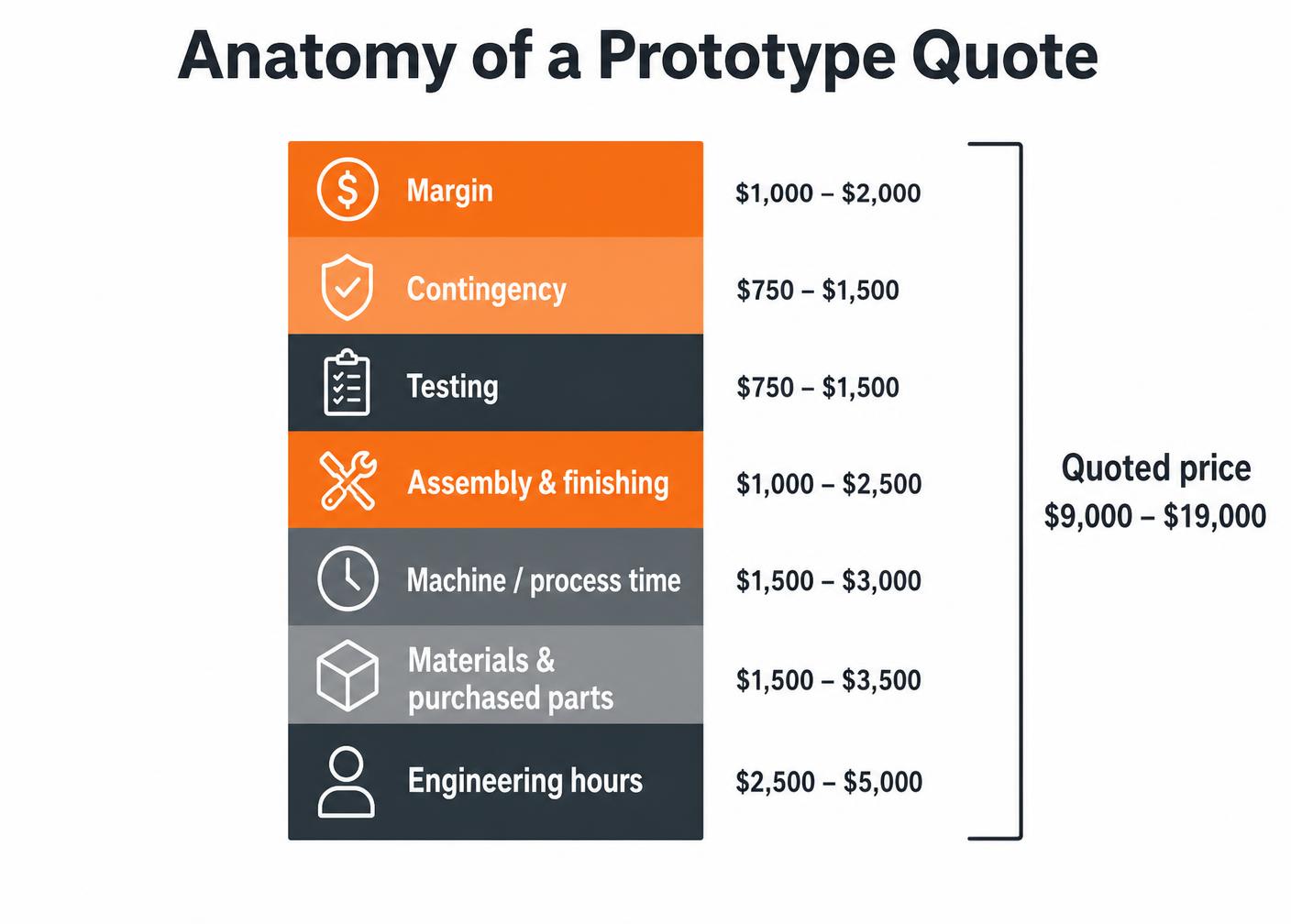
The three estimating methods
Cost estimation as a discipline offers three approaches, and a good prototype estimate usually uses two of them as a cross-check. Using only one is how estimates end up confidently wrong.
Method | How it works | Accuracy | When to use it |
|---|---|---|---|
Expert judgment | An experienced engineer prices it from memory of similar builds | ±40-50% | Very early, before any design exists |
Analogous estimating | Scale the cost of a comparable past project by size or complexity | ±25-35% | Concept stage, when a close analog exists |
Bottom-up estimating | Price every task, part and process, then sum | ±10-20% | Once CAD or a detailed spec exists |
The practical sequence is: expert judgment to decide whether the idea is even affordable, analogous estimating to set a planning budget, then bottom-up estimating before you commit. Asking for a bottom-up estimate when there is no design yet produces a number with false precision — the estimator simply hides assumptions inside it.
An estimate without stated assumptions is not an estimate. It is a guess wearing a suit.
Line 1: Engineering hours
This is the largest line in most prototype budgets and the one clients consistently underestimate. It covers concept work, CAD modeling, drawings, design for manufacturing, electronics schematic and layout, firmware, and the revision cycles that follow testing. US engineering rates for product development typically run $100-$200 per hour.
Estimate it by listing deliverables rather than guessing a total. A moderately complex enclosure with three custom parts might need 20-40 hours of CAD, 8 hours of drawings, and 10-20 hours of revisions after the first build. Electronics adds schematic and layout hours plus firmware, which is nearly always underestimated because bring-up debugging is invisible until it happens.
- How much design work still has to happen? Manufacturable CAD in hand can remove half the budget.
- How many custom parts are there? Each one carries modeling, drawing and revision time.
- Is there firmware or software? Add debugging time equal to at least the development time.
- How many review cycles will stakeholders want? Every round costs hours.
Line 2: Materials and purchased parts
Price the bill of materials at prototype quantity, not production quantity, and expect the difference to be shocking. Components that cost $2 at 10,000 units routinely cost $15 in single quantities, and minimum order quantities force you to buy 100 of a part you need three of.
Add 15-25% to this line for scrap and spares. Printed parts warp, machined parts get scrapped, and something always breaks during assembly. Estimating materials without a scrap allowance is the most common source of small, repeated overruns.
Line 3: Machine and process time
This is fabrication: printer hours, CNC time and setup, casting cycles, sheet metal work, PCB fabrication and assembly. Setup dominates at prototype quantities — a CNC job may take 20 minutes to cut and three hours to program and fixture, and you pay for both.
Process | How it is usually priced | What inflates it |
|---|---|---|
FDM / SLA printing | Per part by volume and time | Support removal, large parts, fine layers |
CNC machining | Setup fee plus run time | Multiple setups, deep pockets, tight tolerances |
Urethane casting | Master pattern plus per-part cost | Multi-part molds, undercuts, clear parts |
PCB fabrication | Per panel, tiered by turnaround | Layer count, small vias, fast-turn premiums |
Sheet metal | Setup plus per-bend and per-cut | Tight bend tolerances, welding, finishing |
Line 4: Assembly and finishing
Assembly labor is straightforward to estimate — hours times rate — but finishing surprises people. Sanding, priming, painting, texturing, polishing and applying graphics on an appearance model frequently costs more than making the parts. A raw SLA print might be $200; the same part sanded, primed and painted to a Class A finish can be $1,200.
Decide explicitly whether finish is part of what you are testing. If the prototype exists to prove a mechanism works, skip finishing entirely and put the money into a second iteration.
Line 5: Testing and validation
Budget for the tests you actually intend to run: drop testing, cycle testing, environmental exposure, EMC pre-scans, usability sessions. Formal certification testing is a separate and much larger expense that belongs in the production budget, but pre-compliance scans during prototyping are cheap insurance and prevent late redesigns.
Testing also consumes prototypes. If you plan to test to destruction, the estimate must include building more than one unit — a line item teams forget until the first one breaks.
Contingency: how much is honest
Contingency is not padding; it is a statement about how much is still unknown. Set it against the maturity of the design rather than picking a comfortable percentage.
Design maturity | Recommended contingency | Why |
|---|---|---|
Idea or sketch only | 40-50% | Scope will change as the design becomes real |
Concept design complete | 25-35% | Major decisions made, details still open |
Detailed CAD complete | 15-20% | Mostly execution risk and part availability |
Second or later iteration | 10-15% | Known process, known parts, known team |
Also budget for iterations rather than a single build. Two to four prototypes is normal, and a program that budgets for one is a program that runs out of money exactly when it starts learning something. A defensible planning approach is to budget the first build in detail and reserve 60-100% of that figure for the iterations that follow.
Reading and comparing quotes
Two quotes for the same prototype can differ by 3x and both be legitimate, because they are quoting different work. Before comparing numbers, normalize scope.
- Is design included? A fabrication-only quote excludes the largest cost line.
- How many revisions are included? "One round" versus "until it works" is an enormous difference.
- Who owns the CAD and design files? If you do not own them, the second quote is captive.
- Is finishing included, and to what standard? Ask for a reference photo, not an adjective.
- Are testing and materials included or billed at cost?
- What is the change-order rate? This is where cheap quotes become expensive projects.
- Is shipping, tariff and lead-time risk on you? Overseas quotes often exclude all three.
A quote that arrives within an hour of a one-paragraph description is not an estimate of your product; it is a rate card. Useful quotes come with questions attached.
A worked example
A small consumer device: injection-molded-style enclosure with three custom parts, an off-the-shelf sensor module, a rechargeable battery and a simple app connection. Estimating bottom-up at concept stage:
Line | Estimate | Basis |
|---|---|---|
Engineering hours | $6,000 | 40 hours CAD and drawings at $150/hr |
Materials and purchased parts | $1,800 | BOM at qty 3 plus 20% scrap allowance |
Machine and process time | $2,400 | SLA parts, one CNC part, PCB assembly |
Assembly and finishing | $1,500 | 10 hours assembly, light finish only |
Testing | $900 | Drop, cycle and battery run-down testing |
Subtotal | $12,600 | |
Contingency at 30% | $3,780 | Concept design complete, details open |
Planning figure | ≈$16,400 | First iteration only |
Then reserve roughly $10,000-$16,000 for the second and third iterations. The result is a program budget rather than a single invoice, which is the number that actually matters when you are raising or allocating funds.
How to make your estimate more accurate
- Supply CAD if you have it; it converts the largest line from guesswork to quotable work.
- Write down what the prototype must prove, in one sentence, and share it with every vendor.
- State your target production cost per unit — it changes material and process recommendations immediately.
- Give a real deadline. Expedited turnaround is priced as a premium and should be a choice, not a surprise.
- Ask for the estimate broken into the five lines above so you can see which assumptions differ between bids.
- Reprice after every iteration; the second estimate is always far better than the first.
If you want a fast planning number before talking to anyone, our prototype cost calculator produces a ballpark from a few questions about your product.
Get a real estimate for your prototype
LA NPDT provides itemized prototype estimates broken into engineering, materials, fabrication, assembly and testing, so you can see what you are buying and where the risk sits. We design and build in-house — concept design, 3D modeling, electronics and short-run manufacturing — which keeps change orders rare.
Want an itemized estimate for your prototype?
Work with LA NPDT: if you are moving from here to execution, start with our rapid prototyping services or talk to us about prototype design.
Building a budget for a federal award? Read the SBIR commercialization plan reviewers believe and how we scope SBIR prototype work by phase.
Frequently asked questions
How do you estimate the cost of a prototype?
Build the estimate from five lines — engineering hours, materials and purchased parts, machine or process time, assembly and finishing, and testing — then add contingency based on how mature the design is. Cross-check the total against a comparable past project. At concept stage expect ±25-35% accuracy; once detailed CAD exists a bottom-up estimate can reach ±10-20%.
What are the three main methods of cost estimating?
Expert judgment, where an experienced engineer prices from memory of similar work; analogous estimating, where a comparable past project is scaled by size or complexity; and bottom-up estimating, where every task, part and process is priced individually and summed. Bottom-up is the most accurate but requires a design detailed enough to decompose.
How much contingency should I add to a prototype budget?
Roughly 40-50% when you only have a sketch, 25-35% after concept design, 15-20% once detailed CAD is complete, and 10-15% for a repeat iteration with a known team and process. Contingency should reflect real remaining uncertainty; a flat 10% on an undefined product is optimism, not planning.
Why do prototype quotes vary so much between vendors?
Usually because they are quoting different scopes. Design work, number of included revisions, finishing standard, testing, file ownership and change-order rates differ enormously and are often unstated. Normalize the scope across bids before comparing totals — the cheapest quote frequently excludes the engineering that dominates the real cost.
Should I include the cost of multiple iterations in my estimate?
Yes. Two to four prototypes is typical before a design is stable enough to tool. A practical rule is to estimate the first build in detail, then reserve 60-100% of that figure for later iterations. Budgeting for a single prototype is the most common reason hardware programs stall midway through development.
How accurate can a prototype estimate be before there is a design?
Expect ±40-50% from expert judgment alone. That is still useful — it answers whether the project is a $15,000 exercise or a $150,000 one — but it should never be treated as a commitment. Accuracy improves sharply once concept design is complete and again once CAD exists, which is why estimates should be revisited at each of those milestones.
Filed under:EducationInspirationWords
Services related to this guide
- Free prototype cost calculatorFive to eight questions, an instant cost range for a first prototype.
- Prototype designLooks-like, works-like or pre-production: what each proves and what it costs.
- Rapid prototypingWorking prototypes in days, from 3D printing to vacuum casting.
- Best product development companiesHow the leading US firms compare, and which one fits your stage and budget.