IoT for Small Business: Costs, Use Cases and Build Steps
How electronic design actually runs: the workflow from block diagram to DFM review, what each check catches, and the mistakes that force a board re-spin.
January 13, 20225 min read

Written by Ashok Chintagunta, MS Computer Science, Louisiana Tech University
CTO & Software Engineer, AI and Automation
Published January 13, 2022Updated September 3, 2026
IoT for small business succeeds or fails on recurring cost, not on the demo. Connectivity fees, cloud storage, certification and firmware maintenance outlive the build budget, and most of them are locked in during electronic design. Cost comes from decisions made in the wrong order - choosing parts before the power budget exists, or laying out a board before the mechanical outline is frozen.
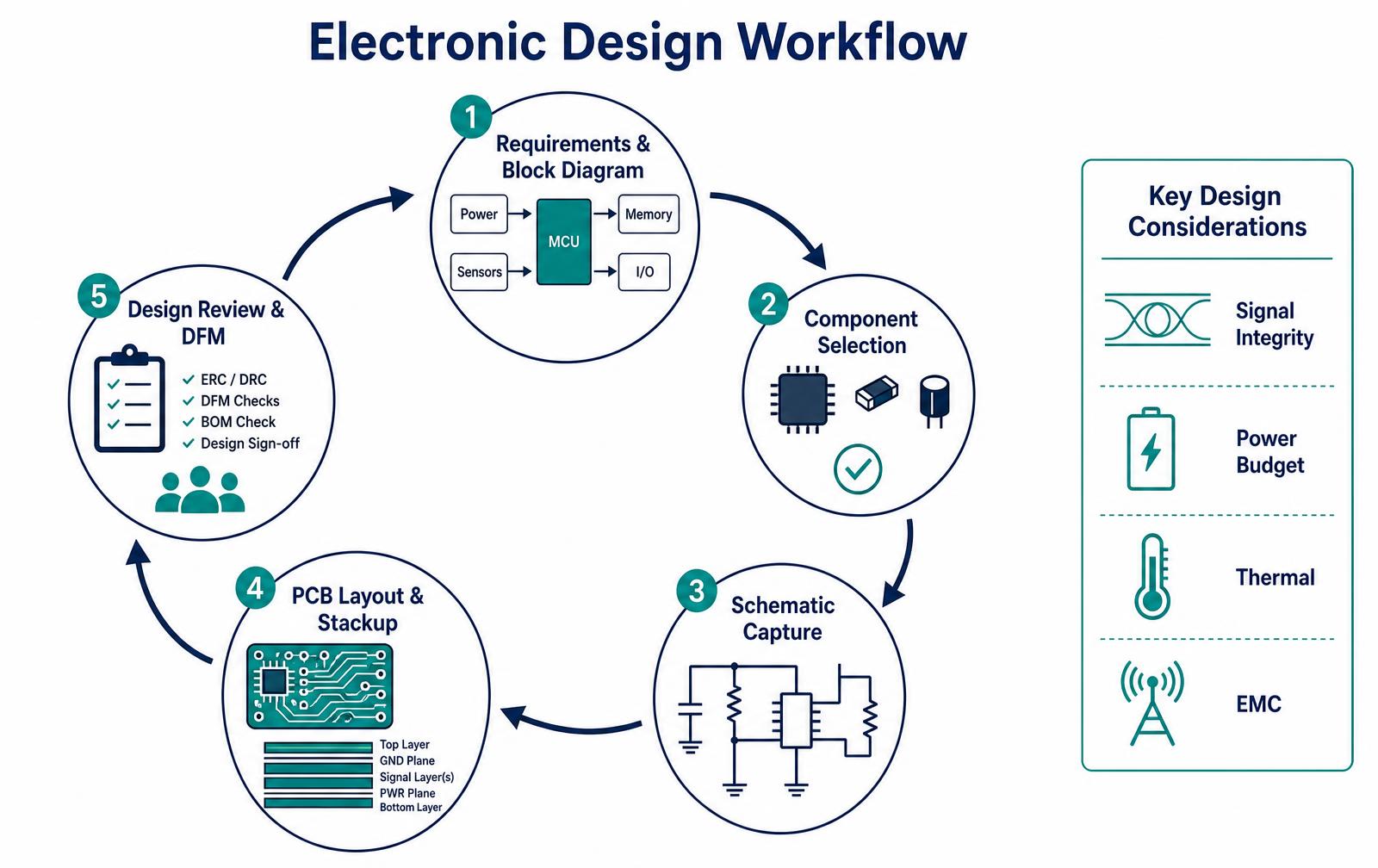
The five steps and what they own
Step | Owns | Exit criterion | Typical duration |
|---|---|---|---|
Requirements and block diagram | Interfaces, power budget, connectivity | Signed block diagram and BOM cost target | 1-3 weeks |
Component selection | Silicon, passives, connectors, second sources | Every critical part has an approved alternate | 1-3 weeks |
Schematic capture | Topology, protection, test points | Peer review with ERC clean | 2-5 weeks |
PCB layout and stackup | Placement, routing, impedance, thermals | DRC clean plus signal and power integrity review | 2-6 weeks |
Design review and DFM | Manufacturability, testability, BOM risk | Fab and assembly house sign-off | 1-2 weeks |
Four constraints that run through every step
- Signal integrity. Controlled impedance, return paths and length matching are stackup decisions, not routing afterthoughts.
- Power budget. Worst-case current per rail, sequencing and decoupling strategy belong in the architecture document.
- Thermal. Copper area, via stitching and component placement decide junction temperatures long before an enclosure exists.
- EMC. Clock edges, cable entry points and ground partitioning determine whether formal testing passes on the first attempt.
Pitfalls that force a re-spin
- No test points. A board you cannot probe or program in fixture costs money on every unit built.
- Single-sourced parts. One obsolete regulator can hold an otherwise finished product for months.
- Antenna placed last. Keep-out zones and ground plane geometry have to be reserved during placement.
- Skipping a pre-scan. A few hours in a pre-compliance chamber routinely saves a failed formal EMC booking.
- Ignoring assembly rules. Courtyard spacing, panelisation and fiducials should come from the assembler, not from defaults.
Related reading: our electronic design services and designing for manufacturability.
What an IoT rollout actually costs
Item | Pilot (5 devices) | Rollout (50 devices) | Notes |
|---|---|---|---|
Hardware per node | $60-$250 | $45-$180 | Off-the-shelf sensors beat custom under 500 units |
Connectivity | $3-$8 per device per month | $2-$6 per device per month | Cellular costs more than Wi-Fi but avoids IT tickets |
Cloud platform | $0-$100 per month | $100-$600 per month | Managed platforms beat self-hosting at this scale |
Integration and dashboards | $5k-$20k | $15k-$60k | Where most of the budget actually goes |
Ongoing support | 10-15% per year | 10-15% per year | Firmware updates, replacements, credentials |
Security basics you cannot skip
- Unique credentials per device. Shared default passwords are how fleets get taken over.
- Signed over-the-air updates. If you cannot patch remotely, you will run vulnerable firmware for years.
- Network segmentation. Put devices on their own VLAN so a compromised sensor cannot reach accounting.
- Encrypt in transit. TLS to the broker or platform, with certificate validation actually enabled.
- Plan for device retirement. Revoke credentials and wipe data when hardware leaves service.
Starting small: the first sensor that pays for itself
Small businesses get value from connected devices when the sensor answers a question that currently costs money to answer by hand.
Temperature logging in a walk-in cooler prevents an inventory loss that has already happened at least once. A runtime counter on a compressor turns guessed maintenance into scheduled maintenance. A door or occupancy sensor validates whether an assumption about foot traffic is true.
Each of these is a few hundred dollars of hardware and a modest monthly service fee, and each has a payback you can calculate before buying. The projects that fail are the ones that start with a platform and then look for something to measure.
Typical starter deployments and payback
Application | Hardware cost | Monthly cost | Typical payback | Main benefit |
|---|---|---|---|---|
Cold storage monitoring | $150-$600 per unit | $5-$20 | 1-6 months | Prevents spoilage losses and supports compliance records |
Equipment runtime and vibration | $200-$1,200 per machine | $10-$40 | 6-18 months | Maintenance before failure instead of after |
Energy submetering | $300-$1,500 per panel | $10-$30 | 12-24 months | Finds the loads that actually drive the bill |
Occupancy and door counting | $100-$400 per door | $5-$15 | 3-12 months | Staffing and hours based on data |
Asset and inventory tracking | $5-$50 per tag | $20-$100 | 6-24 months | Less searching, fewer duplicate purchases |
Avoiding the common traps
- Start with one question, one location and a thirty-day pilot before scaling.
- Check connectivity first: wifi coverage in a cooler or a metal building is often the real project.
- Route alerts to a person with authority to act, or they become noise within a week.
- Ask who owns the data and whether you can export it if you leave the vendor.
- Change default credentials and segment the network; cheap devices are a common entry point.
- Budget the recurring cost over three years, not just the hardware.
Connectivity and security basics
The technology choice that most often derails a small deployment is connectivity.
Wifi is free and already installed but rarely reaches a metal cooler, a back lot or a basement panel. Cellular works nearly anywhere for a few dollars per device per month; LoRaWAN and similar low-power networks cover a whole site cheaply but move only small amounts of data.
Pick based on where the sensor physically sits, then confirm with a signal test before ordering quantity.
On security, the baseline is unglamorous and sufficient for most small businesses: change default credentials, put devices on their own network segment, keep firmware updated, and choose vendors who publish an update policy.
- Test signal at the exact mounting location before buying more than one unit.
- Use cellular for remote or shielded locations; the monthly fee is cheaper than a failed rollout.
- Segment IoT devices onto their own VLAN or guest network.
- Change every default password and disable unused remote access.
- Confirm the vendor ships firmware updates and how long support lasts.
- Check battery life claims against your reporting interval, which usually halves them.
A three-month plan for IoT for small business
Small-business IoT projects fail when they start with a platform decision instead of a measurement. The sequence that works is narrow: pick one loss you can already quantify, instrument it cheaply, prove the number moves, then expand. Three months is enough to know whether the idea deserves capital.
Phase | Weeks | Spend | Decision at the end |
|---|---|---|---|
Define the loss | 1–2 | Internal time | One metric with a dollar value |
Off-the-shelf pilot | 3–6 | $1.5k–$6k | Does the data match reality? |
Operational trial | 7–10 | $2k–$8k | Does anyone act on the alerts? |
Scale or stop | 11–13 | $5k–$40k | Rollout plan with a payback figure |
Recurring costs that decide whether it stays deployed
- Connectivity. Cellular IoT plans run $1–$6 per device per month; Wi-Fi is free until it isn't reliable.
- Cloud and storage. Usually pennies per device, but dashboards and per-seat licenses are not.
- Battery replacement. A sensor at a two-year battery life on a ladder costs more in labor than in hardware.
- Firmware maintenance. Security updates are ongoing work, not a one-time task.
- Alert fatigue. Poorly tuned thresholds get muted, and a muted system saves nothing.
- Ownership. Name the person who checks it weekly, or the deployment quietly dies.
Once a pilot proves the value, a purpose-built device usually costs less to run than stacked off-the-shelf hardware — that is the point where our electronic design services take over.
Key takeaways
IoT pays off for small businesses when it replaces a manual check or prevents a loss that has already occurred, and it disappoints when it starts as a platform purchase. Pick one measurable problem, pilot it for a month with a payback you can calculate, verify connectivity and data ownership up front, and scale only after the first deployment has demonstrably saved money.
Frequently asked questions
What is electronic design?
Electronic design is the engineering work that turns a product requirement into a manufacturable circuit: defining architecture and power budgets, selecting components, capturing a schematic, laying out the PCB with a defined stackup, and reviewing the result for signal integrity, thermals, EMC and manufacturability.
How much does electronic design cost?
A simple two to four layer board typically costs $12,000 to $35,000 through schematic and layout. Multi-rail designs with wireless connectivity or high-speed interfaces usually run $40,000 to $120,000, with firmware and compliance testing budgeted separately.
How many board revisions should I plan for?
Two is the realistic planning number for a new design: a first prototype to prove function, and a second to fold in bring-up fixes, EMC changes and DFM feedback. Each revision adds roughly four to six weeks including fabrication and assembly.
Choosing connectivity for IoT for small business
The connectivity decision determines recurring cost, installation effort and how long a battery-powered sensor lasts. For IoT for small business deployments, picking the simplest option that covers the site usually beats picking the most capable one.
Connectivity options compared
Option | Range | Power use | Recurring cost | Best fit |
|---|---|---|---|---|
Wi-Fi | Building | High | None beyond internet | Powered devices near APs |
Bluetooth LE | Room | Very low | None | Phone-adjacent sensors |
LoRaWAN | Campus / km | Very low | Gateway plus low fees | Battery sensors across a site |
Cellular LTE-M / NB-IoT | Wide | Low | Per device per month | Vehicles, remote assets |
Ethernet | Wired | N/A | None | Fixed critical equipment |
Zigbee / Thread | Building mesh | Low | None | Dense indoor sensor networks |
Whatever the choice, calculate the five-year total cost including subscription fees, battery replacement labor and gateway maintenance. A cheaper device with a monthly fee frequently costs more than a more expensive one on a local network.
Connectivity checklist
- Survey signal coverage at the actual install locations.
- Model five-year total cost including subscriptions and battery swaps.
- Confirm the data volume each device actually needs.
- Plan device provisioning and firmware updates before deployment.
- Verify what happens to data when connectivity drops.
Key takeaways
- Pick the simplest connectivity that covers the site.
- Model five-year total cost, not device price.
- Plan firmware updates and offline behavior before deployment.
Considering connected devices for your operation?
Work with LA NPDT: if you are moving from here to execution, start with our electronic design services or talk to us about IoT development.
Services related to this guide
- Electronic design servicesSchematic, PCB layout, firmware and bring-up, through to production handoff.
- Rapid prototypingWorking prototypes in days, from 3D printing to vacuum casting.
- Product design servicesIndustrial design and CAD taken all the way to manufacturable files.
- Product development examplesReal projects we designed, prototyped and shipped.