How Long Does It Take to Build a Prototype?
Realistic prototype timelines by type, what actually eats the calendar, a week-by-week 10-week schedule, and six ways to build faster without ruining the result.
February 1, 20237 min read

Written by Konstantin Dolgan, Ph.D., NPDP
Founder & CEO, Product Development Engineer
Published February 1, 2023Updated September 2, 2026
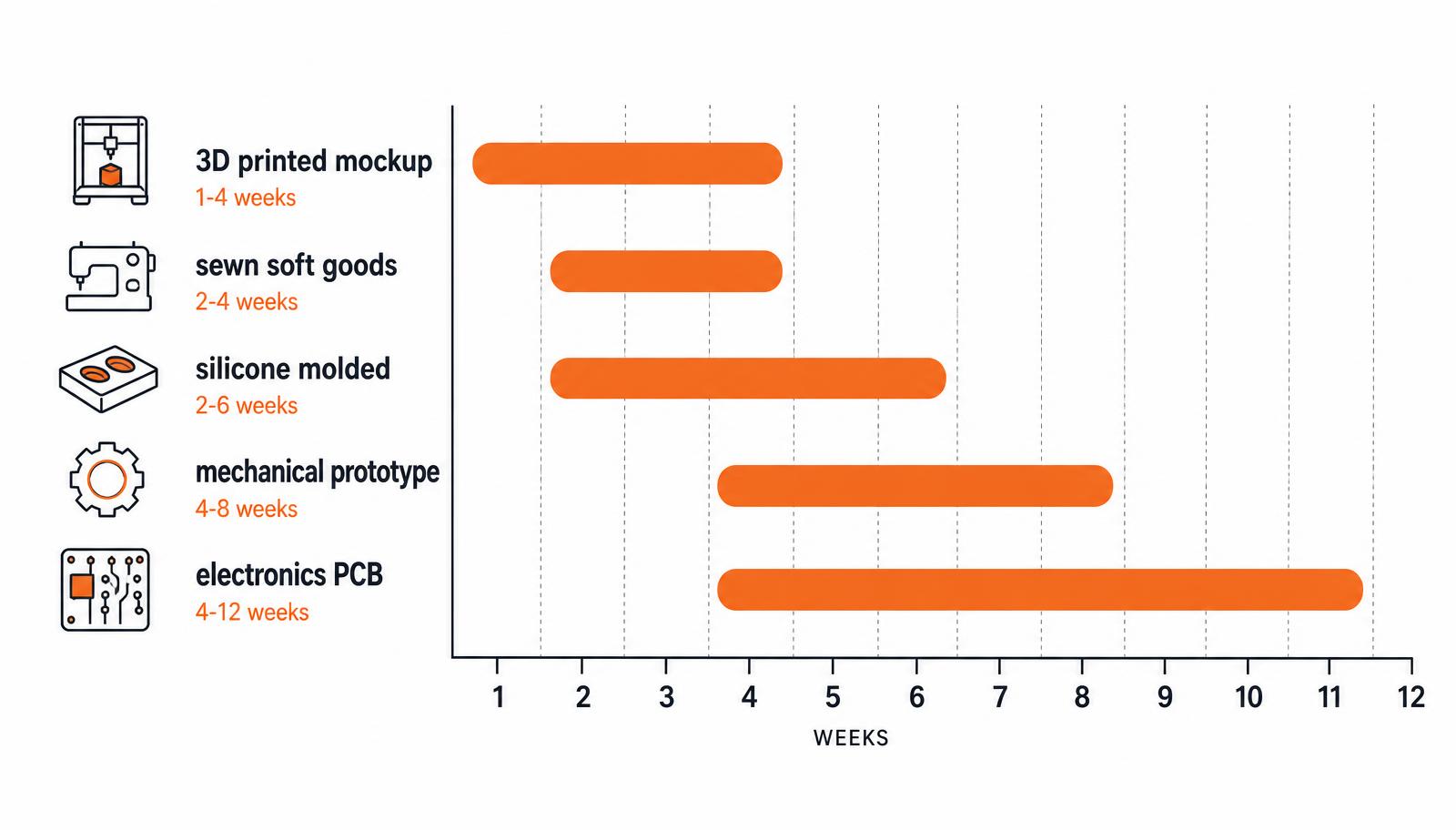
Most prototypes take between one and twelve weeks to build. A simple 3D printed appearance model takes 1-4 weeks, a sewn soft-goods sample 2-4 weeks, a silicone molded part 2-6 weeks, a working mechanical prototype 4-8 weeks, and a custom electronics prototype with its own PCB 4-12 weeks. A full invention prototype that looks and works like the final product typically lands at 1-2 months per iteration, and most products need two or three iterations.
The number people usually want — "how fast can you build mine?" — depends less on the printer and more on how ready the design is. Below is the realistic breakdown by prototype type, what actually consumes the calendar, how to compress the schedule without wrecking the result, and what a two- to three-iteration program looks like end to end.
Prototype build times by type
Prototype type | Typical time | What drives the range |
|---|---|---|
3D printed appearance model | 1-4 weeks | Part size, finish quality, painting and post-processing |
Machined (CNC) prototype | 2-5 weeks | Material, number of setups, shop queue |
Silicone / urethane cast parts | 2-6 weeks | Master pattern quality, number of copies, color matching |
Sewn or soft-goods sample | 2-4 weeks | Pattern making, fabric sourcing, sample-maker availability |
Mechanical working prototype | 4-8 weeks | Number of moving parts, tolerance requirements, off-the-shelf lead times |
Custom electronics (PCB) prototype | 4-12 weeks | Schematic and layout, board fab, component lead times, firmware bring-up |
Full looks-like/works-like invention prototype | 6-12 weeks | Integration of mechanical, electronics and finish in one unit |
These are build windows measured from a frozen design. If you are still deciding what the product does, add the design phase in front of them — that is usually another 2-6 weeks of concept design and CAD.
Watch: how long a prototype really takes
What actually consumes the schedule
Printing time is rarely the bottleneck. On a typical hardware project, machine time is a single-digit percentage of the calendar. The real consumers are decisions, procurement and iteration.
- Design readiness. A prototype cannot start until someone has decided what it is. Unresolved requirements are the number one schedule killer.
- Component lead times. A motor, sensor, pump or display on a 10-week lead time sets the floor for the whole build, no matter how fast the shop is.
- Iteration count. Almost nothing is right on the first build. Plan two to three loops; each loop is roughly a third of the original build time.
- Review cycles. Every approval that waits a week adds a week. Fast projects are almost always projects with a decisive owner.
- Certification and test rigs. If the product touches skin, food, mains power or the body, add time for test-ready samples.
- Finishing. Paint, texture, print and assembly on an appearance model can take longer than making the parts.
A realistic 10-week schedule for a first physical product
Week | Activity | Output |
|---|---|---|
1 | Requirements, benchmarking, sketch concepts | Agreed product definition |
2-3 | CAD modeling and design for manufacturability review | Manufacturable 3D model |
4 | Order long-lead components, release parts to print/machine | Purchase orders placed |
5-6 | Build iteration 1, assemble, first function test | Works-like prototype |
7 | Test, capture failures, revise CAD | Change list |
8-9 | Build iteration 2 with finishes | Looks-like/works-like unit |
10 | User testing, photography, cost and tooling review | Decision-ready prototype |
That schedule assumes decisions land within a day or two and no component sits on allocation. It is the pace we target on rapid prototyping programs, and it is roughly the pace the NIST Manufacturing Extension Partnership describes for small-batch hardware development in the United States.
How to build a prototype faster without ruining it
- Split looks-like from works-like. Two simple prototypes built in parallel are almost always faster than one perfect one built in series.
- Use off-the-shelf guts. Development boards, stock motors and standard fasteners save weeks; custom everything is what turns 6 weeks into 6 months.
- Freeze the interface, not the styling. Fix mounting points and internal volume early so the enclosure can be reprinted without touching the mechanism.
- Order long-lead parts before CAD is final. If a component is certain to be in the product, buy it in week one.
- Batch your changes. Collect failures from a full test round instead of rebuilding after every observation.
- Work with one team, not five vendors. Handoffs between a designer, an engineer, a shop and a firmware contractor are where weeks disappear.
The fastest prototype programs are not the ones with the fastest machines. They are the ones where nobody is waiting for a decision.
How long by product category
Product | Realistic first prototype | Notes |
|---|---|---|
Simple housewares item | 2-4 weeks | Printed or cast, minimal mechanism |
Consumer electronics device | 8-12 weeks | PCB fab plus firmware bring-up dominate |
Medical device (early stage) | 8-16 weeks | Documentation and biocompatible materials add time |
Mechanical tool or attachment | 4-8 weeks | Machining and load testing drive the schedule |
Soft goods / wearable | 3-6 weeks | Pattern iterations, fabric sourcing |
Mobile app or software prototype | 2-6 weeks | Wireframe to clickable to functional build |
Regulated categories carry the widest spread. Our medical device prototyping projects usually run longer than the mechanical equivalent because samples must be traceable, and materials must be documented before testing counts for anything.
How long before the prototype turns into a product?
After a decision-ready prototype, tooling and pilot production typically add 3-6 months for an injection-molded consumer product. Most hardware startups should plan on roughly a year from idea to first sellable units, and closer to two years if the product is regulated or requires custom electronics at volume.
Our new product development process map lays out the full sequence, and short-run manufacturing is often the bridge that lets you sell before hard tooling exists.
Frequently asked questions
How long does it take to build a prototype?
One to twelve weeks for most products, measured from a frozen design. Printed mockups take 1-4 weeks, mechanical working prototypes 4-8 weeks and custom electronics 4-12 weeks. A complete looks-like and works-like invention prototype usually takes 1-2 months per iteration, with two or three iterations before it is decision-ready.
How much does it cost to have a prototype built?
Most professionally built prototypes fall between $3,000 and $25,000 depending on complexity, iterations and whether custom electronics are involved. Simple printed models can be a few hundred dollars; integrated electromechanical products routinely pass $30,000. See our detailed breakdown of what a prototype costs to make.
Can a prototype be built in a week?
Yes, if the design is already complete, the parts are printable and no custom electronics or long-lead components are involved. A one-week prototype is an appearance model or a rough proof of concept — useful for a pitch or a form study, not for validating that the product works.
What are the steps to making a prototype?
Define requirements, sketch concepts, build a CAD model, review it for manufacturability, order long-lead components, fabricate parts, assemble, test against the requirements, and revise. Repeat the last four steps until the prototype answers the question you built it to answer.
Why does my prototype need multiple iterations?
Because each build answers a different question. The first proves the mechanism, the second proves the integration and fit, and the third proves the finish and manufacturability. Skipping iterations does not save time — it moves the discovery into tooling, where changes cost ten to a hundred times more.
Planning your own prototype timeline
Take your product category from the table above, add 2-6 weeks of design if the CAD does not exist yet, add the longest component lead time, and multiply the build window by the number of iterations you expect. That number is your honest timeline — and it is the one worth budgeting against.
LA NPDT builds mechanical, electronic and appearance prototypes under one roof in Shreveport, Louisiana, which removes most of the handoff delay from that math. Send us your sketches or CAD and we will come back with a schedule and a fixed quote for the first iteration.
Where prototype schedules actually slip
Quoted build times describe the shop's hours, not your calendar. A prototype timeline usually stretches on the surrounding activities: waiting for a decision, waiting for a part, waiting for a review. Knowing which of these dominate lets you shorten the parts that are actually long.
Typical time split on a first prototype
Activity | Typical duration | Compressible? |
|---|---|---|
Requirements and concept decisions | 1-3 weeks | Yes, with a decision owner |
CAD and design | 2-4 weeks | Partly, with reused modules |
Quoting and purchasing | 3-10 days | Yes, with pre-approved vendors |
Part fabrication | 3-15 days | Somewhat, at higher cost |
Electronics lead time | 1-6 weeks | Only by choosing stocked parts |
Assembly and bring-up | 3-10 days | Rarely |
Test and evaluation | 1-2 weeks | No, without losing the point |
Approval latency is the most compressible item on the list and the least discussed. Naming one person who can approve a design within 48 hours routinely saves more calendar time than paying for expedited machining.
Schedule protection checklist
- Name a single decision-maker with a 48-hour response commitment.
- Pre-approve vendors so purchasing does not restart each round.
- Choose in-stock electronic components for the first build.
- Order long-lead items in parallel with CAD, not after it.
- Book test time and equipment before the parts arrive.
Key takeaways
- Waiting, not machining, consumes most of a prototype timeline.
- A named decision-maker saves more time than expedited fabrication.
- Order long-lead parts in parallel with design work.
What actually consumes the calendar
Teams estimate prototype schedules by adding up machine time, which is usually the smallest number in the project. The calendar is consumed by decisions, procurement and revisions. On a typical mechanical prototype, active fabrication is three to five days inside a six-week schedule; the rest is waiting for a decision, waiting for a part or rebuilding after a test result.
Activity | Share of elapsed time | Compressible? |
|---|---|---|
Requirements and decision-making | 25% | Yes — pre-book the review dates |
Design and CAD | 20% | Partly — only with a frozen scope |
Purchased-part lead time | 30% | Rarely — order long-lead items on day one |
Fabrication and finishing | 15% | Yes — pay for expedite where it matters |
Assembly, debug and test | 10% | No — cutting this creates rework |
How to compress a prototype schedule without buying a bad result
- Order the long-lead items before the design is finished. Displays, sensors, motors and custom cells drive the date more than any CAD decision.
- Book the review meetings when the project starts. Waiting for calendars is the single most common two-week loss.
- Split fidelity. A rough looks-like model and a separate works-like rig in parallel usually beat one integrated build by two to three weeks.
- Write the test plan before the build. If nobody knows what the prototype must prove, the first build proves nothing and you pay for a second.
- Cap the iteration count in advance. Two rounds with defined exit criteria finish; open-ended refinement does not.
Compression has a floor. Physical processes — curing, plating, anodizing, shipping — do not respond to urgency, and skipping test time simply moves the discovery of a problem into tooling, where each week costs far more. When a date genuinely cannot move, cut scope rather than validation.
Key takeaways
- Machine time is rarely the constraint; decisions and purchased parts are.
- Order long-lead components before the design is frozen.
- Parallel looks-like and works-like builds beat one integrated prototype.
- When the date is fixed, cut scope, never validation.
More questions about prototype timelines
Frequently asked questions
Can a prototype be made in a week?
Yes, when the goal is narrow. A printed appearance model from finished CAD, or a bench rig assembled from catalog parts, can be in your hands in five to seven working days. What cannot happen in a week is a build that needs custom electronics, a purchased long-lead component, or design work that has not started. The honest question is not how fast a prototype can be made but which question the one-week build is allowed to answer.
Why do prototype schedules slip?
Three causes account for most slips: a requirement that changes after the design is underway, a purchased component with a lead time nobody checked, and a review that waits on a calendar. All three are scheduling failures rather than engineering failures, and all three are avoidable by freezing scope, ordering long-lead parts on day one, and booking review dates at kickoff.
How many prototype rounds should I plan for?
Plan two rounds and budget for a third. The first build almost always reveals a fit or usability problem that no drawing review catches; the second confirms the fix and generates the data a tooling quote needs. Programs that budget for only one round do not finish sooner — they simply discover the second round after the money is committed.
Work with LA NPDT: if you are moving from here to execution, start with our rapid prototyping services or talk to us about prototype design.
Filed under:EducationInspirationWords
Services related to this guide
- Best prototyping companiesDevelopment firms, instant-quote bureaus and local shops — who fits which job.
- Free prototype cost calculatorFive to eight questions, an instant cost range for a first prototype.
- Prototype development companiesWhich firms take a sketch to a working prototype — and which only fabricate parts.
- Rapid prototypingWorking prototypes in days, from 3D printing to vacuum casting.