How Much Does a Prototype Cost to Make?
Prototype costs range from under $100 for a cardboard mockup to $50,000+ for automated equipment. Here is what each type actually costs, what drives the price, and how to spend less without wasting the build.
March 1, 20229 min read

Written by Ralph Hill, Mechanical & electrical systems, 3D manufacturing
Prototyping Engineer
Published March 1, 2022Updated September 2, 2026
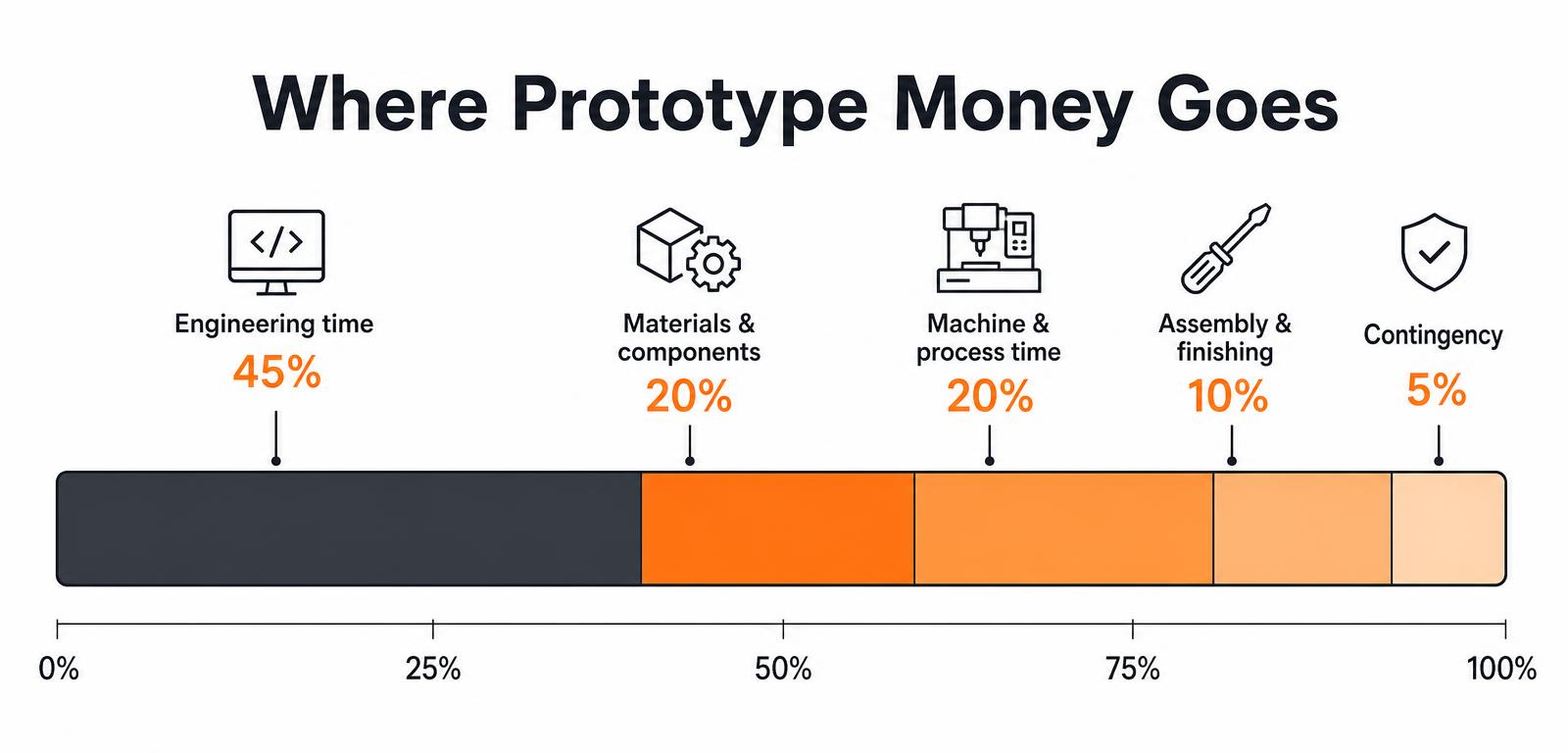
A prototype typically costs between $500 and $30,000, with simple 3D printed appearance models starting around $300 and complex electromechanical prototypes with custom PCBs running $10,000 to $50,000 or more. The single biggest cost driver is not the material — it is engineering time, and specifically how much design work still has to happen before anything can be built.
That range is wide because "prototype" covers everything from a cardboard mockup made in an afternoon to a functioning pre-production unit that has to pass safety testing. This guide breaks the cost down by prototype type, explains the five factors that actually move the number, and covers how to get a useful prototype for less without wasting the build.
Prototype cost by type
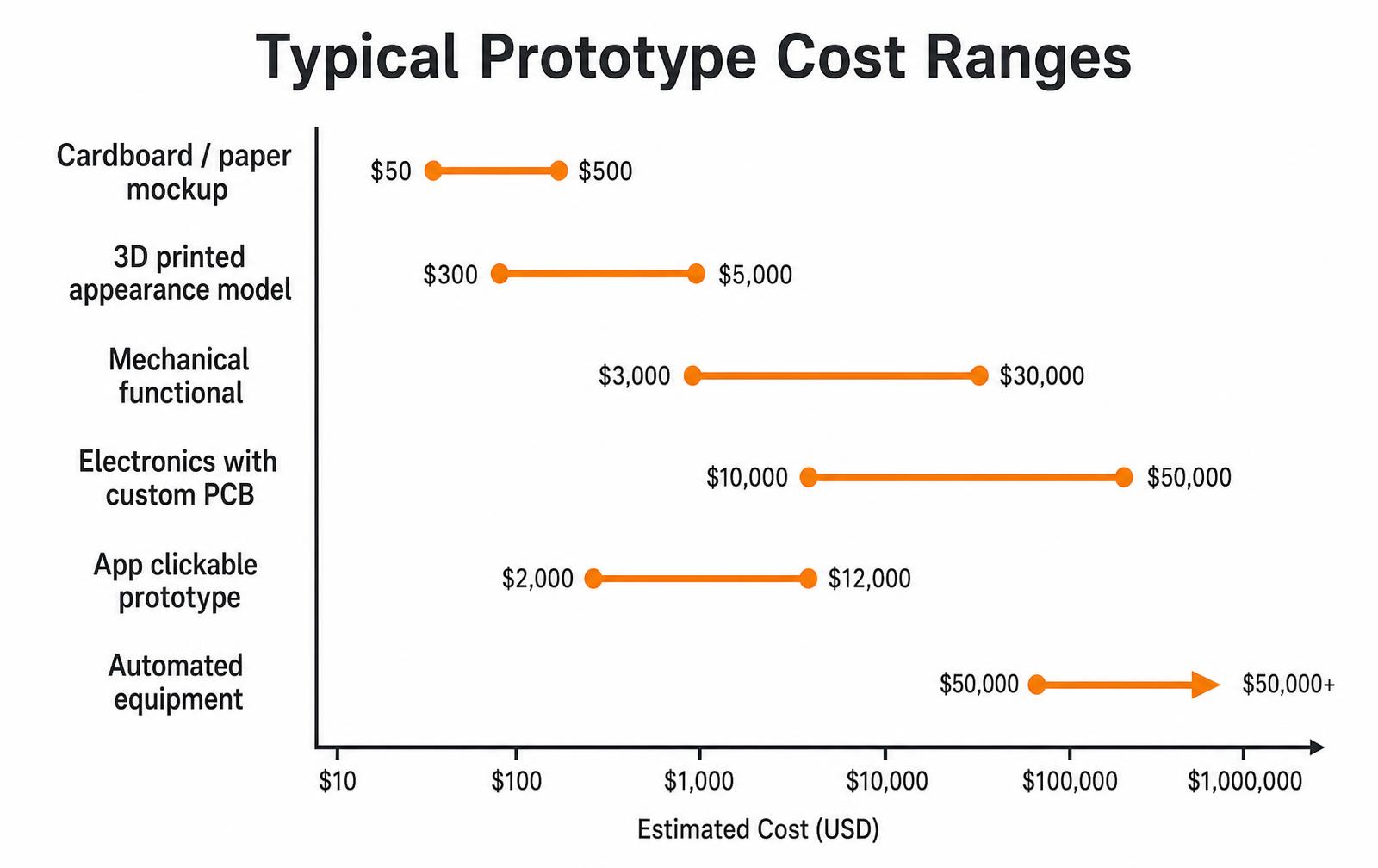
Use these as planning ranges for a single prototype including the engineering needed to build it. Costs assume US-based design and fabrication; overseas builds can be lower on labor but usually add weeks of shipping and revision latency.
Prototype type | Typical cost | Typical timeline | What you learn |
|---|---|---|---|
Paper or cardboard mockup | $50-$500 | 1-3 days | Size, proportion, basic layout |
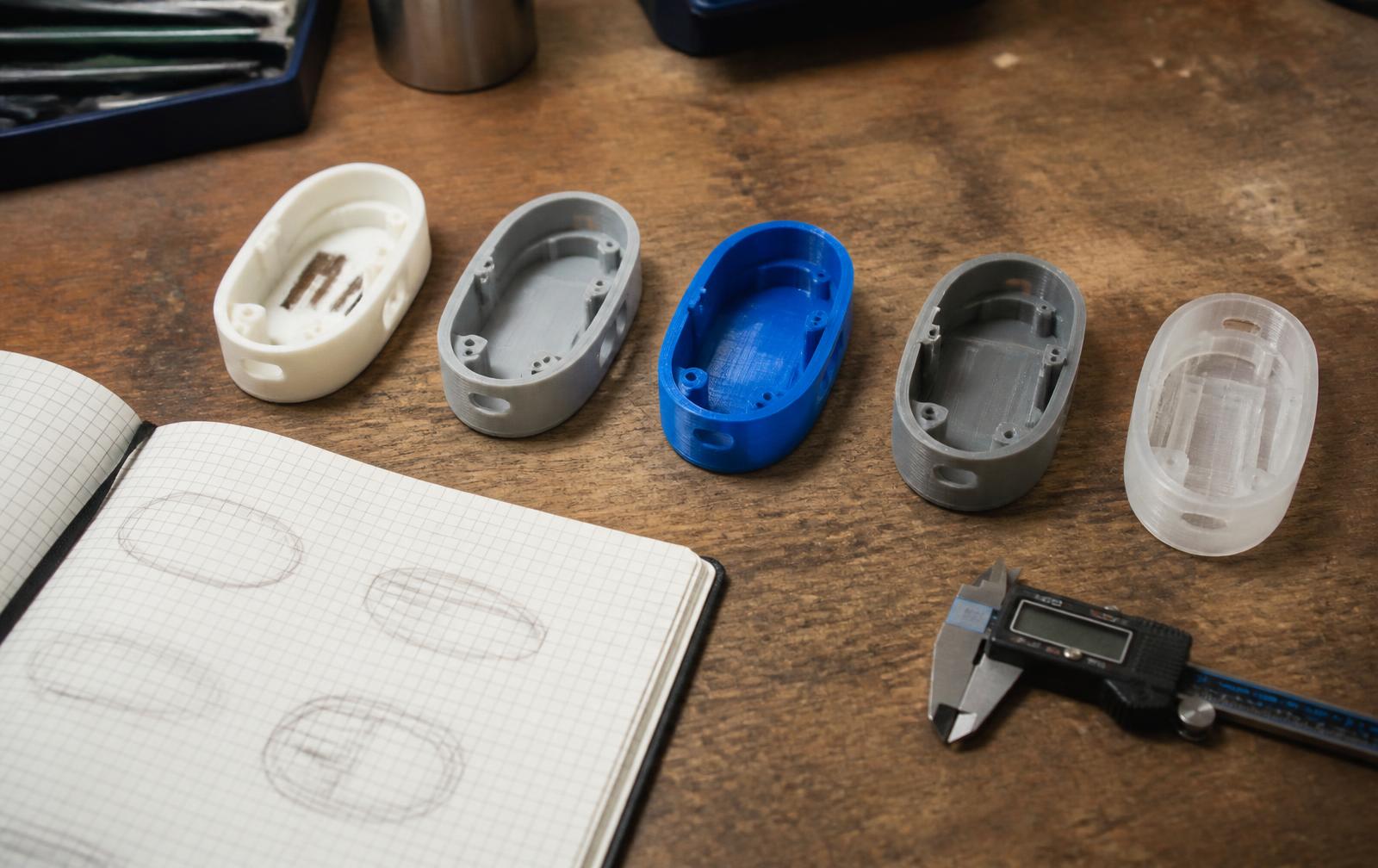
3D printed appearance model | $300-$5,000 | 1-2 weeks | Look, feel, ergonomics, fit |
Mechanical functional prototype | $3,000-$30,000 | 4-8 weeks | Does the mechanism work under load |
Silicone / urethane molded parts | $2,000-$15,000 | 2-6 weeks | Soft-touch parts, small batches, near-production feel |
Fabric or soft-goods prototype | $500-$5,000 | 2-4 weeks | Pattern, fit, material behavior |
Electronics prototype with custom PCB | $10,000-$50,000 | 4-12 weeks | Circuit function, firmware, power, thermal |
Chemical or formulation prototype | $10,000-$50,000 | 3-8 weeks | Stability, efficacy, shelf life |
Mobile app clickable prototype | $2,000-$12,000 | 2-4 weeks | Flow, usability, screen logic |
Mobile app functional prototype | $10,000-$30,000 | 4-10 weeks | Real data, integrations, performance |
Automated equipment / machine | $50,000+ | 3-9 months | Throughput, reliability, safety |
Most consumer hardware programs land in the $5,000-$25,000 range for a first meaningful prototype, then spend a similar amount again across two or three iterations. Budgeting for one prototype is the most common planning error we see.
What actually drives the price
Two prototypes of the same physical size can differ by a factor of ten. These five factors explain almost all of it.
Driver | Low cost end | High cost end |
|---|---|---|
Design maturity | Production-ready CAD and BOM supplied | Sketch or verbal description; design work billed first |
Complexity | Few parts, one material, no electronics | Many interacting parts, custom PCB, firmware, seals |
Fidelity required | Looks-like only, or works-like only | Looks-like and works-like in one unit |
Process and materials | FDM printing, off-the-shelf components | CNC metal, custom silicone tooling, specified medical or food-grade materials |
Iteration count | One build, minor tweaks | Three or more full rebuilds after testing |
Design maturity is worth emphasizing. If you arrive with manufacturable CAD, a bill of materials and clear tolerances, you are paying for fabrication. If you arrive with a sketch, you are paying for product design first — often the majority of the invoice. Neither is wrong, but they are very different quotes, and a shop that gives you a number before knowing which one you are is guessing.
Appearance, functional and pre-production prototypes
The word "prototype" hides three different objects with three different price tags, and asking for the wrong one is the fastest way to overspend.
- Appearance model (looks-like). Correct shape, finish and color; no working internals. Good for investor meetings, packaging design, photography and user reaction. $300-$5,000.
- Functional prototype (works-like). Proves the mechanism, circuit or software. Often ugly, often oversized, often on a bench. $3,000-$30,000.
- Pre-production prototype (looks-like and works-like). Built with near-final materials and processes, used for certification, pilot users and manufacturing validation. Typically the most expensive stage.
Building one unit that does everything at the first attempt is usually the expensive path. Separating looks-like from works-like lets each one be built cheaply, tested, and only merged once both are settled — the sequence we describe in balancing form and function.
What a prototype quote should include
A quote that is only a single number is a risk transfer to you. Ask for the breakdown.
- Engineering hours, separated from fabrication.
- Materials and purchased components, itemized.
- Process costs: machine time, printing, casting, assembly.
- Number of revisions included, and the rate for revisions beyond that.
- Testing and documentation, if any.
- Shipping, handling and any expedite fees.
- Contingency for build failures — 15-25% is normal and honest.
That last item is real. Prototyping is a trial-and-error process; a printed part warps, a board revision has an error, a mold picks up a bubble. Shops that do not carry a contingency simply issue change orders later.
The cheapest prototype is the one that answers your question. Everything else on it is decoration you are paying for.
How payments are usually structured
Most prototyping companies require a deposit before starting, because materials and machine time are committed up front. Deposits commonly range from 30% to 70% of the total. At LA NPDT we work to the industry standard: 50% deposit, with the balance due on completion of each stage.
For multi-stage programs, milestone billing is normal — design, build, test, revise — with a go/no-go decision between stages. That structure protects both sides: you are never more than one milestone deep on a project that is going wrong.
Seven ways to reduce prototype cost
- Arrive with better inputs. Clear CAD, a bill of materials and written requirements can cut the engineering line item substantially.
- Prototype only the risky part. If the uncertainty is one mechanism, build that mechanism, not the whole product.
- Use off-the-shelf components. Every custom part carries design, fabrication and inspection cost. Standard parts carry none.
- Pick the cheapest process that answers the question. FDM for fit checks, SLA for cosmetic review, CNC only when material properties matter.
- Batch your changes. Three small revision requests in one week cost far more than one consolidated revision.
- Simplify geometry. Fewer parts, fewer undercuts, fewer finishes. Complexity costs the same in a prototype as it will in production.
- Plan the iteration count. Budget for two to three prototypes from the start so the second one is not an emergency.
We cover more of these in detail on our rapid prototyping page, and a design for manufacturability review before building often saves more than it costs by removing features that cannot be produced anyway.
How many prototypes will you need?
Most products go through two to four prototypes before launch. Large, complex devices sometimes need only two or three, because each one is expensive and heavily analyzed first. Small, simple products can go through many more, because each iteration is cheap and fast — some consumer accessory programs run dozens of printed iterations in a month.
The right number is the number that retires your remaining risk before tooling. Since injection mold tooling frequently costs $10,000-$100,000 and modifications to hardened steel are expensive, an extra $5,000 prototype that catches a wall thickness problem is a bargain.
How long does it take?
Timelines track complexity more than cost. A simple printed model can be in your hands in a few days. A mechanical functional prototype typically takes four to eight weeks. An electronics prototype with a custom PCB usually runs four to twelve weeks, driven by board fabrication and component lead times. Our full breakdown is in how long it takes to build a prototype.
Component lead times are the most common schedule surprise. Check availability for anything specialized before the design depends on it — a single allocated part can add months regardless of budget.
Prototyping cost in context: what comes next
Prototyping is usually a small fraction of total product development spend. A typical consumer hardware program spends on design and engineering, then prototyping, then tooling and certification, with tooling frequently the largest single line item. Certification testing for regulated categories adds thousands more, and the FDA and CPSC publish the requirements that apply to their categories.
Viewed that way, prototype spending is risk reduction. Its job is to make sure the expensive, irreversible commitments that follow are made with evidence rather than optimism. If you want the full picture before committing, our product development consulting engagements produce a costed plan across all of these stages.
How to get started
Gather what you have before requesting a quote: CAD files if they exist, sketches or reference products if they do not, a written description of what the prototype must prove, target cost per unit at production volume, quantity needed, and your deadline. The more of that you supply, the tighter and more honest the quote will be.
If you do not have CAD, look for a partner who offers design and prototyping together. Handing a design from one company to a fabricator at another adds cost every time a question comes up.
Frequently asked questions about prototype costs
How much does it cost to make a prototype?
Most prototypes cost between $500 and $30,000. A simple 3D printed appearance model typically runs $300 to $5,000, a mechanical functional prototype $3,000 to $30,000, and an electronics prototype with a custom PCB $10,000 to $50,000. Cardboard and paper mockups can be under $500; automated equipment prototypes exceed $50,000. Engineering time, not material, is the dominant cost in nearly every case.
Why are prototypes so expensive?
Because a prototype is a one-off. There is no volume to spread setup, programming, fixturing and engineering time across, so the first unit absorbs all of it. Add specialized equipment, skilled labor, and a realistic failure rate — printed parts warp, boards need respins — and the per-unit cost of one prototype can exceed the eventual production cost by orders of magnitude. That is normal and expected.
How much does a 3D printed prototype cost?
A small FDM printed part for a fit check can cost tens of dollars. A finished SLA appearance model with sanding, priming and paint typically runs $300 to $5,000 depending on size, part count and finish quality. Finishing labor often exceeds the printing cost, so ask whether a quote is for a raw print or a finished model.
How much does an electronics prototype cost?
Expect $10,000 to $50,000 for a functional electronics prototype with a custom PCB, covering schematic design, layout, board fabrication, components, assembly, firmware and bring-up debugging. Using an off-the-shelf development board for the first proof of concept can bring the initial cost down to a few thousand dollars, with the custom board designed only after the concept is proven.
Do I need CAD files before getting a prototype quote?
No, but CAD changes what you are buying. With manufacturable CAD you are paying for fabrication. Without it, design work has to happen first and usually represents the larger part of the invoice. Either way, provide a written description of what the prototype must prove, your target production cost, and your deadline — those three items make a quote meaningful.
How can I make a prototype cheaper?
Prototype only the uncertain part rather than the whole product, use off-the-shelf components wherever possible, choose the cheapest process that answers your question, batch revision requests instead of sending them one at a time, and simplify geometry. Separating a looks-like model from a works-like rig is usually cheaper than building one unit that has to do both.
How many prototypes do I need before production?
Two to four is typical. Simple products may iterate more because each build is inexpensive; complex devices often build fewer but analyze each one heavily. The correct number is whatever retires your remaining technical and usability risk before you commit to tooling, which is generally the most expensive and least reversible step.
Get a real number for your product
Prototype pricing only becomes precise when someone looks at your specific product, your fidelity requirement and your timeline. The ranges above are for planning; a quote requires a conversation about what the prototype has to prove.
LA NPDT designs and builds prototypes in-house in Ruston, Louisiana: concept design, 3D modeling, electronics, and short-run manufacturing, so design questions get answered without a handoff, which is where most prototype budgets quietly leak.
Prototype cost by fidelity level
Asking how much a prototype costs without naming the fidelity is like asking the price of a vehicle. The table below maps the four fidelity levels most hardware programs pass through, with the price a US shop typically quotes for a single unit plus the engineering time required to produce the files.
Looks-like model | Form, size, CMF review | $400 – $2,500 | 20 – 50 hours |
|---|---|---|---|
Works-like rig | Prove a mechanism or sensor | $1,500 – $8,000 | 40 – 120 hours |
Functional alpha | Integrated hardware and firmware | $5,000 – $25,000 | 150 – 400 hours |
Production-representative (EVT) | Test, certify, pilot assembly | $15,000 – $80,000 per build | 300 – 700 hours |
What actually drives the number
- Part count — each additional custom part adds design, fabrication and fit-check time.
- Process choice — SLA and FDM prints cost tens of dollars; CNC aluminum housings cost hundreds; silicone tooling sits between them.
- Electronics — a four-layer board with an off-the-shelf module is a fraction of a custom eight-layer RF design.
- Finish — bead blast, paint, pad print and assembly labor routinely double a bare machined part price.
- Iterations — budget for three. Programs that budget for one always pay for three anyway.
Sample budget: connected handheld device
Industrial design and CAD | $14,000 | Two directions, one refined |
|---|---|---|
Two SLA appearance models | $1,800 | Painted, no electronics |
Electronics design and two board spins | $28,000 | Includes assembly of 10 boards |
Firmware bring-up | $16,000 | Sensor drivers and test harness |
Five functional alpha units | $9,500 | CNC housings, hand assembly |
Total to a demonstrable alpha | $69,300 | Typical 16–22 week span |
Cheaper paths exist and are legitimate: a single looks-like model for an investor conversation can be produced for under $2,000, and a works-like breadboard proving one core claim often costs less than $5,000. What blows budgets is asking a first prototype to be attractive, functional and manufacturable at the same time.
Want a real prototype quote for your product?
Work with LA NPDT: if you are moving from here to execution, start with our rapid prototyping services or talk to us about prototype design.
Filed under:Education
Services related to this guide
- Free prototype cost calculatorFive to eight questions, an instant cost range for a first prototype.
- Prototype designLooks-like, works-like or pre-production: what each proves and what it costs.
- Rapid prototypingWorking prototypes in days, from 3D printing to vacuum casting.
- Best product development companiesHow the leading US firms compare, and which one fits your stage and budget.