How to Develop an Idea into a Product | Process Demystified
Product development without a workable process is a futile endeavor. Follow our product development roadmap to develop your idea effectively
September 4, 202313 min read

Written by Konstantin Dolgan, Ph.D., NPDP
Founder & CEO, Product Development Engineer
Published September 4, 2023Updated September 2, 2026
No two products are developed the same way. While two entrepreneurs can conceive similar ideas simultaneously, the project execution will likely differ. For instance, one might require long study hours to carry out the project, especially if they are not knowledgeable in such a field. On the flip side, the other entrepreneur could be an expert in the same industry. And they might not have to spend much time on the product development process.
However, notwithstanding the dynamic nature of product development, there is a generally applicable procedure. To have seamless production, we’ve come up with 10 phases peculiar to most product development processes. So if I have an idea for an innovation, it would be helpful if I followed these rules.
At the end of this article, you will realize how helpful these steps are in assigning portfolios to designated project mates.
What is the Product Development Process?
In simple terms, the product development process is the aggregate of all activities required to fine-tune an idea and make it commercially available. From the stage when you conceive an idea to the research and production phases, we can deduce that these activities are usually interrelated.
It is worth mentioning that the product development process is not just a ritual that every idea must pass through – deliberate effort is required.
For sure, if rightly done and faithfully followed, this production roadmap will increase your odds of success.
For every successful product, there is an initial evaluation of societal challenges. Ideas are not just handpicked and immediately developed into products. You must identify the problems and the suitable solutions.
When you have ideas to work on, they ought to pass several tests. Accordingly, the McKinsey Data Institute postulates that out of every 7 ideas, only 4 pass the test of fire. And among the 4 ideas that make it to the development stage, just one is likely to succeed.
At the discovery stage of your product development process, you should bring all your options to the table. Here’s the opportunity to screen your ideas. Utilize the SWOT analysis to identify your strengths and weaknesses. The idea with the most opportunities and lesser threats proceeds to the next phase, where you could need the expertise of product design companies.
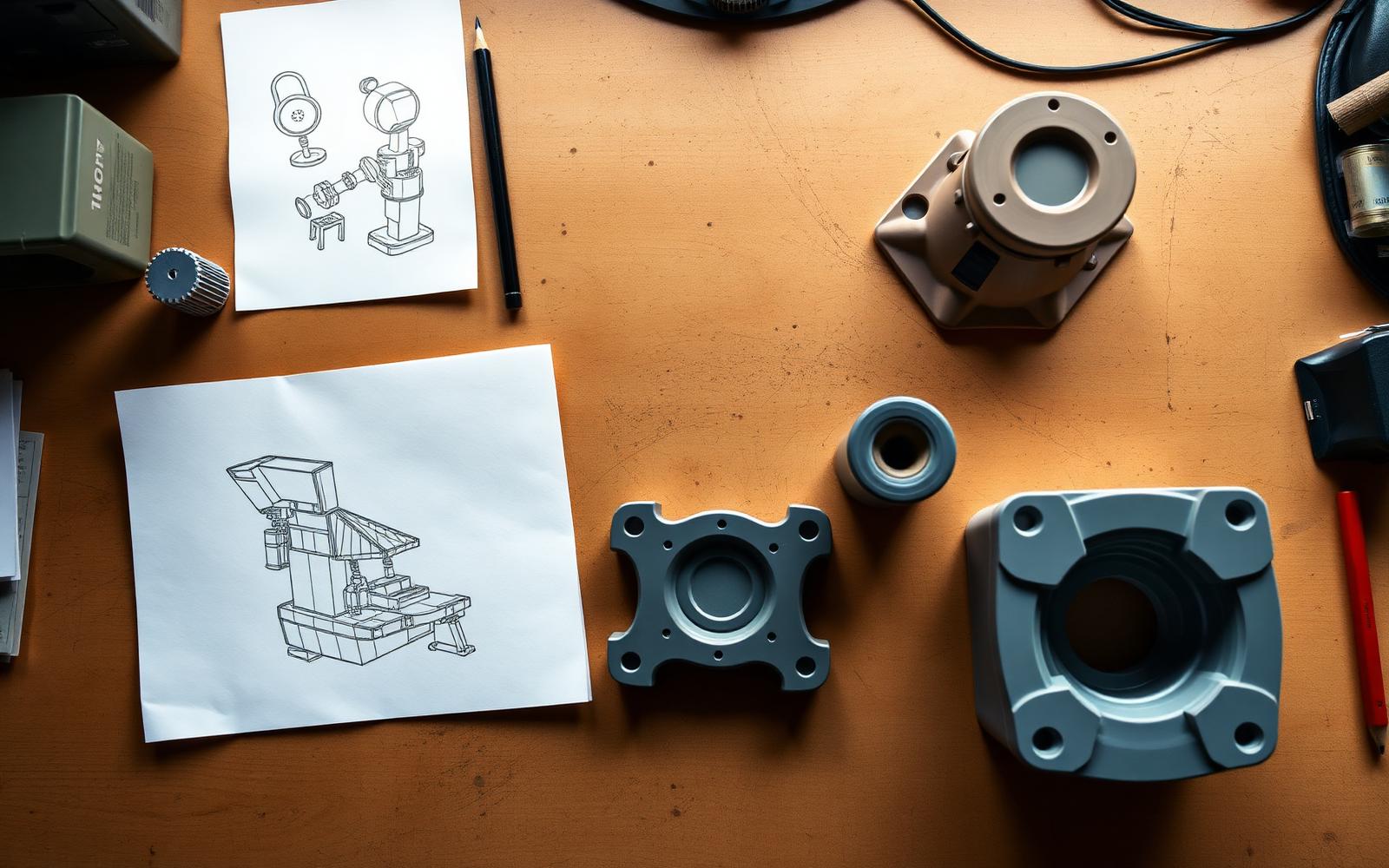
Ideas will remain idle unless you bring them to life. After selecting the most viable option of your ideas, you should have an illustrative rendition of the product, similar to a prototype.
You can sketch the rough idea of the product at first. Subsequently, you can make necessary adjustments. The most important thing to note at this stage is not to have a perfect illustration but rather a legible representation of the product’s components and functions.
If you are unsure of your illustrative skills, you can outsource a 3D rendition of the product to product design companies. Our team will be happy to assist you with that.
Provisional Patent Application
Now that you know you can use external product design services, let’s double back to when we talked about two developers conceiving the same idea.
If you are not proactive, another innovator could eventually reap the benefits of your proposed product. Also, you need to protect your intellectual property from being hijacked by a third party. So if I have an idea for an innovation, how can I preserve the commercial value of my product?
The answer herein lies in a provisional patent application. Once you’ve filed this application, you can discuss your product idea anywhere without fearing intellectual property theft.
Although this application is only valid for 12 months, you’ve got the exclusive right to the product’s design, size, and other related features.
Below is the process for filing your Provisional Patent Application
Research Your Invention
If I have an idea for an innovation and want to make a provisional patent application, I must be sure that the product idea is exclusive to me. If you research and discover another person owns the same or similar idea, you should probably back off.
Gather Patent Information
Your patent application must include information about the product. Specifications, sketches, and what problems you are trying to solve should be included.
Write a Coversheet
The cover sheet contains even more information. You are expected to state the investor(s) name(s), addresses, attorney’s credentials, and correspondence address. There must also be full disclosure about whether any government agency has interest in the product idea.
Product Description
Here, you are expected to disclose all relevant details of the invention. Technicalities like dimensions, schematics, etc., are all required.
Once you are done with the provided steps, it is advisable to review every detail. Make additions and remove unnecessary information if possible. You can now submit it to the United States Patent and Trademark Office (USPTO).
If you are unsure how to go about product description, product design companies can help you.
Potential Consumer Survey
Before investing a dime, entrepreneurs should seek consumers’ opinions. You might be wasting your capital if you don’t verify targeted customers’ preferences and how much they are willing to pay.
It is important to ensure that customers are ready to pay for your product. Again, cheaper does not always equal greater patronage. Don’t shortchange yourself if your product is worth the price.
It is almost impossible to arrive at a finished product in the product development cycle without first rolling out the prototypes. Remember that you are making the product for a target audience, and you cannot be too sure if their preferences are changing. Hence, you should make a Minimum Viable Product (MVP).
In the same vein, one of your goals as an entrepreneur is to maintain a loyal customer base. But this can be pretty difficult to achieve if customers don’t have a sense of belonging in your production process. If you want customers to feel like a part of the family, make product prototypes and consider the feedback. You can then make improvements and improve product value.
IP Protection
A lot of work goes into product development. Thus, it is only advisable to protect your hard work throughout the production cycle. Patents, design rights, trademarks, and copyrights are examples of Intellectual Property you may be willing to protect. If any company violates your intellectual property rights, you may seek adequate compensation accordingly.
Design for Manufacturing
Developers learn a great deal from their product prototypes. After releasing about two prototypes to the market, it’s time to make final design arrangements. Whatever additions you make to the product at this stage are final, so you must be meticulous and decisive.
Before you make the product available to the consumers, ensure to carry your team along. Further, work with the best vendors and share a progress report with the stakeholders. And if your team is not yet satisfied with the product design, go back to the drawing table of the development process and examine their concerns. Product design companies could be hired for the best results.
Marketing Materials
The best products even after employing the best product design services. So before the official launching of your product, you should have an effective marketing strategy. Research and map out the popular platforms to reach your targeted audience.
A user-friendly landing page, emails, and social media account are helpful in this regard.
Licensing and Venturing
Apart from solving problems, your goal as an innovator is to maximize profits.
From day one of your product development processes, you should bear in that investors are monitoring your progress. As you begin to experience business expansion, some bidders will approach you with offers for your intellectual property. Consequently, you may need to employ the services of an attorney to negotiate licensing terms with interested companies.
Product Launch
It’s the beginning of a new dawn in your entrepreneurship journey. You have toiled day and night for this day to come, and you cannot wait to take the market by storm.
At this point, your product development team is bowing out of the process. The burden now rests on the marketing team for a successful launch. The marketing strategy also comes to play here. You can make the official announcement for targeted customers or opt for billboards.
Many times, product developers take a break after a product launch. They fail to realize that a successful product launch does not equal a successful market reign. Accordingly, you should take an active role in monitoring the product’s progress. At no point should you ever relax or stop being innovative.
Uber, for instance, continually innovates. The company is well-informed about the world’s economic conditions. This informs the social class. Uber then updated their products portfolio to include both luxury and cheaper rides. Also, food ordering services were added. And that is probably why no ride-hailing company comes close to Uber, which had a net worth of $47.89B in 2021.
A Classical Example of the Product Development Process
Airbnb
If you are not familiar with the elements of product development, you might not understand how
Airbnb started from having no capital to having a market cap of $78.41 Billion in 2022.
Indeed, it is not surprising that the company is able to make a mark in the industry. The founders, Joe Gebbia, Brian Chesky, and Nathan Blecharczyk, were not moved by their lack of funding. Instead, they understood the fundamentals of the product development process and didn’t hesitate to practice it.
Airbnb founders only needed validation that their idea was viable. Therefore, to achieve this, they put out one of their apartments for a short term. And to confirm their genius, many users indicated an interest in the rentals. Since this validation, Airbnb keeps dominating the lodging industry.
Conclusion
A product developer must not be afraid to invest in the right product. If I have an idea for an innovation, I must give it the best shot. As long as your product is innovative and solves the corresponding problem, your customer base will keep growing. And in turn, you will have more resources to fund other projects.
Additionally, choosing the right product development partner is crucial for the process. And outsourcing product design services is also a fantastic decision.
Don’t sweat it if you want to fund your brilliant product idea. We’ve got a reputable platform to help you out. Kickstarter is a crowdfunding community that can make your dreams come true. If I have an idea for an innovation, we are experienced developers that can guide newbies.
If you’ve got questions or clarifications, don’t hesitate to contact us immediately. Good luck as you start this new phase!
Three reasons why our clients love working with us:
If you ever thought of developing a new product, don’t wait any longer. Talk with one of our experts today.
- 3D (7)
- ecommerce (1)
- Education (230)
- Inspiration (121)
- Market Reports (4)
- Media (17)
- News (50)
- none (61)
- Stories (7)
- Tech (27)
- Tech Talk Podcast (31)
- Time Management (1)
- Uncategorized (109)
- Words (62)
Receive Pdp Example
Please submit your contact info to receive an example of a new product development plan.
Thank you for choosing LA New Product Development Team for your New Product development plan.
If you have any questions or need assistance with your order, please don’t hesitate to contact us.
Thank you for choosing LA New Product Development Team for your Prior Art Search.
Please fill out the form to submit your order.
Upon successful payment, you will receive an email with a Non-Disclosure Agreement (NDA) and a questionnaire regarding your product idea.
Your privacy and security are paramount to us, so rest assured that your information will be handled with the utmost confidentiality.
Step 1: Fill in your contact and billing details.
Step 2: Review your order summary.
Step 3: Submit payment.
After your payment is processed, please check your email for the NDA and questionnaire. Completing these documents promptly will allow us to start your Prior Art Search without delay.
If you have any questions or need assistance with your order, please don’t hesitate to contact us.
Thank you for choosing LA New Product Development Team for your Prior Art Search.
Please fill out the form to submit your order.
Upon successful payment, you will receive an email with a Non-Disclosure Agreement (NDA) and a questionnaire regarding your product idea.
Your privacy and security are paramount to us, so rest assured that your information will be handled with the utmost confidentiality.
Step 1: Fill in your contact and billing details.
Step 2: Review your order summary.
Step 3: Submit payment.
After your payment is processed, please check your email for the NDA and questionnaire. Completing these documents promptly will allow us to start your Prior Art Search without delay.
If you have any questions or need assistance with your order, please don’t hesitate to contact us.
Thank you for choosing LA New Product Development Team for your Prior Art Search.
Please fill out the form to submit your order.
Upon successful payment, you will receive an email with a Non-Disclosure Agreement (NDA) and a questionnaire regarding your product idea.
Your privacy and security are paramount to us, so rest assured that your information will be handled with the utmost confidentiality.
Step 1: Fill in your contact and billing details.
Step 2: Review your order summary.
Step 3: Submit payment.
After your payment is processed, please check your email for the NDA and questionnaire. Completing these documents promptly will allow us to start your Prior Art Search without delay.
If you have any questions or need assistance with your order, please don’t hesitate to contact us.
Stages of Product Development
Stage | Key Activities |
|---|---|
Product Discovery | Evaluate societal challenges; Identify problems and solutions; Screen ideas using SWOT analysis. |
Concept Design | Create illustrative renditions of the product; Sketch rough ideas; Adjust designs; Obtain 3D renditions. |
Provisional Patent Application | Research invention exclusivity; Gather patent information; Write coversheet; Detail product description; Submit to USPTO. |
Potential Consumer Survey | Seek consumer opinions; Verify customer preferences; Assess willingness to pay. |
Prototyping | Create Minimum Viable Product (MVP); Address target audience preferences. |
Frequently asked questions
What is the product development process?
The product development process includes all activities needed to refine an idea and make it available commercially. These activities span from idea conception to research and production phases. They are typically interrelated steps, forming a roadmap to increase the odds of success for an innovation.
What is involved in the product discovery stage?
The product discovery stage involves evaluating societal challenges and identifying suitable solutions. Ideas are screened for viability, often using a SWOT analysis. The goal is to identify an idea with the most opportunities and fewest threats, which then proceeds to the next development phase.
Why is a provisional patent application important?
A provisional patent application protects your intellectual property from being used by others. Once filed, you can discuss your product idea without fear of theft. This application grants exclusive rights to the product's design, size, and features for 12 months, allowing you to secure your innovation.
What information is needed for a provisional patent application?
A provisional patent application requires specific information about your product, including specifications, sketches, and the problems it solves. It also needs a coversheet with investor names, addresses, attorney credentials, and correspondence address. You must disclose if any government agency has an interest in the product idea.
When should consumer opinions be sought in product development?
Before investing any capital, entrepreneurs should seek consumer opinions. It is important to verify targeted customers' preferences and their willingness to pay. This helps ensure that there is a market for the product and prevents capital from being wasted on an unverified idea.
The seven stages, with costs and timelines
Turning an idea into a product is a sequence of decisions, each one cheaper to make than the one after it. The discipline is simple: spend the smallest amount that resolves the biggest current unknown, then move to the next unknown. The numbers below are indicative for a moderately complex electromechanical consumer product.
Stage | What it produces | Typical cost | Duration |
|---|---|---|---|
1. Definition | Written requirements, target cost, success criteria | $5k-$15k | 2-4 weeks |
2. Research and validation | Customer evidence, competitive and patent landscape | $8k-$25k | 3-6 weeks |
3. Concept design | Sketches, industrial design, selected concept | $10k-$35k | 4-8 weeks |
4. Prototyping | Looks-like and works-like prototypes | $15k-$60k | 6-12 weeks |
5. Engineering and DFM | Production-intent CAD, BOM, tolerance analysis | $40k-$150k | 10-20 weeks |
6. Testing and certification | Compliance reports, regulatory marks | $15k-$80k | 8-16 weeks |
7. Tooling and pilot run | Tools, first articles, pilot units | $30k-$250k | 12-20 weeks |
Caption: stages overlap in practice; calendar time to first shipment is usually 12-24 months, not the sum of the rows.
What to do first, before spending anything
- Write the problem down in one sentence, from the customer's point of view.
- Search for the product you think you invented — most ideas already exist in some form.
- Run a patent search on the core mechanism before you spend money designing around nothing.
- Talk to ten people who would buy it and ask what they use today and what it costs them.
- Set a target retail price, then work backwards to a maximum unit cost.
- Decide what evidence would convince you to stop.
Gate criteria: when to move to the next stage
Gate | Move forward only when | Common failure |
|---|---|---|
Definition → Research | Requirements are written and measurable | Feature list masquerading as requirements |
Research → Concept | Real customers described the problem unprompted | Confirmation from friends only |
Concept → Prototype | One concept scored best against written criteria | Falling in love with the first sketch |
Prototype → Engineering | The riskiest function works in hardware | Prototyping the easy parts first |
Engineering → Certification | Design frozen and reviewed for manufacturability | Changing the design during testing |
Certification → Tooling | Compliance passed on production-intent parts | Cutting steel before test results |
Costs founders routinely forget
- Certification retests after a design change — often 40-70% of the original test cost.
- Packaging design, drop testing and the tooling for the package itself.
- First-article inspection, quality documentation and incoming inspection fixtures.
- Inventory: you pay for the whole batch months before you sell it.
- Freight, duties and warehousing on the first container.
- Spare parts, warranty reserve and the cost of the first field failure.
Development readiness checklist
- Requirements document signed by whoever controls the budget.
- Target unit cost derived from a real BOM, not a share of retail price.
- Riskiest technical assumption demonstrated in hardware.
- Regulatory path identified with cost and calendar.
- Manufacturing partner shortlisted and quoted at realistic volume.
- Cash plan that reaches the next funding milestone with three months of margin.
We run this sequence with founders every week — definition and evidence in product discovery, hardware in rapid prototyping, and production-intent design in product engineering.
Frequently asked questions
How do I develop an idea into a product?
Define measurable requirements, validate demand with real customers, select a concept against written criteria, prototype the riskiest function first, engineer for manufacture, certify, then tool and run a pilot batch. Each stage should resolve the largest remaining unknown.
How much does it cost to turn an idea into a product?
For a moderately complex electromechanical product, $120k to $500k from definition through pilot production is a realistic band in the US, with tooling and certification the largest single line items.
How long does it take to bring a product to market?
Twelve to twenty-four months for a first physical product. Compressing this generally means skipping validation or certification preparation, which costs more later than it saved.
Do I need a patent before developing my idea?
You need a patent search before spending on design, so you know what exists. Filing can usually wait until the design is settled, since a provisional application covers what you disclose — and an early filing on a design you later abandon protects nothing useful.
Filed under:EducationInspirationWords
Services related to this guide
- Product design servicesIndustrial design and CAD taken all the way to manufacturable files.
- Rapid prototypingWorking prototypes in days, from 3D printing to vacuum casting.
- Electronic design servicesSchematic, PCB layout, firmware and bring-up, through to production handoff.
- Product development examplesReal projects we designed, prototyped and shipped.