How to Choose an Electronics Contract Manufacturer
Choosing an electronics contract manufacturer is a capability and communication decision, not a price comparison. Here is how to shortlist, evaluate, quote and qualify one properly.
December 1, 20228 min read

Written by Konstantin Dolgan, Ph.D., NPDP
Founder & CEO, Product Development Engineer
Published December 1, 2022Updated September 2, 2026
An electronics contract manufacturer (EMS or CM) builds circuit boards and assembled electronic products for other companies — sourcing components, assembling PCBs, testing them and often handling final assembly and fulfillment. Choosing one is a decision about capability fit, test capability and communication, and the lowest quote is frequently the most expensive option.
Know what kind of manufacturer you need
Type | Typical volume | Best for |
|---|---|---|
Prototype / quick-turn house | 1 to 50 boards | Bring-up boards and design iteration |
Small-to-mid EMS | 100 to 50,000 units/year | Startups and mid-volume products needing engineering support |
Large global EMS | 100,000+ units/year | Established products with stable designs and forecasts |
Box-build / turnkey provider | Any | PCB plus enclosure, cabling, final assembly, packaging and fulfillment |
Volume fit is the single biggest predictor of a good relationship. A large EMS will not prioritize a 2,000-unit order, and a prototype house cannot absorb 50,000 units. Match your annual volume to a manufacturer where you are a meaningful but manageable customer.
Where to find candidates
- Referrals from your design firm or other hardware companies in your category — the highest-signal source by far.
- Industry directories and trade shows such as IPC APEX and regional electronics expos.
- Component distributors and rep firms, who know which shops build what.
- Domestic sourcing programs and manufacturing extension partnerships if you are reshoring.
What to evaluate
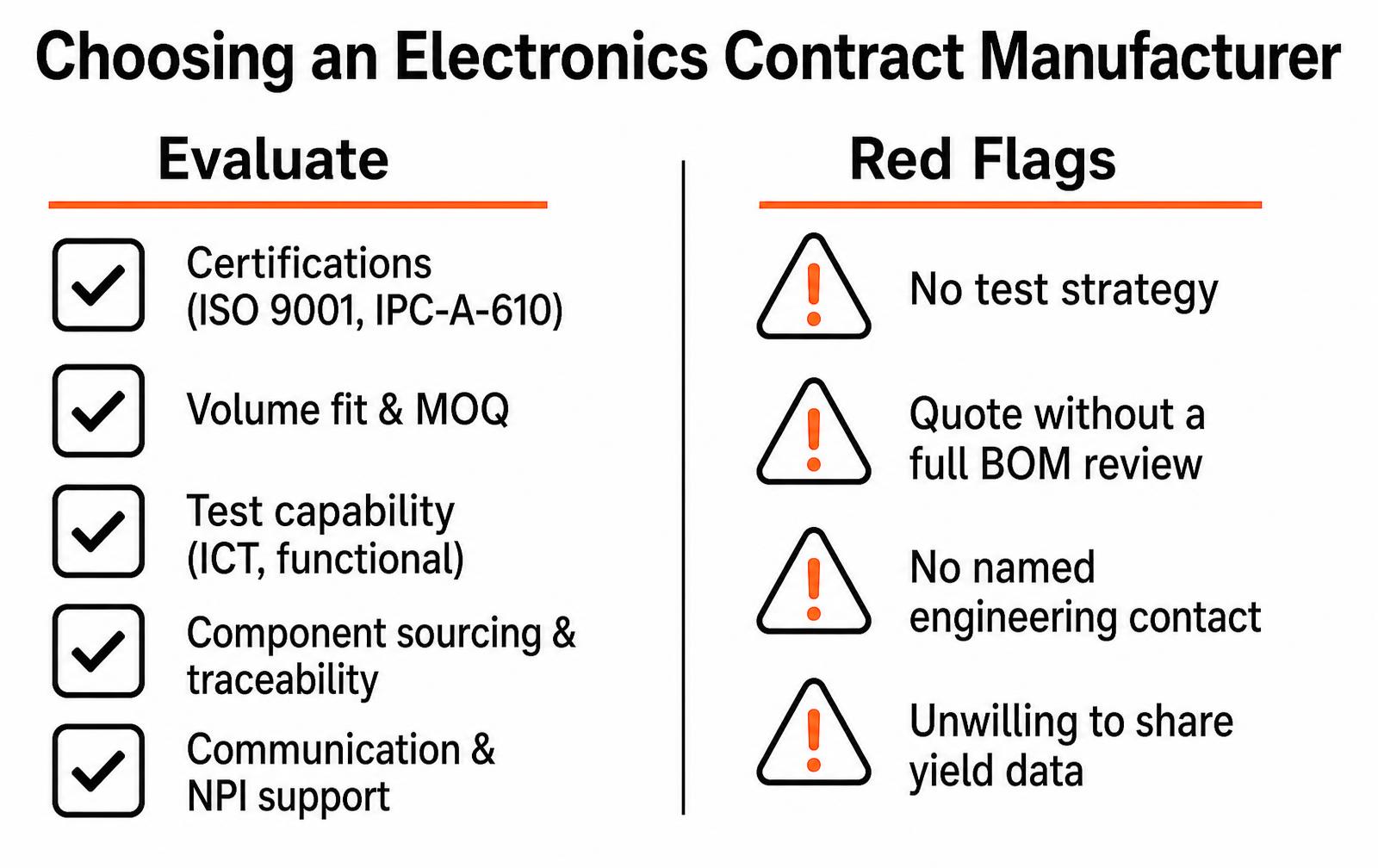
- Certifications. ISO 9001 as a baseline; IPC-A-610 workmanship class appropriate to your product; ISO 13485 for medical; AS9100 for aerospace; IATF 16949 for automotive.
- Test capability. Ask specifically about AOI, X-ray for BGAs, in-circuit test and functional test fixtures — and who develops the functional test.
- Component sourcing. Franchised distribution relationships, counterfeit avoidance policy, traceability by lot, and how they handle a part going end-of-life.
- NPI support. Do they run a design-for-manufacturing review before the first build and return written feedback?
- Capacity and continuity. Current utilization, second line or second site, and their behavior during component shortages.
- Communication. A named engineering contact in your timezone matters more than a slightly better unit price.
How to run the quote process
Send every shortlisted manufacturer an identical package so the quotes are comparable: Gerbers and fabrication drawing, centroid and assembly drawings, a complete BOM with manufacturer part numbers and approved alternates, test requirements, expected annual volume with order sizes, and quality expectations.
Quote line | What to check |
|---|---|
NRE | Stencils, fixtures, programming, test development — one-time and reusable? |
Unit price at each volume break | Compare at your realistic volume, not the best-case one |
Component cost vs assembly cost | Split them out; consigning parts may or may not help |
Test cost per unit | Cheap now, expensive in field failures if omitted |
Lead time and payment terms | Cash impact often exceeds the unit-price difference |
Change and excess material policy | Who owns unused inventory after an engineering change |
Red flags
- Quoting without reviewing the BOM. A serious shop finds problems in your package and tells you.
- No test strategy proposed. Boards shipped untested become your warranty problem.
- No named engineering contact. Sales-only relationships fail at the first technical issue.
- Unwilling to discuss yield or first-pass rates. Transparency here predicts everything else.
- A price far below the others. Something is excluded — usually test, quality, or component quality.
Not sure your design is ready to quote?
We prepare complete manufacturing packages and run DFM reviews so your quotes come back accurate instead of optimistic.
Qualify before you commit
- Run a paid pilot build of 25 to 100 units and inspect the output yourself.
- Audit the facility in person or by video walkthrough — look at ESD discipline, storage and rework areas.
- Review their first-article inspection report and test data, not just the shipment.
- Agree quality metrics, acceptance criteria and an escalation path in writing before volume.
- Keep a second source qualified for anything on your critical path.
What your transfer package must include
- Fabrication files, stack-up, and fabrication drawing with impedance and finish requirements
- Assembly drawings, centroid file and panelization guidance
- BOM with manufacturer part numbers, approved alternates and do-not-substitute flags
- Test procedure, acceptance criteria and production test firmware
- Packaging, labeling, serialization and shipping requirements
- Change control process — who approves a substitution and how
If your design is not at that level of documentation yet, the earlier stages of electronic product development cover what still needs to be produced.
Bringing an electronic product to production?
We take designs through DFM, manufacturer selection and pilot builds, and stay involved through the first production run.
Frequently asked questions
What is an electronics contract manufacturer?
An electronics contract manufacturer, also called an EMS provider, builds electronic products for other companies. Services typically include component sourcing, PCB assembly, inspection and testing, and often box build — enclosure assembly, cabling, packaging and fulfillment.
How do I find an electronics contract manufacturer?
The strongest sources are referrals from your design firm or other hardware companies in your category, industry directories and trade shows such as IPC APEX, and component distributors who know which shops build similar products. Shortlist three to five and send all of them an identical quote package.
What certifications should a contract manufacturer have?
ISO 9001 is the baseline quality standard, and IPC-A-610 defines workmanship acceptance class. Medical products require ISO 13485, aerospace AS9100, and automotive IATF 16949. Ask for current certificates and the scope they cover, not just a logo on the website.
How much does contract manufacturing cost?
Costs split into one-time NRE — stencils, fixtures, programming and test development, commonly $2,000 to $25,000 — and per-unit assembly cost that depends on part count, board complexity and volume. Component cost is usually the largest share of unit price at low volumes.
Should I manufacture domestically or overseas?
Domestic and nearshore manufacturing offers shorter lead times, easier oversight, lower inventory risk and tariff insulation at higher labor cost. Overseas manufacturing wins on unit price at high volume. Many companies prototype and pilot domestically, then decide based on proven demand.
What should be in a manufacturing transfer package?
Fabrication files and drawing, assembly drawings, centroid file, a complete BOM with approved manufacturer part numbers and alternates, test procedures with acceptance criteria, production test firmware, packaging and labeling requirements, and a written change control process.
What an electronics contract manufacturer actually does
An electronics contract manufacturer (EMS provider) buys your components, assembles your boards, tests them, and ships finished goods.
What separates one shop from another is not whether they can place parts — almost all of them can — but how much of the surrounding work they absorb: design for manufacturability feedback, component sourcing and lifecycle management, test fixture development, regulatory pre-compliance support, and the new product introduction (NPI) discipline that turns a working prototype into a repeatable product.
Choosing badly costs more than money. The wrong shop for your volume will quote well, then deprioritise your build behind larger customers, and every schedule slip lands on your launch. The sequence below is the vetting order we use with clients, from a 10-15 shop longlist down to a pilot build with two finalists.
Match the shop to your volume before anything else
Volume fit is the single filter that removes most of a longlist. A prototype house that thrives on 25-board runs will struggle at 20,000 units a year; a high-volume plant will quote your 500-unit run at a price that reflects how little they want it.
Annual volume | Right shop profile | Typical line | What you should expect |
|---|---|---|---|
Under 500 units | Prototype / low-volume EMS | Manual and semi-automatic SMT | Fast turns, high per-unit cost, engineer access |
500-5,000 | Regional mid-volume EMS | One or two SMT lines | Best balance of price and attention |
5,000-50,000 | Established domestic or nearshore EMS | Multiple lines, in-house test | Formal NPI process, cost engineering |
50,000+ | Offshore or large-scale EMS | Dedicated lines | Lowest unit cost, long lead times, MOQ pressure |
Mixed / seasonal | EMS with flexible scheduling | Shared line capacity | Negotiate slot reservations in writing |
The capability screen
Before a single call, screen the longlist against the technical requirements of your board. Most shops publish enough on their capability page to eliminate half the list in an afternoon.
- Minimum component package they place reliably in production (0402 is common; 0201 and micro-BGA are not universal).
- Board layers and technology: rigid, rigid-flex, heavy copper, controlled impedance, buried vias.
- Whether they run both leaded and lead-free lines, and how they handle mixed-process assemblies.
- In-house test capability: automated optical inspection, X-ray for BGAs, in-circuit test, functional test fixture build.
- Conformal coating, potting, cable assembly and final box build — the operations that otherwise force a second vendor.
- Certifications that match your market: ISO 9001 as a baseline, ISO 13485 for medical, AS9100 for aerospace, IPC-A-610 Class 2 or 3 workmanship.
Questions that separate real capability from a good website
Every shop says yes on a capability page. These questions get you an answer that is either specific or evasive, and the difference tells you what you need to know.
Question | Good answer | Warning sign |
|---|---|---|
Who is my day-to-day contact after the quote? | A named NPI engineer, not just sales | "Our team" with no name |
What is your first-pass yield on a board like mine? | A number with the test method behind it | "Very high" |
How do you handle a part that goes end-of-life mid-run? | Documented alternate-part approval process | "We'd let you know" |
Show me a DFM report you sent another customer. | Redacted sample within a day | Never produced one |
What is your current lead time from kit-complete to ship? | Days, with a stated buffer | Depends, unquantified |
Who owns the test fixtures I pay for? | You do, documented in the quote | Silence or "we keep them" |
Reading a quote line by line
Quotes are only comparable once they are decomposed. A shop that looks 12% cheaper on the headline number is often more expensive after non-recurring engineering (NRE), test development and freight.
Line item | Typical share of first-run cost | Where quotes diverge |
|---|---|---|
Bill of materials | 45-70% | Whether they buy at their price or pass through yours |
Stencil and setup (NRE) | $300-$1,500 | Charged once vs. per run |
SMT assembly labour | 10-25% | Per placement vs. per board |
Test development | $1,500-$20,000 | Fixture build often quoted separately |
Functional test time | 5-15% | Per-unit seconds add up at volume |
Rework and yield loss allowance | 1-5% | Some shops hide it, some line-item it |
Packaging and freight | 2-8% | DDP vs. EXW changes the comparison entirely |
Protecting the design
Your schematic, layout, firmware and test procedures are the asset. Put the protections in the manufacturing agreement, not in a side email.
- A mutual NDA signed before the full design package goes out, not after the quote comes back.
- Explicit statement that all design files, gerbers, firmware and test fixtures remain your property.
- A no-overbuild clause: the shop may not produce units beyond your purchase order, and scrap boards are destroyed and documented.
- Named-subcontractor approval so your board is not quietly moved to a shop you never audited.
- An exit clause that requires the transfer of fixtures, documentation and remaining inventory within a defined window.
Run a pilot before you commit
Award the first production run to two finalists rather than one. A 50-100 unit pilot at each shop costs less than one delayed launch and tells you what no audit can: how they communicate when something goes wrong.
Pilot metric | Target | How to measure |
|---|---|---|
First-pass yield | Above 95% for a mature design | Test log, not verbal report |
DFM issues raised before build | 3 or more substantive | Written DFM report |
Quote-to-kit-complete time | Within 10% of promise | Purchase order dates |
Response time on an engineering question | Same business day | Email timestamps |
Documentation returned | Test data per serial number | Delivery package |
Score both shops on the same sheet, then award volume to the winner and keep the runner-up warm with a small annual order. A second qualified source is the cheapest supply-chain insurance you will ever buy.
A scorecard for the final decision
Once two or three shops have quoted and built a pilot, score them on the same sheet rather than on how the last phone call went. Weight the categories before you see the results, so a low price cannot quietly outrank a quality problem.
Category | Weight | What earns full marks |
|---|---|---|
Volume and process fit | 25% | Your annual volume sits mid-range for their line, not at either edge |
Quality system | 20% | Current certifications, documented FAI, traceability to component lot |
Pilot build result | 20% | First-pass yield above 95% with defects explained, not excused |
Total landed cost | 15% | NRE, unit price, freight, duty and payment terms compared on one sheet |
Communication | 10% | A named engineer answers technical questions within one business day |
Supply chain control | 10% | Approved-vendor discipline and written no-substitution policy |
Award the volume to the winner, keep the runner-up qualified with a small annual order, and revisit the scorecard yearly. A second qualified shop is the cheapest insurance a hardware company can buy.
Work with LA NPDT: if you are moving from here to execution, start with our product design services or talk to us about industrial design and development.
Frequently asked questions
How much does an electronics contract manufacturer cost for a first run?
For a moderately complex board, expect $300-$1,500 in setup and stencil charges, $1,500-$20,000 for functional test development if you need it, and an assembly cost of roughly $0.01-$0.03 per placement at low volume. The bill of materials usually dominates: on most consumer-scale products it is 45-70% of the landed cost per unit.
Should I use a domestic or offshore electronics contract manufacturer?
Below roughly 5,000 units a year, domestic or nearshore usually wins once you price in freight, duty, travel for audits, and the cost of a two-week feedback loop on every engineering change. Above that, offshore unit-cost advantages start to outweigh the coordination overhead — provided your design is stable and your test coverage is good enough to catch defects without an engineer on the floor.
Who owns the test fixtures and tooling I pay for?
You should, and it must be written into the quote or manufacturing agreement. Fixtures you funded but do not own are the most common reason a company finds it cannot leave a contract manufacturer without rebuilding several thousand dollars of test hardware.
How long does it take to qualify a new contract manufacturer?
Plan on 8-14 weeks from longlist to a completed pilot build: two weeks of screening and calls, two to three weeks for quoting and DFM review, four to six weeks for the pilot run including component lead times, and one to two weeks to review results and negotiate terms.
What certifications should an electronics contract manufacturer hold?
ISO 9001 is the baseline for any regulated or professional product. Add ISO 13485 for medical devices, AS9100 for aerospace, and IATF 16949 for automotive. Ask for IPC-A-610 Class 2 workmanship as a minimum and Class 3 for products where failure carries safety or field-service consequences.
Filed under:EducationInspirationWords
Services related to this guide
- Electronic design servicesSchematic, PCB layout, firmware and bring-up, through to production handoff.
- Rapid prototypingWorking prototypes in days, from 3D printing to vacuum casting.
- Product design servicesIndustrial design and CAD taken all the way to manufacturable files.
- Product development examplesReal projects we designed, prototyped and shipped.