How to Invent, Design and Prototype a Product: Common Questions Answered
A seven-step path from invention idea to manufacturable product, with prototype types, real cost and time ranges, and answers to the questions inventors ask most.
February 3, 20227 min read

Written by Konstantin Dolgan, Ph.D., NPDP
Founder & CEO, Product Development Engineer
Published February 3, 2022Updated September 2, 2026
To create a prototype of an invention, work through seven steps: research the idea, run a patent search, sketch the concept, model it in CAD, build the first prototype, test and iterate, then prepare for manufacturing. A first working prototype typically takes 4-12 weeks and costs $3,000-$25,000 depending on complexity, and most inventions need two or three iterations before they are ready to sell.
This guide answers the questions inventors ask us most often, in the order they usually come up — from "is my idea already taken?" to "what do I need before a factory will quote me?"
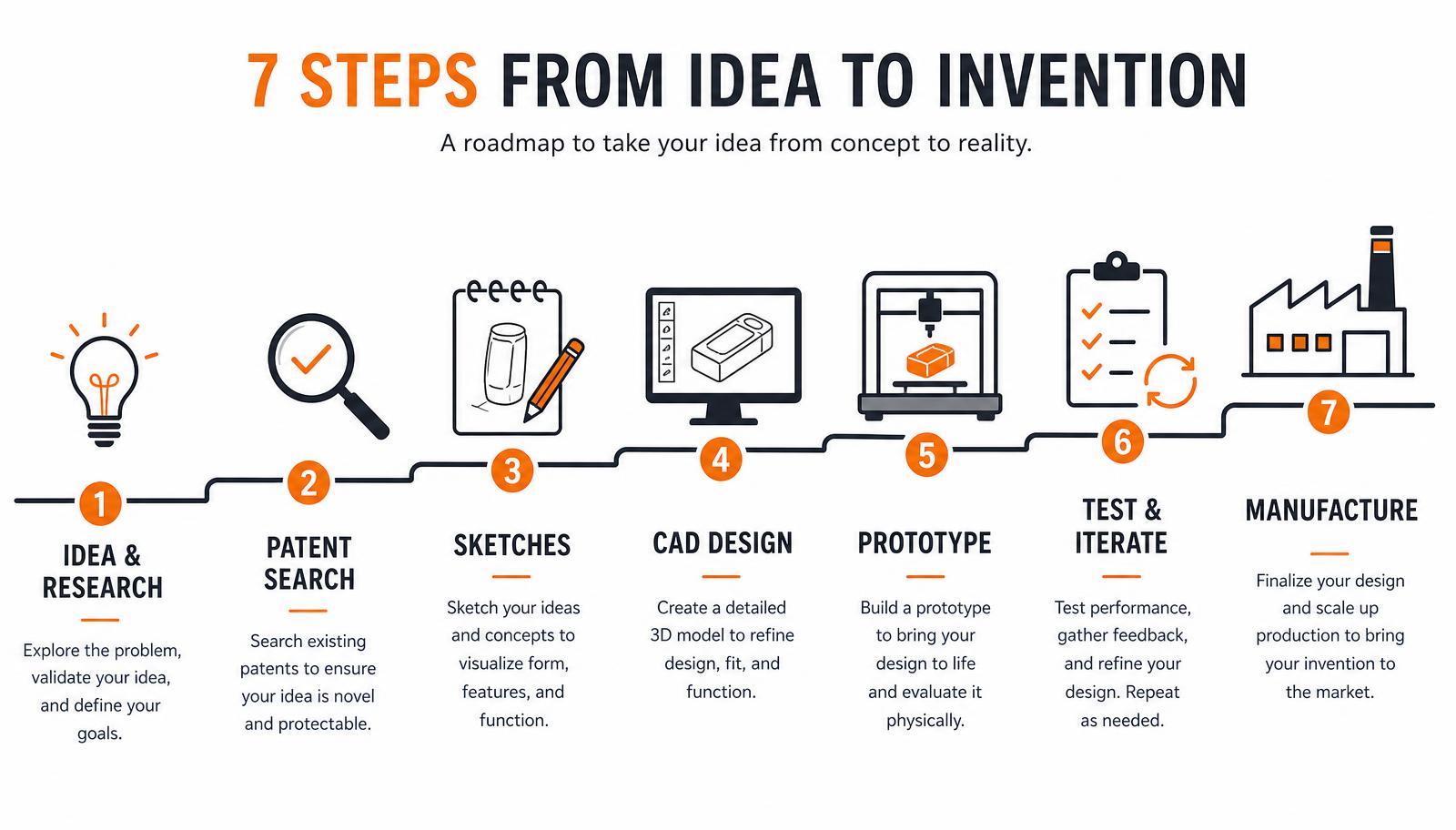
Step 1: Research the idea before spending anything
Before a single sketch, find out whether the product already exists, who is buying the alternatives, and what people complain about in reviews of those alternatives. Review complaints are the cheapest product research available — they tell you exactly which improvement people would pay for.
- Search marketplaces and retailers for the closest existing product.
- Read one- and two-star reviews of the top three alternatives.
- Estimate a realistic retail price, then work backwards to a landed cost target.
- Write down what your version must do that the alternatives do not.
Step 2: Run a patent search
Start with a free search of the USPTO patent database and Google Patents using the function of your product rather than its name.
If the idea looks clear, a professional prior-art search costs a few hundred to a couple of thousand dollars and is far cheaper than discovering a blocking patent after tooling.
A provisional patent application gives you twelve months of "patent pending" while you build and test — see how to protect an idea or invention prototype.
Step 3: Sketch before you model
Sketching is the cheapest place to be wrong. Draw five genuinely different approaches rather than five variations on the first one, then pick the approach that best balances function, cost and manufacturability. Note the size, the way it is held or mounted, the power source if any, and how it is opened, cleaned or serviced.
Step 4: Turn the concept into CAD
A 3D CAD model is the document everyone downstream needs — printers, machinists, mold makers and factories all quote from it. Good CAD is designed for how the part will actually be made, with draft angles, uniform wall thickness and realistic tolerances built in. Our 3D CAD design services exist because most rejected factory quotes come down to models that were never manufacturable.
Deliverable | What it is for | When you need it |
|---|---|---|
3D CAD model (STEP) | Quoting, printing, machining, tooling | Before any prototype |
2D drawings | Critical dimensions and tolerances | Before machining or production |
Bill of materials | Cost and sourcing | Before manufacturing quotes |
Renderings | Investor decks, pre-orders, packaging | Before marketing |
Assembly instructions | Repeatable builds | At pilot production |
Step 5: Build the first prototype
Most inventions need two prototypes rather than one perfect one: a looks-like model that proves size, feel and appeal, and a works-like model that proves the mechanism. Built separately, both come together faster and teach you more.
Prototype type | Typical time | Typical cost | Answers |
|---|---|---|---|
Looks-like appearance model | 1-4 weeks | $500 - $5,000 | Is the size, form and feel right? |
Works-like functional model | 4-8 weeks | $3,000 - $15,000 | Does the mechanism work? |
Integrated prototype | 6-12 weeks | $8,000 - $30,000 | Is this the product? |
Pre-production sample | 8-16 weeks | Varies with tooling | Can it be made repeatably? |
Detailed breakdowns live in how long it takes to build a prototype and how much a prototype costs to make.
Step 6: Test, then change one thing at a time
- Write the test before the build: what result would prove this works?
- Put it in the hands of five to ten real users and watch without coaching them.
- Record every failure, even trivial ones — patterns matter more than severity.
- Batch changes into one revision instead of rebuilding after each observation.
- Stop iterating when the remaining issues are cost issues, not function issues.
An invention becomes a product on the day someone who did not invent it can use it without instructions.
Step 7: Prepare for manufacturing
Factories quote from data, not descriptions. Arrive with a released CAD model, drawings with tolerances, a bill of materials, target annual volume and target landed cost. Expect tooling for an injection-molded part to run $3,000-$30,000 per cavity set, and expect a design-for-manufacturing review to change some of your geometry. Short-run manufacturing is the usual bridge between the last prototype and hard tooling.
What each stage costs and how long it takes
Stage | Typical duration | Typical cost | Output that unlocks the next stage |
|---|---|---|---|
Idea validation and research | 2–4 weeks | $2k–$10k | Evidence someone will pay |
Provisional patent filing | 1–3 weeks | $1.5k–$5k | A priority date, 12 months to decide |
Concept design | 3–8 weeks | $8k–$35k | One selected direction with proportions and function |
Prototype (looks-like / works-like) | 3–6 weeks | $3k–$25k | A physical answer to the biggest risk |
Detailed design engineering | 8–16 weeks | $30k–$150k | Drawings a factory can quote |
Tooling and pilot run | 10–16 weeks | $4k–$60k+ | Parts from production process |
The order that saves money
The sequence matters more than the speed. Test the assumption that would kill the product first, with the cheapest artifact that can test it. If the risk is 'will anyone buy this', a landing page beats a prototype.
If the risk is 'can this mechanism work at this size', a rough functional rig beats a beautiful appearance model. Inventors who build a finished-looking prototype first usually spend the budget answering a question they already knew the answer to.
- Search before you spend. A few hours on Google Patents and retail listings kills a surprising share of ideas at no cost.
- File provisional before public disclosure, including before a trade show, a crowdfunding page or a pitch to a manufacturer.
- Separate looks-like from works-like early; combining them doubles the cost of the first prototype for no added learning.
- Get a manufacturing opinion before detailed design, not after. A ten-minute conversation can remove a $20k tooling problem.
- Budget for three prototype iterations. Programs that budget for one always find the money for the second in a worse way.
Mistakes that cost first-time inventors the most
- Paying an invention-promotion firm a large up-front fee for a 'submission package' with no engineering in it.
- Filing a utility patent before knowing whether the design is manufacturable at a viable cost.
- Signing away IP in a development agreement that assigns rights only at final payment.
- Choosing a manufacturer on unit price alone and discovering the tooling is owned by the factory.
- Skipping certification research until after tooling, then finding a required change to the housing.
Frequently asked questions
How do I create a prototype of an invention?
Define what the prototype must prove, produce a 3D CAD model, then fabricate it by 3D printing, machining or hand-building depending on the material and function. Test it against your requirement, revise the CAD and rebuild. Most inventions reach a decision-ready prototype after two or three iterations over two to four months.
Do I need a patent before making a prototype?
No. You can build and test privately without any filing, and non-disclosure agreements protect conversations with vendors. Many inventors file a provisional application before public demonstrations, crowdfunding or trade shows, since public disclosure starts a twelve-month clock on US filing rights.
How much does it cost to develop an invention?
Design and prototyping for a straightforward mechanical product typically totals $10,000-$40,000 across iterations. Add custom electronics, regulated testing or tooling and the figure moves into six figures. Costs rise sharply once tooling is cut, which is why prototype iterations are the cheap part of the program.
Can I invent a product without engineering skills?
Yes. Most successful inventors bring the insight and the market knowledge and hire the engineering. What you cannot outsource is the decision about what the product must do — arrive with clear requirements and the engineering becomes straightforward.
What is the difference between an idea and an invention?
An idea is a description of a result; an invention is a specific means of achieving it. Patents protect the means, not the result, which is why the first real step is defining how your product works, not what it accomplishes.
Should I license my invention or manufacture it myself?
Licensing trades most of the upside for far less capital and risk, and typically pays 2-5% royalties. Manufacturing keeps the margin and the control but requires funding inventory, sales and support. Either way, a working prototype and some patent protection make the conversation dramatically stronger.
Where inventors get stuck
The two most common failure points are building before defining what the prototype should prove, and jumping to tooling before the design has survived real users. Both are avoidable with a written requirement list and one more iteration. If you would like a second set of eyes before you spend, send us sketches or CAD and we will tell you what the next step should cost.
Invention design gate checklist
Independent inventors lose money at predictable points: paying for CAD before the idea is validated, filing broad patents before the claims are known, and tooling before a single user has handled a working unit. Treat the path as five gates and refuse to fund the next one until the current one closes.
1. Problem proof | Does anyone pay to solve this? | $0 – $1,500 | 20 interviews, 5 pre-orders or LOIs |
|---|---|---|---|
2. Prior art | Is the space open? | $500 – $3,000 | Search report, freedom-to-operate opinion |
3. Concept design | What should it be? | $5,000 – $20,000 | Chosen direction, requirements list |
4. Working prototype | Does it actually work? | $5,000 – $25,000 | Test data on the core claim |
5. Manufacturability | Can it be made at a price? | $10,000 – $40,000 | DFM review, quoted BOM, tooling estimate |
Provisional patent timing
A provisional application buys twelve months of priority and costs a few hundred dollars in fees plus attorney time. File it once the mechanism is defined enough to describe in enabling detail — usually at the end of gate 3 or during gate 4. Filing earlier risks a disclosure that does not cover what you eventually build; filing after a public demo can forfeit rights in most countries outside the US.
Where inventor budgets actually go
- Roughly 40% of a first-time inventor budget is spent re-doing work that was started before requirements existed.
- Injection mold tooling for a simple two-part enclosure starts near $8,000 and is the first truly irreversible spend.
- Certification for anything with a radio adds $10,000 to $25,000 and eight or more weeks.
- Packaging and fulfillment setup routinely surprise inventors at $5,000 to $15,000.
Sequencing matters more than total spend. An inventor who reaches gate 4 with $30,000 and hard test data is in a far stronger position than one who spent $80,000 on beautiful CAD and a patent that describes a product nobody tested.
Ready to turn your invention into a prototype?
Work with LA NPDT: if you are moving from here to execution, start with our rapid prototyping services or talk to us about prototype design.
Deciding who to hire? See our guide to companies that help with inventions, including the free routes and the promoters to avoid.
Filed under:Education
Services related to this guide
- Best prototyping companiesDevelopment firms, instant-quote bureaus and local shops — who fits which job.
- Free prototype cost calculatorFive to eight questions, an instant cost range for a first prototype.
- Prototype development companiesWhich firms take a sketch to a working prototype — and which only fabricate parts.
- Rapid prototypingWorking prototypes in days, from 3D printing to vacuum casting.