
Product Launch Timeline: How Long a Launch Really Takes
What a realistic product launch timeline looks like week by week, what a two-week launch can actually include, and the delays that wreck launch dates.
June 15, 20208 min read

Written by Konstantin Dolgan, Ph.D., NPDP
Founder & CEO, Product Development Engineer
Published June 15, 2020Updated September 2, 2026
A product launch timeline is not the same as a development timeline. Launch is the set of activities that happen once the product exists — positioning, pricing, packaging, compliance evidence, inventory, channel setup and demand building. Run in parallel, that is roughly sixteen weeks for a physical product. Run sequentially, it becomes nine months and a missed season.
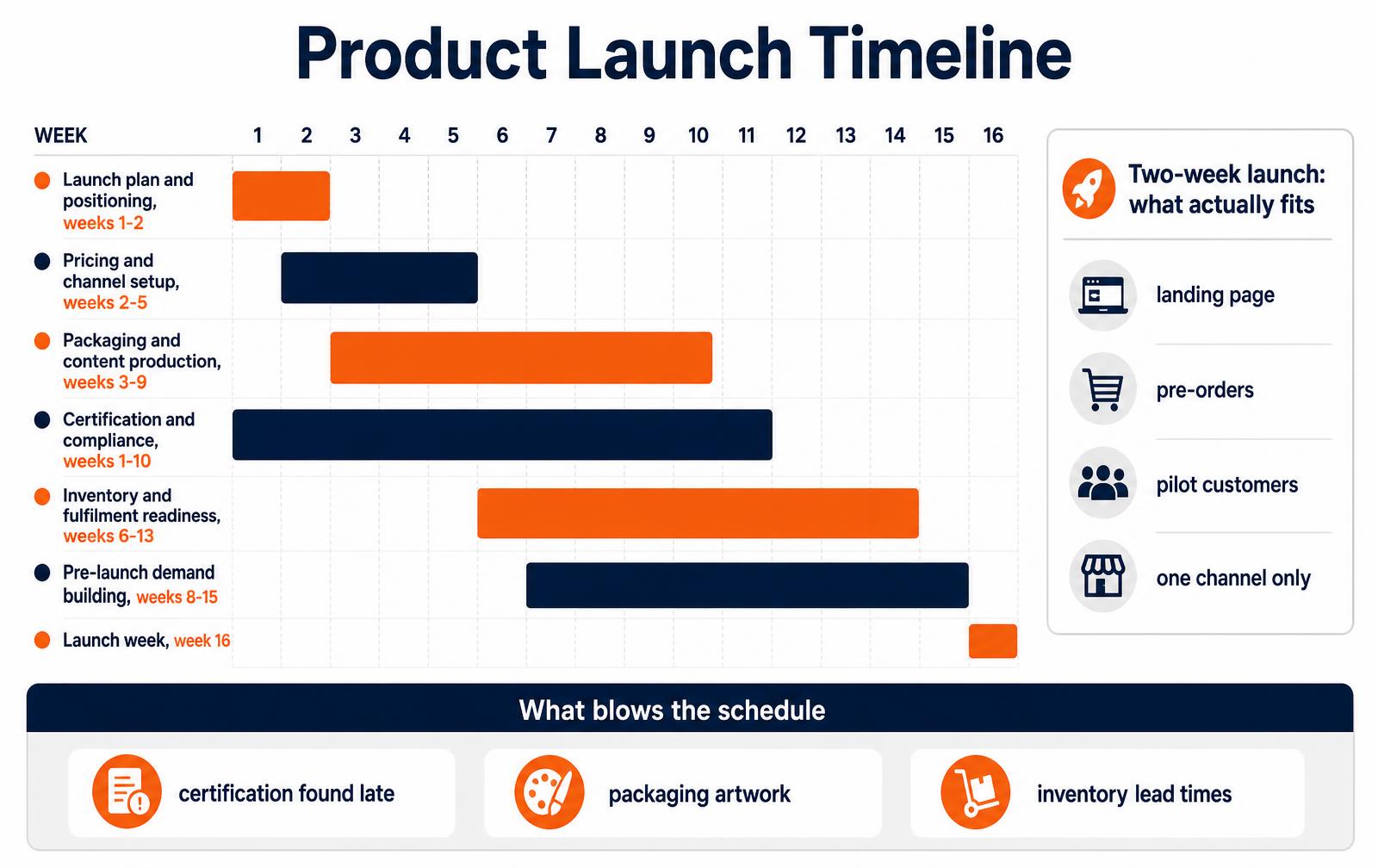
The 16-week launch, week by week
Workstream | Weeks | Owner | Gate to pass |
|---|---|---|---|
Launch plan and positioning | 1-2 | Product marketing | One agreed sentence about who it is for |
Pricing and channel setup | 2-5 | Commercial | Margin holds at landed cost plus fees |
Packaging and content production | 3-9 | Design and marketing | Artwork approved against final dimensions |
Certification and compliance | 1-10 | Engineering | Test reports in hand, labels correct |
Inventory and fulfilment readiness | 6-13 | Operations | First units received and inspected |
Pre-launch demand building | 8-15 | Marketing | A waitlist or pipeline large enough to matter |
Launch week | 16 | Everyone | Support, returns and restock plans live |
What you can actually launch in two weeks
A great deal, as long as you are honest about what "launch" means. In two weeks a small team can put up a landing page with real positioning, take pre-orders or deposits, run a pilot with a handful of named customers, and sell through exactly one channel.
What does not fit into two weeks is certification, tooled packaging, retail listings or stocked inventory. Launching the commercial test early and the physical supply chain later is a legitimate strategy — pretending the second half does not exist is not.
- Days 1-3. Positioning, price point, and the single customer segment you are addressing.
- Days 4-7. Landing page, photography or renders, and a payment or deposit path that works.
- Days 8-11. Outreach to an existing list, partners or communities where that segment already gathers.
- Days 12-14. Open orders, measure conversion, and decide whether to fund the full launch.
What blows the schedule
Delay | Typical cost in weeks | How to avoid it |
|---|---|---|
Certification discovered late | 6-16 | Identify applicable standards during design, not before shipping |
Packaging artwork rework | 2-6 | Freeze product dimensions before artwork starts |
Component or inventory lead times | 4-12 | Place long-lead orders against the design freeze, not the launch date |
Failed first article inspection | 3-8 | Inspect a pilot run before committing to full production |
No demand pipeline at launch | Indefinite | Start building the list eight weeks out, not at launch |
Two of those — certification and lead times — start during engineering, which is why launch planning belongs in the development schedule rather than after it. Our development process maps where each launch dependency begins, and consulting engagements can run the launch plan alongside the build.
Frequently asked questions
How long does a product launch take?
For a physical product, plan roughly sixteen weeks from launch planning to launch week with workstreams running in parallel: positioning and pricing in weeks one to five, packaging and content in weeks three to nine, certification across weeks one to ten, inventory readiness weeks six to thirteen, and demand building weeks eight to fifteen. Software or service launches compress to four to eight weeks.
Can you launch a product in two weeks?
You can launch a commercial test in two weeks: positioning, a landing page, pre-orders or deposits, a pilot group and one sales channel. You cannot complete certification, tooled packaging, retail listings or stocked inventory in that window. Treat the two-week version as a demand test that funds the full launch.
What usually delays a product launch?
The three most common delays are certification requirements discovered late, which costs six to sixteen weeks. Packaging artwork rework caused by unfrozen product dimensions, two to six weeks. And component or inventory lead times, four to twelve weeks. A failed first article inspection and an empty demand pipeline at launch are close behind.
What can be compressed and what cannot
Every product launch timeline is a negotiation between things governed by decisions and things governed by physics, queues and regulators. Decisions can be made in a morning. Steel cannot be cut faster than the tool shop's queue, certification labs have their own calendars, and ocean freight takes the time it takes. Compressing a launch means attacking the first category ruthlessly and planning honestly around the second.
Activity | Governed by | Compressible? | Realistic floor |
|---|---|---|---|
Positioning and messaging | Decisions | Yes | 2-3 days |
Packaging design | Decisions plus print queue | Partly | 1-2 weeks |
Photography and content | Sample availability | Yes if samples exist | 1 week |
Injection tooling | Tool shop queue and steel | Barely | 4-8 weeks |
Regulatory certification | Lab calendar | Only by paying for expedite | 3-8 weeks |
Ocean freight | Physics | No, air freight instead | 4-6 weeks |
Retail set date | Buyer's calendar | No | Fixed |
Listing and storefront build | Decisions | Yes | 2-3 days |
When a two-week launch is actually possible
A genuinely fast launch is achievable when the product already exists in a saleable state and what is being launched is the commercial layer: a new variant of an existing platform, a bundle, a regional expansion, or a direct-to-consumer launch of something previously sold only through a channel. The compression comes from having nothing left to manufacture or certify.
- Inventory is already in the destination market, or drop-ships from existing stock.
- Certification covers the configuration being sold, with no changes to the radio, power supply or enclosure.
- Packaging exists, or the product ships in neutral packaging with a printed insert.
- Support content can be adapted from an existing product's documentation.
- The launch channel is owned — your store and your list — rather than a retailer's calendar.
A two-week compressed launch plan
Day | Workstream | Output |
|---|---|---|
1 | Positioning lock | One-page message hierarchy and target buyer |
2 | Pricing and offer | Price, bundle, launch incentive, margin check |
3-4 | Photography and video | Hero shots, in-use set, 30-second demo |
4-5 | Storefront build | Product page, variants, shipping rules, tax setup |
5 | Support readiness | FAQ, returns policy, warranty terms, ticket macros |
6-7 | Content assets | Email sequence, three social cuts, launch post |
8 | Operations dry run | Test order placed, picked, shipped and returned |
9 | Soft launch | Page live to list segment, monitor conversion |
10-11 | Fix and iterate | Copy and page fixes from soft-launch data |
12 | Full announcement | List, social, partners, paid launch |
13-14 | Monitor and respond | Daily conversion, support volume, stock burn |
Readiness gates worth keeping even under pressure
Speed is bought by cutting sequential dependencies, not by cutting verification. These gates cost hours and prevent the failures that turn a fast launch into a refund event.
Gate | Check | Why it stays |
|---|---|---|
Order-to-delivery test | One real order shipped and received | Catches tax, shipping and packing errors |
Returns test | One return processed end to end | Catches label and restocking gaps |
Compliance confirmation | Certificates match the shipping configuration | A mismatch is a stop-sale, not a fix |
Content accuracy | Specs on page match the physical product | Spec errors drive returns and chargebacks |
Support load estimate | Expected tickets per hundred orders | Prevents a queue that eats the launch |
Stock and reorder math | Days of cover at forecast rate | Avoids a stockout at peak attention |
Where compressed launches actually break
- Payment and tax configuration untested in the destination market, so orders fail at checkout on day one.
- Photography shot on pre-production samples that differ visibly from shipped units.
- Shipping rates set from guesswork, quietly consuming the entire margin on heavy items.
- Support inbox unmonitored over the first weekend, turning solvable issues into public reviews.
- Inventory allocated to a marketplace and the direct store simultaneously, with no shared stock counter.
- A demo video showing a feature that shipped disabled in firmware.
What a normal hardware launch timeline looks like
For context, when the product still needs to be made, the honest schedule from design freeze looks like this. Teams that promise two weeks in this situation are usually not counting the same activities.
Phase | Duration | Runs in parallel with |
|---|---|---|
Design freeze to tooling kickoff | 1-2 weeks | Packaging design |
Tool build | 5-8 weeks | Certification prep, content |
First article and tuning | 2-4 weeks | Photography on T1 parts |
Certification testing | 3-8 weeks | Retail listing build |
Pilot production | 2-3 weeks | Support content, training |
Production run | 3-5 weeks | Channel loading |
Freight and customs | 4-6 weeks ocean | Pre-launch marketing |
Total from freeze | 5-8 months | - |
More questions teams ask
Can you really launch a hardware product in two weeks?
Only when manufacturing and certification are already complete. Two weeks is enough to build the commercial layer — pricing, page, content, support and operations — around inventory that exists. It is never enough to make and certify something new.
What is the single biggest schedule risk in a fast launch?
Untested operations. Checkout, tax, shipping rates and returns fail quietly and only under real orders, so a live test order and a live test return are non-negotiable regardless of how compressed the plan is.
Should we soft launch first?
Yes. Even a two-day soft launch to a list segment surfaces page, pricing and fulfilment problems while the audience is small and forgiving, and it produces conversion data that improves the full announcement.
How much inventory should be on hand at launch?
Enough for the forecast plus the reorder lead time, at minimum. Running out during the attention peak is more damaging than carrying extra stock, because the traffic does not come back a second time.
What should be cut first when time runs short?
Breadth, not quality. Launch in one channel, one region, one configuration, done properly — then expand. Cutting verification to preserve scope is the trade that produces recalls and refunds.
Planning a launch date you can defend?
We build launch schedules against certification, tooling and lead-time realities, so the date survives the first supplier quote.
What each launch phase actually consumes
Phase | Typical duration | Long pole | Can it be compressed? |
|---|---|---|---|
Launch plan and positioning | 1-2 weeks | Agreement on the single claim | Yes, with a decision owner |
Packaging and label artwork | 2-4 weeks | Legal and compliance review | Partly - start during DVT |
Photography and content | 2-3 weeks | Sample availability | Yes, shoot pre-production units |
Listing build and channel setup | 1-2 weeks | Marketplace category approvals | Rarely |
Certification and test reports | 3-8 weeks | Lab queue and retests | No - book the slot early |
First production run | 4-8 weeks | Component lead times | No |
Freight and inbound | 2-6 weeks | Ocean versus air decision | Yes, at a cost |
Soft launch and review seeding | 2-3 weeks | Reviewer turnaround | Partly |
A launch measured in two weeks is almost always a launch of the announcement, not of the product. The physical chain - certification, production, freight - sets the floor, and no amount of marketing parallelism moves it. What a compressed schedule really buys you is overlap: running artwork, content and channel setup alongside the build instead of after it.
The two-week launch: when it is genuinely possible
- Inventory is already in the destination warehouse and has passed incoming inspection.
- Certification is complete and the reports are in hand, not pending.
- Packaging is printed and the artwork carries the final regulatory marks.
- You are launching into an existing channel with an approved seller account and category.
- The product is a variant of something you already sell, so the content template exists.
- Support has an answer script and a returns policy for the new SKU.
A realistic 16-week schedule
Week | Milestone | Owner |
|---|---|---|
1-2 | Positioning locked, pricing and margin approved | Product lead |
2-5 | Packaging artwork, compliance marks, barcode assignment | Design and regulatory |
3-8 | Certification testing booked and executed | Regulatory |
4-6 | Photography and video from pre-production units | Marketing |
6-12 | Production run, in-line QC, packout | Operations |
10-12 | Listings built, channel assets uploaded, pricing staged | Ecommerce |
12-15 | Freight, customs, inbound to fulfilment | Logistics |
15-16 | Soft launch, review seeding, paid switched on | Marketing |
Publish this schedule with named owners and one weekly checkpoint. Most missed launch dates trace back to a task nobody owned - barcode assignment, a missing test report, or artwork waiting on a legal sign-off - rather than to a manufacturing failure. See our product development process guide for how launch planning connects back to the design gates that precede it.

Launch readiness checklist
- Certification reports filed and the certificate numbers printed where required.
- Barcodes assigned, registered and scanned against live inventory.
- Listing copy proofed against the claims you can substantiate.
- Returns, warranty and support workflow live before the first order ships.
- Spare parts and packaging replenishment ordered with the first run, not after it.
- A rollback plan for the first quality escape, including who can pause the listing.
Where launch schedules slip most often
Slip | Typical delay | Early warning sign | Preventive action |
|---|---|---|---|
Certification retest after a failure | 3-6 weeks | Pre-compliance skipped | Run pre-compliance during DVT |
Packaging artwork rework | 2-3 weeks | No named regulatory reviewer | Freeze claims before artwork starts |
Component shortage at build | 4-12 weeks | Single-sourced long-lead part | Buy long-lead parts at design freeze |
Marketplace listing rejection | 1-3 weeks | New category, no prior approval | Open the category weeks before launch |
Freight and customs hold | 1-4 weeks | Incomplete commercial documents | Pre-clear paperwork with the broker |
Content shot from the wrong sample | 2 weeks | Photography before the cosmetic freeze | Shoot only post-freeze units |
Nearly all of these have the same structural cause: a serial dependency that nobody flagged as a critical path item. Build the schedule backwards from the ship date, mark the tasks that cannot start until another finishes, and protect those with a named owner and a weekly status. Everything else can float.
Soft launch before full launch
A soft launch of a few hundred units into one channel buys information that no amount of internal testing produces: how customers describe the product in their own words, which parts of the listing they ignore, what they contact support about, and whether the packaging survives the real shipping network. Two to three weeks of that data will change your copy, your FAQ and often your accessory strategy before you spend money on paid acquisition.
- Ship to a limited region or a single channel so quality issues stay containable.
- Instrument support: tag every contact by reason and review the tags weekly.
- Read the first fifty reviews line by line and rewrite the listing against them.
- Photograph returned units before restocking; damage patterns reveal packaging faults.
- Hold at least 15 percent of the run back so you can correct before the main push.
- Only turn paid spend on once return rate and support volume are stable for a week.
Treated this way, a launch stops being a single date and becomes a sequence of decisions with evidence behind each one. The calendar still matters, but the teams that win the second year are the ones that used the first eight weeks of real customer contact to fix the product and the story rather than to defend the original plan.
Frequently asked questions about launch timing
How long does a product launch take from finished design? For a physical consumer product with tooling already cut and certification complete, twelve to sixteen weeks is a realistic window from design freeze to first customer shipment. If certification and the first production run still lie ahead, plan on five to seven months and treat anything shorter as a stretch case that depends on every supplier hitting their quote.
What is the single biggest lever on launch speed? Ordering long-lead components at design freeze rather than after the first article inspection. Electronics, custom motors, batteries and specialty fasteners routinely carry lead times longer than the entire rest of the launch plan, and buying them early converts a schedule risk into an inventory risk you can quantify.
Should marketing start before the product is finished? Positioning and audience work should start early, because they influence packaging and claims. Photography, paid campaigns and hard launch dates should not - each one written against a design that later changes has to be redone, and the rework usually costs more than the wait would have.
How much inventory should the first run carry? Enough to cover roughly eight to twelve weeks of conservative demand plus warranty replacements, and no more. First runs almost always reveal a change worth making, and a large opening order locks you into shipping the version you already know how to improve.
Work with LA NPDT: if you are moving from here to execution, start with our new product marketing or talk to us about market research.
Filed under:EducationInspirationNews
Services related to this guide
- Product design servicesIndustrial design and CAD taken all the way to manufacturable files.
- Rapid prototypingWorking prototypes in days, from 3D printing to vacuum casting.
- Electronic design servicesSchematic, PCB layout, firmware and bring-up, through to production handoff.
- Product development examplesReal projects we designed, prototyped and shipped.