Traits of the Best Product Development Companies
Portfolios all look alike. The traits that decide whether your program launches show up in scoping, manufacturing handoff and IP terms — here is how to check each one.
February 4, 20226 min read

Written by Konstantin Dolgan, Ph.D., NPDP
Founder & CEO, Product Development Engineer
Published February 4, 2022Updated September 2, 2026
Most portfolios look the same. Rendered products, a wall of logos, a claim about “concept to shelf.” The differences that decide whether your program launches are visible in how a firm scopes work, hands off to manufacturing and behaves when something goes wrong — none of which appears on a portfolio page.
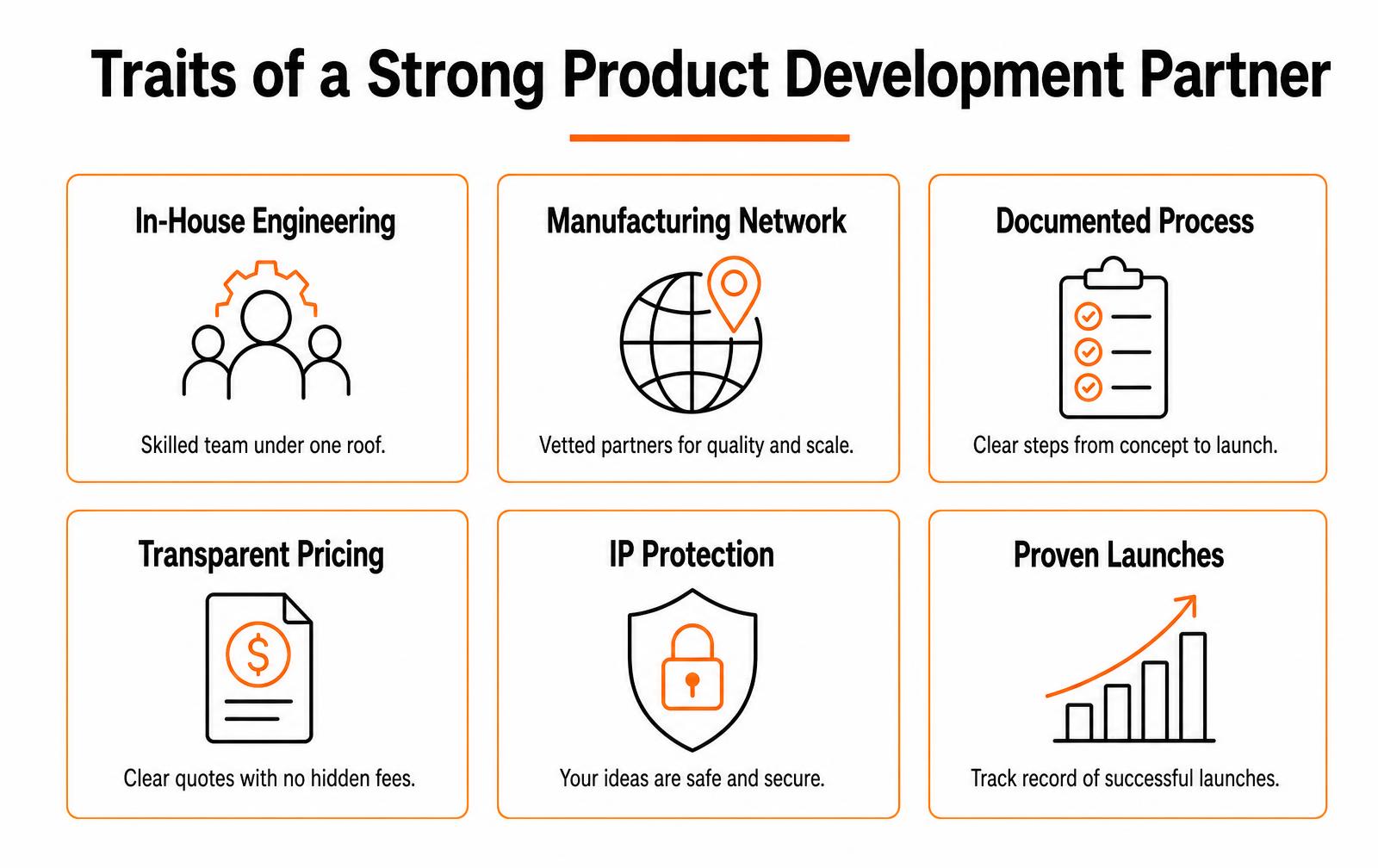
Below are the six traits that separate firms that finish from firms that deliver beautiful CAD, along with the questions that surface each one during a first call.
1. Industrial design and engineering under one roof
When design and engineering sit in different companies, the tension between how a product looks and how it can be built gets resolved by email, late, and usually by redesigning something that was already approved. An integrated team resolves it in the same review. Ask who does the mechanical engineering, whether they are employees, and how design intent gets handed to CAD.
2. A real manufacturing network, not a referral list
A firm that has taken products into production knows which shops hold tolerance, which quote fast, and which will actually answer at month four. That knowledge changes designs early — wall thickness, fastening approach, material choice — instead of forcing rework once tooling quotes arrive. Ask for the names of factories they have shipped from in your product class and what the tooling budget looked like.
3. A documented process with named gates
Phase | What should be delivered | How you know it is real |
|---|---|---|
Discovery | Requirements document with numbers and verification methods | They ask about volume and target cost before quoting |
Concept | Multiple directions with cost implications noted | Concepts are compared, not presented as one hero |
Engineering | CAD, tolerance analysis, DFM notes | They name the manufacturing process during design |
Prototype | Builds tied to specific questions | Each build has a test plan attached |
DFM and tooling | Supplier-reviewed drawings, tool release package | A named factory reviewed the files |
Launch | Golden sample, inspection criteria, first-article report | Quality criteria exist in writing |
Our own product development process lays out the same gate structure, including what leaves each phase.
4. Pricing you can audit
- Fixed-fee phases with defined deliverables, not an open hourly meter across the whole program.
- A written change-order mechanism, so scope movement is priced rather than argued.
- Prototype and tooling costs quoted separately from engineering fees.
- A stated assumption list — the things the price depends on being true.
- Willingness to scope a small paid discovery phase before a large commitment.
A firm that will not put a number on a first phase usually cannot predict its own effort, which is itself the answer.
5. IP handling that protects you by default
Signing an NDA is the minimum, not the credential. What matters is that the agreement assigns all work product to you on payment, that subcontractors and factories are bound by equivalent terms, and that they will not reuse your tooling or design for another client. Ask specifically who owns the CAD files and what happens to the tooling if you change manufacturers. Our guide to protecting an idea or invention covers the clauses worth insisting on.
6. Launches you can verify
Renders prove a firm can render. Ask which of the products in the portfolio actually shipped, in what volume, and whether the client will speak with you. A firm with real launches answers that comfortably and can tell you what went wrong on at least one of them — the ones that claim every program went perfectly have either not run many or are not being straight with you.
Warning signs in a first conversation
Signal | What it usually means |
|---|---|
A price before any requirements discussion | The scope will move, and so will the price |
No questions about production volume | Design decisions will not be cost-aware |
“We do everything” with no named specialisms | Work will be subcontracted invisibly |
Reluctance to name manufacturing partners | Limited production experience |
Portfolio is renders only | Programs may not have reached tooling |
Ownership of CAD left vague in the agreement | You may be locked in for future revisions |
Questions worth asking every candidate
- Which products in your portfolio reached mass production, and at what volume?
- Who on your team will do the mechanical engineering, and are they employees?
- Which factories have you shipped from in this product category?
- What does phase one cost, what is delivered, and what assumptions is that based on?
- How are change requests priced?
- Who owns the CAD, drawings and tooling at the end?
- What went wrong on your last program, and how did you handle it?
If you are early and still comparing options, our guide to choosing a product development company covers engagement models and typical costs in more depth.
What a first engagement should cost and produce
Ranges vary by complexity, but a credible firm can put numbers and deliverables against a first phase before the contract is signed. If the proposal only contains hours and roles, you are buying effort rather than an outcome.
Phase | Typical fee | Duration | What you should receive |
|---|---|---|---|
Discovery / feasibility | $3,000 – $15,000 | 2 – 4 weeks | Requirements document, risk list, budget and schedule estimate |
Industrial design | $8,000 – $40,000 | 4 – 8 weeks | Concept sketches, CMF direction, refined surfaces, appearance model |
Mechanical engineering | $20,000 – $120,000 | 8 – 20 weeks | Parametric CAD, tolerance stack-ups, DFM review, drawings |
Electronics and firmware | $25,000 – $150,000 | 10 – 24 weeks | Schematic, layout, bring-up boards, source code, BOM |
Prototyping rounds | $2,000 – $25,000 per round | 1 – 3 weeks each | Working units, test report, revision list |
Manufacturing transfer | $10,000 – $60,000 | 6 – 16 weeks | Full data pack, supplier quotes, first article inspection plan |

How to compare three proposals fairly
Firms scope differently on purpose, which makes side-by-side comparison hard. Normalize before you decide: put every proposal into the same table and fill the gaps by asking, rather than assuming the cheapest one is efficient.
Compare on | Good answer | Warning answer |
|---|---|---|
Scope boundary | Named deliverables and an explicit exclusion list | "Full product development" with no exclusions |
Iteration count | A stated number of prototype rounds and revisions | Unlimited revisions (nobody honors this) |
Change process | Written change orders with fee impact | "We'll work it out as we go" |
Testing | Named standards and who pays for lab time | Testing not mentioned |
Tooling ownership | You own tools you paid for, documented | Tools held at the supplier under the firm's account |
Data pack | STEP + native CAD + drawings + BOM at handover | PDF drawings only, native files withheld |
Team | Named engineers with hours allocated | "Our team" with no names |
Red flags after the contract starts
- Renders replace hardware for more than one review cycle. Physical progress should be visible by the second month on a mechanical program.
- Meeting notes and decision logs stop appearing. Undocumented decisions become disputes at tooling.
- The manufacturing conversation keeps being deferred. DFM input belongs in the CAD phase, not after it.
- Change orders arrive after the work is done, instead of before it is authorized.
- The invoice curve outruns the deliverable curve — 60 percent billed against 30 percent of the milestone list.
- You cannot get a straight answer on cost per unit at volume. A firm that has shipped products always has a view.
Key takeaways
- Ask for phase fees, durations and deliverables in writing before signing; a firm that cannot estimate a first phase cannot manage a program.
- Normalize competing proposals into one table — scope boundaries and iteration counts explain most price differences.
- Verify shipped products, not portfolio renders, and confirm in writing that you own the CAD, drawings and tooling.
- Watch the deliverable curve against the invoice curve; divergence is the earliest reliable warning sign.
Frequently asked questions
What should I look for in a product development company?
In-house industrial design and mechanical engineering, real manufacturing relationships in your product class, a documented phase-gate process with defined deliverables, auditable fixed-fee pricing, clear IP assignment, and verifiable products that reached production volume.
What is the difference between an industrial design firm and a product development company?
An industrial design firm focuses on form, user experience and appearance, typically delivering concepts and surface CAD. A product development company carries the product through mechanical engineering, prototyping, design for manufacture and production handoff. If you hire only design, budget for engineering separately and plan for a handoff gap.
How much does it cost to hire a product development company?
A discovery or feasibility phase typically runs a few thousand to low five figures, full industrial design and engineering for a consumer device commonly lands in the mid five to low six figures, and injection tooling is a separate cost. Any firm quoting a full program before discussing requirements and volume is guessing.
Who owns the design when you hire a product development firm?
You should, on payment — and the agreement must say so explicitly, covering CAD files, drawings, firmware and tooling, with equivalent terms flowed down to subcontractors and factories. Vague ownership language is the most common way clients get locked into a vendor for future revisions.
How do I verify a product development company's track record?
Ask which portfolio products actually shipped and in what volume, request client references you can call, ask for the names of factories they have produced with, and ask what went wrong on their last program. Firms with real launch experience answer all four without hesitation.
How to evaluate an industrial design firm before you sign?
Portfolios are curated, so evaluate process instead of pictures. Ask a candidate firm to walk through one project from brief to production: what the research said, which concepts were killed and why, how the design changed after the first DFM review, and what the part looked like coming out of tooling.
Firms that carried a product into manufacturing will have that story ready, including the ugly parts. Firms that stopped at renderings will change the subject. The second test is engineering proximity.
Industrial design that never meets a mold flow analysis produces beautiful concepts that get value-engineered into something unrecognisable. Whether the engineering is in-house or a long-standing partner matters less than whether the two disciplines review together, early and often. Ask for one full case walked from research through production tooling, not a gallery.
Filed under:TechUncategorized
Services related to this guide
- Best industrial design firmsWhich studios take an idea from form to manufacturable hardware, and what they charge.
- Product design servicesIndustrial design and CAD taken all the way to manufacturable files.
- Prototype designLooks-like, works-like or pre-production: what each proves and what it costs.
- Product development examplesReal projects we designed, prototyped and shipped.