Invention Help: How To Develop Product Ideas Using The 3D Ideation Process
There’s never a lack of great product ideas. Yet, you need invention help to process ideas and make them work. So check out this blog.
December 5, 20227 min read

Written by Konstantin Dolgan, Ph.D., NPDP
Founder & CEO, Product Development Engineer
Published December 5, 2022Updated September 2, 2026
How To Develop Product Ideas Using The 3D Ideation Process
According to Inc Magazine, a successful American business magazine, . The statistics also show that only 6 percent of all known ideas succeed commercially. You will find on the page how to get out of your current situation and how to get proper invention help.
The statistics above show the gap between the number of people who can be creative, the ideas they generate, and the development success of those ideas. Therefore, there is a need for an initial stage of the product development process. This stage is called the ideation process.
In this article, you will find out everything you need to know about getting invention help or transforming an idea into a commercial success. In addition, you will find the steps to refine and develop product ideas.
What is Ideation Process in Light of Invention Help?
You need an ideation process to develop products. This first stage of product development includes generating ideas and finding solutions for ambiguities in an initial idea. Also, the ideation process makes communicating ideas to others possible.
Against popular opinion, it is not only a stage for producing an idea or invention help. This stage deals with finding better ways of executing certain processes of an idea.
You need to know how to go about developing your initial idea. Hence, we are introducing a three-step process called the 3D ideation process.
Invention Help: 3D Ideation Process
In this section, you will find out how to make your idea concrete by finetuning it. Then, it will show you every important feature of your idea before it gets to the stage of product development. The stages in this process are Device, Detail, and Describe.
- Device: This stage is where you document your thoughts. It is where you take the idea or product out of your head by writing it, recording it, or using graphics design software.
It includes capturing your idea through sketches, brief descriptions, visual representation, etc. This process aims to make your thought or idea perceptible. Hence, you have to put it on tangible media.
- Detail: You have to develop that idea you have put on tangible media. Therefore, this stage is where you improve and make that idea (look) better. To achieve your desired better look, you have to perform critical thinking.
According to the California State University, Northridge, critical thinking is making detailed observations. In addition, it involves distinguishing facts from opinions. The page further talks about elements of critical thinking.
Critical thinking has to do with considering the idea using different perspectives. And using these perspectives to shape your idea by removing parts that are not feasible. Through this stage, you can focus on areas with more potential and promise.
Besides critical thinking, it would help to explore the landscape through thorough research. The landscape you will explore is dependent on your product idea.
Whatever the product is or invention help you need, look out for similar products in the market. Sometimes, you can use your intuition to explore the market. For instance, what do customers want from the product, or what possible need does it meet?
For hardware products, you must consider their size, shape, length, shipping, manufacturing, packaging, state and federal regulations, and other specifics that apply to your product or idea. Think about your product from different angles and perspectives.
For software products, you can use graphical tools to sketch how the UI and other app components will look. You can even project the product into the feature. This projection will help you know what value your product will serve in the market in a year, ten years, or more.
In summary, this stage is where you apply necessary specifics to your initial vision and ideas before product developement. This step is where you apply all forms of creativity to the product.
It involves gathering all the possible information to shape your product. This stage will make developing your product idea very nice, promising, realistic, and feasible.
- Describe: In this stage, you want to present your idea so that anybody can understand the product. Therefore, it has to be easy and logical to understand. And you have to come up with something concise but detailed enough for a random person.
When they are done reading, they must know the importance of the product and why it is better than existing alternatives. Perhaps it is a new initiative with nothing like it before; a random reader must be able to tell what they can accomplish with it.
While putting together your description when looking for invention help, you may notice some initial idea gaps. You have to go back and finetune some of those details. It would help if you reiterated these stages until you are sure the idea is what you want to showcase and any random person can understand it.
Hottest Questions on How to Develop Product Ideas
Here are some of the most popular questions asked by our clients on developing product ideas.
How do you develop a product idea?
You first need to understand what your idea is, what it will do, and how your product will be different or better than existing alternatives. Hence, you have to devise, detail, and describe it.
What is step three in the product design process?
The three steps of any product design process are to create, adapt, and deliver. Therefore, the third step of this process is ensuring that the product meets regulations and standards.
What are three sources of new product ideas?
You can get new product ideas from customers, distributors, and private institutions. There are several other sources, but getting information from customers has been the most effective over the years.
What are the three ways to generate ideas?
You can generate new ideas by thinking outside the box. Firstly, it could be breaking the pattern of old thinking patterns. But, aside from that, you can get fresh perspectives and make new connections.
Bottom Line
Only a few percentages of ideas make it to product development. Hence, you need an ideation process. This process is more than just producing ideas. You need to make your idea perceptible by putting it on tangible media.
Also, through critical thinking and exploring the product landscape, your need to make your idea (look) better. Lastly, you have to come up with a product description that is concise but detailed.
This description should be enough for a random person to read and understand what your product is about and why it is better than existing alternatives. Your team of designers and developers also needs it to develop products.
LA NPDT is focused on making a difference in the marketplace through product innovation. Our cross-functional team will transform your product ideas into business ventures. Some of our services are CAD models and PCB circuits, building prototypes, and more. Contact us today through Lanpdt: schedule consultation la npdt or call directly at 318-243-5789.
The 3D Ideation Process
Stage | Purpose | Activities |
|---|---|---|
Device | Document thoughts | Writing, recording, graphics design, sketches, visual representation |
Detail | Improve and refine the idea | Critical thinking, market research, considering specifics like size/shape/regulations, UI sketching |
Describe | Present the idea for understanding | Creating a concise but detailed explanation, addressing gaps |
Sources and standards
- USPTO — patent basics — Official filing guidance from the US Patent and Trademark Office.
- WIPO PCT system — International patent filing route for products sold abroad.
- NIST Manufacturing Extension Partnership — Federal program supporting US small and mid-size manufacturers.
Running the product ideation process as a real workflow

The 3D framework above — Device, Detail, Describe — is the shape of the work. What turns it into a repeatable process is deciding, in advance, what each stage must produce and what evidence lets a concept move forward. Without those gates, ideation becomes an endless loop of variations that all feel equally plausible.
What each stage must produce
Stage | Duration | Output artefact | Exit criterion |
|---|---|---|---|
Device (capture) | 1-2 weeks | Dated concept sketches, a one-paragraph problem statement, list of assumptions | The idea is legible to someone who was not in the room |
Detail (refine) | 2-6 weeks | Concept scorecard, rough CAD or foam model, target cost range, patent landscape scan | At least one concept scores above threshold on all must-have criteria |
Describe (communicate) | 1-2 weeks | One-page product brief, value proposition, comparison to alternatives, demo plan | A prospective buyer can say yes or no without further explanation |
Caption: gate artefacts for each stage of the product ideation process.
A concept scorecard that actually screens
Score every surviving concept from 1 to 5 on each criterion, and mark the must-haves. Any concept failing a must-have is out, regardless of total score — averaging hides fatal flaws.
Criterion | Must-have? | What a 5 looks like | What a 1 looks like |
|---|---|---|---|
Problem intensity | Yes | Users already pay to work around it | Users say it would be nice |
Technical feasibility | Yes | Every subsystem exists off the shelf | Requires an unproven physics result |
Target cost | Yes | Estimated COGS under 30% of expected price | Cost unknown or above price |
Defensibility | No | Novel mechanism, filing prepared | Easily copied appearance change |
Route to market | No | Existing channel wants the category | No identified buyer |
Regulatory load | No | No certification beyond basic safety | Medical or aviation approval path |
Common failure modes in ideation
- Falling in love with the first concept and generating decoys around it rather than genuine alternatives.
- Skipping the cost estimate until CAD is finished, then discovering the product cannot be sold profitably.
- Confusing feature count with value; each added feature carries tooling, testing and failure modes.
- Describing the idea only in terms of how it works, never in terms of what the user gets.
- Not searching the patent landscape until after a design is locked.
- Treating ideation as a one-time event instead of returning to it after each prototype round.
Once one concept clears the scorecard, the next step is physical. A rough functional unit answers questions that no amount of further sketching will — our rapid prototyping and prototype design services exist precisely for that transition, and the product development process page shows what follows it.
Frequently asked questions
How many concepts should the ideation process generate?
Enough that discarding your favourite is not painful — usually eight to fifteen distinct approaches, not variations of one. Distinct means they solve the problem by different mechanisms, so that killing one does not kill the programme.
When should an inventor stop ideating and start prototyping?
When the remaining questions are physical rather than conceptual. If the open items are 'will this mechanism hold under load' or 'can a hand reach this control', more sketching cannot answer them and a rough prototype can, cheaply.
Does the product ideation process differ for hardware and software?
The stages are the same but the constraints bite in different places. Hardware ideation must carry manufacturing cost, tolerance and certification from the very first screen, because those cannot be refactored later. Software ideation can defer more decisions.
How do you protect an idea while still getting feedback on it?
File a provisional application before wider discussion, use NDAs with suppliers and evaluators, keep dated records of conception, and share the problem and benefit rather than the mechanism when talking to potential customers.
A repeatable product ideation process
Dimension | Question to answer | Artifact |
|---|---|---|
User and job | Who fails at what task today, and how badly? | Task map with observed failure points |
Physical constraint | What must it fit, survive, and weigh? | Envelope drawing and environment spec |
Commercial envelope | What retail price and margin must hold? | Target landed cost with volume assumption |
From sketch to physical model in one week
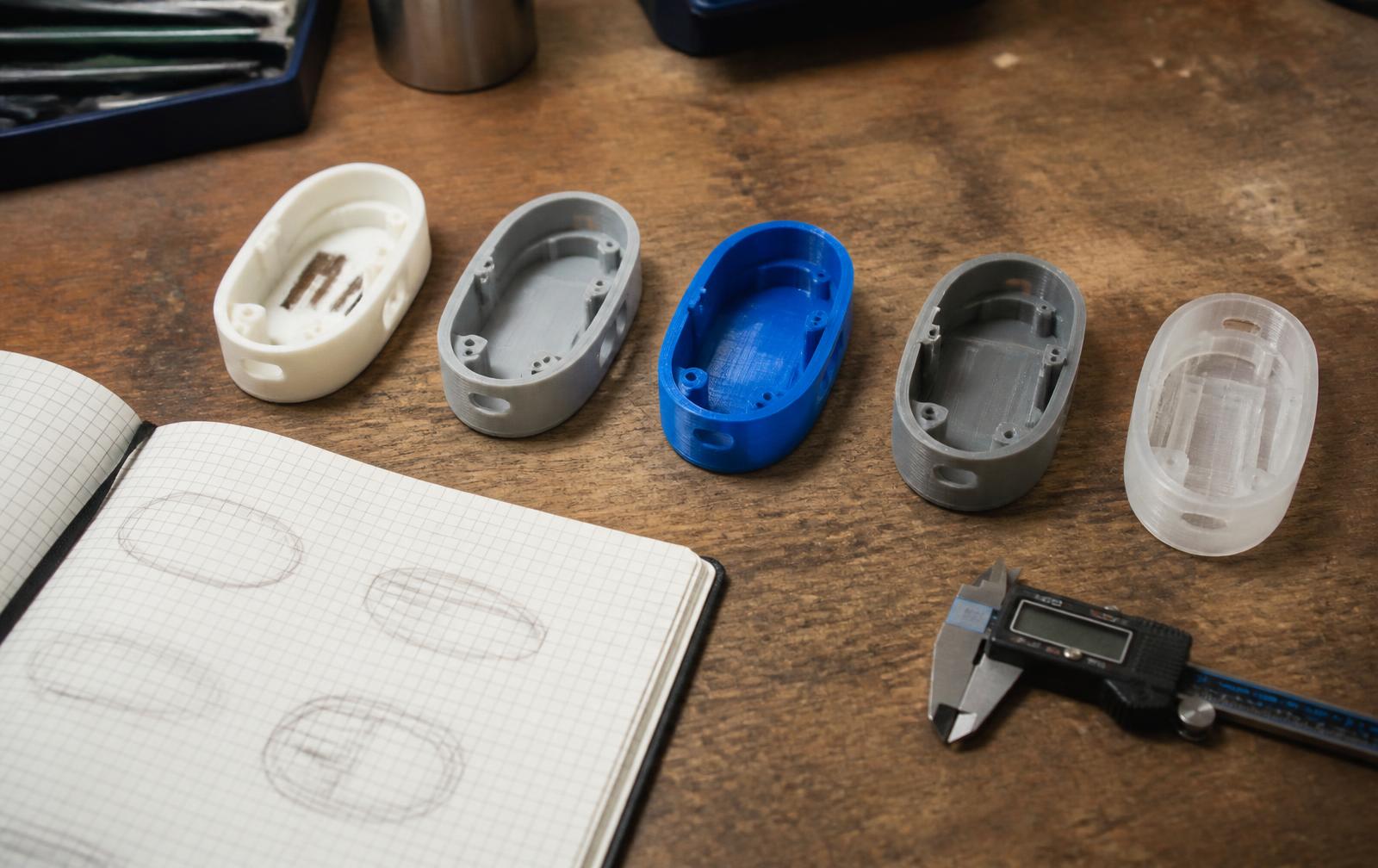
- Day 1. Volume study in foam or cardboard at full size. Nobody judges ergonomics from a screen.
- Day 2. Twenty rough sketches against the task map, no styling, mechanism only.
- Day 3. Screen to four directions using the weighted criteria; write down why the others died.
- Day 4. Quick CAD blockouts, print the two that survive contact with the envelope drawing.
- Day 5. Hand the printed models to six untrained users and record the first-attempt failures.
Screening criteria and score anchors
Criterion | Weight | Score 1 | Score 5 |
|---|---|---|---|
First-attempt task success | 30% | Under half of users succeed | All users succeed unaided |
Landed cost versus target | 25% | Over target by 25%+ | At or under target |
Part count and assembly time | 15% | Over 20 parts, manual alignment | Under 8 parts, self-locating |
Tooling risk | 15% | Multiple side actions and undercuts | Straight pull, simple parting line |
Differentiation | 15% | Cosmetic difference only | Functional advantage worth claiming |
Filed under:EducationInspirationWords
Services related to this guide
- Product design servicesIndustrial design and CAD taken all the way to manufacturable files.
- Rapid prototypingWorking prototypes in days, from 3D printing to vacuum casting.
- Electronic design servicesSchematic, PCB layout, firmware and bring-up, through to production handoff.
- Product development examplesReal projects we designed, prototyped and shipped.