Prototype Development Cost: What Drives the Price and Who to Hire
Design studios, prototype shops, contract manufacturers and full-service firms do different jobs. Here is what each costs and which one your project needs.
August 26, 20177 min read

Written by Konstantin Dolgan, Ph.D., NPDP
Founder & CEO, Product Development Engineer
Published August 26, 2017Updated September 2, 2026
Prototype development cost depends far less on hours than on which kind of prototype you actually need. A looks-like model, a works-like rig and an engineering prototype answer different questions and are built by different shops - and picking the wrong one is the most common way an inventor burns a first budget. A shop that prints beautiful parts cannot tell you whether the mechanism will survive 10,000 cycles.

The four categories
Type | What they do | Best for | Typical engagement |
|---|---|---|---|
Design studio | Industrial design, CAD, appearance models | Look, feel and user experience | $8k-$40k |
Prototype shop | 3D printing, CNC, casting, assembly | Parts from files you already have | $300-$15k per round |
Contract manufacturer | Tooling, pilot runs, volume production | Production after design freeze | $20k-$200k+ |
Full-service development firm | Research through production handoff | Products that must reach market | $60k-$300k |
The distinction that matters: a prototype shop sells parts, a development firm sells a working product. If you send files to a shop, you own every engineering decision. That is fine when your CAD is production-ready and wrong when it is a sketch converted to a solid model.
What prototypes actually cost
Deliverable | Method | Cost | Lead time |
|---|---|---|---|
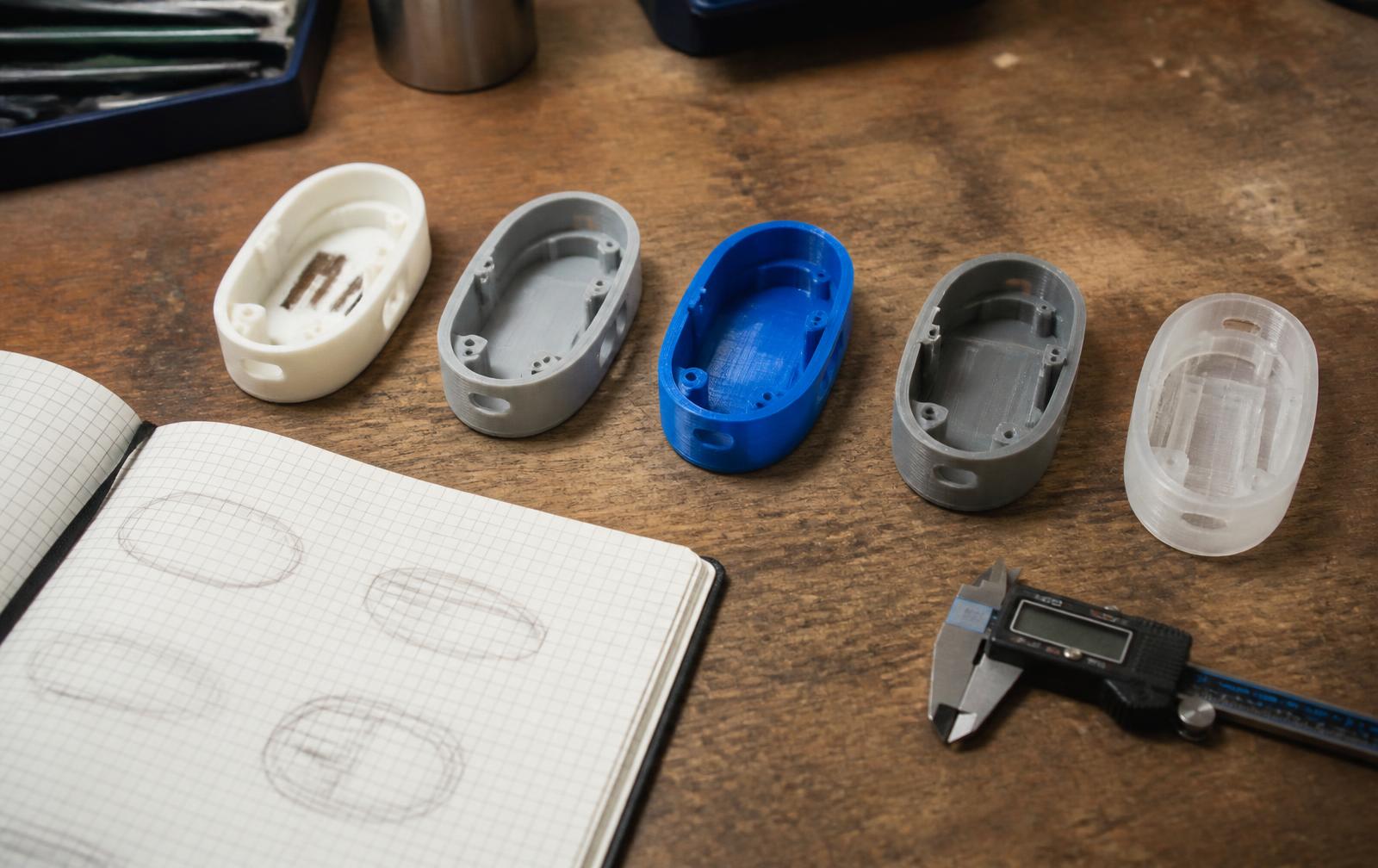
Appearance model | SLA print, hand finished and painted | $300-$2,500 | 1-2 weeks |
Functional mechanical prototype | CNC or SLS, fasteners and bearings | $1,500-$8,000 | 2-4 weeks |
Electronics prototype | Custom PCB, firmware bring-up | $5,000-$25,000 | 4-10 weeks |
Production-intent batch | Soft tooling or urethane casting, 25-100 units | $5,000-$40,000 | 4-8 weeks |
Full development program | Design through production handoff | $60,000-$300,000 | 6-18 months |
Questions to ask before you send files
- Which products of yours reached mass production, and can I speak to those clients?
- Who owns the CAD, drawings and firmware when the project ends? The answer must be: I do.
- Will you quote design for manufacturing feedback, or only build what I send?
- What tolerances can you hold on this geometry, and in which material?
- Which parts of the job are subcontracted, and to whom?
- What does a change cost mid-project, and how are change orders priced?
- Do you carry an NDA, and will you sign mine before I send files?
Red flags
- Invention promotion pitches - firms that charge for a "submission package" to manufacturers and cannot show licensed products. Federal law requires them to disclose success rates; ask for them.
- Royalty-only interest - a shop that wants equity or royalties instead of a fee often lacks paying customers.
- No engineering questions - a competent partner interrogates load cases, volumes and cost targets before quoting.
- Flat fee for an undefined scope - a fixed price for "a prototype" with no drawing package guarantees a dispute.
- Ownership buried in the terms - any clause that keeps CAD or tooling with the vendor is a lock-in.
Domestic versus overseas prototype companies
Factor | Domestic (US) | Overseas |
|---|---|---|
Part cost | 1.5-3x higher | Lowest |
Lead time | 3-10 days typical | 2-5 weeks with shipping |
Iteration speed | Same-week revisions | Each loop costs a week |
IP exposure | Enforceable contracts | Harder to enforce |
Best used for | Early loops, regulated work | Cost-down after design freeze |
The practical pattern is to iterate domestically while the design is still moving and shift to an overseas contract manufacturer only once drawings are frozen and inspection criteria are written.
Where prototype budgets actually go
Quoted prototype prices vary by an order of magnitude because the word covers very different objects. A looks-like model that photographs well and a works-like unit that survives a user test share almost no cost structure.
Engineering time, not material, dominates every serious quote: CAD, electronics design, firmware and the iteration loops between them typically account for sixty to eighty percent of the invoice.
That is why a fixed price for a first prototype should always be read as a fixed price for a defined scope, and why the second question after cost is how many revisions are included.
Typical prototype cost ranges
Prototype type | Typical cost | Time | What it proves |
|---|---|---|---|
Concept sketch and CAD | $2,000-$8,000 | 2-4 weeks | Feasibility and appearance |
Looks-like model | $3,000-$12,000 | 3-5 weeks | Appearance, ergonomics, investor and buyer reaction |
Works-like mechanical | $8,000-$30,000 | 6-12 weeks | Function, durability, assembly |
Connected electronics prototype | $25,000-$120,000 | 3-7 months | Hardware, firmware and app working together |
Production-intent pilot | $40,000-$250,000 | 4-9 months | That it can be manufactured repeatably |
How to keep prototype spend under control
- Write down the question each prototype must answer, and build only enough to answer it.
- Separate looks-like from works-like early; combining them doubles cost for no extra learning.
- Use off-the-shelf modules for the first electronics build, then integrate once the concept holds.
- Fix the scope of revisions in the agreement so change requests are visible, not silent.
- Own the CAD and source files; re-creating them later costs more than negotiating for them now.
- Ask for a manufacturing cost estimate alongside the prototype, not after it.
Choosing and working with a development partner
The gap between prototype shops is mostly about what happens after the prototype. A model shop delivers an object; a product development firm delivers an object plus the drawings, tolerances, supplier quotes and test data that let a factory build it. For a one-off appearance model the first is fine and cheaper.
For anything heading to production, ask what the deliverable package contains, who owns it, and whether the same team can support design for manufacture, tooling review and first-article inspection.
Reference calls with clients who reached production are more informative than any portfolio, because portfolios show prototypes, not launches.
- Ask for the deliverable list in writing: native CAD, drawings, BOM, test reports, supplier contacts.
- Confirm IP ownership transfers to you on payment, including firmware.
- Request references who reached production, not just prototype clients.
- Check for in-house manufacturing knowledge, or a documented relationship with factories.
- Agree a change-order process up front so scope creep is visible.
- Start with a small paid scoping phase before committing the full budget.
Key takeaways
Prototype cost is driven by engineering hours and by how faithful the prototype must be to production. Define the question before the build, keep appearance and function models separate while the concept is still moving, and make sure the deliverable includes the source files and a cost estimate you can act on.
What a prototype actually costs, by type
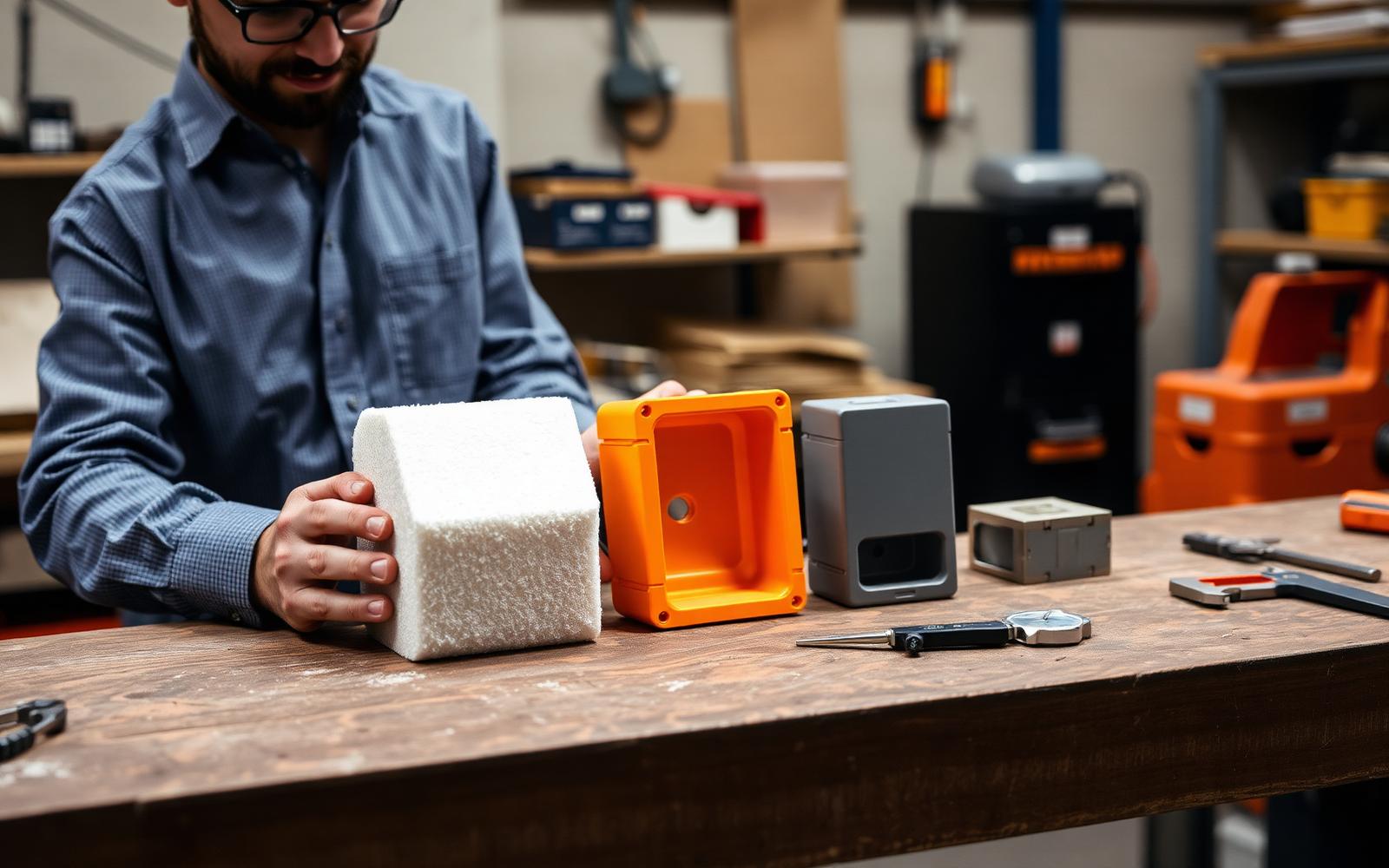
"How much is a prototype" has no single answer because the word covers everything from a foam block to a certified pre-production unit. Price the build against the question it answers and the range narrows quickly.
Prototype type | What it proves | Typical cost |
|---|---|---|
Appearance model | Form, size, ergonomics | $800–$6,000 |
Functional mechanical prototype | Mechanism works | $2,500–$15,000 |
Electronics breadboard / dev-kit rig | Circuit concept and firmware | $3,000–$20,000 |
Integrated alpha unit | Whole product works together | $10,000–$60,000 |
Beta / pre-production unit | Manufacturable and testable | $25,000–$150,000 |
Where the money goes
- Engineering hours dominate: CAD, electronics design and firmware usually exceed the parts cost by 3–10x.
- Iteration count matters more than unit price — three cycles of a $2,000 build costs $6,000 plus engineering each time.
- Cosmetic finishing is labor, not machine time, and often doubles the cost of an appearance model.
- Custom PCBs carry NRE for assembly setup and stencils regardless of quantity.
- Certification pre-scans on an alpha unit cost $1,500–$5,000 and routinely save far more later.
Choosing who builds it
Provider | Rate / cost | Good for | Watch for |
|---|---|---|---|
Local machine or print shop | $60–$150/hr | Parts from your CAD | No design help — you own all decisions |
Freelance engineer | $70–$160/hr | Focused single-discipline work | Coverage gaps between disciplines |
Product development firm | $110–$220/hr | Concept through production | Scope discipline; get phased quotes |
Invention promotion company | Flat "packages" | Rarely anything | High fees, low delivery — check disclosures |
Offshore shop | $35–$90/hr | Well-specified builds | Time zones, IP terms, revision loops |
Cutting cost without cutting evidence
- Split the prototype: prove function in an ugly rig, prove form in a non-working model. Combining them costs far more.
- Use off-the-shelf development boards for alpha electronics rather than custom PCBs.
- Print in-house or locally for fit checks and reserve paid builds for milestone reviews.
- Write the test question before ordering the build; unfocused prototypes generate opinions, not answers.
- Ask for a phased quote with a stop point after each phase rather than a lump sum.
Our rapid prototyping work is quoted in phases for exactly this reason, and consulting can scope the build before you spend.
How to scope a prototype so the quote is comparable
Prototype quotes vary by a factor of five for the same idea, and the variance is almost always caused by an underspecified request rather than by shop pricing. A shop that assumes a cosmetic model will quote a fraction of a shop that assumes a functional, testable unit. Send every vendor the same one-page brief and the spread collapses to something you can actually judge.
- State the purpose in one sentence: investor demo, user testing, certification pre-check, or design verification. Each implies a different build.
- Specify how many units and what happens to them - units that get destroyed in testing need different tolerances than units that sit on a shelf.
- List the functions that must work and the ones that can be faked; a hollow shell with an off-the-shelf module inside is often the honest answer.
- Give target dimensions, mass and any hard interfaces (a phone that must fit, a rail it must mount to).
- Name the finish level: raw print with visible layer lines, sanded and primed, or painted to a colour standard.
- Attach the deadline and say what it is tied to, so the shop can quote a realistic path rather than a rush surcharge.
Prototype class | Typical cost | Lead time | What it proves | What it cannot prove |
|---|---|---|---|---|
Appearance model (SLA, painted) | $300-$2,500 | 1-2 weeks | Form, scale, colour, shelf appeal | Function, durability, manufacturability |
Functional mechanical rig | $2,000-$12,000 | 2-4 weeks | Mechanisms, loads, fit and motion | Cosmetics, final cost |
Electronics breadboard | $1,500-$8,000 | 2-5 weeks | Circuit behaviour, firmware, power draw | Enclosure integration, EMC |
Integrated works-like looks-like | $8,000-$40,000 | 5-10 weeks | End-to-end user experience, test-ready unit | Mass-production yield |
Production-intent pilot unit | $25,000-$120,000+ | 10-20 weeks | Process, tooling, certification readiness | Long-term field reliability |
Evaluating a prototype company before you commit
The cheapest quote is rarely the cheapest project. What separates a shop that saves you money from one that costs you a rebuild is whether they push back on your brief. A vendor who accepts an ambiguous spec without a single question is quoting to protect themselves, not to solve your problem.
- Ask to see a project that failed and what they changed afterwards; the answer tells you more than a portfolio does.
- Confirm who owns the CAD and the design files when the engagement ends - get it in the contract, not the email thread.
- Check whether they can carry you into design for manufacture, or whether the relationship ends at the prototype.
- Ask what their change process costs: how a mid-build revision is priced and how quickly it is scheduled.
- Request a named engineer, not an account manager, as the technical contact for the build.
Budget in phases rather than as a lump sum. Fund the cheapest build that can kill the riskiest assumption, review the evidence, then release the next phase. Inventors who follow that sequence usually spend less in total than those who commission one expensive integrated prototype before they know whether the core mechanism works.
Frequently asked questions
How much do prototype companies charge?
A single printed appearance model runs $300-$2,500. A functional mechanical prototype typically costs $1,500-$8,000, electronics prototypes $5,000-$25,000, and a complete development program from concept to production handoff $60,000-$300,000.
Do I need a patent before contacting a prototype company?
No. A signed NDA is enough for most engagements, and many inventors file a provisional application first for a year of protection while prototypes and market tests run. Legitimate firms sign NDAs without hesitation.
What is the difference between a prototype shop and a product development company?
A prototype shop builds the parts you specify and takes no responsibility for whether the design works. A product development company owns the engineering: requirements, design for manufacturing, testing, supplier selection and the handoff package the factory needs.
How long does a prototype take?
Printed parts arrive in one to two weeks, machined functional prototypes in two to four, and an integrated electromechanical prototype in six to twelve weeks including circuit board fabrication and firmware bring-up.
LA NPDT works as a full-service development partner - research, design, prototyping and production handoff under one roof, with you owning every file. Request a quote to see a scoped plan for your product.
Work with LA NPDT: if you are moving from here to execution, start with our rapid prototyping services or talk to us about prototype design .
Filed under:Education
Services related to this guide
- Best product development companiesHow the leading US firms compare, and which one fits your stage and budget.
- Best product design companiesDesign studios compared by scope, industry and what they hand off.
- Product engineering companiesEngineering firms for physical products compared by discipline, rigor and budget.
- Consultant vs firm vs freelancerWhat each option costs, what it delivers and where to find them.