Industrial Design Consultancy: What They Do and How to Pick One
What an industrial design consultancy delivers, how fees are structured, and how to tell stylists from teams that can get a product built.
October 28, 20198 min read

Written by Konstantin Dolgan, Ph.D., NPDP
Founder & CEO, Product Development Engineer
Published October 28, 2019Updated September 2, 2026
Product design companies fall into three bands - independent freelancers, design studios and full-service development firms - and picking the wrong band costs more than picking the wrong company. A studio that makes beautiful renders cannot release tooling. A firm built for tooling is expensive for a concept sprint. This guide compares capability, cost and contract terms so you can match the partner to the stage you are actually at.
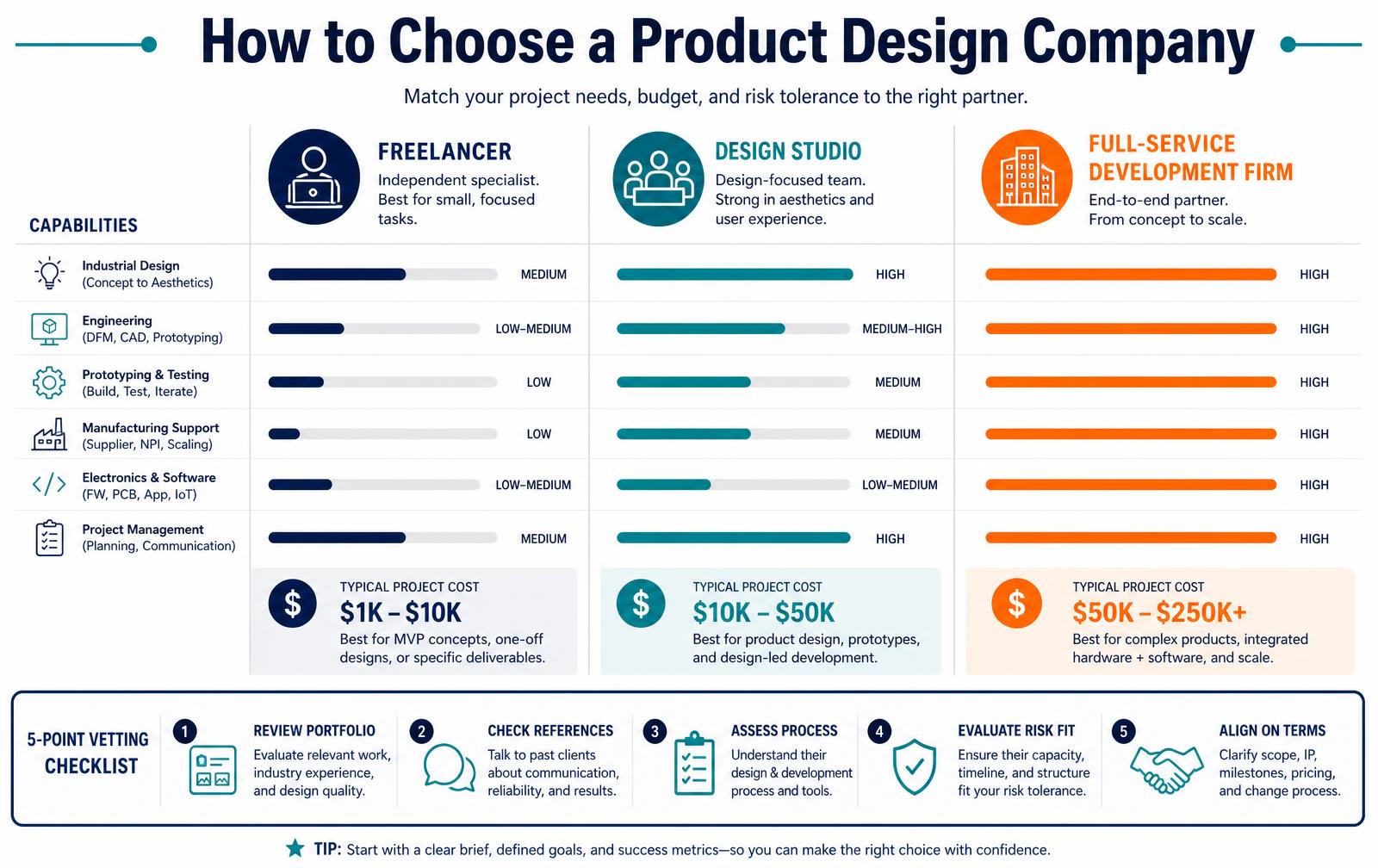
The three bands compared
Partner type | Strongest at | Weakest at | Typical project |
|---|---|---|---|
Freelancer | One deliverable, fast, low cost | Engineering depth, continuity | $1k-$10k |
Design studio | Form, UX, brand-led concepts | Manufacturing release, testing | $10k-$50k |
Full-service firm | Concept through production | Cost for small, isolated tasks | $50k-$250k+ |
Contract manufacturer design desk | DFM for their own processes | Independent concept work | Bundled with tooling |
What a complete scope includes
- Research and requirements, written as testable specs rather than adjectives.
- Concept development with at least three genuinely different directions.
- Industrial design and CMF, resolved against a manufacturing process.
- Mechanical engineering, CAD and tolerance analysis.
- Prototypes at two fidelities: looks-like and works-like.
- Design for manufacture, supplier quoting and first-article support.
What it costs by product type
Product | Design and engineering | Prototyping | Tooling |
|---|---|---|---|
Simple moulded consumer good | $15k-$45k | $3k-$12k | $8k-$40k |
Consumer electronics | $60k-$180k | $15k-$60k | $40k-$180k |
Medical device (Class II) | $120k-$400k | $30k-$120k | $50k-$250k |
Industrial equipment | $80k-$250k | $20k-$90k | Low or none |
Five checks before you sign
- Portfolio - ask for products that shipped, not concepts. Request the manufacturer name.
- References - talk to a client whose project went badly; how the firm handled it tells you more than a success story.
- Process - phase gates, deliverables and a change procedure in writing.
- Team - meet the engineer doing the work, not only the principal.
- Terms - IP, CAD files, test data and tooling transfer to you on payment; exit is possible at any phase boundary.
Red flags
- A fixed price for the whole programme before requirements exist.
- Renders in the portfolio with no photograph of a produced unit.
- Refusal to name the factory or share DFM feedback.
- Ownership of tooling or design files retained by the firm.
- No prototyping budget in the proposal.
Industrial design engagement models
Model | Typical cost | Best for | Watch out for |
|---|---|---|---|
Hourly time and materials | $85-$175/hr | Evolving scope, ongoing support | Budget drift without a cap |
Fixed-fee phase | $15k-$75k per phase | Well-defined deliverables | Change orders on every new idea |
Monthly retainer | $8k-$30k/mo | Multi-SKU roadmaps | Paying for idle capacity |
Equity or royalty hybrid | Reduced cash plus 1-5% | Cash-poor early startups | Long-term cost far exceeds fees |
How to evaluate a consultancy
- Ask to see products that shipped, not renderings. Request the tooled part in hand if possible.
- Meet the engineers who will do the work, not only the principal who sells it.
- Confirm in-house engineering depth. Design-only shops hand you concepts you still must engineer.
- Ask how they handle factory communication and whether they have worked with your region of manufacture.
- Get IP ownership in writing, including CAD files and any firmware.
- Request one reference whose project went badly. How they describe it tells you more than the wins.
What industrial designers actually deliver
Industrial design sits between what a product should feel like and what it can physically be.
The deliverables that matter are concrete: user and ergonomic research that produces dimensional constraints rather than adjectives, sketch exploration that covers genuinely different directions instead of five versions of one, appearance models you can hold and put in front of buyers, surfaced CAD that an engineer can build on, and a color-material-finish specification with real supplier references and approved samples.
The last one is where inexperienced teams lose months. A CMF spec that says "matte black soft touch" is not a specification. A usable one names the resin, the texture standard such as a Mold-Tech number, the gloss level, the paint or coating supplier and part number, and the approved master sample against which production is judged. Without it, every production run looks slightly different and nobody can prove which one was correct.
Good industrial design also constrains itself. A designer who has shipped products will avoid surfaces that cannot be drafted, split lines that cannot be held, and finishes that will not survive the product's real environment. That self-restraint is the difference between a concept that photographs well and a product that can be made ten thousand times.
How the design and engineering handoff should work
The costliest structure in product development is a design firm that hands concepts to an engineering firm with no shared accountability.
Each side is honest and the product still fails: the designer says the engineer ruined the form, the engineer says the form was never manufacturable, and you pay for the third iteration that reconciles them.
If you must use two vendors, insist they meet during concept, not after, and give one of them written authority over the final geometry.
A healthier pattern is continuous involvement. Engineering reviews the concepts before they are presented to you, flagging the ones that imply expensive tooling. Design stays engaged through detailed design, approving the small compromises that draft angles and wall thickness force. Both attend the first article review, because that is where you learn whether the intent survived the factory.
When you evaluate a consultancy, ask directly how the handoff happens inside their shop, who owns the model after concept freeze, and how many revisions are included when engineering finds a problem. The answer tells you whether you are buying a coordinated program or two separate projects with your name on the seam between them.
- One owner for final geometry. Shared ownership means no ownership when a decision is contested.
- Engineering in the concept review, before the concepts reach you.
- A written CMF spec with supplier part numbers and an approved master sample.
- Included revisions for manufacturability findings, stated as a number in the contract.
- Both parties at first article, comparing the tooled part against design intent.
Our industrial design and development team keeps design and engineering under one roof, backed by product design services that carry a concept to tooling-ready CAD and a portfolio of products that reached shelves rather than renderings.
Budgeting the design phase realistically
For a single consumer product of moderate complexity, industrial design through appearance model usually lands between fifteen and sixty thousand dollars, and design plus mechanical engineering through tooling-ready files typically runs sixty thousand to two hundred thousand.
Ranges that wide are not evasive; they reflect real drivers. Part count, cosmetic expectations, whether the product contains electronics, regulatory exposure and how many concept directions you want explored each move the number substantially.
Budget for iteration explicitly. Two rounds of physical prototypes is the realistic minimum for a product with any ergonomic or assembly complexity, and every program discovers something in the first tooled parts. A plan with no contingency does not remove the iterations; it just funds them out of the launch budget later, usually at the moment when schedule pressure makes good decisions hardest.
Red flags in a proposal
Proposals reveal more than portfolios do. Be wary of a scope written entirely in phases and hours with no named deliverables, because it gives you no way to know whether a phase is complete. Be wary of a fixed fee that seems low against the described scope; the gap reappears as change orders once you are committed.
Be wary of any proposal that omits manufacturability, tolerance work or a first-article review, since those are precisely the activities that separate a design that ships from one that photographs well.
Positive signals are equally readable: a stated assumption list, an explicit exclusion list, named revision counts, a defined change-order rate, and a schedule that includes the client's own review time. A consultancy that has run real programs knows the client is usually the slowest link and plans for it rather than pretending approvals happen overnight.
Key takeaways
- A consultancy's real product is a manufacturable documentation package, not a rendering.
- Keep industrial design and mechanical engineering under one accountable owner.
- Design for manufacturing early is the cheapest insurance against tooling changes.
- Structure the engagement as phase gates with defined deliverables you can exit.
Work with LA NPDT: if you are moving from here to execution, start with our product design services or talk to us about concept design services.
Frequently asked questions
What do product design companies do?
They turn a requirement into a manufacturable product: research, concepts, industrial design, mechanical and electrical engineering, prototyping, testing and the production file set a factory needs to quote and build.
How much do product design companies charge?
Freelancers run $50-$150 per hour, studios $110-$200, and full-service firms $130-$250 with blended team rates. Most partners will quote fixed-fee phases once requirements are defined; a typical consumer product reaches production-ready design for $25,000-$150,000.
Should I hire a local product design company?
Proximity matters most during prototyping and factory visits. A partner in your time zone who can hold a physical prototype with you usually beats a cheaper remote team on schedule, though distributed work is normal for software-heavy products.
Who owns the design when I hire a product design company?
You should, on payment - including CAD, drawings, test data, firmware and tooling. Insist on a written assignment of work product in the agreement rather than a licence back to you. Related reading: our product development services , our portfolio and request a quote .
What an industrial design consultancy actually delivers?
Recognition lists are a useful signal, but they do not tell a founder what they are buying.
An industrial design consultancy sits between the idea and the factory: it converts intent into geometry, geometry into a manufacturable design, and the design into a documentation package a contract manufacturer can quote without guessing.
The work is part aesthetics and mostly engineering judgment — wall thickness, draft, tolerance stacks, material selection, and the hundred small decisions that determine whether a beautiful concept can be molded at a price the market accepts.
The value shows up in what does not happen: tools that do not need modification, assemblies that do not need a shim, packages that do not fail drop testing a month before launch.
A tool change measured in tens of thousands of dollars is the price of a decision that a design review would have caught for a fraction of that.
How to evaluate a consultancy before you sign?
Ask to see products that shipped, not only renderings — anyone can render. Ask who does the work: the person in the pitch should be on the project. Confirm engineering and design live under one roof, or expect to manage the handoff yourself.
Ask how they handle a failed prototype — the answer reveals the real process. Require a written deliverable list per phase, with what you own at the end. Check that they have taken something through tooling in your manufacturing region. Ask for one reference whose project went badly and what happened next.
Where founders lose money working with the wrong partner?
Three patterns account for most of the waste. First, buying styling without engineering, which produces a gorgeous CAD file that no factory can quote. Second, splitting design and engineering across two firms with no single owner of the outcome — every defect becomes a jurisdiction argument.
Third, skipping design for manufacturing to save weeks, then losing months when first articles come back warped or out of tolerance. The alternative is not a more expensive firm; it is a clearer contract.
Phase gates with defined exit criteria, a named technical owner, and a documentation package specified up front turn a consultancy relationship from an open-ended spend into a series of decisions you can stop at any point.
Filed under:InspirationNews
Services related to this guide
- Product design servicesIndustrial design and CAD taken all the way to manufacturable files.
- Rapid prototypingWorking prototypes in days, from 3D printing to vacuum casting.
- Electronic design servicesSchematic, PCB layout, firmware and bring-up, through to production handoff.
- Product development examplesReal projects we designed, prototyped and shipped.