Innovation Companies: What They Do, What They Cost and How to Pick One
Innovation company covers four very different businesses. Here is what each one does, what it costs, and how to tell which one your project needs.
March 16, 20165 min read

Written by Konstantin Dolgan, Ph.D., NPDP
Founder & CEO, Product Development Engineer
Published March 16, 2016Updated September 2, 2026
"Innovation company" covers four very different businesses, and hiring the wrong one is the most common way good ideas stall. A research lab will happily spend two years proving a material works. A product development firm will get a manufacturable version on a shelf. A strategy consultancy will produce a roadmap. All three are legitimate; only one of them matches what you need this year.
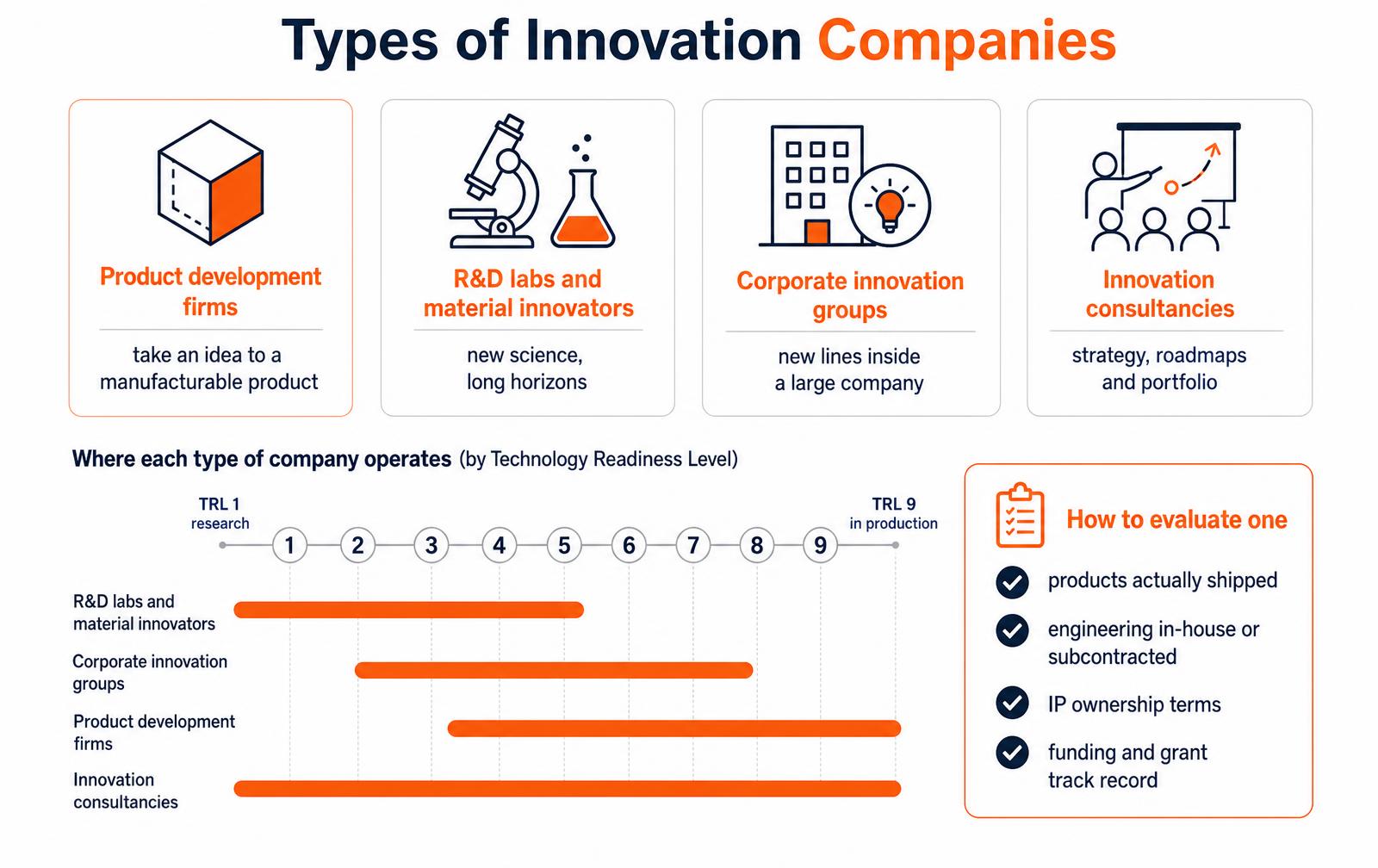
The four kinds of innovation company
Type | Typical engagement | What you get | Best when |
|---|---|---|---|
Product development firm | 3-18 months, $50k-$1M+ | Working product, drawings, tooling-ready design | The science works and you need a manufacturable product |
R&D lab / material innovator | 1-4 years, grant or milestone funded | Validated science, publications, patents | The core mechanism is unproven |
Corporate innovation group | Ongoing internal budget | New lines and ventures inside an existing company | Distribution exists but the pipeline is empty |
Innovation consultancy | 6-16 weeks, $30k-$250k | Strategy, portfolio and roadmap | The question is what to build, not how |
Use technology readiness to decide
Technology readiness levels are a blunt instrument, but they answer the hiring question quickly. Below roughly TRL 4 — the physics is not yet demonstrated outside a lab bench — you need research capability and probably grant funding.
From TRL 5 upward, when the mechanism works but the product does not exist, a product development company is the right partner. Paying a research lab to do TRL 8 work is slow; paying a product firm to do TRL 2 work is expensive and usually disappointing.
How innovation gets funded
- Innovation and enterprise funds. Regional and university-linked funds back early technical work — our own graphene project was selected by an innovation enterprise fund, which paid for the science before any product spend.
- SBIR / STTR grants. Non-dilutive federal money for high-risk research with a commercialization path. Slow to apply for, excellent to have.
- Strategic partners. A future customer funding development in exchange for early access or exclusivity in a narrow field.
- Equity. Appropriate once technical risk is retired and the remaining questions are market and scale, not physics.
Six questions to ask before signing
- Which products of yours are on the market right now, and can I hold one?
- Is the engineering done in-house, or subcontracted to someone I will never meet?
- Who owns the IP created during the project, and is that unconditional on final payment?
- What is the deliverable at each phase, and what evidence proves it is finished?
- Who is actually assigned to my project, and what else are they on?
- What happens when the first prototype fails — is rework in scope or a change order?
The answers separate firms that ship from firms that produce renderings. If you are early and want to stress-test the concept before spending, our discovery stage exists for exactly that.
Frequently asked questions
What is an innovation company?
It is a firm whose product is new capability rather than an existing catalogue item. In practice the label covers product development firms, R&D labs and material innovators, corporate innovation groups, and strategy consultancies — each operating at a different stage of technology readiness.
How much does it cost to work with an innovation company?
Strategy engagements typically run $30,000-$250,000 over six to sixteen weeks. Taking a physical product from concept to production-ready design commonly runs $50,000 to over $1,000,000 depending on electronics, regulation and tooling. Research-stage work is usually grant or milestone funded rather than priced as a project.
Who owns the intellectual property?
In a well-written development agreement, the client owns all project-specific IP on payment, while the firm keeps its pre-existing tools and general know-how. Be cautious with any contract that retains rights to project inventions or licenses your design back to you.
Funding follows evidence of readiness, not novelty
Advanced materials projects fail funding rounds for a predictable reason: the science is interesting and the path to a manufactured product is undefined. Innovation companies that consistently win support treat readiness as the deliverable. They can state, in one page, what has been demonstrated, at what scale, under what conditions, and what the next demonstration will cost.
That discipline is what separates a laboratory result from a fundable programme. Reviewers are rarely evaluating whether the material works; they are evaluating whether the team knows what remains unknown.
Technology readiness gates for a materials programme
Level | Demonstration | Typical evidence | Funding stage |
|---|---|---|---|
1-2 | Principle observed and formulated | Published results, patent filing | Research grant |
3 | Proof of concept in the lab | Coupon-level property data | Seed or innovation fund |
4 | Component validated in the lab | Test article with repeatable results | Innovation fund |
5 | Validated in a relevant environment | Environmental and life testing | Development grant, strategic partner |
6 | Prototype in a relevant environment | Sub-scale system with performance data | Series A, corporate partner |
7-8 | Demonstrated in operational setting, qualified | Pilot line output, qualification report | Growth capital, customer funding |
9 | Proven in production | Yield and cost data at rate | Commercial revenue |
Where advanced materials programmes actually break
- Scale-up variance: properties measured on gram-scale samples do not reproduce at kilogram scale without process control that has not yet been designed.
- Characterisation gaps: no agreed test method means every partner measures differently and results cannot be compared.
- Integration: the material outperforms the incumbent in isolation and fails in the assembly because of adhesion, thermal expansion or joining.
- Supply chain: a single precursor source with no second supplier makes the whole programme uninvestable for an industrial customer.
- Regulatory and handling: nanomaterials and novel chemistries carry occupational exposure and disposal obligations that arrive late and cost real money.
- Cost per functional unit: cheaper per kilogram is irrelevant if more kilograms are needed to achieve the same performance.
Funding routes and what each expects
Route | Typical amount | What they fund | What they require |
|---|---|---|---|
Public innovation grant | $50k-500k | Feasibility and lab validation | Defined milestones, reporting, matched effort |
Innovation or enterprise fund | $250k-2M | Prototype and relevant-environment testing | Equity or convertible, commercial thesis |
Corporate development partner | $100k-1M plus in-kind | Application-specific development | Exclusivity window or field-of-use rights |
Strategic investor | $2M-10M | Pilot line and qualification | Board seat, clear route to volume |
Customer-funded NRE | $50k-500k | Specific product integration | Delivery to their specification and schedule |
Structuring a project so it stays fundable
Element | Weak version | Fundable version |
|---|---|---|
Objective | Improve material performance | Achieve 30% conductivity gain at under $X per functional unit |
Milestones | Quarterly progress reports | Gated demonstrations with pass criteria and go/no-go |
Test method | In-house measurement | Standardised method, third-party verified |
IP position | Patent pending | Freedom-to-operate analysis plus filed claims mapped to the product |
Team | Researchers | Researchers plus a process engineer who has scaled something |
Route to market | Licensing eventually | Named application, named first customer, defined qualification path |
The diligence questions funds ask
- What is the performance advantage in the customer's units, not in laboratory units?
- At what production scale has the process been demonstrated, and what changed between scales?
- What does the material cost per functional unit at target volume, with the process you actually intend to use?
- Who else can make this, and what stops them?
- What is the qualification path at the first customer, and how long does it take?
- Which single failure would end the programme, and what is the plan to test it first?
That last question is the one experienced reviewers weight most heavily. A team that has already sequenced its riskiest experiment early is managing a programme; a team that has scheduled it last is managing a story.
Partner structures for collaborative development
Structure | Best for | Watch out for |
|---|---|---|
Fee-for-service development | Well-defined engineering scope | Little upside participation for the developer |
Joint development agreement | Shared technical risk with a customer | IP ownership and field-of-use ambiguity |
Licence with milestones | Mature technology, established manufacturer | Diligence obligations that are unenforceable |
Equity plus development | Long programmes needing aligned incentives | Dilution before value inflection |
Consortium or grant-funded group | Pre-competitive material science | Slow decisions, diffuse ownership |
More questions teams ask
Frequently asked questions
What do innovation funds look for in an advanced materials project?
Evidence of readiness rather than novelty: repeatable property data, a defined scale-up path with the process risks named, a costed route to a functional unit price, and a first application with a real customer and qualification timeline.
How long does an advanced materials programme take to reach production?
Typically five to ten years from laboratory proof to qualified production, with the longest stretch between relevant-environment validation and pilot-scale yield. Programmes that compress this usually do so by targeting a low-qualification-burden application first.
What is the most common scale-up surprise?
Variance. Properties that are consistent at gram scale spread widely at kilogram scale because mixing, thermal history and contamination control differ. Building statistical process capability into the pilot plan is the mitigation.
Should a materials company build products or license?
Licensing is faster to revenue and gives away margin and roadmap control; building products keeps both and requires far more capital and time. Many teams do both — a demonstrator product to prove the value, licences for volume markets they cannot serve.
How do we price a novel material?
Per functional unit at the customer's application, benchmarked against the incumbent's total cost including processing and yield. Price per kilogram is the wrong comparison when the performance advantage lets the customer use less material or eliminate a process step. Work with LA NPDT: if you are moving from here to execution, start with our our product development process or talk to us about end-to-end product development .
Filed under:News
Tagged:CommercializationDevelopmentGraphenoNewsProduct Development
Services related to this guide
- Product design servicesIndustrial design and CAD taken all the way to manufacturable files.
- Rapid prototypingWorking prototypes in days, from 3D printing to vacuum casting.
- Electronic design servicesSchematic, PCB layout, firmware and bring-up, through to production handoff.
- Product development examplesReal projects we designed, prototyped and shipped.