Graphene Composites: Properties, Applications and Costs
Graphene composite properties translated into engineering decisions - real applications, material pricing, technology readiness and when it is worth designing in.
April 26, 20166 min read

Written by Konstantin Dolgan, Ph.D., NPDP
Founder & CEO, Product Development Engineer
Published April 26, 2016Updated September 2, 2026
Graphene is a single layer of carbon atoms in a hexagonal lattice - stronger than steel by weight and more thermally conductive than copper. Those headline numbers describe pristine, lab-grown monolayer.
What you can actually buy at product volumes are graphene composites: nanoplatelets or reduced graphene oxide dispersed into a polymer, resin or metal matrix, where the performance you get is a fraction of the datasheet. Here is how to tell a real application from a marketing claim.
Properties that matter to designers
Property | Pristine monolayer | What you get in a real part |
|---|---|---|
Tensile strength | ~130 GPa | Composite gains of 10-40% vs base resin |
Thermal conductivity | ~3,000-5,000 W/mK | 20-1,500 W/mK in films and pastes |
Electrical conductivity | ~10^6 S/m | Enough for ESD and EMI, rarely for traces |
Surface area | ~2,630 m2/g | Drives battery and sensor use cases |
Density | 2.2 g/cm3 | Loadings of 0.1-5% by weight are typical |
Applications that ship today
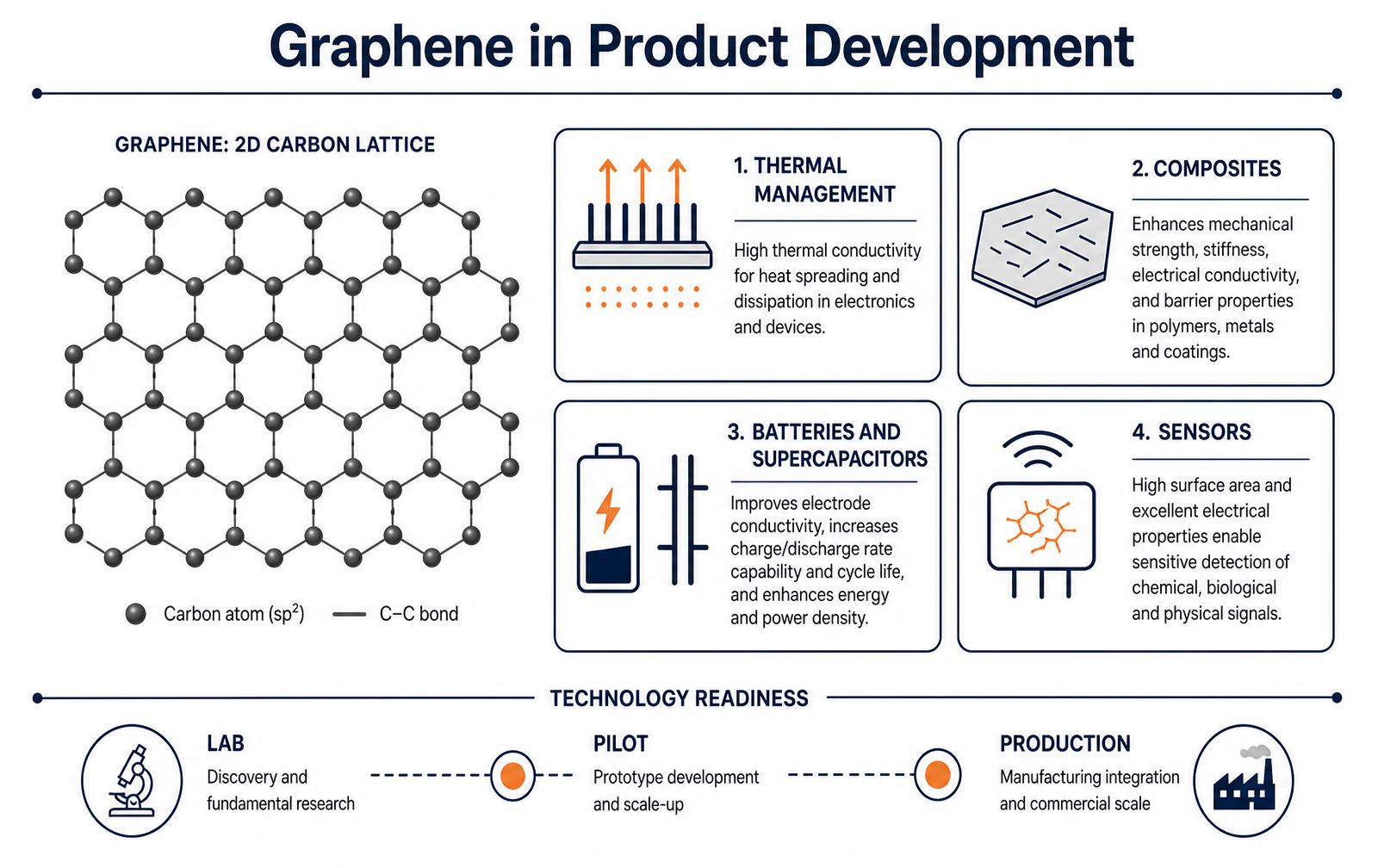
- Thermal management - graphene films and thermal interface materials in phones, laptops and LED modules. The most commercially mature use.
- Polymer and composite reinforcement - small loadings improve stiffness, barrier properties and conductivity in housings, sporting goods and pipes.
- Coatings - anti-corrosion and barrier coatings for marine and industrial assets.
- Batteries and supercapacitors - as a conductive additive in electrodes, improving rate capability and cycle life. Widely used; rarely the headline chemistry.
- Sensors - chemical, strain and biosensors exploiting surface area and conductivity. Mostly pilot scale.
- ESD and EMI control - conductive fillers in enclosures and packaging.
What graphene materials cost
Form | Typical price | Where it is used |
|---|---|---|
Graphene nanoplatelets (industrial grade) | $50-$300 /kg | Composites, coatings, concrete |
Reduced graphene oxide powder | $200-$1,000 /kg | Batteries, inks |
Dispersions / masterbatch | $150-$600 /kg | Injection molding and extrusion |
CVD monolayer film on substrate | $100-$500 per 4-inch wafer | Research, sensors, photonics |
At 1% loading, a $200/kg nanoplatelet adds roughly $2 per kilogram of finished polymer - trivial on a premium part, meaningful on a commodity one. The cost that kills programs is usually dispersion process development, not the powder.
How to evaluate a graphene supplier claim
- Ask for the number of layers and lateral flake size, with TEM or AFM data - much of what is sold as graphene is fine graphite.
- Request Raman spectra showing the D, G and 2D bands, plus batch-to-batch variation.
- Ask for oxygen content; heavily oxidised material behaves nothing like graphene electrically.
- Insist on property data in your matrix, at your loading, from your process - not neat-material datasheets.
- Confirm kilogram-scale supply and a second source before designing it in.
- Check regulatory and safety handling requirements for nanomaterials in your target markets.
When it is worth designing in
Graphene is worth the qualification effort when a single property is genuinely limiting your product - heat you cannot get out of a small enclosure, a barrier requirement no standard polymer meets, or cycle life on a cell you already ship. It is not worth it when the gain is marginal, when a cheaper filler like carbon black or boron nitride gets you 80% of the way, or when the only justification is the word on the box.
Dispersion is the whole engineering problem
Graphene works because of surface area, and surface area is exactly what makes it agglomerate. Dry flakes pulled straight into a polymer melt clump into stacks that behave like ordinary graphite filler: you pay a premium price for a mediocre reinforcement and sometimes lose impact strength in the bargain.
Suppliers that deliver measurable property gains almost always ship a masterbatch or a functionalised grade where the dispersion work is already done, and they will tell you the loading window, the screw profile and the drying schedule.
If a supplier cannot describe how the flakes stay separated in your specific resin, the datasheet numbers were measured on a film that has nothing to do with your part.
Realistic property gains by application
Application | Typical loading | Reported gain | Practical caveat |
|---|---|---|---|
Thermal management pads and housings | 2-10 wt% | 2-8x through-plane conductivity | Gains fall sharply if flakes are not aligned |
Anti-static and EMI shielding | 1-5 wt% | Surface resistivity to 10^4-10^6 ohm/sq | Carbon black is often cheaper for pure ESD |
Barrier coatings | 0.5-2 wt% | 30-70% lower permeability | Coating adhesion becomes the limiting factor |
Structural reinforcement in polymers | 0.1-1 wt% | 10-30% modulus, variable strength | Impact strength can drop; test the actual part |
Battery electrode additive | 0.5-3 wt% | Faster charge acceptance, cycle life | Qualification cycles dominate the schedule |
Qualification steps before you design it in
- Ask for the characterisation data: flake lateral size, layer count, oxygen content and the method used to measure each.
- Run a molded plaque study at three loadings on your resin and your machine, not on a supplier sample.
- Test the property you actually need, plus the two you might sacrifice: impact, elongation, warpage.
- Check colour and surface finish. Grey to black is the practical palette; cosmetic parts often stop here.
- Confirm supply continuity. Ask for batch-to-batch data across at least three lots and the annual capacity in kilograms.
- Price the finished part, not the powder. A 1% loading of a $200/kg additive is often a few cents; the trial and qualification work is the real spend.
Handling, safety and supply reality
Graphene powders are light, conductive and airborne in a way that surprises shops used to mineral fillers. Conductive dust and open electronics do not mix, so most facilities handle raw powder in a contained station or avoid it entirely by buying a masterbatch pellet.
Occupational exposure guidance for nanomaterials is still developing, which in practice means respiratory protection, local exhaust and documented handling procedures rather than a settled exposure limit.
On the supply side the market is fragmented: many suppliers are pilot-scale, product names describe grades rather than standards, and lot-to-lot variation is the norm. Treat any single-source graphene grade as a program risk and qualify a second supplier before it reaches production.
- Buy masterbatch, not powder, unless you have containment and a reason.
- Ask for the safety data sheet and handling guidance specific to the grade, not to graphite.
- Qualify a second source early; pilot-scale suppliers change capacity and ownership often.
- Write the specification in measurable terms: flake size distribution, layer count, purity, not marketing labels.
- Retain samples of every lot so a property drift can be traced.
- Confirm end-of-life and recycling implications if the part carries environmental claims.
Key takeaways
Where graphene actually earns its price
Most products that claim graphene composites use a fraction of a percent by weight, and the honest question is whether that loading changes a property you can sell. These are the applications where the data holds up.
Application | Typical loading | Measured benefit | Cost adder | Maturity |
|---|---|---|---|---|
EMI shielding coatings | 2-8 wt% | 30-60 dB attenuation, thin layer | $$ | Commercial |
Thermal interface / heat spreaders | 5-20 wt% | 2-8x in-plane conductivity | $$ | Commercial |
Anti-corrosion barrier coatings | 0.5-2 wt% | 2-5x salt-spray hours | $ | Commercial |
Structural epoxy toughening | 0.1-0.5 wt% | 20-40% fracture toughness | $ | Pilot |
Battery anode/conductive additive | 1-3 wt% | Rate capability, cycle life | $$$ | Pilot / scaling |
Bulk polymer stiffness | 1-5 wt% | 5-15% modulus | $$$ | Rarely worth it |
Cost and sourcing reality
Grade | Price range | What you get | Use when |
|---|---|---|---|
Graphene nanoplatelets (industrial) | $40-$200/kg | Multi-layer, 5-50 um flakes | Coatings, filler, thermal |
Few-layer graphene dispersion | $300-$1,200/kg solids | Better exfoliation, stable in resin | Structural, electrical |
CVD monolayer film | $100+/cm2 | True single layer | Research and sensors only |
Reduced graphene oxide | $60-$400/kg | Defect-rich, functionalizable | Barrier coatings, composites |
Qualification path before you put it on the label
- Get a TEM or Raman report per lot — "graphene" from a low-cost supplier is often graphite powder.
- Test dispersion, not just loading — agglomerated flakes reduce properties instead of improving them.
- Run the property you are claiming, on your part geometry, against an unfilled control.
- Check processing impact — viscosity rises sharply above 3-5 wt% and can break your molding window.
- Confirm regulatory posture — nanomaterial disclosure rules vary by market and end use.
- Price at production volume, not lab sample volume; the delta is often 5-10x.
Graphene is a legitimate engineering material when the requirement is conductivity, thermal transport, or barrier performance. It is a marketing expense when the requirement is stiffness. Our engineering team runs the control-versus-filled comparison before anyone commits to a supply agreement.
Frequently asked questions
Graphene delivers real property gains when the dispersion, loading and processing are controlled and the target property is one the material actually improves. It disappoints when a supplier datasheet is treated as a product specification. Qualify the grade against your own process, test the composite rather than the powder, and hold the program to the same evidence standard you would apply to any other engineered material.
What is graphene?
Graphene is a two-dimensional sheet of carbon atoms arranged in a hexagonal lattice, one atom thick. Stacking many layers gives graphite; a single isolated layer gives the exceptional strength, conductivity and surface area graphene is known for.
Is graphene used in real products yet?
Yes - most visibly as thermal spreader films in consumer electronics, as a conductive additive in lithium-ion electrodes, and as a filler in composites, coatings and concrete. Applications relying on pristine monolayer, such as transistors, remain largely pre-commercial.
How much does graphene cost?
Industrial-grade nanoplatelets run roughly $50-$300 per kilogram, dispersions $150-$600 per kilogram, and CVD monolayer film on a 4-inch wafer $100-$500. Prices have fallen sharply since 2015 as production scaled.
Can graphene be injection molded?
Yes, usually via a masterbatch pre-dispersed in the base resin. The engineering work is achieving uniform dispersion without agglomerates, which requires screw and process tuning and mechanical testing on molded parts, not plaques.
Related reading: sheet metal prototyping methods, design for manufacturing and our product development services.
How to test what a supplier actually shipped
Material sold as graphene ranges from genuine few-layer material to graphite powder with a marketing label. Because performance depends on layer count, lateral flake size and defect density, the only reliable path is independent characterization on the exact lot you plan to buy. Third-party testing costs far less than a failed production trial.
Characterization methods and what they tell you
Method | What it measures | Typical cost per sample | Why it matters |
|---|---|---|---|
Raman spectroscopy | Layer count, defect density (D/G ratio) | $100-$400 | Separates graphene from graphite |
SEM / TEM imaging | Flake size and morphology | $200-$800 | Confirms aspect ratio claims |
BET surface area | Specific surface area | $150-$400 | Correlates with dispersion behavior |
TGA | Thermal stability, residual content | $100-$300 | Detects binders and impurities |
XPS | Oxygen content, functionalization | $300-$900 | Predicts matrix compatibility |
Elemental / ICP analysis | Metal catalyst residues | $150-$500 | Matters for electronics and medical use |
Ask for the supplier's own data first, then verify one lot independently. Write incoming acceptance criteria into the purchase agreement — a D/G ratio range and a flake size distribution — so later lots can be rejected on evidence rather than argument.
Purchase agreement essentials
- Numeric acceptance criteria per lot, not a datasheet reference.
- Certificate of analysis with each shipment, tied to the lot number.
- Retained samples held by both parties for dispute resolution.
- Notification before any change to the production route or feedstock.
- Handling and dust-control guidance, since fine powders raise workplace exposure questions.
Key takeaways
- Verify one lot independently before designing a graphene material in.
- Raman plus imaging separates real few-layer material from graphite powder.
- Put numeric acceptance criteria into the purchase agreement up front.
Evaluating advanced materials for a new product?
Work with LA NPDT: if you are moving from here to execution, start with our prototype design or talk to us about design optimization.
Filed under:News
Tagged:CommercializationGraphenoInnovationLouisianaTechnology
Services related to this guide
- Product design servicesIndustrial design and CAD taken all the way to manufacturable files.
- Rapid prototypingWorking prototypes in days, from 3D printing to vacuum casting.
- Electronic design servicesSchematic, PCB layout, firmware and bring-up, through to production handoff.
- Product development examplesReal projects we designed, prototyped and shipped.