Market Research: Hire a Firm or Do It Yourself?
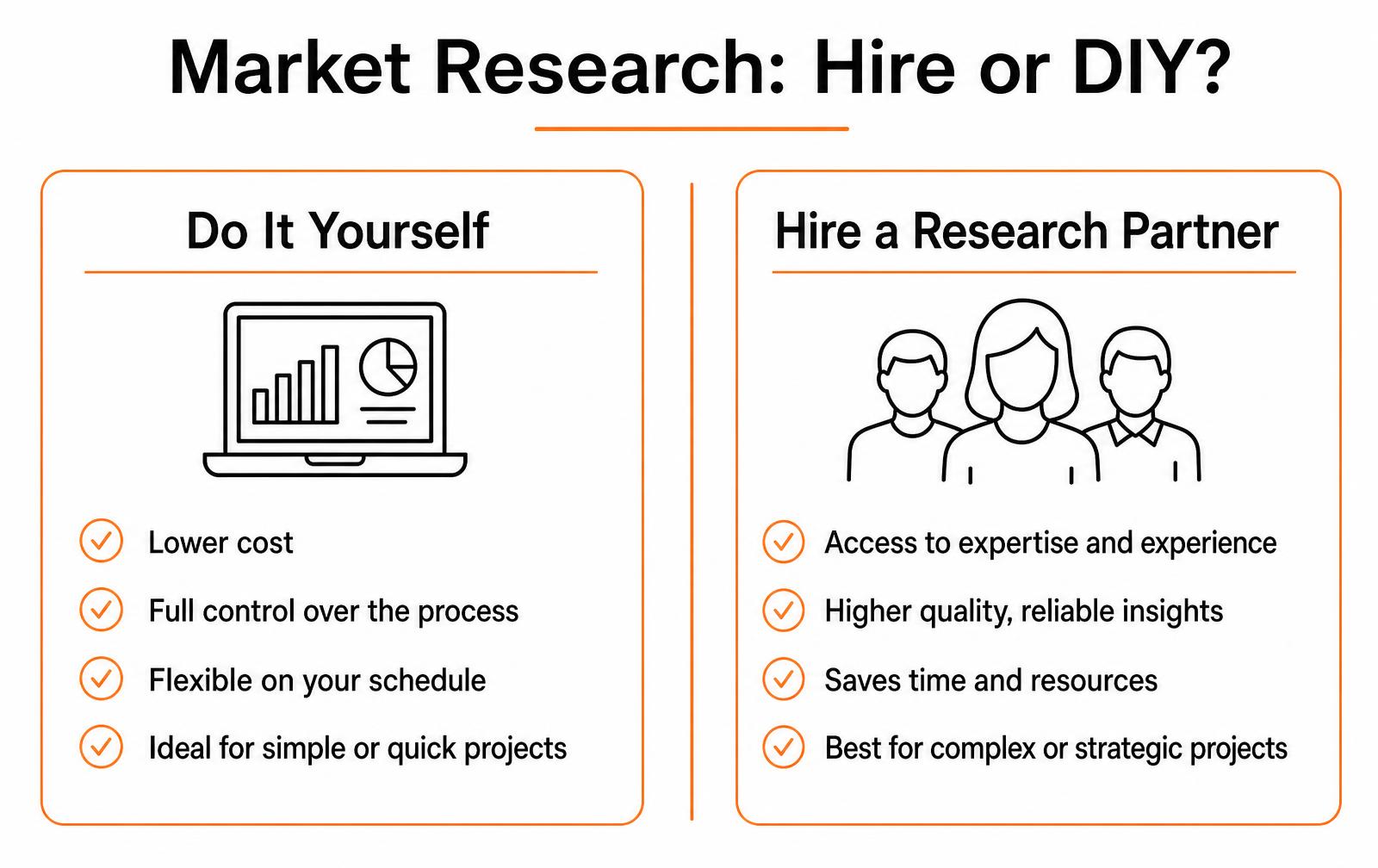
DIY research buys speed and closeness to customers; a firm buys sampling rigour and credibility. Here is how to decide on a specific project rather than in the abstract.
February 28, 20175 min read

Written by Yelena Rymbayeva, MPhil Communication & Media Studies, BTech Quality Control
Marketing & Product Leader, Technology Commercialization
Published February 28, 2017Updated September 2, 2026
Most founders can run useful market research themselves. The question is not whether you are qualified — it is whether the decision the research supports is big enough, and reversible enough, to justify paying someone else to be wrong about it too.
This guide covers what DIY research does well, where it reliably fails, what agencies actually charge in 2026, and a decision framework for choosing between them on a specific project rather than in the abstract.
The short answer
- Do it yourself when the decision is reversible, the audience is reachable, and you need direction rather than proof.
- Hire a firm when the research will be shown to investors, retail buyers or a board, when the audience is hard to reach, or when a wrong answer costs more than the study.
- Do both on most hardware programs: run your own discovery interviews first, then commission a structured study only for the questions that survived.
What each approach is actually good at
Dimension | Do it yourself | Hire a research firm |
|---|---|---|
Typical cost | $0-$3,000 (tools, incentives, ads) | $8,000-$60,000 per study |
Typical timeline | 1-3 weeks | 4-10 weeks |
Sample quality | Convenience samples, friendly bias | Screened, quota-controlled panels |
Depth of insight | High — you hear the objection yourself | Depends on the moderator and brief |
Credibility to third parties | Low | High |
Risk | Confirmation bias | A polished report answering the wrong question |
The failure mode on each side is different and worth naming. DIY research fails because founders ask leading questions of people who like them. Agency research fails because the brief was vague, so you receive an expensive description of a market you already understood.
Match the method to the question
Question you are trying to answer | Best method | DIY feasible? |
|---|---|---|
Does this problem matter enough to pay for? | 15-20 customer interviews | Yes |
Which of three concepts resonates most? | Concept test with 100-200 respondents | Yes, with a panel tool |
What will people actually pay? | Van Westendorp or Gabor-Granger pricing study | Partly — analysis is easy to botch |
How large is the addressable market? | Desk research plus category data | Yes, with paid databases |
Will a retail buyer stock this? | Buyer interviews and category review | Usually needs an introducer |
Is the claim defensible in marketing? | Statistically valid survey with documented method | No — hire |
Regulated or clinical claims | Formal study with protocol | No — hire |
Doing it yourself, properly
- Write the decision before the questions. "We will drop the subscription model if fewer than 3 in 10 accept it" is a decision. "Learn about customers" is not.
- Recruit strangers, not your network. Paid panels, category subreddits, trade shows and cold outreach cost more effort and return far better data.
- Ask about the past, not the future. "What did you buy last time and what did it cost you?" beats "Would you buy this?" every time.
- Separate the interviewer from the founder. If you must run them yourself, never pitch — describe nothing until the last five minutes.
- Record and code answers. Twenty interviews with tagged themes is data; twenty remembered conversations is a story you already believed.
- Pre-register your threshold. Decide what result would change your mind before you see any results.
If no plausible outcome of the research would change what you build next, the research is a formality — save the money and ship the prototype.
Hiring well: what a good brief contains
Brief element | Why it matters |
|---|---|
The decision at stake | Keeps the deliverable actionable rather than descriptive |
Screening criteria | Prevents a sample of people who are not your buyer |
Sample size and confidence needed | Drives cost more than any other variable |
Stimulus to be tested | Renders, video, price points, packaging |
Required deliverables | Raw data plus report — insist on the raw data |
Follow-up access | The right to re-contact respondents for depth |
Ask any firm for a redacted sample report and the screener from a comparable study. Firms that cannot show either are selling summaries of public data. Our own discovery stage service pairs structured research with engineering feasibility so the findings arrive as design inputs, not as a slide deck.
A hybrid sequence that works
Week | Activity | Who |
|---|---|---|
1-2 | 15 discovery interviews to find the real objection | You |
3 | Desk research on category size, pricing, competitors | You |
4 | Write the brief around the two questions still unresolved | You |
5-8 | Commissioned quantitative study on those questions only | Firm |
9 | Translate findings into requirements and a prototype scope | Both |
Scoping the paid study after your own interviews typically cuts its cost by half, because you are no longer paying an agency to discover what your first ten customers would have told you for free. From there, validating the idea and prototyping continue the evidence chain.
what Diy Research Really Costs
Doing it yourself is not free — it trades cash for founder hours and for the credibility of the result. Budget both explicitly before deciding, because twenty interviews consume most of a month if you are also building the product.
Line item | DIY cost | Time cost | Note |
|---|---|---|---|
Recruiting 20 target participants | $400 – $1,200 in incentives | 10 – 15 hours | Screener quality drives everything downstream |
Interview time | $0 | 20 – 25 hours | 45 minutes each plus scheduling churn |
Transcription and synthesis | $50 – $200 | 10 – 15 hours | Cheap tooling, expensive attention |
Survey panel, 200 responses | $800 – $2,500 | 8 hours | Cost rises sharply with low-incidence audiences |
Smoke-test landing page and ads | $500 – $2,000 | 10 hours | Measures behavior, not stated intent |
Total, typical DIY study | $1,800 – $5,900 | 60 – 75 hours | Roughly two founder weeks |

A screener that keeps friends out of your data
- Screen on behavior in the last 90 days, not on attitude — "bought," "replaced," "repaired," never "interested in."
- Require budget authority for B2B studies, or you are interviewing influencers and forecasting from them.
- Exclude anyone in your network, plus anyone who works in your industry unless they are the buyer.
- Cap any single company or household at one participant to avoid a shared opinion counted twice.
- Include two decoy categories in the screening question so respondents cannot guess the desired answer.
- Track incidence rate — if 90 percent of people qualify, your screener is broken.
What a paid study should hand back
Deliverable | Why it matters | Ask for it in the contract |
|---|---|---|
Raw data file | Lets you re-cut the analysis later | Yes, in CSV plus the codebook |
Screener and questionnaire | Shows how the sample was built | Yes, final versions as fielded |
Sample composition report | Reveals quota gaps and low-incidence substitutions | Yes, by segment |
Verbatim transcripts | The most reusable asset in the study | Yes, anonymized |
Method and limitations section | Shows where the numbers should not be pushed | Yes, explicit |
Debrief session | Where the real nuance surfaces | Yes, recorded |
Key takeaways
- DIY research is the right default early: it is fast, cheap in cash and forces founder contact with buyers.
- Hire a firm when the output must persuade someone else, when the sample is hard to reach, or when bias would be fatal.
- Budget 60 to 75 founder hours for a serious DIY study — the cash cost is not the real cost.
- Whatever the route, screen on recent behavior and always take delivery of the raw data.
Frequently asked questions
How much does market research cost for a new product?
DIY research usually costs under $3,000 in tools and respondent incentives. A commissioned concept or pricing study typically runs $8,000-$25,000, and a full multi-market segmentation study $30,000-$60,000. Cost is driven mostly by sample size, how hard the audience is to screen for, and whether qualitative moderation is included.
Can I do market research myself as a startup founder?
Yes, and for early direction you should. Fifteen to twenty structured interviews with strangers in your target segment will surface the real objections faster than any purchased report. The discipline that matters is recruiting outside your network, asking about past behaviour rather than future intent, and setting the decision threshold before you collect data.
When is hiring a market research firm worth it?
When the result must persuade someone else — investors, a retail buyer, a licensing partner — or when the audience is hard to reach, the claim must be statistically defensible, or the decision is expensive to reverse, such as committing to tooling. In those cases the study cost is small relative to the decision it protects.
How many interviews are enough for qualitative research?
For a single well-defined segment, themes usually saturate between 12 and 20 interviews — you stop hearing new objections. If you are studying several distinct segments, plan for that many per segment. Quantitative validation of pricing or preference needs a different order of magnitude, typically 200-400 screened respondents.
What is the Biggest Mistake in Diy Market Research?
Asking people who want you to succeed whether your idea is good. Friends, family and your professional network will confirm almost anything. The second biggest is asking hypothetical purchase-intent questions, which overstate real demand dramatically; ask what people currently spend and what workaround they use instead.
running Diy Interviews That Produce Usable Data
DIY market research fails mostly on interview technique. Founders ask leading questions, hear enthusiasm, and mistake politeness for demand. The corrective is a fixed structure that asks about past behavior rather than future intentions, and a note-taking discipline that separates what was said from what you concluded.
Question types ranked by usefulness
Question type | Example | Value |
|---|---|---|
Past behavior | "What did you do the last time this happened?" | Highest - it is factual |
Current workaround | "What do you use today, and what does it cost?" | High - reveals real spend |
Frequency and severity | "How often, and what happens when it goes wrong?" | High - sizes the problem |
Decision process | "Who else has to approve a purchase like this?" | High for B2B |
Reaction to a concept | "What would stop you from using this?" | Medium - useful when negative |
Future intent | "Would you buy this?" | Lowest - systematically inflated |
End each interview by asking who else you should speak with. Referral chains reach real buyers far faster than cold outreach, and they are the main reason a self-run study can match an agency panel on quality for this kind of work.
Interview discipline checklist
- Use the same question set for every interview so answers compare.
- Ask about the last time, not the next time.
- Do not pitch during the interview; save the concept for the end.
- Record and transcribe rather than relying on memory.
- Tag findings by theme and count them before drawing conclusions.
Key takeaways
- Ask about past behavior; future intent is systematically inflated.
- Keep the question set fixed so answers can be compared.
- Referral chains beat cold recruiting for reaching real buyers.
Want help turning research into product decisions?
Work with LA NPDT: if you are moving from here to execution, start with our product development consulting or talk to us about end-to-end product development.
Filed under:Education
Tagged:CustomerDiyLouisianaMarket ResearchMarketingSavingsShreveport
Services related to this guide
- Best product development companiesHow the leading US firms compare, and which one fits your stage and budget.
- Best product design companiesDesign studios compared by scope, industry and what they hand off.
- Product engineering companiesEngineering firms for physical products compared by discipline, rigor and budget.
- Consultant vs firm vs freelancerWhat each option costs, what it delivers and where to find them.