Concept Testing Methods: How to Validate a Product Concept
Concept testing tells you whether a product idea is worth engineering. Here are the three methods, the metrics to score, and the thresholds that justify tooling.
January 17, 20176 min read

Written by Yelena Rymbayeva, MPhil Communication & Media Studies, BTech Quality Control
Marketing & Product Leader, Technology Commercialization
Published January 17, 2017Updated September 2, 2026
Concept testing measures buyer response to a product idea before you spend engineering money on it. You show a described or visualized concept to a defined audience, score it against benchmarks, and decide whether to develop, revise or kill it. The method you pick changes the answer, so pick deliberately.
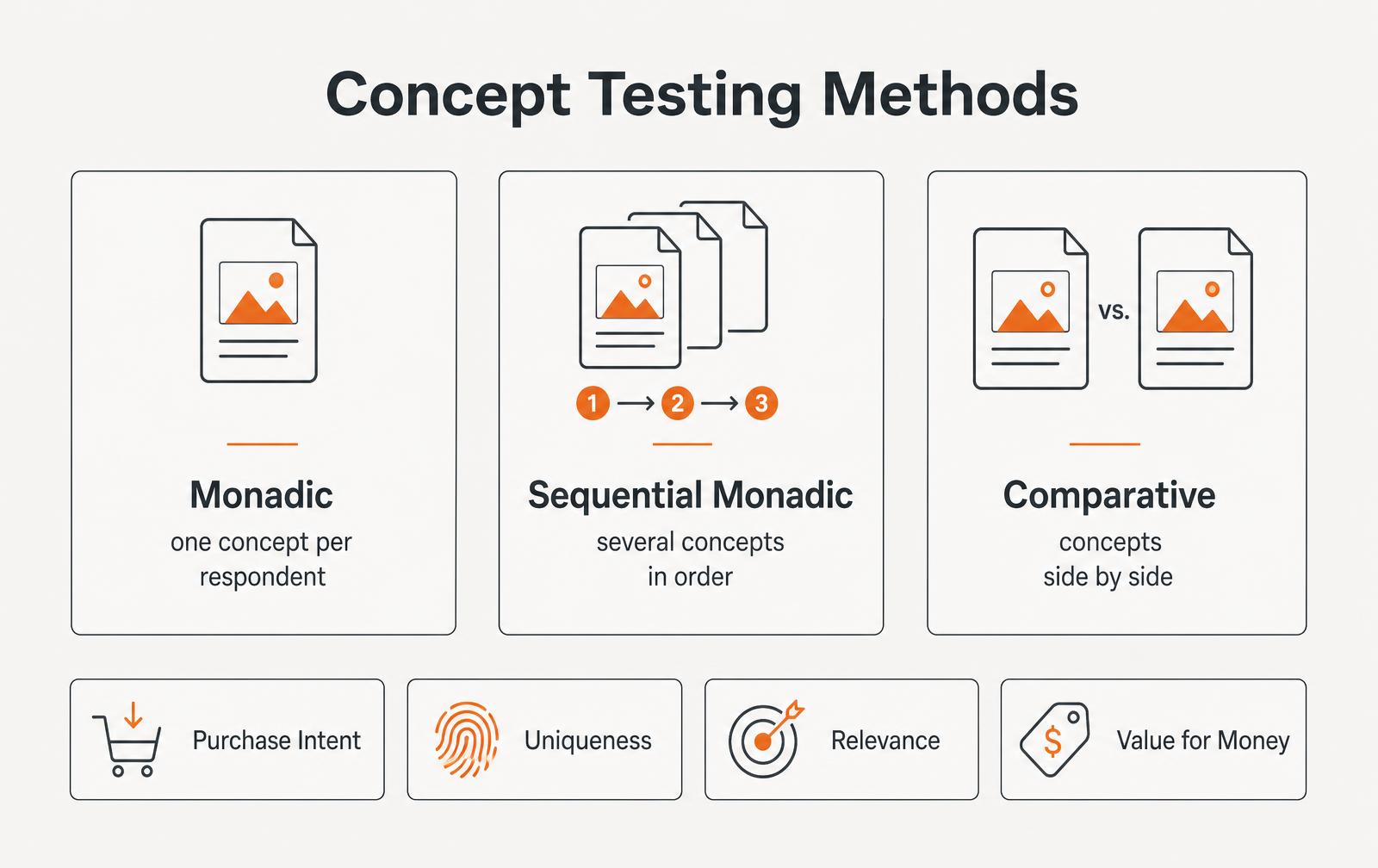
The three concept testing methods
Method | How it works | Best for | Sample per cell |
|---|---|---|---|
Monadic | Each respondent sees one concept only | Clean absolute read on a single concept | 150-300 |
Sequential monadic | Each respondent sees 2-4 concepts in rotated order | Comparing a small set on the same respondents | 200-400 |
Comparative | Concepts shown side by side and ranked | Fast preference read late in the funnel | 100-200 |
Protomonadic | Monadic read followed by a direct comparison | Absolute score plus a preference winner | 200-400 |
Monadic gives the cleanest absolute score because nothing anchors the respondent. Sequential monadic is cheaper per concept but suffers order bias, which is why rotation is mandatory. Comparative inflates differences: side by side, people find distinctions they would never notice on a shelf.
The four metrics that decide the outcome
- Purchase intent - the top-two-box share on a five-point scale. The single best predictor of trial.
- Uniqueness - whether the concept reads as different from what is already available.
- Relevance - whether it solves a problem the respondent actually has.
- Value for money - purchase intent re-asked at the real price, which is where most concepts collapse.
- Believability - whether the claim is credible without a demo, which matters for technical products.
Go/no-go thresholds
Signal | Kill | Revise | Develop |
|---|---|---|---|
Top-two-box purchase intent | Under 20% | 20-35% | Over 35% |
Purchase intent at real price | Drops by half | Drops 20-40% | Drops under 20% |
Uniqueness top-two-box | Under 25% | 25-40% | Over 40% |
Relevance top-two-box | Under 40% | 40-55% | Over 55% |
Open-ended objections | One objection dominates | Mixed, fixable | Mostly execution questions |
Treat thresholds as category-relative. A 30% top-two-box is weak for a $15 consumable and strong for a $900 capital device. If you have prior concepts in the same category, benchmark against your own history rather than published norms.
How to write a concept that tests honestly
- One paragraph: the problem, the solution, the primary benefit, the price. Nothing else.
- State the real price in the concept. A concept tested without price measures curiosity, not demand.
- Use one neutral visual - a render or a photo of a prototype - not a finished ad.
- Cut superlatives. Marketing language raises scores and destroys the predictive value.
- Test the riskiest claim explicitly, then ask believability on it.
What concept testing costs
Approach | Turnaround | Typical cost |
|---|---|---|
DIY panel survey, one concept | 3-7 days | $1,000-$3,000 |
Managed monadic test, 3 concepts | 2-3 weeks | $8,000-$25,000 |
Qualitative concept interviews (12-20) | 2-4 weeks | $6,000-$20,000 |
B2B concept testing with buyer panel | 4-6 weeks | $15,000-$45,000 |
In-context prototype test | 4-8 weeks | $20,000-$60,000 |
The cost of the test is almost never the deciding number. Tooling a rejected concept runs $15,000-$120,000, so a $10,000 test that kills one bad program pays for a decade of testing. When a concept passes, we take it straight into prototyping and design for manufacture so the validated claim survives into the built product.
Common ways concept tests mislead
- Testing without price, then discovering the whole appeal was the imagined price.
- Sampling your own newsletter, which is your most favorable audience and not the market.
- Running comparative when you needed an absolute read, then over-reading a 6-point gap.
- Cell sizes under 100, where a 5-point difference is noise.
- Asking respondents to predict their behavior instead of scoring the concept in front of them.
Sample sizes and what they can actually tell you
Concept testing goes wrong in two directions: too few responses to mean anything, or a large sample of the wrong people. Precision comes from the sample size; validity comes from who is in it. A thousand responses from a general panel will tell you less about a $900 professional tool than forty responses from people who buy that category.
Method | Sample | Answers | Does not answer |
|---|---|---|---|
Qualitative interviews | 8–15 per segment | Why a concept resonates or confuses | How many will buy |
Monadic concept test | 150–300 per cell | Purchase intent, appeal, uniqueness | Actual willingness to pay |
MaxDiff / conjoint | 250–500 | Feature trade-offs, price sensitivity | Whether the product can be built at that price |
Landing-page smoke test | 1,000+ visitors | Real click-through and email capture | Whether interest survives a real price |
Pre-order or crowdfunding | Open | Cash-backed demand, the strongest signal available | Retention and repeat purchase |
Writing questions that do not lead
- Ask about past behavior before intentions: what they bought last time predicts better than what they say they will do.
- Show price with the concept. Intent measured without a price is uniformly inflated.
- Force a trade-off — pick one of three, allocate a fixed budget — instead of rating everything on a five-point scale.
- Include a decoy or an obviously weak concept to detect acquiescence bias in the panel.
- Never describe the concept with adjectives you hope respondents will repeat back.
Turning results into a build decision
Set the decision rule before the data arrives. Write down what top-two-box intent, price acceptance and segment concentration would justify proceeding, and what result would stop the program.
Teams that pick thresholds afterwards find a reading that supports the decision they already made — which is an expensive way to run research.
When results land between the thresholds, the answer is usually a cheaper test rather than a bigger one: a landing page, a small pre-sale, or a functional prototype in ten target users' hands for a week.
Frequently asked questions
What is concept testing?
Concept testing is quantitative or qualitative research that measures target-buyer response to a described product idea before development. It scores purchase intent, uniqueness, relevance and value for money to decide whether to build, revise or kill the concept.
What sample size does a concept test need?
Plan on 150-300 qualified respondents per concept cell for a consumer monadic test. Below 100 per cell, normal sampling error is larger than the differences you are trying to detect. B2B tests run smaller, 60-120, and lean more on qualitative depth.
Monadic or comparative testing - which is better?
Use monadic when you need a clean absolute score you can benchmark, which is most early-stage decisions. Use comparative only when the real purchase decision is genuinely a side-by-side choice, such as a shelf set or a spec sheet bake-off.
When should concept testing happen?
After the concept is specific enough to price and before detailed design starts. Testing earlier produces vague answers; testing after tooling turns research into an expensive post-mortem.
Concept testing methods compared
Concept testing measures whether a described or demonstrated product creates real purchase intent before you spend on tooling. The methods differ in what they can prove. Qualitative work explains why people react as they do. Quantitative work estimates how many will act. Behavioural methods - where money or a real commitment changes hands - are the only ones that survive contact with a launch forecast.

Method | Sample size | What it proves | Cost | Timeline |
|---|---|---|---|---|
In-depth interviews | 8-15 | Language, objections, unmet needs | $3k-$12k | 2-3 weeks |
Monadic concept survey | 200-400 per cell | Purchase intent, appeal, uniqueness | $4k-$15k | 2-3 weeks |
MaxDiff or conjoint | 300-600 | Feature trade-offs and price sensitivity | $10k-$30k | 3-5 weeks |
Landing page smoke test | 2k-10k visitors | Click-through and email conversion | $1k-$6k ad spend | 1-2 weeks |
Preorder or crowdfunding | Open | Willingness to pay real money | $5k-$40k | 4-8 weeks |
In-home use test | 20-60 households | Real usage, retention, failure modes | $15k-$60k | 6-10 weeks |
How to avoid the numbers that lie to you
- Use monadic exposure. Show one concept per respondent; side-by-side comparison inflates the favourite.
- Include the price. Intent measured without a price is entertainment.
- Apply top-two-box discipline. Only definitely-would-buy plus probably-would-buy counts, and discount the second by roughly 70%.
- Screen for the real buyer. Category purchasers in the last 12 months, not a general panel.
- Ask what it replaces. A concept with no displaced alternative usually has no budget behind it.
- Validate with behaviour. Follow any survey signal with a smoke test or a deposit before committing tooling.
Turning results into a go or no-go decision
Set the thresholds before the data arrives. A common gate for consumer hardware is a discounted top-two-box above 20%, a smoke-test email conversion above 3%, and at least one clearly articulated displaced alternative. Write the thresholds into the project plan, and treat a miss as a signal to reposition or reprice rather than as a reason to run the study again with friendlier wording.
- Key takeaway 1: Qualitative explains, quantitative sizes, behavioural proves.
- Key takeaway 2: Always test the concept at its real price with the real buyer.
- Key takeaway 3: Discount stated intent heavily before it enters a forecast.
- Key takeaway 4: Fix decision thresholds before you see the results.
Sequencing concept testing methods across a program
Teams often treat concept testing as a single event. In practice the useful pattern is a short sequence of small studies, each answering the question that the previous one raised, with the spend increasing only as the decision gets more expensive.
A four-study sequence
Study | Timing | Sample | Question answered |
|---|---|---|---|
Qualitative interviews | Before concepts exist | 8-12 | Is the problem real and worth paying for |
Monadic concept test | Early concept | 150-200 per cell | Does the concept appeal at price |
Feature trade-off | Concept refinement | 250+ | Which features justify their cost |
Prototype in-home use | Pre-tooling | 15-30 | Does it work in real conditions |
The in-home use test is the one most often skipped and the one that most often prevents a costly mistake. A concept can test well on a screen and fail immediately when someone has to store it, clean it or use it one-handed.
Sequencing rules
- Match study cost to the cost of the decision it informs.
- Never run a big quantitative study before qualitative framing.
- Put at least one physical use test before tooling commitment.
- Reuse the same core metrics across studies so they compare.
- Write the decision rule for each study before fielding it.
Key takeaways
- Run a sequence of small studies rather than one large one.
- Scale study cost to the cost of the decision it informs.
- An in-home use test before tooling catches failures screens cannot.
Need a validation plan sized to your decisions?
Work with LA NPDT: if you are moving from here to execution, start with our product development consulting or talk to us about end-to-end product development.
Filed under:Education
Tagged:BossierInnovationLouisianaMarketingMarketing PlanNew Product DevelopmentProduct DesignProduct DevelopmentProduct LaunchProduct MarketingPrototypingShreveport
Services related to this guide
- Product design servicesIndustrial design and CAD taken all the way to manufacturable files.
- Rapid prototypingWorking prototypes in days, from 3D printing to vacuum casting.
- Electronic design servicesSchematic, PCB layout, firmware and bring-up, through to production handoff.
- Product development examplesReal projects we designed, prototyped and shipped.