New Product Marketing Plan: A 90-Day Framework
A week-by-week product launch timeline for physical products, from tooling sign-off through channel readiness, launch day and the 30-day post-launch review.
July 27, 20208 min read

Written by Yelena Rymbayeva, MPhil Communication & Media Studies, BTech Quality Control
Marketing & Product Leader, Technology Commercialization
Published July 27, 2020Updated September 2, 2026
Product Launch Timeline: A 90-Day Plan for Physical Products
Hardware launches fail quietly. Not because the product is bad, but because inventory landed before the audience existed, or the first twenty reviews were written by strangers who did not understand the product. A launch strategy is the schedule that prevents both. Here is the 90-day version we run with clients shipping physical goods.
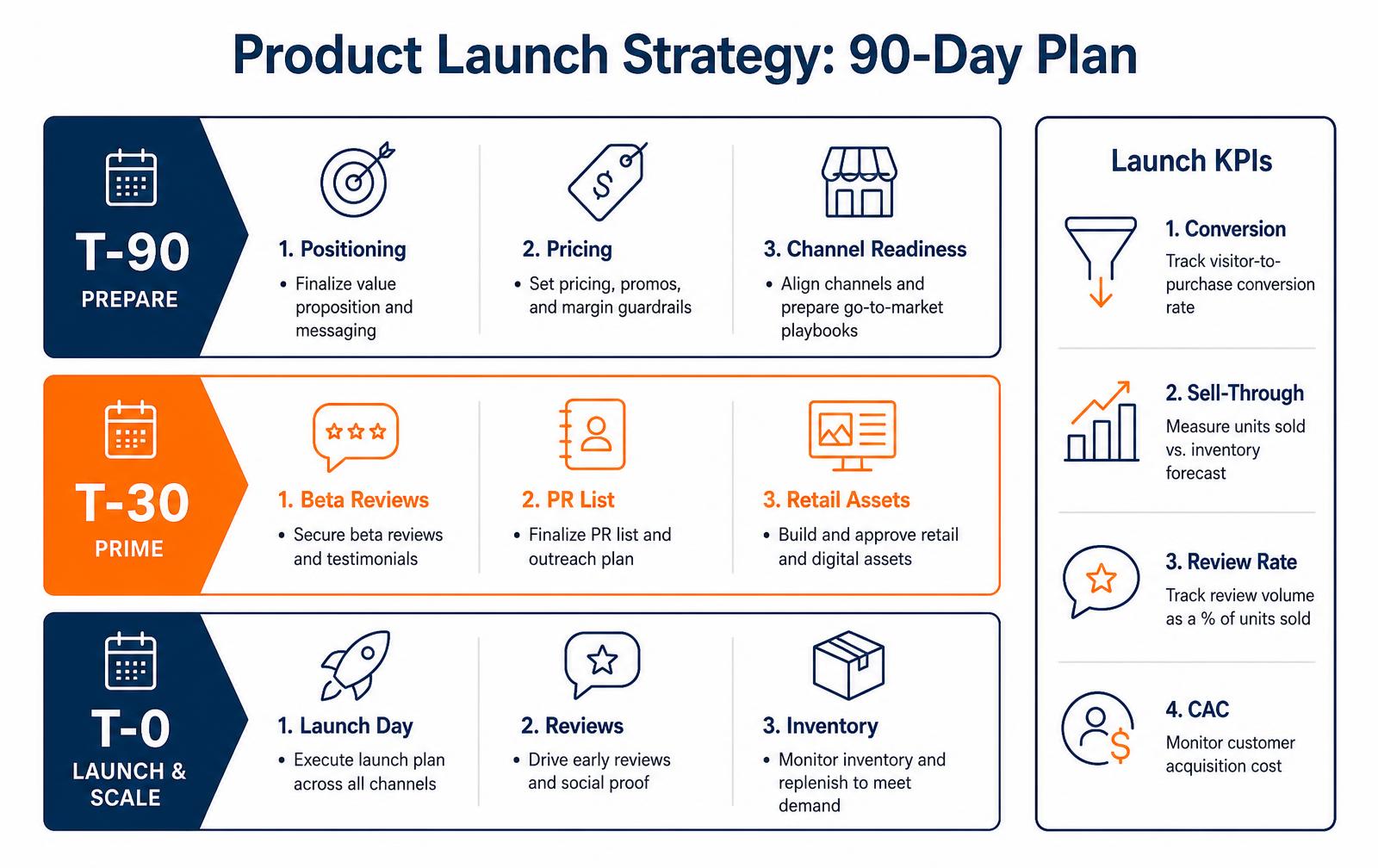
T-90: Prepare
- Lock positioning: one sentence naming buyer, job and reason to believe. Every asset is a translation of it.
- Set price and margin guardrails, including the discount floor you will not cross in month one.
- Decide channels - direct, Amazon, retail, distributor - and confirm each one's lead time for listings and assets.
- Finish photography, video and packaging artwork; these gate everything downstream.
- Build the email list and waitlist. A launch with no list is a paid-ads gamble.
T-30: Prime
- Seed 20-50 units to beta users and reviewers so day-one social proof exists.
- Finalise the PR and creator list with personalised angles, not a blast.
- Load listings, A+ content and retail assets; verify barcodes, dimensions and shipping classes.
- Run a paid-ads pilot at low spend to find the working creative before launch budget hits.
- Confirm inventory arrival dates and a reorder trigger point.
T-0: Launch and Scale
Launch day is a coordination exercise, not a marketing event: email and creators go out together, ads scale onto proven creative, and support is staffed for the question volume a new product generates. Weeks two to six are where the real work is - convert early buyers into reviews, fix the listing copy the questions expose, and hold price.
Launch budget
Line item | Scope | Typical spend |
|---|---|---|
Photography and video | Studio, lifestyle, one launch film | $4,000-$20,000 |
Packaging artwork and prototypes | Dielines, print proofs | $3,000-$12,000 |
Seeding units | 20-50 units at COGS plus shipping | $1,000-$8,000 |
PR and creator outreach | Freelance or agency, 8-12 weeks | $5,000-$30,000 |
Paid media, first 90 days | Pilot plus scale | $10,000-$75,000 |
Retail or marketplace fees | Listing, slotting, promos | Varies by channel |
Metrics that matter
KPI | What it tells you | Healthy early signal |
|---|---|---|
Landing page conversion | Whether positioning and price land | 2-5% direct-to-consumer |
Review rate | Whether buyers are satisfied enough to speak | 1-3% of units sold in 60 days |
Sell-through | Whether inventory matched demand | 40-60% of first run in 90 days |
CAC vs contribution margin | Whether growth is fundable | CAC below 1/3 of margin |
Retail and channel lead times to plan around
Milestone | Lead time before launch | Owner |
|---|---|---|
Retail buyer meetings | 6-9 months | Sales |
UPC/GTIN registration and listing data | 12 weeks | Ops |
Packaging print files locked | 10 weeks | Design |
Ocean freight from Asia | 6-8 weeks in transit | Logistics |
Amazon listing and A+ content live | 4 weeks | Marketing |
Review seeding and press samples out | 3-4 weeks | PR |
Paid media creative approved | 2 weeks | Marketing |
Launch-blocking items to close first
- Certifications in hand (FCC, UL, CPSC as applicable) with the test report, not a verbal pass.
- Safety stock landed, not on the water. Launch demand spikes and reorders take a full production cycle.
- Returns and warranty process live, including a support inbox someone actually monitors.
- Instructions and packaging proofread by someone outside the team. Reprints are slow and visible.
- Pricing tested against landed cost including duty, freight and channel fees, not just factory cost.
Inventory math for a physical launch
Software launches can absorb demand; physical ones cannot. Your first order quantity is a bet made months before you have any real demand signal, and both directions of error are expensive.
Too little inventory and you spend your launch window out of stock, watching paid traffic convert to nothing while the algorithm quietly deprioritizes your listing.
Too much and you have capital sitting in a warehouse accruing storage fees, with the discounting cycle that eventually follows destroying the margin you planned on.
Work backwards from replenishment time rather than from optimism. If production is six weeks and ocean freight is another seven, your reorder lands thirteen weeks after you place it, so the first order needs to cover the launch spike plus a full replenishment cycle plus safety stock.
Many teams split the difference by air-freighting a small first batch to hit the launch date while the main quantity travels by sea, accepting the higher per-unit cost on a few hundred units in exchange for not missing the window.
Whatever number you choose, decide the reorder trigger before launch, not during it. A written rule such as "reorder when 60 percent of first order is sold or at day 21, whichever comes first" removes a decision from the week when everyone is busiest and least able to think clearly.
Sequencing channels instead of launching everywhere
Launching on your own site, a marketplace and in retail simultaneously sounds ambitious and usually just splits a thin inventory position across three channels that each look weak. Sequence them. Start direct, where you own the customer data, control pricing and can learn what messaging converts without a retail partner watching your sell-through. Direct sales also produce the reviews and content that make the next channel work.
Move to marketplaces once your listing content is refined and you have enough inventory that a rank improvement is not immediately followed by a stockout. Marketplace algorithms reward consistent availability and velocity, so entering with two weeks of stock actively hurts you. Retail comes last for most products, because buyers want proof of sell-through and because retail requires packaging, barcodes, case packs and terms that take months to prepare.
The exception is a product whose entire proposition is discovery at shelf. If your product needs to be handled to be understood and has no search demand, retail may have to lead, and the direct channel becomes support rather than the primary engine. Decide which case you are in honestly, because the whole launch calendar follows from it.
- Weeks 1-4 direct: own the data, gather reviews, test messaging against real conversion.
- Weeks 4-10 marketplace: enter with enough stock to sustain velocity, not just to appear.
- Month 3+ retail: approach buyers with sell-through data instead of a forecast.
- Always: one price architecture across channels, so no partner discovers they are the expensive one.
If the product itself is still moving, our product development services and low volume manufacturing shorten the replenishment cycle, and new product marketing covers the launch assets that channel partners expect.
What to measure in the first 90 days
Revenue is a lagging number and a poor guide during launch. Watch sell-through rate per week, because it tells you whether the reorder trigger is close.
Watch return rate and the stated reason, because a five percent return rate with a consistent reason is a product problem you can still fix cheaply in the second production run. Watch review velocity and average rating, since both compound in marketplace ranking.
Watch contribution margin after all channel fees, freight and returns, not gross margin on the factory invoice.
Set a review date at day 45 with the authority to change something real: price, packaging copy, the hero image, or the second production run's specification. A launch that cannot be adjusted for six months is not a launch plan, it is a hope.
Packaging is part of the launch, not an afterthought
Packaging carries three jobs at launch: it protects the product through a supply chain you do not control, it sells the product in the two seconds a shopper spends scanning a shelf or a thumbnail, and it satisfies the compliance requirements of every channel you sell through.
Teams routinely design for the second job and discover the other two late.
Drop testing, ISTA transit testing where a retailer requires it, barcode placement, country-of-origin marking, recycling symbols and any regulatory statements all have to be settled before print files lock, and print lead times leave no room to redo them.
Design the unboxing for the channel you actually sell in. A marketplace product ships in its own container and needs to survive rough handling without an overbox, while a retail product needs a face that reads at three feet and a case pack that a stocker can open in one cut. The same artwork rarely serves both without adjustment, and planning two versions from the start costs less than an emergency reprint six weeks before launch.
Frequently asked questions
What is a product launch strategy?
A product launch strategy is the sequenced plan covering positioning, pricing, channel readiness, seeding and reviews, PR, paid media and inventory that takes a finished product from ready-to-ship to sustained sales.
How long before launch should planning start?
Ninety days for a first product, because photography, packaging artwork, retail listings and reviewer seeding each need four to eight weeks and they run partly in sequence.
How much should a product launch cost?
A credible consumer hardware launch runs $25,000 to $150,000 across creative, seeding, PR and first-quarter paid media, excluding inventory.
Should I discount at launch?
Avoid it. Early discounting anchors the price low and makes later full-price sales harder. Use bundles, extended warranty or founder editions to create urgency instead.
Assigning owners across a new product marketing plan
A new product marketing plan fails most often in execution, not in strategy. Every deliverable in the timeline needs one owner and one date; anything owned by a team is owned by nobody, and those are the items discovered as missing in launch week.
Deliverables, owners and deadlines
Deliverable | Owner role | Due |
|---|---|---|
Positioning statement and messaging | Marketing lead | T-90 |
Product photography and video | Creative | T-60 |
Retail and listing copy | Marketing | T-45 |
Packaging artwork approved | Design plus product | T-60 |
Press and reviewer outreach | Communications | T-45 |
Landing page and analytics | Web | T-30 |
Support documentation and FAQs | Support lead | T-21 |
Paid media assets and budgets | Growth | T-14 |
Launch-day checklist rehearsal | Program lead | T-7 |
Hold one weekly meeting where each owner reports red, amber or green against their item. Fifteen minutes a week for twelve weeks is far cheaper than the alternative, which is discovering an unbuilt landing page the day inventory lands.
Execution checklist
- Give every deliverable one named owner and one date.
- Run a short weekly status review with a simple traffic-light rating.
- Escalate amber items immediately rather than at the deadline.
- Freeze scope four weeks before launch.
- Rehearse launch day end to end before it happens.
Key takeaways
- Every marketing deliverable needs one owner and one date.
- A short weekly status review catches slippage while it is fixable.
- Freeze scope four weeks out and rehearse launch day.
Planning a product launch and need the engineering side ready on time?
Building the New Product Marketing Plan Week by Week
A marketing plan for a new physical product fails for a different reason than a software launch does: inventory is finite, lead times are long, and a demand spike you cannot fulfill is nearly as damaging as no demand at all. The plan below sequences audience building, proof gathering, and channel activation against those constraints.
Positioning Before Spending
Every dollar of paid media multiplies whatever message it carries, including a weak one. Before any spend, write the positioning as a single sentence naming the buyer, the specific job the product does better, and the evidence for that claim. Then test it: show three versions to people outside your network and keep the one they can repeat back accurately. Message clarity typically moves conversion more than creative production value does.
Proof Assets in Priority Order
- A sixty-second demo showing the product solving the problem in real conditions, not a studio.
- Fifteen to thirty honest reviews from real first users, collected before the wide launch.
- One before-and-after or measurable outcome that a skeptical buyer can verify.
- Certifications, test reports, or standards compliance where the category expects them.
- A comparison page that names the alternatives honestly instead of avoiding them.
Channel Selection Against Inventory Reality
Match channel velocity to replenishment lead time. Paid social can outrun a ninety-day manufacturing cycle in a week, which turns a good campaign into backorders and refund requests. When lead times are long, weight the plan toward waitlists, staged drops, and retail conversations that come with purchase orders and forecast visibility, and keep paid acquisition as a controllable throttle rather than the main engine.
Metrics That Decide the Next Move
- Cost per acquired customer against contribution margin, not against revenue.
- Waitlist to purchase conversion, measured per acquisition source.
- Sell-through rate per retail door per week, if you are in retail.
- Return rate and the top three stated reasons, reviewed weekly in the first quarter.
- Reorder or attachment rate, which determines whether acquisition spend is an investment or a cost.
Review these five numbers on a fixed weekly cadence and change one variable at a time. Most launch plans do not fail from a lack of ideas; they fail because too many things changed at once and nobody could tell which one worked.
Work with LA NPDT: if you are moving from here to execution, start with our new product marketing or talk to us about market research.
Filed under:EducationInspirationNewsWords
Services related to this guide
- Product design servicesIndustrial design and CAD taken all the way to manufacturable files.
- Rapid prototypingWorking prototypes in days, from 3D printing to vacuum casting.
- Electronic design servicesSchematic, PCB layout, firmware and bring-up, through to production handoff.
- Product development examplesReal projects we designed, prototyped and shipped.