New Product Development Examples: Five Real Paths From Idea to Market
Textbook funnels do not match real projects. Here are five new product development examples with the timelines, budgets and failure modes that go with them.
May 24, 20186 min read

Written by Konstantin Dolgan, Ph.D., NPDP
Founder & CEO, Product Development Engineer
Published May 24, 2018Updated September 2, 2026
Every textbook draws the same five-stage funnel, and no real product follows it exactly. The useful way to learn new product development is to look at concrete examples — what each category actually costs, how long it takes, and where teams in that category lose their schedule. Below are five patterns we see repeatedly, with the numbers that go with them.
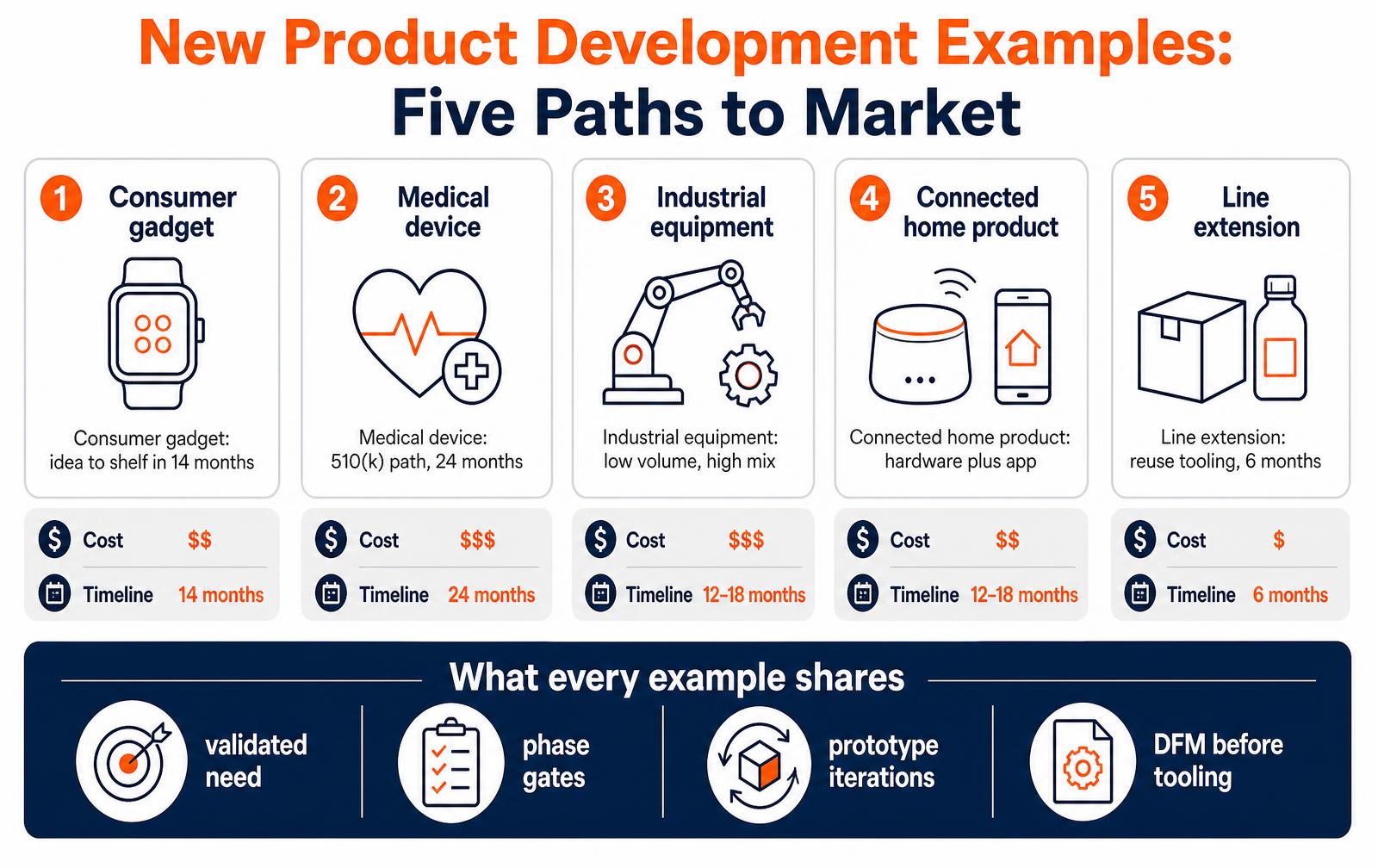
Example 1: A consumer gadget, idea to shelf in 14 months
A handheld device with a rechargeable battery, a small display and injection-moulded housing. Two months of research and concept work, four months of mechanical and electrical engineering with three prototype rounds, two months of design for manufacturing, three months of tooling, then EVT-DVT-PVT builds.
Typical spend: $120,000-$250,000 in development plus $40,000-$150,000 in tooling. The schedule killer is almost always a late cosmetic change that reopens the tool.
Example 2: A Class II medical device on a 510(k) path
Same engineering work, wrapped in a design-history file. Requirements are traceable to risk analysis, every change is documented, and verification and validation testing is formal. Expect 20-30 months and $400,000 to $1.5 million including biocompatibility, electrical safety and submission. Teams that treat documentation as a phase at the end pay for it twice — see our guide to medical device design and development.
Example 3: Industrial equipment at low volume, high mix
When annual volume is measured in dozens, tooling never pays back. The design shifts to sheet metal, machined parts, off-the-shelf actuators and modular options. Development is 12-18 months and $150,000-$400,000, but the unit cost stays high by design and the margin comes from service and spares rather than from scale.
Example 4: A connected home product
Hardware, firmware, a mobile app and cloud infrastructure, all on one release date. Typically 12-18 months and $250,000-$600,000. The characteristic failure is not technical: it is scheduling three teams independently, so the app is ready two months after the hardware and the onboarding flow is never tested on production units.
Example 5: A line extension that reuses tooling
A new size, colour, or feature variant built on an existing platform. Six months and $30,000-$80,000, most of it in artwork, minor tool inserts and re-certification. This is the highest-return work most companies systematically under-invest in, because it is less exciting than a new platform.
What all five examples have in common
- A validated need before engineering starts. Interviews, pre-orders or a signed letter of intent — something outside the founder's conviction.
- Phase gates with the authority to stop. A gate that has never killed a project is a status meeting.
- Multiple prototype rounds. Nobody gets the mechanism right the first time; budget three iterations and be pleased if you need two.
- DFM before tooling, not after. Wall thickness, draft, parting lines and tolerances reviewed with the actual moulder.
- A named owner for cost. Target unit cost tracked weekly, or it drifts up 30% and nobody can say when.
Example | Timeline | Development cost | Main risk |
|---|---|---|---|
Consumer gadget | 14 months | $120k-$250k | Late cosmetic changes reopen tooling |
Class II medical device | 20-30 months | $400k-$1.5M | Documentation treated as an afterthought |
Industrial equipment | 12-18 months | $150k-$400k | Designing for volume that will never come |
Connected home product | 12-18 months | $250k-$600k | Hardware, app and cloud on separate schedules |
Line extension | 6 months | $30k-$80k | Underfunded because it is not glamorous |
Five development paths and what each costs
Real programs do not all follow the same route. A simple injection-molded consumer accessory, a connected device, a regulated medical product, an industrial machine and a licensed concept each have different gates, budgets and risk profiles. Picking the wrong template - running a medical program like a consumer accessory, or over-engineering a licensing play - is the most expensive planning error a founder can make.
What the successful examples share is early risk retirement. Whatever is most likely to kill the product gets tested first, whether that is a technical unknown, a cost target, a regulatory pathway or simply whether anyone will pay. Programs that sequence work by convenience instead of by risk discover the fatal problem after the tooling deposit.
Path | Typical development cost | Timeline | Dominant risk |
|---|---|---|---|
Simple molded consumer product | $25k-$75k | 4-8 months | Cost target and retail price |
Connected consumer device | $120k-$400k | 9-18 months | Firmware, certification, app |
Regulated medical device | $250k-$2M+ | 18-36 months | Regulatory pathway and V&V |
Industrial equipment | $150k-$600k | 12-24 months | Integration and service model |
Licensed concept | $8k-$40k | 3-9 months | Finding a licensee |
What separates programs that ship
Across these paths the same practices predict delivery: a written design brief with a cost target, a single decision-maker, prototypes that answer specific questions, design for manufacturing engaged before CAD is finished, and a supplier chosen early enough to influence the design. None of that is exotic. It is simply the discipline of deciding what you are building before spending money on building it.
- Retire the biggest risk first, whatever category it falls in.
- Set a landed cost target in the brief and design against it.
- Engage manufacturing before geometry is frozen.
- Give each prototype one question to answer.
- Name one decision-maker per program.
- Re-quote at every major design change, not just at the end.
Key takeaways
- Development cost varies 50x by product category - budget against the right template.
- Sequence work by risk, not by convenience.
- Cost targets belong in the brief, not in the post-mortem.
- Manufacturing input before CAD freeze prevents the expensive respin.
- Licensing is a legitimate low-cost path when the concept is the value.
Gate criteria that keep programs honest
Each stage should end with a written decision: proceed, revise or stop. The criteria differ by path but the structure does not - evidence, cost, risk, and a named decision-maker. Programs without gates drift, because nobody is ever forced to say the product is not working, and money keeps flowing until it runs out rather than until a decision is made.
- Concept gate: user evidence and a landed cost estimate within 25%.
- Design gate: manufacturable CAD and a supplier quote in hand.
- Prototype gate: functional performance verified against the brief.
- Pre-production gate: pre-compliance passed and tooling quoted.
- Launch gate: inventory received, listings live, support ready.
Five program shapes and what they cost
Real product development examples rarely follow one template. The five shapes below cover most of what we see, and the differences matter — a licensing path and a tooled DTC launch need very different spending in the first six months.
Path | Typical spend to first units | Timeline | Main risk |
|---|---|---|---|
Inventor licensing a concept | $12k–$45k | 4–9 months | Prototype not convincing enough to license |
Crowdfunded consumer hardware | $80k–$300k | 9–18 months | Fulfillment cost underestimated |
Retail-driven consumer product | $150k–$600k | 12–20 months | Shelf date compresses testing |
Industrial equipment line | $200k–$900k | 12–24 months | Serviceability and controls standardization |
Medical or regulated device | $400k–$2M+ | 18–36 months | Design controls and clinical evidence |
Practices that separate the programs that ship
- A written requirements document that predates CAD, updated as evidence arrives.
- One decision owner per gate — committees delay freezes and freezes are what create schedules.
- Manufacturer involvement during design, not after; the first DFM review should happen on concept CAD.
- A prototype log where each build states the question it answers.
- Cost modeled continuously, not audited at the end.
- A risk register with named owners and retirement plans, reviewed weekly.
What each path teaches
Example | Transferable lesson |
|---|---|
Licensing | A rough functional prototype plus a filed provisional beats a polished render |
Crowdfunding | Set the price after landed cost and fulfillment are quoted, not before |
Retail | Packaging and shipping tests belong in the schedule, not after the PO |
Industrial | Standardize controls first; mechanical variety is manageable, control variety is not |
Regulated | Documentation is a deliverable with its own staffing, not paperwork |
Whichever shape yours takes, our consulting and full development engagements adapt the gates to the path.
Frequently asked questions
What is an example of new product development?
A consumer gadget is the clearest example: two months of research and concept work, four months of mechanical and electrical engineering with three prototype rounds, two months of design for manufacturing, three months of tooling, then pilot builds — roughly 14 months and $120,000-$250,000 in development plus tooling.
What are the five stages of new product development?
Idea generation and screening, concept development and validation, design and engineering, prototyping and testing, then manufacturing and launch. In practice the stages overlap and loop — prototyping usually sends you back into engineering at least twice.
Why do most new products fail?
Rarely because the engineering was impossible. The common causes are building for a need nobody validated, a unit cost that leaves no margin at the price the market accepts, and running out of money before the second prototype round because the budget assumed the first one would work.
Best-practice scorecard for a new product development program
Programs rarely fail on a single decision. They fail because five or six practices were skipped, each defensible on its own. Score an active program against the list below; anything under 70% is running on luck.
Written requirements with measurable acceptance criteria | 20 | Every requirement has a test method |
|---|---|---|
Landed cost model maintained from concept onward | 15 | Quoted BOM, not an estimate spreadsheet |
Risk register with owners and retirement plans | 15 | Top five risks retired before detailed design |
DFM engagement before design freeze | 15 | Supplier redlines incorporated in CAD |
Verification plan mapped to requirements | 15 | Traceability matrix exists |
Named decision owner at each gate | 10 | Meeting minutes record decisions, not discussion |
Change control after freeze | 10 | ECOs numbered and impact-assessed |
Examples of the practices in action
- A kitchen appliance team that quoted a BOM at concept discovered a $9 motor gap and switched architecture in week 6 instead of week 40.
- A wearable program that ran DFM with the molder during CAD avoided two steel-safe corrections worth roughly $22k.
- An industrial sensor team with a traceability matrix passed certification on the first submission because every requirement already had test evidence.
- A consumer device team without change control shipped two BOM revisions to the contract manufacturer in the same week and built 400 units with the wrong gasket.
Review cadence that keeps a program honest
Program stand-up | Weekly | Blockers with owners and dates |
|---|---|---|
Cost review | Every two weeks | Updated landed cost against target |
Risk review | Monthly | Retired risks and new entries |
Gate review | Per stage | Pass, conditional pass with a date, or stop |
None of this requires expensive software. A shared requirements document, a quoted BOM, a risk register and a change log — maintained honestly — separate the programs that ship on plan from the ones that discover their problems during pilot production.
Want to see which example matches your product?
Tell us what you are building and we will map the phases, the realistic timeline and the budget it needs.
Work with LA NPDT: if you are moving from here to execution, start with our our product development process or talk to us about end-to-end product development.
Filed under:Education
Services related to this guide
- Best product development companiesHow the leading US firms compare, and which one fits your stage and budget.
- Best product design companiesDesign studios compared by scope, industry and what they hand off.
- Product engineering companiesEngineering firms for physical products compared by discipline, rigor and budget.
- Consultant vs firm vs freelancerWhat each option costs, what it delivers and where to find them.