Go To Market Checklist: What Must Be Ready Before Launch
A go to market checklist for physical products - certification, packaging, inventory, channels, support and the sign-offs that gate a ship date.
June 7, 20186 min read

Written by Konstantin Dolgan, Ph.D., NPDP
Founder & CEO, Product Development Engineer
Published June 7, 2018Updated September 2, 2026
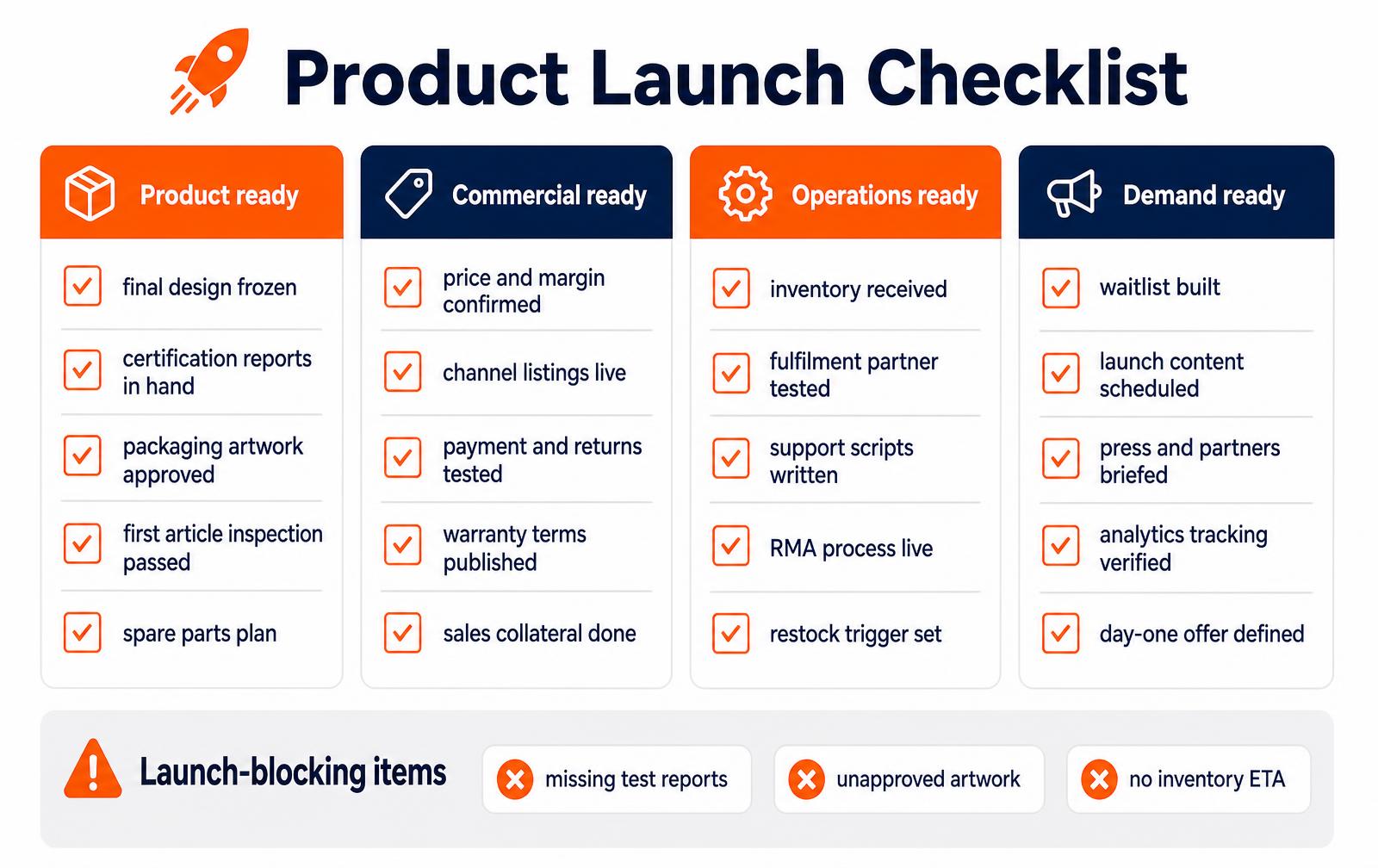
Most launches do not fail on the launch date. They fail on an item somebody assumed was handled. A test report that never arrived, artwork printed against outdated dimensions, or a beautiful campaign pointed at a checkout that has never processed a real card. This checklist covers the four readiness tracks — product, commercial, operations and demand — and marks which items genuinely block a launch.
1. Product readiness
- Design frozen and revision-controlled. Every downstream item — artwork, listings, manuals — is built against a specific revision. If that revision can still change, nothing downstream is safe to start.
- Certification and test reports in hand. Not scheduled. In hand, with the correct legal entity and model number printed on them.
- Labels and markings correct. Regulatory marks, country of origin, model and serial format, and any required warnings on both product and packaging.
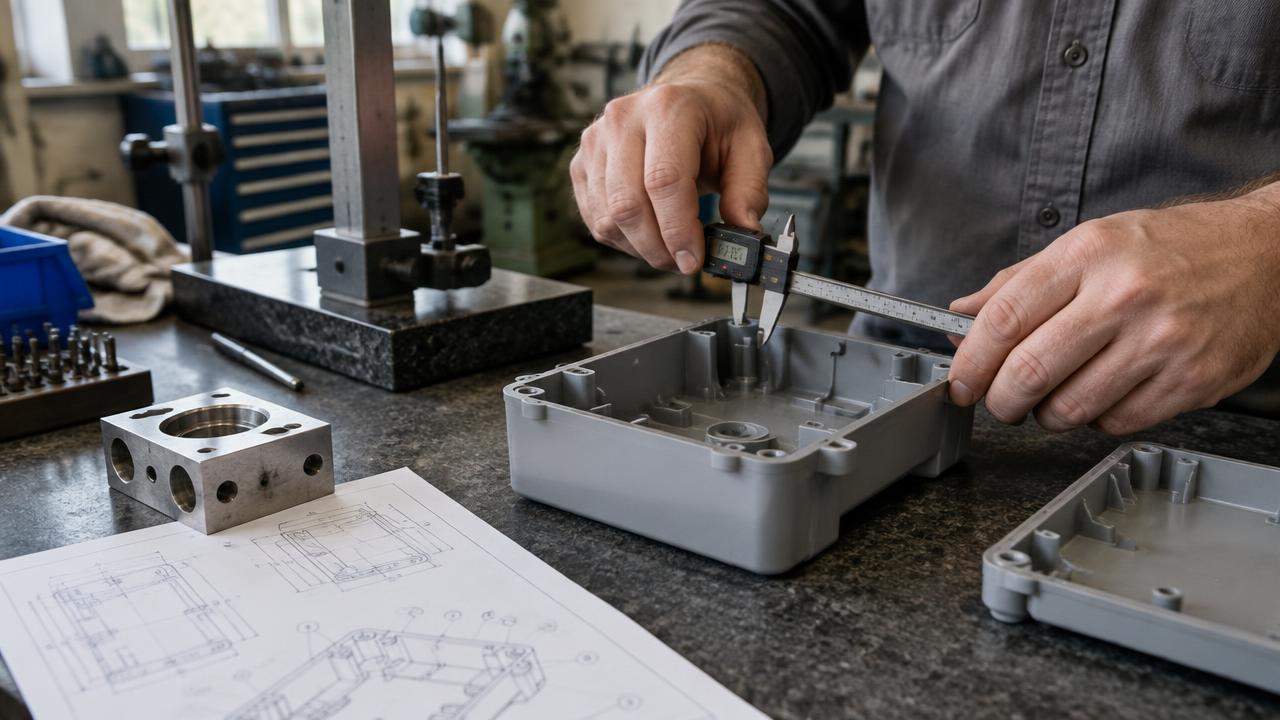
- First article inspection passed. Parts measured against the drawing, not eyeballed against a prototype.
- Packaging tested, not just designed. Drop and transit testing on the actual pack, because damage in transit is the fastest way to burn early reviews.
- Spare parts and service plan. What breaks, what you stock, and who repairs or replaces it.
2. Commercial readiness
- Price confirmed against landed cost. Landed cost includes duty, freight, payment fees, returns and channel margin — not just the factory quote.
- Channel listings live and complete. Titles, images, specs, compliance documents and shipping profiles, all created before launch day, not during it.
- Payment, tax and returns tested end to end. Place a real order with a real card and process a real return.
- Warranty and terms published. Ambiguous warranty terms turn into refunds you did not budget.
- Sales collateral ready. Spec sheet, comparison against the incumbent, and answers to the three objections you already know you will hear.
3. Operations readiness
- Inventory physically received and inspected. "On the water" is not inventory.
- Fulfilment tested with real shipments. Including one to yourself, in the packaging a customer will receive.
- Support material written. Setup guide, top ten questions, and a troubleshooting path for the failure modes testing already revealed.
- Returns and RMA process live. A named owner, a shipping label path, and a rule for what gets refurbished.
- Restock trigger set. A reorder point calculated from lead time, because running out during your best week is a self-inflicted wound.
4. Demand readiness
Hype is not a strategy, but an audience is. Start building a waitlist eight weeks before launch, publish the content that answers the buying questions, brief press and partners under embargo, verify analytics and attribution actually fire, and decide the day-one offer in advance. A launch to an empty list is just an announcement.
What blocks a launch, and what can wait
Item | Blocks launch? | Why |
|---|---|---|
Certification test reports | Yes | Selling without them is a legal and recall risk |
Correct labelling and markings | Yes | Relabelling stock after the fact is expensive and slow |
Inventory received and inspected | Yes | Orders you cannot ship destroy launch momentum |
Working checkout, tax and returns | Yes | Every failed transaction is a permanent lost sale |
Full accessory range | No | Add after the core product proves demand |
Every channel live | No | One channel done properly beats four done badly |
Perfect photography | No | Good enough now, upgrade with real customer imagery |
For the sequencing behind this list, see our product launch timeline, and the development process for where each launch dependency starts.
The sixteen-week launch runway
Most launch failures are calendar failures. Certification queues, artwork proofs and ocean freight all have fixed durations that no amount of urgency compresses. Working backwards from the launch date and putting the immovable items first turns a wish into a plan, and it exposes the date that was never achievable while there is still time to move it.
Weeks before launch | Milestone | Owner |
|---|---|---|
16 | Design freeze; long-lead purchase orders released | Engineering |
14 | Certification samples submitted; artwork to pre-press | Compliance / brand |
10 | First article inspection passed; packaging drop tested | Quality |
8 | Waitlist and content programme starts; press briefed under embargo | Marketing |
6 | Production run complete; inventory booked on vessel | Operations |
3 | Inventory received and inspected; listings staged | Operations |
1 | End-to-end order, delivery and returns test with real shipments | Ecommerce |

Launch-day rehearsal
- Place a real order on the live storefront with a real card and let it ship to a real address.
- Return that order through the published process and time the refund.
- Send the support team ten questions from the FAQ and check the answers match the manual.
- Confirm every link in the launch email resolves, including the ones in the footer.
- Agree in advance what triggers a pause: a safety issue, a labelling error, or a fulfilment failure above a set rate.
Key takeaways
- Build the plan backwards from launch day and place the fixed-duration items first.
- Certification, artwork and freight are the three schedule killers; start them earliest.
- Rehearse the full purchase and return flow with real money before announcing.
- Define the pause criteria before launch, while the decision is still unemotional.
Who owns what on launch week
Most launch chaos is an ownership problem rather than a work problem. Write a one-page RACI before the final month so that when something breaks at 7 a.m. on launch day, nobody is deciding who decides.
Area | Owner | Decides | Escalation trigger |
|---|---|---|---|
Inventory and fulfillment | Operations | Hold or release stock, allocate between channels | Any SKU below two weeks of cover |
Listing and pricing | Commercial | Price changes, promo activation | Competitor undercut or listing suppression |
Product defects | Engineering | Ship, quarantine or recall | Two or more field reports of the same failure |
Support and returns | Customer service | Refund, replace, escalate | Return rate above target in the first week |
Messaging and press | Marketing | Statements, corrections, timing | Any safety or compliance question in public |
What to measure in the first 30 days
- Sell-through rate, not units shipped — inventory sitting in a channel is not a sale.
- Return rate and stated reason, categorized as defect, expectation gap or fit issue; each demands a different fix.
- Support contacts per hundred units, which predicts warranty cost better than any test result.
- Time to first value, measured from unboxing to the customer's first successful use.
- Review sentiment by theme, because the first fifty reviews set the listing's conversion rate for a year.
Post-launch: the first design revision
Assume a revision. The first production run always teaches you something the prototypes could not: a fastener that strips in the field, an instruction step everyone skips, a packaging insert that fails a drop it should survive.
Plan a revision window roughly eight to twelve weeks after launch, hold a small engineering budget for it, and collect field data in a form that supports the decision — photographs, returned units, and the specific lot codes involved.
- Keep returned units instead of scrapping them; failure analysis needs the actual parts.
- Track failures by lot and date code so you can tell a design problem from a process excursion.
- Batch fixes into one tool revision to avoid paying for multiple tool changes.
- Update the instructions and packaging at the same time — most 'defects' in early returns are use errors.
Frequently asked questions
What should be on a product launch checklist?
A complete product launch checklist covers four tracks. Product readiness: frozen design, certification reports, correct labelling, first article inspection, tested packaging and a service plan. Commercial readiness: confirmed pricing, live listings, tested checkout and returns, published warranty and sales collateral.
Operations readiness: received inventory, tested fulfilment, support content, an RMA process and a restock trigger. Demand readiness: a waitlist, scheduled content, briefed press and verified analytics.
What are the most common launch blockers?
Missing certification test reports, incorrect labels or regulatory markings, inventory that has not physically arrived, and an untested checkout or returns flow. Each one stops a launch outright. Accessories, additional sales channels and upgraded photography can safely follow the launch.
How far in advance should launch preparation start?
Roughly sixteen weeks before launch for a physical product, with certification and long-lead purchasing starting even earlier during engineering. Demand building should begin about eight weeks out so there is a list to launch to rather than an announcement into silence.
Planning for what goes wrong in launch week
Every go to market checklist covers what should happen. The teams that launch calmly also plan what to do when it does not: stock arriving late, a listing not going live, a defect surfacing in the first hundred units. Deciding the response in advance turns a crisis into a procedure.
Contingency plan by failure mode
Failure | Trigger to watch | Pre-agreed response |
|---|---|---|
Inventory arrives late | Shipment milestone missed | Switch to backorder messaging, delay paid spend |
Listing or site not live | Go-live check fails | Hold announcements, fix, re-verify before spend |
Early defect reports | Support tickets on one theme | Pause shipping, quarantine lot, assess |
Demand far above forecast | Stock burn rate | Cap order quantities, communicate lead times |
Demand far below forecast | Conversion rate at day three | Test messaging, hold inventory commitments |
Payment or fulfillment error | Failed orders | Manual processing plus customer outreach |
Name the person who can pause a launch and give them the authority in writing. Most damaging launch weeks involve someone noticing a problem early and not having the standing to stop the machine.
Contingency checklist
- Write a response for each of the six failure modes above.
- Name the person who can pause shipping or spend.
- Set up daily metric checks for the first two weeks.
- Prepare backorder and delay messaging before you need it.
- Keep a small inventory reserve for replacements and reviewers.
Key takeaways
- Plan responses to launch failures before launch week, not during it.
- One named person needs written authority to pause.
- Daily metric checks catch problems while they are still cheap.
Want a launch plan that holds up when something goes wrong?
Work with LA NPDT: if you are moving from here to execution, start with our new product marketing or talk to us about market research.
Services related to this guide
- Product design servicesIndustrial design and CAD taken all the way to manufacturable files.
- Rapid prototypingWorking prototypes in days, from 3D printing to vacuum casting.
- Electronic design servicesSchematic, PCB layout, firmware and bring-up, through to production handoff.
- Product development examplesReal projects we designed, prototyped and shipped.