observe. Solve. Invent.
Is the earth still spinning around the sun? If yes, that is all you need to know; the next big idea is very close to you. Concept Design services
October 18, 20227 min read

Written by Konstantin Dolgan, Ph.D., NPDP
Founder & CEO, Product Development Engineer
Published October 18, 2022Updated September 2, 2026
How does an idea come? Guess what? No one really knows. It chooses its own path. But your part is to trap it when it comes. A life-changing idea that would make everyone’s head twirl on release is always hidden in the subtlest things. Thus, in your product development pursuits, you should factor it in as a lead towards your business’ future.
In this article, you will pick up how to pay keen attention to the world around you for a big product idea. You would also see how you could build on the idea and engage the same for commercial uses. It’s not hard, really. You only have to observe, solve, and invent.
OBSERVE
We believe that ideas rule the world. That is, the little thoughts that pop in our minds at the oddest of times or periods when we deliberately call for them have the ability to change the world. And sometimes, all we have to do is to be patient enough to see through the details of natural happenings around us.
How did Isaac Newton discover the infamous law of gravity? He was sitting under an apple tree, and one of the fruits detached from its stalk and hit him. Well, it wasn’t only the apple that hit him at that moment. An idea did too. He thought to himself that if the natural phenomenon is that whatever is up falls to the ground, then there must be a force that makes that happen. And voila! That was the birth of knowledge about gravitational force.
This simple event is a picture of our everyday life. Daily, there are places we go to, conversations we have, stories we listen to, and people we interact with. Each of these occasions might bring you inspiration for a challenge or ready-to-go decision to start a business or develop an idea.
SOLVE
It does not only matter that you are observant of the world around you. It also matters that the idea that you come up with can solve a specific problem in society. The last thing you want to do is make a product, and no one opts for it.
Thus, your idea must be carefully curated to solve a need for people. And once it does, there is a clear market for such a product. So, right as you brainstorm and the idea hits you, you should also factor into consideration whether or not it has a specific need it meets with people around you.
It’s pretty simple. As you go on in your daily life, whether personal or professional, you would meet with people. Not only that, you would talk with them, interact with them, and hear from them. When you do, do not only be keen on picking up what is making them uncomfortable. Be more open to seeing how you could craft up a solution to their discomfort. And sometimes, to do this, you would need the expertise of new product development firms.
INVENT
No, go on to develop the solution-driven idea. Remember, the fact that it would be solving a problem means that there is pretty much an existing market waiting for it. A good story in this light is that of Dr. Kourosh Maddahi, a cosmetic dentist in Beverly Hills.
He spent decades recommending mouthwash products to patients who were advised not to brush for one week after certain procedures. He found that producers of those products would change their formulas or disappear altogether. So, in 2015, he developed his own Lumineux Oral Essentials. If he ignored his clients’ needs, he would not create a best-selling product line.
Further, this inventive stage is intertwined with a constant need for concept design services. And while you serve people, you would pick what areas of your product you should modify and enhance. A good example is a company that recognized an opportunity to expand its offering to meet customers where they shop the most. Honest Paws is a wellness brand specializing in CBD products formulated for pets.
Founded in 2016, Honest Paws makes premium pet products while striving to provide a world-class customer experience. The team at Honest Paws realized early on that they’d benefit from broadening their focus beyond CBD-based pet products into general pet wellness.
As they expanded their line of products to include non-CBD offerings, they began to sell on Amazon. “We recognized how important it is to meet our customers everywhere they are, and a lot of them are on Amazon,” explains Josh Awad, the COO at Honest Paws.
At the end of the day, we would all realize that inventions are all around us. The next big idea is probably sitting right next to you, waiting to be actualized. You see, opportunities are there, and it takes an effort to bring them to life.
Some people have a eureka moment and dedicate their lives to realizing that idea. Others are on a constant lookout for ideas through several deliberate brainstorming ventures. The truth is that both ways lead to success with effort.
Thus, whether the idea comes to you mush easily, or you have to dig for it, the principles for the invention’s success remain the same. It must solve a need in society, and you must pump your energy into the product’s development. What you do not work on will not grow. This is a natural law of business.
Conclusion
As noted earlier, the next product idea that would shake the world is right within and around you. Turning that idea into a world-class product requires some rigorous process, but you do not have to take on that burden on yourself. You could go on to observe, solve, and invent. And as a product development firm, we will be there to provide you with technical skills to develop your product.
Stages of Product Idea Development
Stage | Description | Example |
|---|---|---|
Observe | Pay attention to surroundings for inspiration. | Isaac Newton and the apple discovering gravity. |
Solve | Ensure the idea addresses a specific problem or need. | Dr. Maddahi creating mouthwash for patients with specific post-procedure needs. |
Invent | Develop the solution and refine it over time. | Honest Paws expanding product lines and sales channels to meet customer needs. |
What concept design actually produces
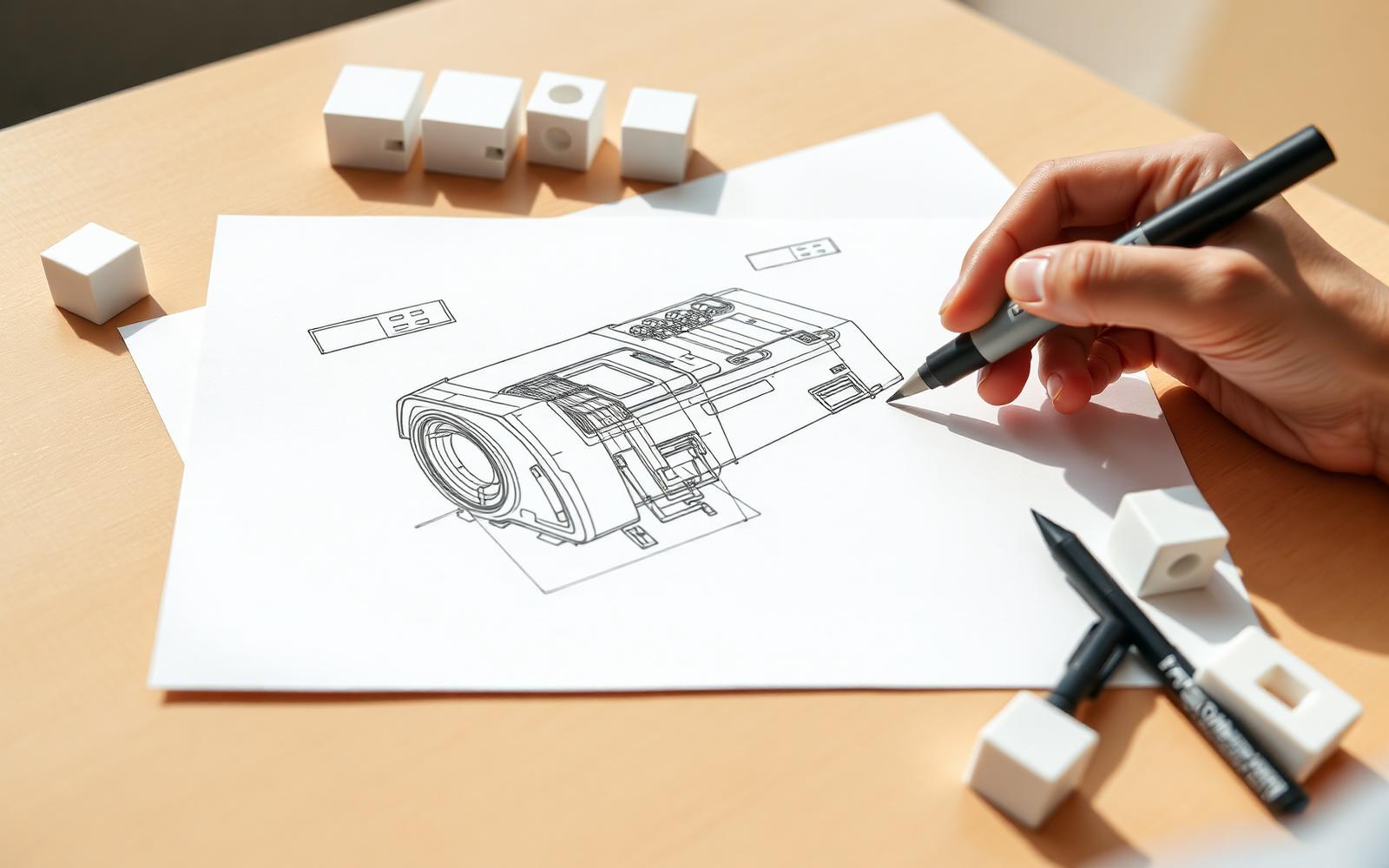
Concept design is the phase where the product is still cheap to change. The deliverables are not decoration — each one exists so a later decision costs less. If a concept phase ends without a chosen architecture and a first cost estimate, it ended early.
Deliverable | What it settles | Typical effort | Cost range |
|---|---|---|---|
Opportunity and user brief | Who it is for and what job it does | 1–2 weeks | $3k–$10k |
Sketch concepts (5–15 directions) | Form language and feature set | 1–3 weeks | $4k–$15k |
Architecture block diagram | How subsystems divide and connect | 1 week | $3k–$9k |
Concept CAD of 2–3 directions | Volume, ergonomics, packaging feasibility | 2–4 weeks | $8k–$30k |
Appearance or study model | Whether people respond to it | 1–2 weeks | $2k–$12k |
Preliminary BOM and cost model | Whether the business case survives | 1 week | $3k–$8k |
The questions a concept phase has to answer
- What is the single job this product does better than the alternative the customer uses today?
- What is the target landed unit cost, and does the chosen architecture fit inside it?
- Which subsystem carries the most technical risk, and what test would retire it?
- What manufacturing process does the form imply, and is that process available at our volume?
- What regulatory scope does the feature set create — radio, battery, contact with skin or food?
- What must be true in twelve months for this to be worth building?
Why concepts get killed and that is a good outcome
A healthy concept phase kills roughly half the directions it produces, and occasionally the entire program. The cost of that is measured in tens of thousands of dollars; the cost of discovering the same facts after tooling is measured in hundreds of thousands plus a lost season.
Documenting why a direction was rejected matters as much as documenting the winner — teams reliably rediscover dead concepts eighteen months later and have to relitigate them from scratch.
From concept to a fundable plan
- Rank the surviving concepts against cost, risk, time to market and differentiation — explicitly, in a table, not in conversation.
- Attach a prototype plan to the winner that names the risk each build retires.
- Get one manufacturing opinion before detailed design starts; molders and machinists change concepts for free at this stage.
- Convert the brief into testable requirements so verification later has something to test against.
- Set the phase gate: what evidence lets the program spend the next tier of money?
Our design and development services run concept work this way, and consulting engagements can cover just the concept phase if that is the decision you need to make.
Frequently asked questions
How can I find a big product idea?
You can find a big product idea by observing the world around you. Inspiration can come from daily interactions, conversations, stories, and places. Patience and attention to detail in natural happenings can reveal opportunities for new product ideas or solutions to challenges.
Why is it important for a new product idea to solve a problem?
It is important for a new product idea to solve a specific problem because it ensures there is a clear market for the product. Products that address a specific need are more likely to be adopted by users, avoiding the creation of a product no one opts for.
What is the 'Invent' stage in product development?
The 'Invent' stage involves developing the solution-driven idea. This stage recognizes that if a product solves a problem, an existing market likely awaits it. It also includes refining and enhancing the product based on customer needs, sometimes requiring concept design services.
Do I need outside help to develop a new product?
Turning an idea into a world-class product can involve a rigorous process, but you do not have to undertake it alone. A product development firm can provide technical skills to help you develop your product, supporting you through the observe, solve, and invent stages.
Sources and standards
- Industrial Designers Society of America — Professional body for industrial design practice in the US.
- Nielsen Norman Group usability research — Evidence-based usability findings applied to product interaction.
- USPTO — patent basics — Official guidance on provisional and non-provisional filings for new products.
Have an idea that needs a concept phase before anyone builds anything?
What invention design services actually deliver
Stage | Deliverable | What it decides | Typical duration |
|---|---|---|---|
Observe | Use study notes, task map, requirement list | Who it is for and what must not fail | 1-3 weeks |
Solve | Concept sketches, block models, screening matrix | Which direction survives cost and use | 2-4 weeks |
Invent | Refined CAD, appearance model, cost estimate | Whether the business case holds | 3-6 weeks |
Protect | Prior art search, provisional filing support | What is defensible before disclosure | 2-4 weeks |
Engineer | Production CAD, DFM, tooling package | How it will be made and for how much | 6-12 weeks |
Concept screening that respects the budget
- Task success, weighted heaviest: does an untrained user complete the job first time?
- Manufacturability: part count, undercuts, draft, secondary operations.
- Landed cost against the retail price you need, including freight and duty.
- Tooling exposure: how much steel is at risk if the design changes after launch.
- Patentability: is there a genuine functional difference, not just a styling difference?
- Certification burden: does the concept drag in electrical, food-contact, or child-safety testing?
Common inventor mistakes and what they cost
Mistake | Where it surfaces | Typical cost to correct |
|---|---|---|
Public disclosure before filing | Patent examination | Loss of rights in most territories |
Designing for a prototype process | First tooling quote | Full geometry rework, 4-8 weeks |
No target landed cost | Post-tooling costing | Redesign or margin collapse |
Single supplier, no second quote | Production ramp | 10-30 percent unit cost premium |
Skipping use studies | Post-launch returns | Returns, reviews, packaging reprint |
Over-featuring version one | Everywhere | Schedule slip and diluted positioning |
Filed under:EducationInspirationWords
Services related to this guide
- Product design servicesIndustrial design and CAD taken all the way to manufacturable files.
- Best industrial design firmsWhich studios take an idea from form to manufacturable hardware, and what they charge.
- Prototype designLooks-like, works-like or pre-production: what each proves and what it costs.
- Product development examplesReal projects we designed, prototyped and shipped.