Written by Yelena Rymbayeva, MPhil Communication & Media Studies, BTech Quality Control
Marketing & Product Leader, Technology Commercialization
Published August 10, 2026
A laser-cut metal award is designed as a single flat profile: everything that reads as detail has to survive being cut from one sheet, with no undercuts, no thin islands and no features smaller than the beam can hold.
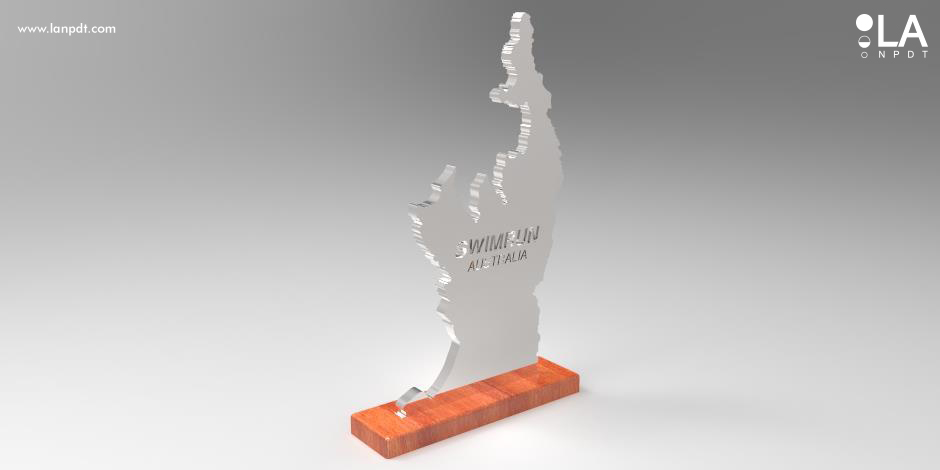
Swimrun Australia came to us with a rough idea for a trophy for their multi-stage swim-and-run race. We designed a profile that carries the region, the race course and the event name in one silhouette, then handed over CAD files their local fabricator could cut directly.
Project at a glance
- Client
- Swimrun Australia — multi-stage swimming and running competition organiser
- Category
- Sports trophy / sheet-metal product design
- Starting point
- A rough idea and a set of requirements, no drawings
- Constraint
- Must be cuttable from metal sheet on a laser cutter
- What we delivered
- Trophy concept design, 3D model and CAD files for fabrication
- Outcome
- Design approved and manufactured locally in Australia from our files
The client
Swimrun Australia organises a multi-stage swimming and running competition. They needed trophies for the race series and had a rough idea of what they wanted, but no drawings and no design their fabricator could quote.
The challenge
The award had to be cut from metal sheet on a laser cutter, which removes most of the vocabulary a trophy designer normally uses. There is no carving, no undercut and no relief — only a flat profile. Everything meaningful about the event had to survive as a single outline, and the finished piece had to stand up on a table.
Our solution
We let the coastline and the race course become the silhouette, so the trophy reads as that specific event rather than as a generic plaque. Material and gauge were fixed first, because thickness sets stiffness, weight, price and how fine the detail can go.
From there the artwork was coarsened deliberately: internal cut-outs given a minimum radius, thin bridges widened past the sheet thickness so they would not warp or snap, and lettering sized so the kerf could not close it up. The standing detail was solved in the same pass rather than bolted on afterwards.
The result
Swimrun Australia approved the design and took our CAD and flat cutting files to a fabricator in Australia, who produced the awards locally without a redraw. The client owns the files, so future editions of the race can be run again — or restyled — without starting over.

What custom award design has to solve
Custom award design is a manufacturing problem wearing a ceremonial hat. The method chosen — laser-cut sheet, machined block, cast resin, acrylic — decides how much detail is possible, what the piece weighs in the hand, and what it costs per unit at the quantity the event actually needs.
The deliverable that matters is not a picture of a trophy. It is a set of files a fabricator can run: 3D model, flat DXF profile, material, thickness and finish called out. With that in hand an organiser can quote several shops, in any country, and reproduce the award every year without paying for design again.
How a laser-cut trophy gets designed for the cutter
The design and the manufacturing constraint are the same conversation. Every choice below is made against what a sheet-metal laser can actually produce.
1. Turn the story into a silhouette
A flat award only has an outline, so the outline has to do the work. For Swimrun we let the coastline and the course shape the profile, so the trophy reads as that race rather than as a generic plaque.
2. Design for one sheet, one thickness
Material and gauge are picked first — they set stiffness, weight and cost. Once the thickness is fixed, every feature is drawn as a 2D profile, because a laser cuts through, it does not carve.
3. Respect the beam and the kerf
Internal cut-outs need a minimum radius, thin bridges snap during handling, and lettering that is too fine closes up. Detail is coarsened deliberately until every feature is wider than the cutter's practical minimum.
4. Solve standing and finishing
A flat part needs a base, a bent foot or a slot-and-tab stand. Finish — brushed, powder-coated, anodised — is decided at design time because it changes tolerances on any mating slot.
5. Hand over files the fabricator can run
The deliverable is CAD plus a flat DXF profile with material, thickness and finish called out. Swimrun took ours to a fabricator in Australia and produced the awards locally without a redraw.
| Feature | Rule of thumb | Why |
|---|---|---|
| Internal cut-out | Radius at least half the sheet thickness | Sharp internal corners need extra passes or leave burn marks |
| Thin bridge | Wider than the sheet thickness | Narrow bridges warp from heat and snap in handling |
| Engraved text | Cut through, or etch — not both at 2mm | Fine cut lettering closes up as the kerf overlaps |
| Stand | Bent foot or separate slotted base | A flat plate cannot stand unaided |
Questions about this project
Straight answers from the engineers who ran the build. Have a different question? Ask us directly.
Talk to an engineerWhat file does a laser cutting shop need?
A flat 2D profile — DXF is the common exchange format — plus the material, sheet thickness and finish. We supply that alongside the 3D model so the same design can also be quoted for waterjet or plasma if the shop prefers.
How detailed can a laser-cut award be?
Detail is limited by sheet thickness. Thicker stock feels better in the hand but forces coarser features; thinner stock holds fine detail but flexes. We choose the pairing early and design the artwork to suit rather than shrinking a logo until it fails.
Can you design an award we manufacture ourselves?
Yes — that was the arrangement here. We own the design and the manufacturing files; you take them to whichever fabricator you prefer, in whichever country.