Our work / Fingolazo
Custom Board Game Design and Development
Fingolazo: a tabletop soccer game built to survive real play
Start a project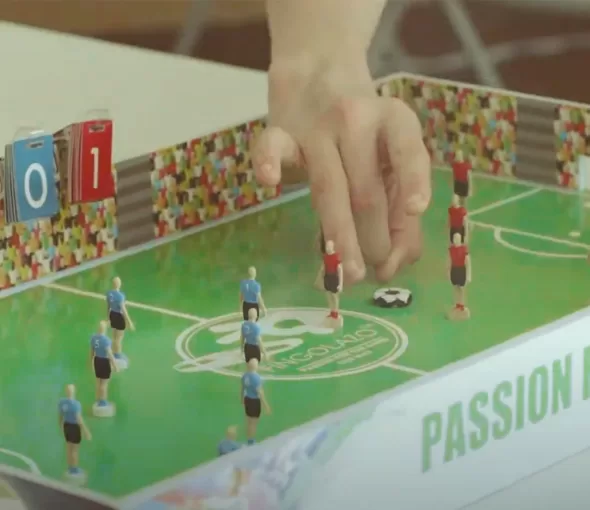

Written by Ralph Hill, Mechanical & electrical systems, 3D manufacturing
Prototyping Engineer
Published August 10, 2026
Getting a board game manufactured takes four things: a rule set that survives real play, a component list priced against a print run, physical prototypes of every piece, and a production package a game factory can quote from.
Fingolazo — a tabletop soccer game by Pedro Diaz — went through exactly that sequence with us: renderings for approval, material selection for pieces that survive aggressive play, 3D-printed and hand-painted figurines, then board, packaging and promotional assets.
Project at a glance
- Client
- Pedro Diaz — creator of Fingolazo
- Category
- Tabletop game design and prototyping
- Starting point
- A tabletop soccer game that existed as rules, sketches and stand-in pieces
- What we delivered
- Concept renderings, component and figurine design, material selection, 3D-printed and hand-painted figurines, board graphics and layout, playable prototype, promotional video and website
- Key constraints
- Pieces that survive aggressive play, detail that reads at arm's length and still moulds and paints cleanly, a component list the retail price can carry
- Where it was built
- Design, 3D printing and hand painting in our Ruston, Louisiana studio
- Outcome
- A complete playable prototype put in front of target users, with launch assets finished around it
Pedro Diaz came to LA NPDT with a game, not a product. Fingolazo is a tabletop soccer game for fans of every age, and it existed as rules, sketches and stand-in pieces. Our job was to turn that into a board game prototype that could be manufactured, boxed, photographed and sold — pieces that mould and paint cleanly, a board and layout that read at a glance, and a component list a factory can quote.
What made this one hard
- Gameplay is physical. Players flick, press and knock the pieces, so every part had to take abuse that a display model never sees.
- The figurines carry the personality of the game. They needed detail that reads at arm's length and still survives moulding and hand painting.
- Every extra component adds tooling, packout time and box volume. The design had to stay inside a component list the retail price could carry.
- Board art, piece design and packaging all had to be settled together — changing one late moves the other two.
How we designed and proved the board game prototype
Renderings before anything physical
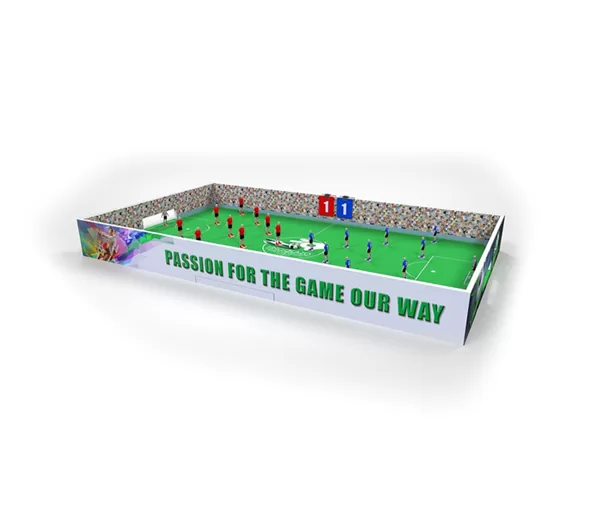
We modelled the board, the pieces and the figurines and produced renderings for Pedro to react to. Iterating on screen is where the cheap decisions live: proportions, colour, how a piece sits in the hand, how crowded the board looks with a full set out. Nothing was printed until the look was signed off.
Materials chosen against real gameplay
We identified the material combination that holds up to aggressive play and still keeps the game manufacturable at a sensible price — the same trade-off that decides board thickness, piece grade and insert type on any tabletop product. Modelling, printing and painting all happened in our Ruston, Louisiana prototyping studio, so a change to a figure could be reprinted and back on the board the same week.
3D printed and hand painted figurines
The miniature soccer figures were 3D printed and hand painted in house, so Pedro could hold the set, test grip and weight, and see exactly how much detail carries through paint before anything was committed to tooling.

Graphics, layout and the launch package
Alongside the physical build we handled the graphic design and board layout, then produced the promotional video and the website once the prototype was finished — so the game had something to be seen with the moment it was ready to show.
Where it landed
Fingolazo went into the hands of target users for testing as a complete, playable prototype, with the artwork, figurines and launch assets finished around it. If you are developing a board game of your own, the sequence below is the one we would run again — and it is the same path we use on other toy and game development projects.
Capabilities used on this project
Rapid prototyping services
3D printing, CNC machining, urethane casting and functional prototype builds with published materials, tolerances and lead times.
How a board game actually gets made
The order matters more than the budget. Each step below removes a cost or a risk that is far more expensive to discover after tooling.
1. Lock the rules before you design anything
Component count is the single biggest driver of unit cost. Every extra token, card deck or miniature adds tooling, packout time and box volume. Rules get playtested on paper first, so the component list is settled before a designer touches CAD.
2. Design the components as manufactured parts
Figurines are injection-molded or resin-cast parts with draft angles, wall thicknesses and paint masks — not just sculptures. On Fingolazo we modeled the mini soccer figures so the detail that reads at arm's length survives the mold and the paint operation.
3. Prototype the pieces people handle most
Boards and cards are print problems and rarely surprise you. Moving parts, launchers and figures do. We 3D printed and hand-painted the Fingolazo figurines so the client could test grip, weight and durability under real gameplay before committing.
4. Choose materials against a shelf price, not a wish list
Board thickness, card stock weight, plastic grade and insert type each move the landed cost. We identify the combination that withstands aggressive play and still lands at a price the game can retail at, then hold the design to it.
5. Build the production package
A game factory quotes from dielines, print-ready art at correct bleed, part drawings, material call-outs, packout diagrams and a bill of materials. Give them anything less and the quotes come back padded or wrong.
6. Create the launch assets while tooling runs
Renderings, a promotional video and a storefront can be produced from the same CAD and artwork you already paid for. Fingolazo's video and site were built off the prototype so pre-orders could open the moment the game was demonstrable.
| Decision | Cheaper | More expensive | Why it matters |
|---|---|---|---|
| Figurines | Flat tokens or printed standees | Molded and painted miniatures | Molds and paint masks are per-piece tooling |
| Board | Folding board, standard thickness | Thick board, custom shape, magnets | Die and lamination costs plus box volume |
| Insert | Paper divider | Vacuum-formed or molded tray | A tray needs its own tool but protects parts in transit |
| Box | Standard retail footprint | Oversize or custom-cut | Box size drives freight and shelf acceptance |
Questions about this project
Straight answers from the engineers who ran the build. Have a different question? Ask us directly.
Talk to an engineerWhat is a board game prototype and what should it include?
A board game prototype is a physical, playable set of every component a player touches: the board at final size, the cards or tokens at final stock, and the pieces that carry the game's personality. On Fingolazo that meant a printed board with production artwork plus 3D-printed and hand-painted soccer figurines, so grip, weight, durability and readability could be judged in play rather than on a screen.
How many prototypes does a board game need before manufacturing?
As many as it takes to stop learning something new from the next one — usually a paper playtest set first, then one or two physical rounds of the pieces people actually handle. On Fingolazo the boards and cards were print problems that behaved predictably; the figurines were the parts we printed and painted so the client could test grip, weight and durability before anything was committed.
How long does a board game prototype take?
For a game with a settled rule set, four to eight weeks is typical: about a week or two of modelling and renderings for approval, a week of printing and painting the pieces, and the rest spent on board graphics, layout and a play round that usually triggers one revision. Games with mechanisms, launchers or moving parts add a cycle.
Can game figurines be 3D printed instead of moulded?
For prototypes and very small runs, yes — that is exactly how the Fingolazo figures were made. For a real print run the economics flip to moulding, which is why we design the figures as manufacturable parts from the start: draft angles, wall thickness and paint masks, not just a sculpture that happens to print.
What drives the cost of getting a board game manufactured?
Component count above everything else. Every extra token, deck or miniature adds tooling, packout time and box volume. After that it is material choices — board thickness, card stock weight, plastic grade and insert type — which is why we pick them against a shelf price rather than a wish list.
Industries this project belongs to
See how we approach development in each of these categories, and the other products we have taken from sketch to production there.