
Written by Ashok Chintagunta, MS Computer Science, Louisiana Tech University
CTO & Software Engineer, AI and Automation
Published August 10, 2026
An online product configurator lets a buyer assemble a valid version of your product on the page and see it before ordering — replacing spec tables, sample kits and back-and-forth email.
For Big Sight Systems we rendered all sixteen front-and-rear sight combinations and wrapped them in an interactive configurator so customers could self-select instead of waiting on a mailed gauge tool.
Project at a glance
- Client
- Big Sight Systems — firearm accessories manufacturer
- Product
- BigSights oversized sights for multiple Glock models
- Scope
- Online product configurator, 3D product renderings, site migration
- Combinations
- Four front and four rear sights — sixteen valid pairings, each rendered
- Replaced
- Mailing every customer a 3D printed gauge tool
- Platform
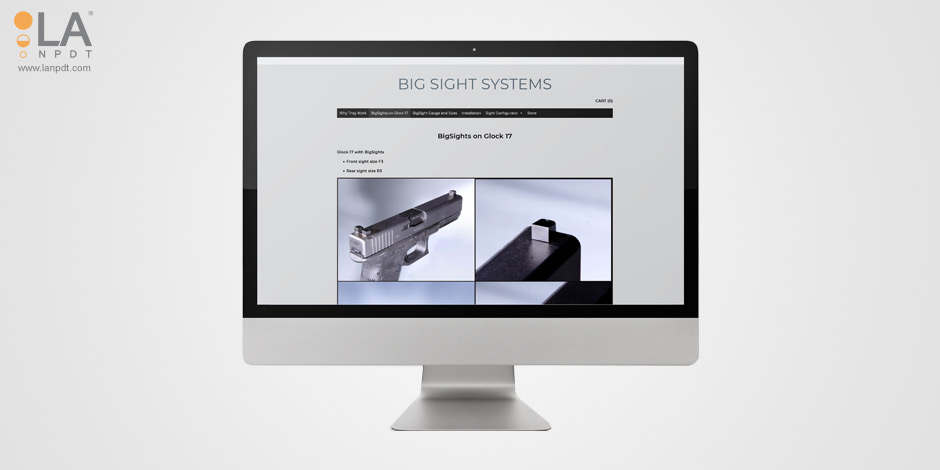
- Moved from Squarespace to WordPress to host the configurator
The client
Big Sight Systems makes and sells firearm accessories. Their BigSights line is a set of oversized sights for different Glock models, designed for shooters whose near vision has declined — the front and rear sights are sized and gapped so the sight picture reads clearly to an eye that can no longer focus at arm length.
The challenge

The right sight picture depends on the ratio between the front and rear sight, and Big Sight Systems offers four of each — sixteen valid combinations. Customers could not judge which one suited their eyes from a spec table, and the original plan, mailing every buyer a 3D printed gauge tool, was too expensive to scale.
An online product configurator was the alternative, but only if it looked real. A flat diagram would not settle the question the customer was actually asking, and the sights had to appear on the correct Glock model, since the slide length changes how the combination reads.
Our solution
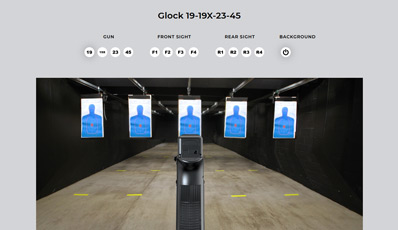
Working from the client CAD, we produced sixteen photoreal renderings — every front and rear pairing, mounted on the pistol, framed the way a shooter sees it. Each gun model was rendered separately rather than scaled, because a sight combination that looks right on one slide length looks wrong on another.
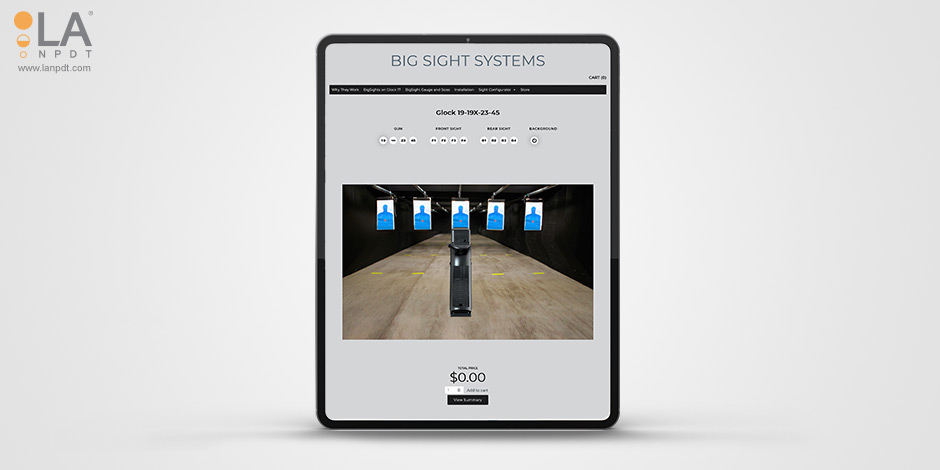
On top of that image set we built an interactive configurator with direct controls for gun model, front sight and rear sight, so a buyer flips between combinations and compares them instantly at any screen size. The client site was on Squarespace, which could not host the interaction properly, so we migrated it to WordPress and integrated the configurator there.
The result
Buyers now self-select a valid configuration on the website instead of waiting on a mailed gauge tool, which removed both the fulfillment cost of the gauges and the delay between interest and order. Because the configurator only offers combinations the company actually makes, the orders that come through are buildable as entered.

When an online product configurator pays for itself
A configurator earns its build cost in one of two ways: it removes a step a human was doing by hand, or it removes the hesitation that keeps a buyer from ordering. Here it did both — no gauge tools to print and mail, and no customer stuck deciding between sixteen options described in text.
The part teams underestimate is the visual asset work. The interface is the cheap half; the renderings, or the real-time 3D model behind them, are where the budget goes, and they are also what makes the tool convincing. If a configurator does not look like the product the customer will receive, it does not answer the question it was built to answer, and the emails to support start again.
Capabilities used on this project
Rapid prototyping services
3D printing, CNC machining, urethane casting and functional prototype builds with published materials, tolerances and lead times.
How to build an online product configurator that sells
1. Map the valid combinations first
List every pairing the business actually builds and every one it refuses. Sixteen here. That matrix decides how many visuals you need and stops the tool from accepting an order production cannot fill.
2. Decide what the buyer is really judging
Appearance, fit and proportion need convincing visuals; capacity or compatibility can be answered with logic and text. Getting this wrong either wastes rendering budget or leaves the buyer still unsure.
3. Produce the visual set at product quality
Either render every combination or build a real-time 3D model that generates them. Both are the expensive half of the project, and both are what makes the configurator credible enough to close.
4. Check the platform can host it before design starts
Some site builders cannot carry custom interaction cleanly. This project moved from Squarespace to WordPress — better found at the start than after the tool is finished.
5. Design for the smallest screen and the real order flow
Options must stay comparable on a phone, and the chosen configuration has to travel into the cart or quote request intact, so nobody retypes it.
| Method | Cost to run | Limits |
|---|---|---|
| Spec table | Free | Buyer cannot picture the result |
| Mailed sample or gauge kit | High per inquiry | Slow, kills order momentum |
| Rendered configurator | Build cost, then free | Needs a visual set per combination |
| Real-time 3D configurator | Highest build cost | Needs clean, optimised CAD |
Questions about this project
Straight answers from the engineers who ran the build. Have a different question? Ask us directly.
Talk to an engineerWhat does an online product configurator do for a manufacturer?
It moves the selection decision from a phone call or an email thread onto the product page. The buyer sees the exact combination they are ordering, and because the tool only offers combinations you actually build, the order that arrives is buildable as entered.
Do you need photoreal renderings, or are diagrams enough?
It depends on what the buyer is judging. Here they were judging a visual sight picture, so a diagram could not settle it. Whenever the decision is about appearance, fit or proportion, the visuals are the product of the configurator, not decoration on it.
Where does the cost of a configurator actually go?
Into the visual assets. The interface is comparatively cheap; producing every valid combination as a convincing rendering, or building a real-time 3D model that can generate them, is the bulk of the work and the bulk of the value.
Can a configurator be added to an existing website?
Usually, if the platform allows custom code and integrations. This client was on Squarespace, which could not host the interaction cleanly, so the site moved to WordPress. Checking that before designing the tool avoids rebuilding it twice.
How do you keep a configurator usable on a phone?
Design the controls for the smallest screen first and keep the rendered product at a size where the difference between options is still visible. A configurator that requires pinch-zoom to compare two options has failed at its one job.