
Written by Ralph Hill, Mechanical & electrical systems, 3D manufacturing
Prototyping Engineer
Published August 10, 2026
Redesigning a product to cut manufacturing cost works by changing what the part is made of and how it is formed — not by squeezing the supplier. Material, forming process, part count and shipping volume are where the money is.
Offset Feeder Legs came to us with a deer feeder leg set that cost too much to make. We moved to rolled square tubing, prototyped and field-tested the design, and worked with a manufacturing partner to cut manufacturing cost by 50 percent while adding adjustability and levelling.
Project at a glance
- Client
- Offset Feeder Legs — a returning client
- Category
- Outdoor and hunting equipment
- Starting point
- An existing feeder leg product with manufacturing costs too high to sell direct to consumers
- What we delivered
- Design for cost redesign, rolled square tubing development, prototypes, field testing, manufacturing partner coordination, investor samples
- Outcome
- Manufacturing cost reduced by 50 percent, with adjustable height and levelling added and the feeder made raccoon-proof
The client
Offset Feeder Legs is a Louisiana deer feeder company and a returning client. The owner sells a leg set that raises a gravity feeder off the ground and keeps raccoons and other unwanted animals out of the feed.
The challenge

The existing product cost too much to make. At that unit cost the owner could not sell direct to consumers and still leave room for distributors, retailers and wholesalers, so the whole business model was capped by manufacturing.
The most promising fix — rolling square tubing for the legs — was also the riskiest. Square section requires special dies, and nobody would commit to that tooling until prototypes proved the geometry held up under a loaded feeder.
Our solution
We worked the design and the supply chain together rather than in sequence. With our manufacturing partner we settled the tubing specification, the forming process and the price points at the same time as the geometry, so every design decision was priced as it was made.
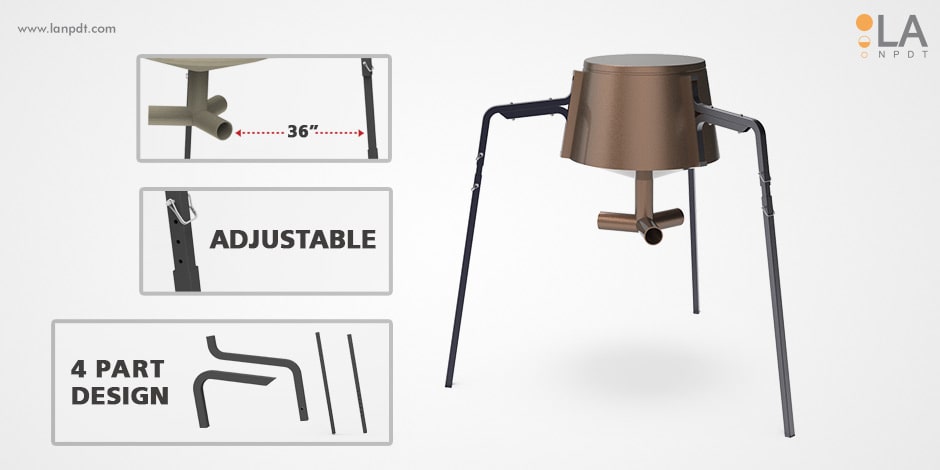
Prototypes were built and tested in the field, not just checked on screen. Several iterations followed — adjusting the leg section, the joints and the adjustment mechanism — until the stand held the gravity head steady, levelled on uneven ground and stayed raccoon-proof. Two finished sets were produced for the client to put in front of investors.

The result
Manufacturing cost came down by 50 percent, which is what made direct-to-consumer and wholesale pricing possible at the same time.
The redesign also added value that cost nothing to build in: the legs are adjustable, so the gravity head sits at whatever height suits the animals you want to feed, and the feeder can be levelled on uneven ground. Offset Feeder Legs took the investor samples forward to finance mass production.


Where hunting hardware loses its margin
Feeder legs are simple parts that quietly destroy margin: welded assemblies ship as bulky freight, and every extra weld is labor. The owner wanted to sell direct rather than through a distributor, which meant the product had to survive parcel shipping and land at a price that still worked at retail.
What we changed
We rebuilt the leg set as bent, bolt-together components that nest flat in the carton, reduced the number of unique parts, and reran the load case so the stand still handles a full barrel plus wind loading. Production drawings and a vetted fabricator quote went out together, so the client could compare landed cost before committing to tooling.
Capabilities used on this project
Rapid prototyping services
3D printing, CNC machining, urethane casting and functional prototype builds with published materials, tolerances and lead times.
Where cost actually comes out of a product
1. Cost the existing part before touching it
Break the current price into material, forming, welding, finishing, assembly and freight. Teams usually guess wrong about which of those dominates, and redesign the wrong thing.
2. Change the forming process
Rolling square tubing for the legs was the move on this project. It needed special dies and prototypes to prove viable — but the process change, not a cheaper vendor, is what delivered the saving.
3. Reduce part count and welds
Every weld is fixture time and a quality risk. Fewer, simpler joints lower labour cost and raise consistency at the same time.
4. Prototype and test in the field
We built prototypes and tested them in our own backyard. Cost reductions that fail in the field are not savings — this design still had to be raccoon-proof and hold the gravity head at height.
5. Involve the manufacturer in the design
The details of tubing, price points and design were worked out with the manufacturing partner directly. A factory will tell you which tolerance is expensive long before a quote does.
6. Add value where it is free
The redesign made the legs adjustable and levellable. Features that arrive as a side effect of a better geometry are the cheapest features you will ever ship.
| Lever | Typical saving | Cost to implement |
|---|---|---|
| Change forming process | Large | Tooling or dies, plus prototypes |
| Reduce part and weld count | Large | Design time only |
| Material grade or gauge | Moderate | Requires field or load testing |
| Flat-pack for shipping | Moderate | Packaging and assembly instructions |
| Renegotiate with supplier | Small | Low, and rarely repeatable |
Questions about this project
Straight answers from the engineers who ran the build. Have a different question? Ask us directly.
Talk to an engineerHow much can a redesign realistically save?
It depends entirely on where the cost sits. On this project a change of forming process plus manufacturer involvement cut the cost in half. When the current design is already simple and well-formed, ten to twenty percent is a more typical result.
Do I need new tooling to lower my cost?
Often yes — the square-tube approach here required special dies, and prototypes to prove it was viable. The tooling pays back through unit cost, so the calculation is saving per unit against your annual volume.
Will a cheaper design still hold up in the field?
Only if you test it. We prototype and field-test cost-reduced designs before release, because a saving that fails in use costs more in warranty and reputation than it ever returned.
Can you work with my existing manufacturer?
Yes, and it usually speeds things up. On this project the tubing details, price points and design were resolved directly with the manufacturing partner, which is how the 50 percent reduction was confirmed before tooling was ordered.
How long does a design-for-cost redesign take?
Typically six to twelve weeks from cost breakdown to a proven prototype, depending on whether the change needs new dies and how much field testing the product demands.
Industries this project belongs to
See how we approach development in each of these categories, and the other products we have taken from sketch to production there.