Written by Konstantin Dolgan, Ph.D., NPDP
Founder & CEO, Product Development Engineer
Published August 10, 2026
3D printing can be the manufacturing method, not just the prototype step — when the product is small, the volumes are modest and tooling would cost more than the first year of sales.
DJ Mills, a gutter service company owner, brought us a sketched template for cutting 45-degree miters. Rapid print-test iterations solved the fit, and because the product was designed for printing, he was selling within weeks and saved tens of thousands in tooling.
Project at a glance
- Client
- DJ Mills — owner of Home Innovations, a gutter service company
- Product
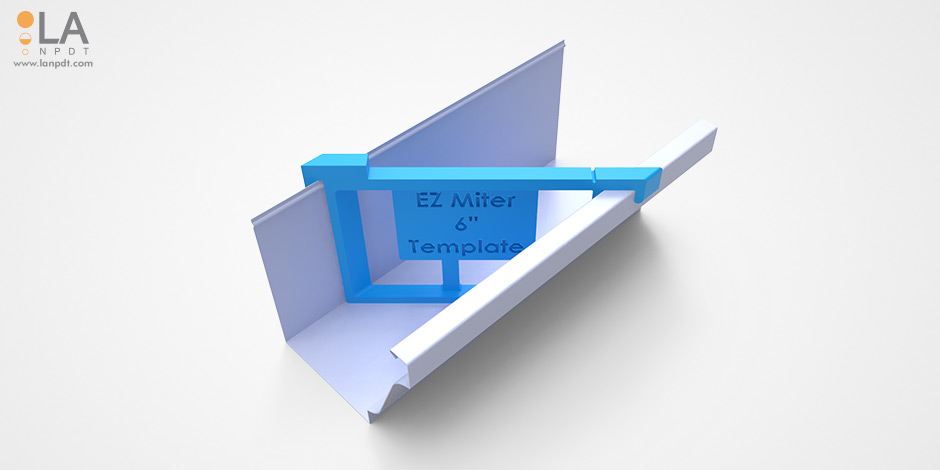
- EZ Miter — a template for precise 45-degree gutter cuts
- Hard problem
- Thin, deformable gutter material made accurate fit difficult
- Process
- Rapid design-print-test iterations; versions for multiple gutter types and sizes
- Outcome
- Selling within weeks; tens of thousands saved by printing instead of molding
The client

The challenge

Our solution
The result


Construction tool design at a glance
| Scope | Field research, concept, CAD, prototypes, production package |
|---|---|
| Requirements | Repeatable accuracy, glove-friendly use, weather and abuse resistance |
| Deliverables | Production CAD, prototypes, drawings, manufacturing quotes |
| Typical timeline | 4-10 months |
Jobsite tools are tested by the worst conditions, not the best
A gutter template is used on a ladder, in wind, by someone wearing gloves. It has to register consistently on real material that is never perfectly straight, survive being dropped, and be faster than the method the installer already trusts. Anything that requires care to use will be abandoned.
What we designed
We studied how miters are actually cut in the field, then designed positive registration features that locate on the gutter profile itself so the cut repeats without measuring. Prototypes were tested by installers, and the final design was detailed for durable, low-cost production in materials that tolerate weather and rough handling.
Frequently asked questions
Do you test tools with real users?
Yes. Field testing with trade professionals is part of the process, not an afterthought.
Can you help protect the design?
We prepare patent drawings and work alongside your attorney on utility and design filings.
What production methods suit tools like this?
Injection molding, sheet metal forming or extrusion, chosen against volume and durability targets.
Capabilities used on this project
Rapid prototyping services
3D printing, CNC machining, urethane casting and functional prototype builds with published materials, tolerances and lead times.
Low-volume manufacturing
Bridge tooling, short-run production and supplier management for first commercial batches.
How a 3D printed product goes from sketch to sales
1. Solve a problem you see every week
DJ's crews struggled to cut gutters precisely at 45 degrees, and he knew other gutter companies had the same problem. A customer who is also the user writes the best brief there is.
2. Expect the fit to fight you
The CAD model looked right; the printed templates did not fit. Thin gutter material deforms easily, so the template's registering geometry had to be tuned against real gutters, not nominal drawings.
3. Iterate cheap and fast
Several design-prototype rounds ran in days. Each print answered one question about fit, and the loop continued until the template worked every time — the economics only work because a print costs almost nothing.
4. Design the family, not the part
Versions for different gutter types and sizes were created and each was optimized for fast printing — orientation, wall thickness and minimal support all affect what a unit costs to make.
5. Skip the mold entirely
Because the product was designed to be 3D printable for production, DJ sold within a couple of weeks of finalizing the design, with no injection molding investment. Revenue arrived before tooling would even have been delivered.
| 3D printed production | Injection molded | |
|---|---|---|
| Upfront cost | Nearly none | Tens of thousands in tooling |
| Time to first sale | Weeks | Months |
| Unit cost | Higher, stable | Low at volume |
| Design change | Edit the file, print tomorrow | Modify the tool, wait weeks |
Questions about this project
Straight answers from the engineers who ran the build. Have a different question? Ask us directly.
Talk to an engineerCan I manufacture my product with 3D printing instead of injection molding?
Often, yes — small parts at modest volumes are the sweet spot. EZ Miter skipped tooling entirely and was generating revenue within weeks. Printing wins until volume makes the mold's unit cost irresistible.
Why didn't the first printed prototype fit?
Because real gutters deform and vary, while CAD assumes perfect geometry. Fit against flexible material is only settled by printing, trying and adjusting — which is why rapid iteration mattered more than modeling time.
How do I keep per-unit print cost down?
Design for it: orientation that needs little support, wall thicknesses that print fast, and a shape that nests on a build plate. We optimized each EZ Miter variant for print speed as part of the design work.
Industries this project belongs to
See how we approach development in each of these categories, and the other products we have taken from sketch to production there.