Our work / Master Flo Games for OTC 2019
Master Flo OTC 2019: Trade Show Game Development
Start a project

Written by Ashok Chintagunta, MS Computer Science, Louisiana Tech University
CTO & Software Engineer, AI and Automation
Published August 10, 2026
A trade show game turns a booth from a wall of banners into the busiest spot in the aisle — when it is built to start a sales conversation, not just entertain.
For Master Flo at OTC 2019 we built three interactive games and a 3D animation around their choke valves, with our engineers writing the flow and pressure formulas the play loops run on.
Project at a glance
- Client
- Master Flo, choke valve manufacturer — OTC 2019, Houston
- Industry
- Oil and gas equipment
- Starting point
- A booth that needed to explain flow control to passing attendees
- What we delivered
- Three interactive games, a 3D animation, custom graphics and on-site support
- Engineering input
- In-house engineers wrote the pressure and flow-rate formulas behind the play
- Outcome
- A crowd-drawing booth attraction Master Flo still uses with office visitors
The client
Master Flo is a leading producer of choke valves for the oil and gas industry. The company brought us in to build its presence at the Offshore Technology Conference in Houston — a show where every competitor has a large stand and a wall of product literature.
Interactive games were one part of a larger engagement; the physical stand itself is covered in the Master Flo trade show booth study. The job of the games was narrow and commercial: stop people in the aisle and teach them, in under two minutes, what a choke valve does.
The challenge
OTC attendees walk past hundreds of stands. An attraction has roughly ten seconds to pull someone out of the aisle and about two minutes before they leave, so each game had to be immediately legible, quick to finish and genuinely fun — while still teaching something true about flow control.
That last requirement is where booth games usually break. Simplify the physics and engineers in the audience dismiss it; model it faithfully and nobody can win a round in ninety seconds. Getting pressure and flow-rate behaviour to feel right and play fast at the same time took our engineers and game designers working from the same table.

Our solution
We built three games, each aimed at a different part of Master Flo''s story, plus a supporting 3D animation. Our engineers wrote the underlying formulas and our developers built the play loops on top of them, so scoring well genuinely required understanding how a valve behaves.
- Virtual teardown — using motion tracking, players rotated, disassembled and reassembled a choke valve with their hands, learning the components as they went.
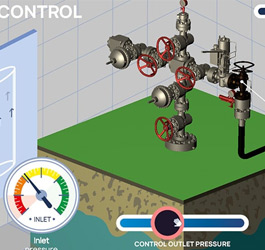
- Flow Control — players manipulated the valve opening to hold a pressure gauge in the green zone, which makes the trade-off between opening and pressure obvious in a way a datasheet does not.
- Well conditions — players chose a well scenario and a valve, then saw the consequences of that pairing: the specification conversation, played rather than explained.
Roughly ten build versions went through testing, debugging and refinement before the show, with custom graphics and Master Flo''s technical content layered onto the play loops. We finished with a light touch that did more work than expected: at the end of a round a player could pose for a photo and email it to themselves — a memento for the visitor and a natural moment for a rep to step in and start talking.
The result
Master Flo had one of the more memorable attractions on the floor at OTC 2019, and their staff had a reliable opening line every time a round ended. The games drew traffic that was self-selecting — the people who wanted to play with a choke valve were the people who buy them — and made the technical pitch something visitors performed instead of listened to.
The builds outlived the show. Master Flo continues to run them for office visitors and prospects, which is the difference between a booth expense and a marketing asset.


What makes a trade show game pay for itself
A generic arcade clone draws generic traffic: people play, win a t-shirt and leave knowing nothing about the product. A game built around the equipment itself filters the aisle for you and hands the sales team a scripted moment to step into — the score screen, the photo, the leaderboard. Keep a round under ninety seconds so the crowd rotates, and scope the build to run after the show on the website and in sales meetings.
Related work: the OTC booth design and our product marketing services. Concept, engineering, art and code were produced by our team in Ruston, Louisiana.
How a trade show game earns its keep
1. Build the game around the product's story
A generic arcade clone draws generic traffic. Each Master Flo game taught one thing about choke valves — components, pressure control, or valve selection for well conditions — so the visitors who stopped were the ones who buy.
2. Let engineers write the physics
Our in-house engineers supplied the formulas behind pressure and flow rate, and the developers built the play loop on top. That is what keeps a technical audience from dismissing the game after one round.
3. Keep a play under ninety seconds
Long games create a queue of one. A short round keeps the crowd rotating and gives booth staff repeated openings through the day.
4. Make the handoff to staff part of the design
Master Flo's games ended with a photo the player could email to themselves — a memento for the visitor and a scripted moment for a rep to step in.
5. Reuse it after the show
Master Flo still runs the builds for office visitors and prospects. Trade show content that only works for three days is badly scoped.
| Attraction | Draws traffic | Qualified leads |
|---|---|---|
| Giveaways | High volume | Low quality |
| Product demo | Medium | High |
| Custom game | High | Medium-high |
| Static graphics | Low | Low |
Questions about this project
Straight answers from the engineers who ran the build. Have a different question? Ask us directly.
Talk to an engineerHow much does a custom trade show game cost?
A custom booth game typically runs $8,000 to $30,000 depending on complexity. Hardware rental or purchase is separate.
How long does it take to build one?
Six to ten weeks from concept to a tested build — start at least twelve weeks before the show to leave margin for shipping and setup.
Does a booth game actually generate leads?
When designed to, yes. The traffic is the easy part; the value comes from building conversation triggers and lead capture into the game flow itself.
Can a game show how technical equipment really behaves?
Yes. For Master Flo the pressure and flow behaviour came from formulas our engineers wrote, so winning a round meant reading the valve correctly rather than guessing.
Can the game be used after the trade show?
It should be. The same build runs on a website, in sales meetings and at the next show — Master Flo has kept theirs in use since OTC 2019.
Industries this project belongs to
See how we approach development in each of these categories, and the other products we have taken from sketch to production there.