Our work / Tapdole Tape Cutter
Licensed to Shurtech
T-Rex Tape Cutter: Prototype to Production
Start a project

Written by Ralph Hill, Mechanical & electrical systems, 3D manufacturing
Prototyping Engineer
Published August 10, 2026
Getting from prototype to production means proving three things in hardware: the mechanism still works when parts are molded rather than printed, the assembly is fast, and the unit cost leaves a margin at the shelf price.
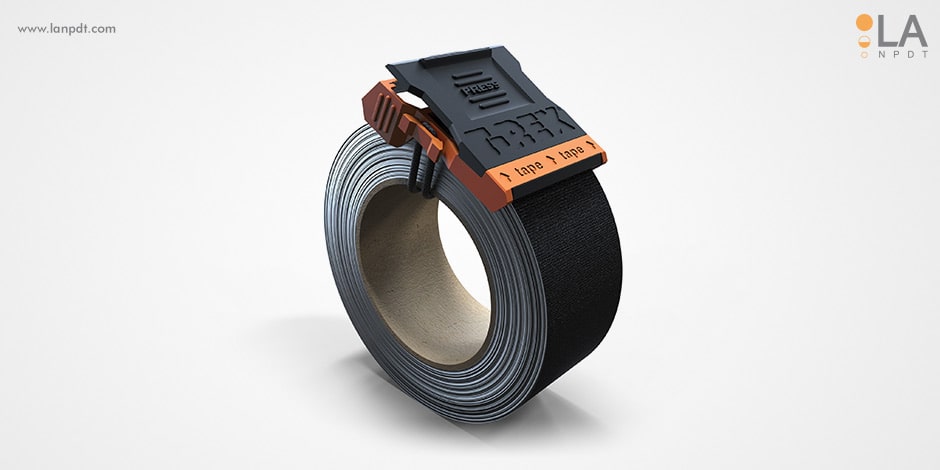
The T-Rex tape cutter went through that full loop with us — design, dozens of functional prototype rounds, cut testing against real reinforced tape, and a two-piece design ready for tooling quotes.
Project at a glance
- Client
- Lee Mallahan III — CEO, Tadpole Tape Cutter
- Category
- Consumer hand tool
- Starting point
- An inventor's concept for cutting the toughest tapes cleanly
- What we delivered
- Product design, dozens of functional prototype rounds, blade and mechanism development, prototype-to-production support
- Key constraints
- Cutting heavy-duty reinforced tape, shielded blade, one-handed use, two injection-moldable parts
- Outcome
- A production tape cutter now sold to consumers
The client
Lee Mallahan III is the inventor and CEO of Tadpole Tape Cutter. He came to us with a concept and a specific problem: reinforced packaging tapes had gotten strong enough that the cutters people already owned could no longer handle them. Tadpole hired us to design the tool, prove it in hardware, and get it ready for manufacturing.
The challenge

T-Rex Tape is engineered not to tear. It holds hundreds of pounds, resists hand tearing, and dulls or jams the blade on a standard dispenser. A tool that cuts it cleanly has to carry a genuinely sharp edge — and then live in a junk drawer, a toolbox or a shipping station where someone reaches in without looking.
Those two requirements pull against each other, and a third pulled against both: the finished product had to be cheap enough to sell as an accessory, which meant a small number of injection-moldable parts and no exotic hardware.
Our solution
We treated the blade geometry and the hand motion as one problem rather than two. Several dozen prototypes were built and cut-tested against real reinforced tape — not paper stand-ins — with each round answering a specific question: does the edge engage at this angle, does the roll seat without slipping, can a user finish the cut in one motion, can a finger reach the blade.
The design that survived is a two-piece assembly built around what became Safe Flex Blade Technology: the cutting edge is shielded in the rest position and presented only where the tape passes. Two parts also meant the tooling stayed simple and the assembly step stayed short.

The result
Tadpole went from a concept to a production tape cutter sold to consumers, with the first tool on the market able to cut the strongest tapes by hand. The final geometry carried the draft angles, wall thicknesses and assembly features a molder needs, so the design that passed testing is the design that got tooled.
Finishing on schedule mattered as much as the design itself: high-performance tapes were an emerging category, and the cutter arrived while the shelf space was still open.


What prototype to production really asks of a design
A prototype only has to work once, in your hands, with you being careful. A production part has to work ten thousand times, in anyone hands, coming out of a mold that costs more than the whole prototype program did. The gap between those two is where most inventor projects stall.
Crossing it means answering three questions in hardware before anyone cuts steel: does the mechanism still work when the parts are molded rather than printed, can the assembly be done in seconds by someone who has never seen it, and does the cost per unit leave a margin at the shelf price. Every prototype round should retire one of those questions. Rounds that only produce a nicer-looking model are rounds you paid for twice.
Capabilities used on this project
Rapid prototyping services
3D printing, CNC machining, urethane casting and functional prototype builds with published materials, tolerances and lead times.
How prototype production actually works
1. Define what the prototype must prove
A cutting tool has to cut cleanly, seat tape rolls securely and survive being dropped. We list the proof points first so every prototype dollar buys an answer, not just an object.
2. Match the process to the question
Form and fit questions get 3D prints. Function questions get prints plus real blades and hardware. The T-Rex used functional prototypes because a cutting edge cannot be evaluated on paper.
3. Test against the real use case
We ran the cutter against commercial packing tape in repeated cycles — the exact abuse it would see in a shipping room — and fed failures back into the design.
4. Iterate toward a production-ready design
Each prototype round closes issues. The final version carries the draft angles, wall thicknesses and assembly features a molder needs, so the design you tested is the design you tool.
| Prototype | Proves | Does not prove |
|---|---|---|
| Appearance model | Look, size, proportion | Function or durability |
| Functional prototype | Mechanism, ergonomics, use | Production materials |
| Pre-production unit | Materials and assembly | Final tooling quality |
Questions about this project
Straight answers from the engineers who ran the build. Have a different question? Ask us directly.
Talk to an engineerWhat has to be true before a prototype is ready for production?
The mechanism still works when parts are molded instead of printed, the assembly can be done in seconds by someone who has never seen it, and the unit cost leaves a margin at the shelf price. Until all three are answered in hardware, tooling is a gamble.
How many prototype rounds does a product like this take?
This one took several dozen builds. A cutting edge cannot be evaluated on a screen, so each round was cut-tested against real reinforced tape and each failure fed the next revision. Simple-looking products usually take more rounds, not fewer.
Why is a simple design harder to engineer?
Fewer parts means each remaining part carries more requirements at once — structure, safety, grip, moldability. Adding a component is the easy way out of a conflict; resolving it inside two parts is what keeps the tooling and the unit cost down.
Can 3D printed prototypes predict how molded parts will behave?
Partially. They answer form, fit and mechanism questions well. They do not predict molded material stiffness, shrink or surface finish, which is why pre-production units in the real material come before tooling sign-off.
Who owns the design when the project ends?
The client does. Tadpole received the production-intent CAD and could take it to any molder for quotes — a design you cannot move between manufacturers is a liability, not a deliverable.
Industries this project belongs to
See how we approach development in each of these categories, and the other products we have taken from sketch to production there.