Our work / Scratch Square
As seen on QVC & Shark Tank
Scratch Square: Design for Manufacturing and Assembly
Start a project

Written by Ralph Hill, Mechanical & electrical systems, 3D manufacturing
Prototyping Engineer
Published August 10, 2026
Design for manufacturing and assembly (DFMA) means changing the product so the mold gets simpler and the assembly gets shorter — fewer parts, fewer side actions, fewer steps — because that is where unit cost actually lives.
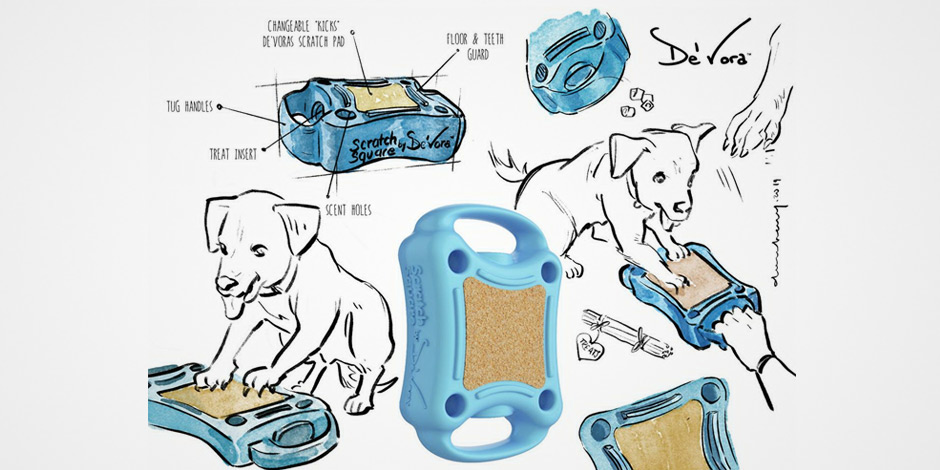
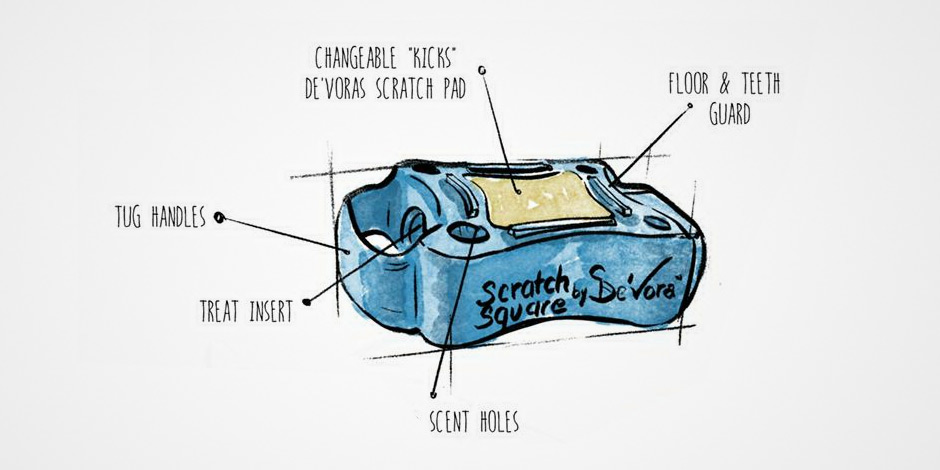
De'Vora brought us Scratch Square, a nail-filing pet toy whose rubber enclosure needed a complex mold. We redesigned the problem areas, solved the inner-core removal with the manufacturer, and got the first batch produced with minimum upfront investment.
Project at a glance
- Client
- De'Vora — pet products company
- Category
- Pet product development
- Starting point
- An early Scratch Square design needing production readiness
- What we delivered
- Design for manufacturing, mold and assembly design, prototype iterations
- Key constraints
- Complex single-piece rubber enclosure, durable abrasive surface, inexpensive production
- Outcome
- Product prepared for manufacturing and now sold at retail
The client
The challenge

Our solution
The result


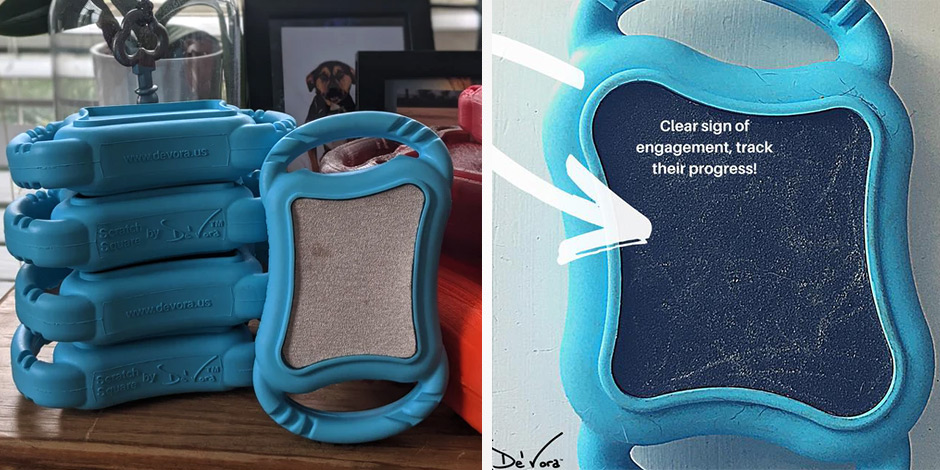
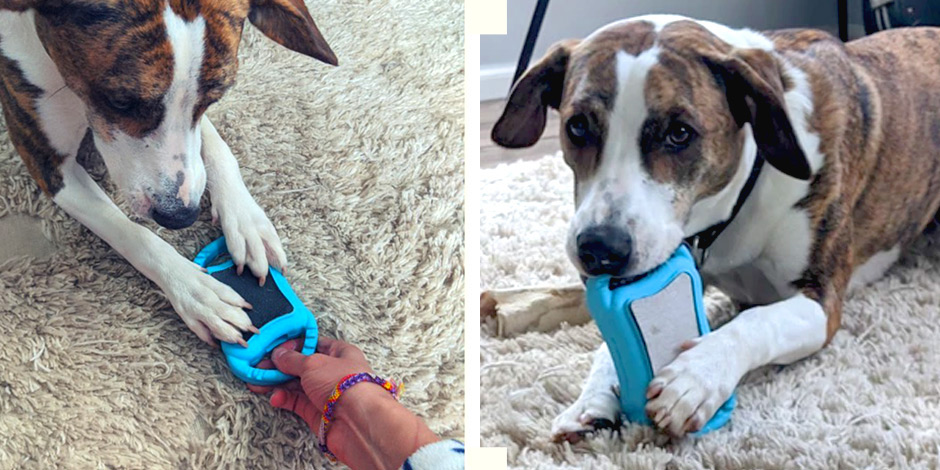
Design for manufacturing and assembly at a glance
| Scope | Part consolidation, tooling review, assembly sequence, cost modeling |
|---|---|
| Levers | Fewer parts, simpler tools, snap fits, fewer secondary operations |
| Deliverables | Revised CAD, DFM report, assembly instructions, cost comparison |
| Typical timeline | 3-8 weeks |
Unit cost is set by decisions, not negotiation
Most teams try to lower cost by re-quoting suppliers. The larger savings are structural: a part that needs a side action, a fastener that adds an assembly station, a finish that requires a second operation. DFMA finds those before tooling locks them in.
What we changed on Scratch Square
We consolidated components, removed geometry that forced tooling complexity, and replaced fasteners with molded features so assembly dropped to a short, repeatable sequence. Wall sections were normalized for consistent molding cycles, and the revised design was documented with a before-and-after cost comparison.
Frequently asked questions
Can you run DFMA on an existing product?
Yes. Redesigning a product already in production is common and often pays back within one order.
How much cost can DFMA remove?
Savings of 15-40% on unit cost are typical when a product has never been reviewed for manufacturability.
Do you work with our existing manufacturer?
Yes. We review their feedback, quote impact and tooling constraints directly with them.
Capabilities used on this project
Design for manufacturing
Molding-ready geometry, tolerances, production drawings, assembly documentation and DFM review with the tooling vendor.
How DFMA cuts cost out of a molded product
1. Map where the mold complexity comes from
Scratch Square's rubber enclosure had a shape that would normally mean multiple parts or a complex tool. Naming the expensive features is the first step to removing them.
2. Fix the problems on the screen, not the steel
Once the initial mold design existed, the areas that would cause manufacturing trouble were identified and modified — before any tooling was cut, when changes are still cheap.
3. Solve demolding explicitly
The hardest feature was extracting the inner core forming the main cavity, with side handles blocking access. Our engineers worked directly with the manufacturer on a creative removal process instead of accepting a costlier tool.
4. Consolidate parts and assembly steps
Every part that merges with another removes a mold, a handling step and a failure point. The DFMA pass simplified both the tool and the build sequence.
5. Prove it with a first batch
The simplified molds produced Scratch Square's first run at minimum upfront investment — the design pass paying for itself in tooling cost avoided.
| Lever | Effect |
|---|---|
| Fewer parts | Fewer molds, less handling, fewer failure points |
| Simpler tool actions | Lower tool cost, faster cycle, less maintenance |
| Designed-in demolding | No stuck parts, no manual prying, no scrap |
| Fewer assembly steps | Lower labour cost and more consistent quality |
Questions about this project
Straight answers from the engineers who ran the build. Have a different question? Ask us directly.
Talk to an engineerWhat is the difference between DFM and DFMA?
DFM optimizes each part for its manufacturing process; DFMA adds the assembly view — part consolidation, fastening method and build sequence. The biggest savings usually come from the assembly side, which is why we run both together.
My product needs a complex mold. Can that be fixed?
Usually. Complex tools come from specific features — undercuts, blocked access, deep cores. Redesigning those features, as we did with Scratch Square's inner core and side handles, typically simplifies the tool without changing what the product does.
When in my project should DFMA happen?
Before tooling is cut, always — and ideally before the design is considered final. Changes on screen cost hours; the same changes in a finished mold cost thousands and weeks.