Written by Konstantin Dolgan, Ph.D., NPDP
Founder & CEO, Product Development Engineer
Published August 10, 2026
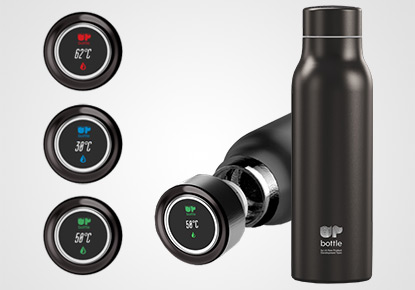
Product concept design turns a vague want into a defined feature set. The UP bottle started as a water bottle with our signature style, and concept development turned it into a smart lid that tells you what is in your bottle and how hot it is.
This is LA NPDT's in-house project: three sensors built into an insulated lid, read by turning the bottle upside down for a few seconds, plus a silicone rubber base pad for grip and quiet placement.
Project at a glance
- Client
- LA NPDT in-house UP product line
- Industry
- Smart consumer products
- Starting point
- Keeping our own team hydrated without buying off-the-shelf mugs
- What we delivered
- Product concept design, smart lid with sensors, LED display and LCD touch screen, working prototypes
- Key features
- Water-purity and temperature sensing, stainless vacuum-insulated double walls, silicone base pad, batteries lasting up to three years
- Outcome
- An in-house smart bottle developed to a sellable concept
The client
The challenge
Our solution
- two sensors determine Total Dissolved Solids (TDS), i.e. liquid’s purity in PPM (parts per million)
- and the T ̊ sensor measures content’s temperature
The result


Product concept design at a glance
| Scope | Research, sketch concepts, form development, CAD, renderings |
|---|---|
| Output | Three to five directions narrowed to one refined concept |
| Deliverables | Concept boards, renderings, basic CAD, feasibility notes |
| Typical timeline | 3-8 weeks |
Concept work is where money is saved
Decisions made in the first three weeks set most of a product's eventual cost. Concept design exists to explore those options cheaply — on paper and in renderings — instead of discovering them after tooling. For the UP Bottle that meant testing forms against how it is carried, filled, cleaned and molded before any engineering began.
How the concept developed
We generated distinct directions rather than variations of one idea, evaluated each against ergonomics and molding feasibility, and refined the surviving concept into CAD and photoreal renderings the client could use for feedback, investor conversations and manufacturer discussions.
Frequently asked questions
What do we get from a concept phase?
Sketch directions, a refined concept, renderings and an honest read on manufacturability and rough cost.
Can we stop after concept design?
Yes. The deliverables are yours and can go to any engineering firm; most clients continue with us because context carries forward.
How much does product concept design cost?
Typically $3,000 to $15,000 depending on the number of directions and rendering quality.
Capabilities used on this project
Concept design
Sketch exploration, form studies and CAD concepts that turn an idea into a buildable direction.
The concept design playbook
Start with the real annoyance
Our team drinks water at desks all day and forgets to refill. The bottle began as a reminder problem, not a styling exercise — which is why the features it grew were useful ones.
Let the concept phase change the brief
We set out to make a regular bottle with our style. Concept development surfaced the fact that water tastes different from different sources, and that tea and coffee drinkers want to know their drink is still hot. The brief expanded because the thinking did.
Sensors where they belong
All three sensors live in the insulated lid, not the body. The user turns the bottle upside down for a few seconds so liquid touches the sensors — a simple interaction instead of a complicated one.
Small details make the product
A silicone rubber pad on the base kills the loud clack when the bottle hits a desk and adds grip. Concept design is where those details get invented rather than bolted on later.
| Insight | Feature it produced | Where it lives |
|---|---|---|
| We forget to drink enough | Intake awareness through the smart lid | Insulated lid |
| Water quality varies by source | Sensing built into the lid | Insulated lid |
| Hot drinks, hot climate | Temperature readout | Insulated lid |
| Bottles are loud and slippery | Silicone rubber base pad | Bottle base |
Questions about this project
Straight answers from the engineers who ran the build. Have a different question? Ask us directly.
Talk to an engineerWhat does product concept design cost?
Concept design for a consumer product typically runs $3,000 to $12,000, covering research, ideation, sketch development, CAD concepts, and renderings before engineering begins.
What is the difference between concept design and engineering?
Concept design decides what the product should be and do; engineering makes it manufacturable. The UP bottle's smart lid was a concept-phase decision, not an engineering one.
Should the concept phase be allowed to change the brief?
That is its purpose. The UP bottle went from a plain bottle to a sensing smart lid because concept work uncovered needs the original brief never named.
How long does concept design take?
Two to six weeks for a product of this class, ending with defined features, concept CAD, and renderings ready for engineering.
Why put the electronics in the lid instead of the bottle?
Because it keeps the vessel washable and simple to manufacture. Concentrating the sensors, display and batteries in the insulated lid also puts them where liquid can reach them on demand — a turn of the bottle is the whole user interaction.
Industries this project belongs to
See how we approach development in each of these categories, and the other products we have taken from sketch to production there.