Product Development Design Concepts – 6 Ideas
Through conceptual design, you can tell good design concepts are vital. Find out here the six ideas for product development design concepts.
September 7, 20237 min read

Written by Konstantin Dolgan, Ph.D., NPDP
Founder & CEO, Product Development Engineer
Published September 7, 2023Updated September 2, 2026
A good design always begins with a good design concept. If you’re trying to solve a problem, then only your concept will give you the right direction for your decisions. So how do you form a concept?
What questions do you need to ask yourself in order to develop one? How can you make your concept the road map for your design?
Continue reading and discover six easy ideas for product development design concepts because it is very important for the conceptual design phase and process for new products.
Industrial Design
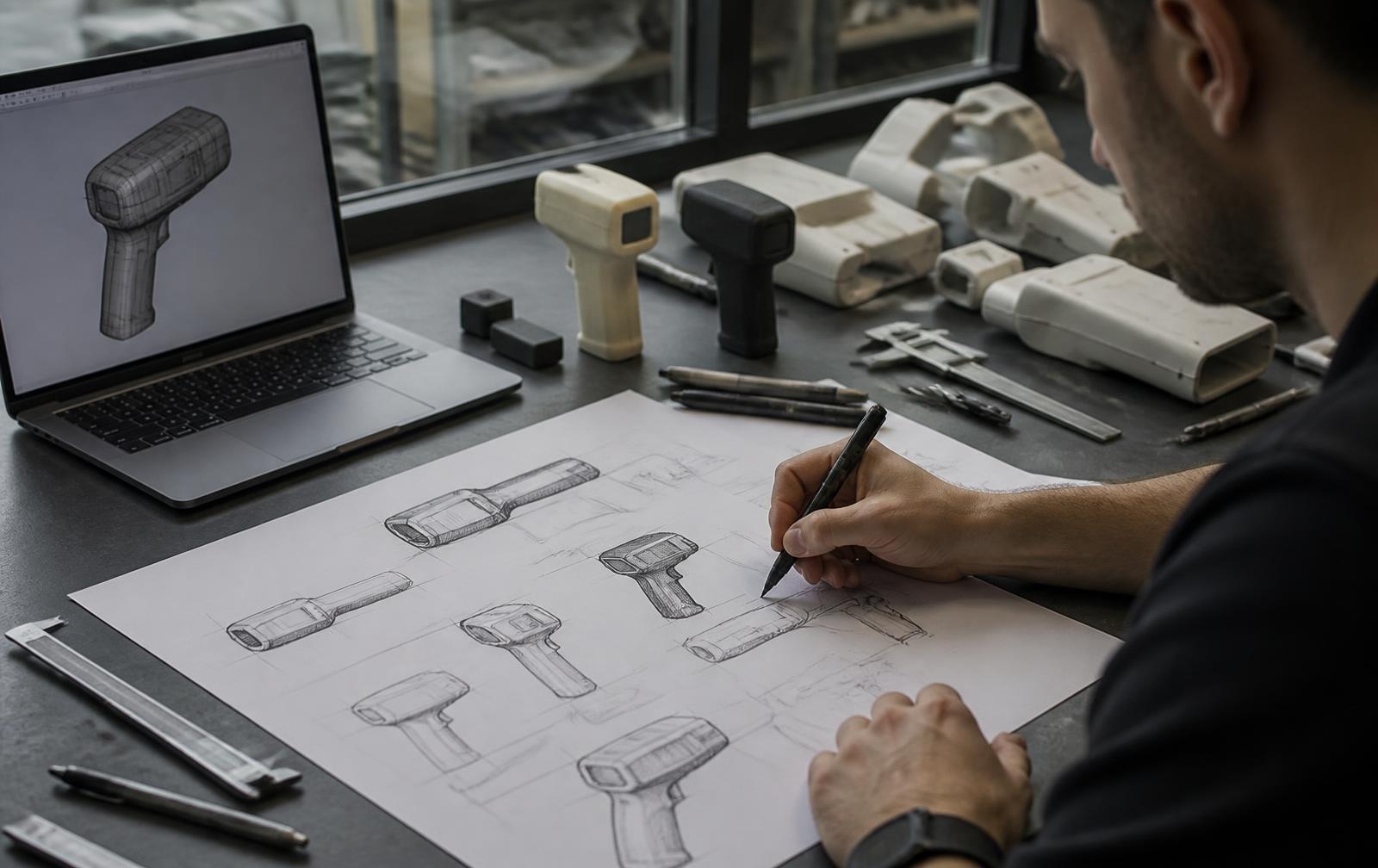
If you are wondering where to start, then here is the first step. Industrial design is the first step for product development design concepts. It includes the conceptual designs for tools, goods, transportation, and other things you come across daily.
You must make sure that you use industrial designs that are efficient, cost-effective, and reliable. You must avoid using complex and difficult designs at all costs because the industrial design is the starting point for any new product. May it be as simple as a salt shaker or as complex as a spaceship. If your industrial design is flawed, anything you build on it will be useless.
Graphic Design
Here is the next step. Graphic design refers to projections in 2D which are produced for commercial uses. The most common types of graphic designs are books & CD covers, billboards, newspapers, magazines, and other fine prints.
Graphic design can be used in different phases, including the conceptual design phase, and it comes in many forms. Some of the most used forms are screening, lithography, public service signs, and typography. Graphic designing is vital because it creates the outlook of your new product.
As industrial design incorporates convenience, graphic design combines legibility with amazing and engaging visual presentation.
Interior design is a field of architecture which focuses on spaces in a home. It also focuses on how humans interact with these spaces. A skilled interior designer can transform an ordinary space into something attractive and unique.
How and what to use to fill an empty space is the most crucial skill for any interior design. It involves floor covering, wall finishing, plants, artwork, and lighting. Make sure you address every need, especially in the conceptual design phase, when designing the interior of your building.
Some old houses can be decorated and restored to their original vintage look. While some others make use of more modern, sleek designs which are trending. Make sure that you choose an interior design that fits perfectly with your new product launch.
Fashion Design
Now comes the turn for the next step. Fashion is often defined as a style personified. It is also used to make a personal statement. That is how you express yourself. When launching a new product, the fashion design can be your chosen branding image. Select vibrant colours and textures when designing your product brand. It should reflect what your brand is all about.
Effective designs portray trust, quality, and class.
User Experience
The next step is the user experience. This is where your customers meet with your product. You should always hire a professional who can make this easy and enjoyable.
This is where the UX designers come to play. User experience designers focus on people’s emotions and reactions. They are responsible for the accessibility, credibility, value, and usefulness of your product development design concepts.
User experience can best be maximized when first reviewed in the conceptual design phase before implementation.
Film & Video (Multimedia) Design
If you are looking for better engagement with your audience, make sure to include giving them something attractive and helpful in the conceptual phase. Multimedia, such as videos and images, can help you engage more visitors. Therefore, always hire a multimedia expert for your new product launch. Film and videos are excellent choices for creating awareness.
They not only add a lot of value to your content. But also they can include rich infographics, how-to videos, and images that will add a touch of class to your business.
Conclusion
Some simple design concepts above can get you thinking about your next design project or your conceptual design review. Every concept is unique, and the same concept is unsuitable for every project. How you use them is entirely up to you. Always design with a purpose in mind, and have fun! Always remember to try new ideas because new is always better!
Product Development Design Concept Ideas
Concept Type | Primary Focus | Application Examples |
|---|---|---|
Industrial Design | Efficiency, Cost-Effectiveness, Reliability | Tools, Goods, Transportation |
Graphic Design | Legibility, Engaging Visual Presentation | Books, CD Covers, Billboards |
Interior Design | Human Interaction with Spaces | Floor Covering, Wall Finishing, Lighting |
Fashion Design | Branding Image, Personal Statement | Vibrant Colors, Textures for Brand |
User Experience | Accessibility, Credibility, Usefulness | Customer Interaction with Product |
Film & Video Design | Audience Engagement, Awareness | Infographics, How-to Videos, Images |
Frequently asked questions
What is industrial design in product development?
Industrial design is the first step for product development design concepts. It involves conceptual designs for tools, goods, and transportation. These designs should be efficient, cost-effective, and reliable. Complex or difficult designs should be avoided. A flawed industrial design can make subsequent efforts useless for any new product, from a salt shaker to a spaceship.
How does graphic design apply to product development?
Graphic design involves 2D projections produced for commercial uses. Common types include books, CD covers, and billboards. It can be used in different phases, including the conceptual design phase. Forms like screening, lithography, and typography are often used. Graphic design combines legibility with visual presentation to create a new product's outlook.
What is the role of user experience (UX) in product design?
User experience (UX) describes how customers interact with a product. UX designers focus on people’s emotions and reactions. They are responsible for a product's accessibility, credibility, value, and usefulness. Maximizing user experience is best achieved when reviewed in the conceptual design phase, before implementation. This step aims to make the interaction easy and enjoyable.
How can multimedia design engage an audience for a new product?
Film and video (multimedia) design can help engage visitors and create awareness for a new product. Including multimedia, such as videos and images, in the conceptual phase can add value to content. Multimedia can feature rich infographics and how-to videos. A multimedia expert can be hired for a new product launch to enhance audience engagement.
Why is a good design concept important for product development?
A good design concept provides direction for decisions when solving a problem. It acts as a roadmap for the entire design process. This conceptual design phase is very important for new products. Each concept is unique, and the same concept is not suitable for every project. Designing with a purpose in mind is essential.
Sources and standards
- USPTO — patent basics — Official guidance on provisional and non-provisional filings for new products.
- NIST Manufacturing Extension Partnership — Federal program supporting US small and mid-size manufacturers.
- ISO 9001 quality management — The quality-system standard most contract manufacturers are audited against.
How design concepts change in aerospace product design and development
Aerospace product design and development applies the same design disciplines as consumer work, but under constraints that reorder every priority. Weight, traceability and qualification cost dominate, and a concept that ignores them will not survive first review no matter how well it is resolved visually.
Constraint comparison
Dimension | Consumer product | Aerospace product |
|---|---|---|
Primary cost driver | Unit cost at volume | Qualification and certification |
Volume | Thousands to millions | Tens to thousands |
Material selection | Cost and appearance | Certified stock with full traceability |
Change control | Fast revisions | Formal configuration management |
Documentation | Moderate | Extensive and auditable |
Supplier base | Broad | Approved suppliers with special processes |
Development timeline | Months | Years |
The practical consequence is that concept exploration must include the certification path. Choosing a material or a joining method without confirming an approved process exists creates rework that no amount of design quality can offset later.
Aerospace concept checklist
- Confirm certified material availability before locking geometry.
- Verify approved special processes exist for coatings and welding.
- Budget qualification testing alongside development.
- Establish configuration management from the first release.
- Plan for full material and process traceability records.
Key takeaways
- Certification cost, not unit cost, dominates aerospace programs.
- Check certified material and approved process availability during concept.
- Configuration management starts at first release, not at production.
Developing a product for a regulated or aerospace application?
Screening Product Design Concepts Before Anyone Spends Engineering Hours
Generating concepts is the cheap half of the work. The expensive half is deciding which two or three deserve engineering time, because every concept carried forward multiplies tooling studies, supplier conversations, and test builds. A structured screen replaces the loudest-voice-in-the-room default with criteria the whole team agreed on before anyone fell in love with a sketch.
Divergence Rules That Produce Genuinely Different Concepts
Most concept sets fail because the variants differ cosmetically while sharing one architecture. Force real divergence by assigning each concept a different constraint to optimize: lowest part count, lowest tooling investment, best user ergonomics, fastest time to first shipment.
When four concepts each win on a different axis, the screening conversation becomes a trade discussion instead of a taste debate, and the eventual selection is defensible to an investor or a board.
What a Concept Package Should Contain
- A control sketch or CAD block model showing overall proportions and interfaces.
- A one-page architecture note: major subassemblies, materials, and joining methods.
- A rough bill of materials with count of unique parts and count of tooled parts.
- The single riskiest assumption, written as a testable statement.
- A named test that would prove or kill that assumption for under a few thousand dollars.
From Concept to Engineering Handoff
The handoff is where good concepts get quietly redesigned. Prevent that by freezing three things in writing: the critical dimensions the user touches, the performance targets with tolerances, and the cost ceiling per unit. Everything else is fair game for engineering to change.
Teams that skip this freeze usually discover late that the shape they validated with customers no longer exists in the production design, and the market feedback they collected no longer applies to the product they are about to tool.
A practical cadence is two weeks of divergence, one week of screening with the table above, then a two-week build of the top concept as a rough works-like model. That five-week loop is faster than most teams expect and removes far more risk than another month of refining renderings.
Filed under:Inspiration
Services related to this guide
- Product design servicesIndustrial design and CAD taken all the way to manufacturable files.
- Best industrial design firmsWhich studios take an idea from form to manufacturable hardware, and what they charge.
- Prototype designLooks-like, works-like or pre-production: what each proves and what it costs.
- Product development examplesReal projects we designed, prototyped and shipped.