Packaging Design Process: Steps, Materials and Costs
The packaging design process step by step - structure, materials, transit testing and graphics - plus what each stage costs.
June 23, 20165 min read

Written by Konstantin Dolgan, Ph.D., NPDP
Founder & CEO, Product Development Engineer
Published June 23, 2016Updated September 2, 2026
Packaging is the only part of your product every customer touches before they decide to keep it. It also has to survive a supply chain that will drop it, stack it and leave it in a hot trailer. Good packaging design solves both jobs at once - structure first, graphics second - and it starts before the product design is frozen, not after.
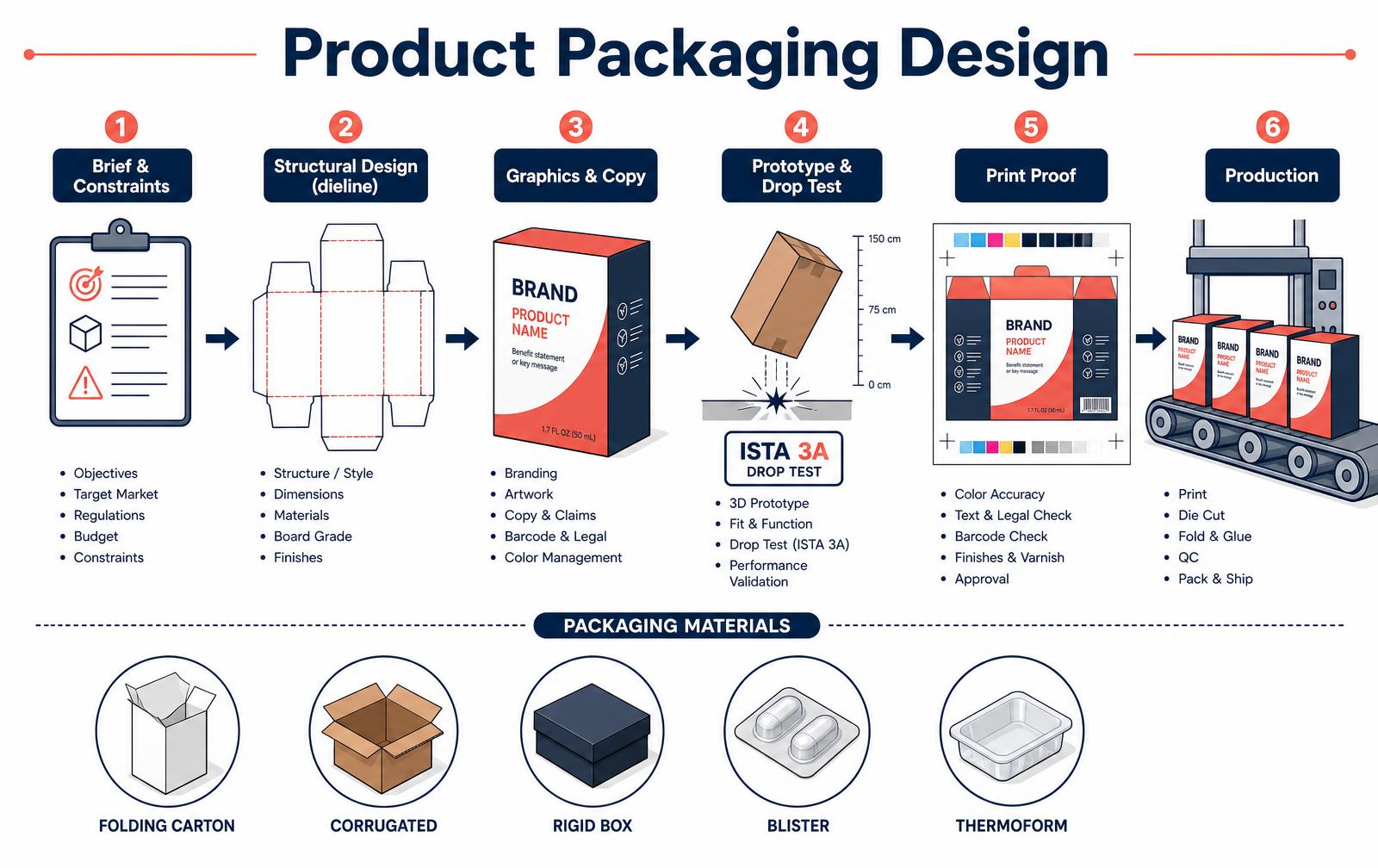
The six steps
- Brief and constraints - channel (retail shelf, e-commerce, both), product weight and fragility, regulatory marks, sustainability goals, budget per unit and target volume.
- Structural design - the dieline: box style, dimensions, board grade, inserts and closure. This decides material cost and whether the pack survives shipping.
- Graphics and copy - branding, hierarchy on the shelf face, claims, barcode placement, legal panel, and colour management to a defined spec.
- Prototype and drop test - printed mock-ups plus real transit testing, typically ISTA 3A for parcel shipping or ISTA 1A for a simple sanity check.
- Print proof - hard proof or press check for colour accuracy, varnish and foil effects, barcode scannability and text corrections.
- Production - print, die cut, fold and glue, QC, and pack-out at the assembly line.
Choosing a material
Material | Best for | Typical unit cost | Notes |
|---|---|---|---|
Folding carton (SBS/CCNB) | Retail products under 2 lb | $0.25-$1.20 | Best print quality per dollar; needs an insert for fragile goods |
Corrugated (E/B flute) | E-commerce, heavier products | $0.60-$3.00 | Strong, ships well; litho-laminate for premium print |
Rigid box | Premium, gift and electronics | $2.50-$12.00 | High perceived value, long lead time, high tooling |
Blister / clamshell | Small hardware, hanging retail | $0.20-$0.90 | Cheap and secure; poor sustainability perception |
Moulded pulp or foam insert | Protection layer | $0.30-$2.50 | Pulp for eco positioning, EPE/EPS for shock |
What the design work costs
Scope | Cost | Timeline |
|---|---|---|
Graphics only, supplied dieline | $1,500-$5,000 | 2-3 weeks |
Structural + graphics, one SKU | $5,000-$15,000 | 4-8 weeks |
Full system: multi-SKU family, inserts, transit testing | $15,000-$45,000 | 8-14 weeks |
Transit testing (ISTA 3A, third-party lab) | $1,200-$4,000 | 1-2 weeks |
Print tooling: dies, plates, foil | $500-$4,000 | 1-3 weeks |
Design rules that prevent expensive reprints
- Set up artwork in CMYK with named spot colours, at 300 dpi, with 3 mm bleed and a documented keyline layer.
- Keep critical text and logos 5 mm clear of folds, glue flaps and creases.
- Verify barcode magnification and quiet zone, and print a test scan before the press run - failed scans mean rejected retail deliveries.
- Design the pack around a standard board size and pallet footprint; a 5 mm dimension change can cut cases per pallet by 10%.
- Check the unboxing sequence physically. The order in which parts appear is a design decision, not an accident.
- Prototype in the real board grade. Paper mock-ups hide the stiffness and crease behaviour that decide whether the pack feels cheap.
E-commerce vs retail
Retail packaging optimises for shelf impact: face graphics, hang tabs, planogram dimensions, and anti-theft considerations. E-commerce packaging optimises for damage-free arrival and a good unboxing: frustration-free opening, right-sized boxes to avoid dimensional weight charges, and enough protection to pass a parcel drop profile. If you sell both, design a primary pack that survives shipping inside a plain shipper rather than two separate systems.
Packaging that survives the trip
Packaging has two jobs and they pull in opposite directions: sell the product on the shelf or in the unboxing video, and deliver it undamaged through a distribution channel that treats every box as a projectile. The channel decides the requirement. Retail shipments travel palletized and see compression; e-commerce parcels travel alone and see drops, and a design that passes retail testing routinely fails as a standalone parcel.
Test | Standard | What it simulates | Typical requirement |
|---|---|---|---|
Drop sequence | ISTA 3A / ASTM D5276 | Parcel handling | 10 drops, height by weight class |
Compression | ASTM D642 | Pallet stacking in a warehouse | Stack height x 3 safety factor |
Vibration | ASTM D999 | Truck and rail transport | 1–3 hours random vibration |
Climatic conditioning | ISTA preconditioning | Humidity in transit and storage | Corrugate loses ~30% strength when damp |
Incline / impact | ASTM D880 | Rail car coupling, rough handling | Horizontal impact at set velocity |
Materials and cost per unit
- Corrugated board (E, B, BC flute): $0.35–$1.80 per box; E-flute prints well and suits retail, BC protects heavier goods.
- Folding carton (SBS): $0.15–$0.90; best print quality, minimal protection, needs an inner structure.
- Molded pulp inserts: $0.30–$1.50; recyclable, tooling $2k–$8k, tolerances loose so allow generous clearances.
- Die-cut foam (EPE, PE): $0.60–$4.00; strong protection, poor recyclability perception in consumer channels.
- Thermoformed PET tray: $0.25–$1.20; crisp presentation, tooling $1.5k–$6k.
- Printing setup: $400–$3,000 per SKU for plates; a design that fits fewer colors saves real money at low volume.
Regulatory and retail requirements to check early
Packaging carries obligations that arrive late and cost weeks. Country-of-origin marking, recycling symbology, extended producer responsibility registration in the EU and several US states, UPC/GTIN assignment, and retailer-specific pack specs all constrain artwork and structure.
Amazon's Ships-in-Own-Container certification, for example, changes the drop requirement and can remove the need for an outer carton entirely — but only if the design is built for it from the start.
Structure, graphics and the unboxing sequence are part of the product experience, which is why we develop them alongside industrial design rather than after the design is frozen.
Frequently asked questions
How much does product packaging design cost?
Graphics-only work on a supplied dieline runs $1,500-$5,000. Structural plus graphics design for one SKU is typically $5,000-$15,000, and a multi-SKU system with inserts and transit testing runs $15,000-$45,000.
What is a dieline?
A dieline is the flat, scaled template of the package showing cut lines, crease and fold lines, glue areas and bleed. Graphics are laid out on it so the printer can cut and fold accurately.
When should packaging design start?
Start structural packaging work as soon as the product geometry and weight are stable, usually during detailed design. Waiting until after design freeze forces oversized packs and last-minute tooling costs.
What is Ista 3A Testing?
ISTA 3A is a transit test protocol for individually shipped parcels, combining drops, vibration and atmospheric conditioning. Passing it is the practical standard for e-commerce packaging.
The packaging design process step by step
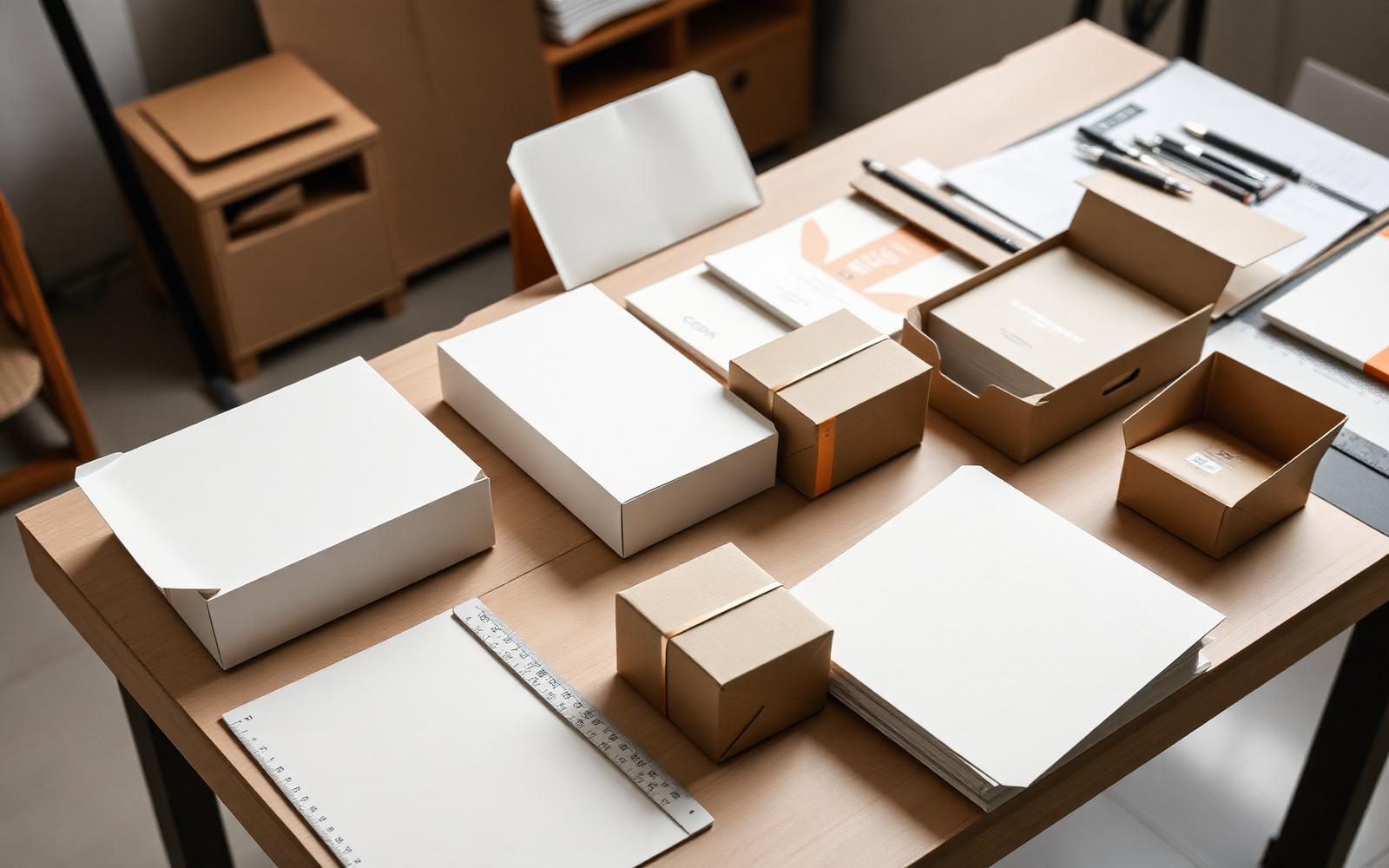
A disciplined packaging design process runs in six steps: brief and constraints, structural concepts, dieline development, physical mockups, transit and retail testing, then print production. The constraint set matters more than the creative brief - carton dimensions are driven by pallet efficiency, retailer shelf depth, and the carrier dimensional-weight formula long before anyone chooses a colour.
Step | Deliverable | Duration | Typical cost |
|---|---|---|---|
Brief and constraints | Dimensional, retail and logistics requirements | 1 week | $1k-$3k |
Structural concepts | 2-4 concept directions in white board | 1-2 weeks | $2k-$6k |
Dieline development | CAD dielines and material spec | 1-2 weeks | $2k-$5k |
Mockups | Digitally printed comps | 1 week | $400-$1.5k |
Transit and retail testing | ISTA report, shelf audit | 2-3 weeks | $2k-$8k |
Print production | Press-ready files, plates, first article | 3-5 weeks | Die $1.5k-$4k plus unit cost |
Choosing the right material and board grade
- SBS folding carton - premium retail face, best print fidelity, poor protection on its own.
- E-flute corrugated - retail-quality print with real crush resistance, the default for direct-to-consumer.
- B and C-flute corrugated - shippers and master cases where stacking strength matters.
- Molded pulp - protective insert with a sustainability story; tooling $3k-$12k and 3-5 week lead time.
- EPE and EPS foam - cheapest protection per unit, increasingly rejected by retailers and EU packaging rules.
- Thermoformed PET - visibility on shelf, but check recycled content requirements in your target markets.
Testing before you commit to a print run
Two tests catch most failures. ISTA 3A simulates parcel handling with drops, vibration, and atmospheric conditioning - run it with the actual product inside, not a weighted dummy. A shelf audit puts a printed comp on the real fixture at the real distance: type that reads perfectly on a monitor often disappears at three feet under retail lighting. Both cost far less than a rerun of 30,000 cartons.
- Key takeaway 1: Logistics constraints define the box before design begins.
- Key takeaway 2: Board grade is a protection decision first and a print decision second.
- Key takeaway 3: ISTA testing with the real product prevents damage claims that dwarf the test fee.
- Key takeaway 4: Audit a printed comp on a real shelf before releasing plates.
We design structure and graphics together, prototype in real board and validate with transit testing before you commit to print tooling.
Where packaging design decisions get expensive
Packaging is usually specified last and paid for forever. Every millimetre of secondary carton drives pallet count, container fill and freight per unit, and every unplanned finish adds a print pass.
Lock the primary pack geometry the moment the product enclosure freezes, then work outward: primary, secondary, shipper, pallet pattern. Teams that reverse that order discover at launch that the shipper wastes 18 percent of the container and that the drop test fails at the corner the artwork team wanted rounded.
- Pallet-first sizing. Fit the shipper to a standard 48x40 pallet footprint before approving the carton.
- Drop and vibration early. ISTA 3A on a real pack beats a spreadsheet estimate of transit damage.
- Print passes cost money. Every spot colour and varnish adds setup; consolidate before artwork sign-off.
- Unboxing without waste. Moulded pulp and single-material films protect brand and recyclability at once.
- Label real estate. Reserve space for regulatory marks now, not after certification.
Work with LA NPDT: if you are moving from here to execution, start with our product design services or talk to us about concept design services.
Filed under:Education
Tagged:BossierInnovationLouisianaNew Product DevelopmentProduct DesignProduct DevelopmentProduct LaunchPrototypingShreveport
Services related to this guide
- Product design servicesIndustrial design and CAD taken all the way to manufacturable files.
- Rapid prototypingWorking prototypes in days, from 3D printing to vacuum casting.
- Electronic design servicesSchematic, PCB layout, firmware and bring-up, through to production handoff.
- Product development examplesReal projects we designed, prototyped and shipped.