Outsourcing Product Development: Models, Costs and Risks
Outsourcing product development - partner types, contract models, IP and tooling ownership, and the handoffs where projects usually break.
September 7, 20175 min read

Written by Konstantin Dolgan, Ph.D., NPDP
Founder & CEO, Product Development Engineer
Published September 7, 2017Updated September 2, 2026
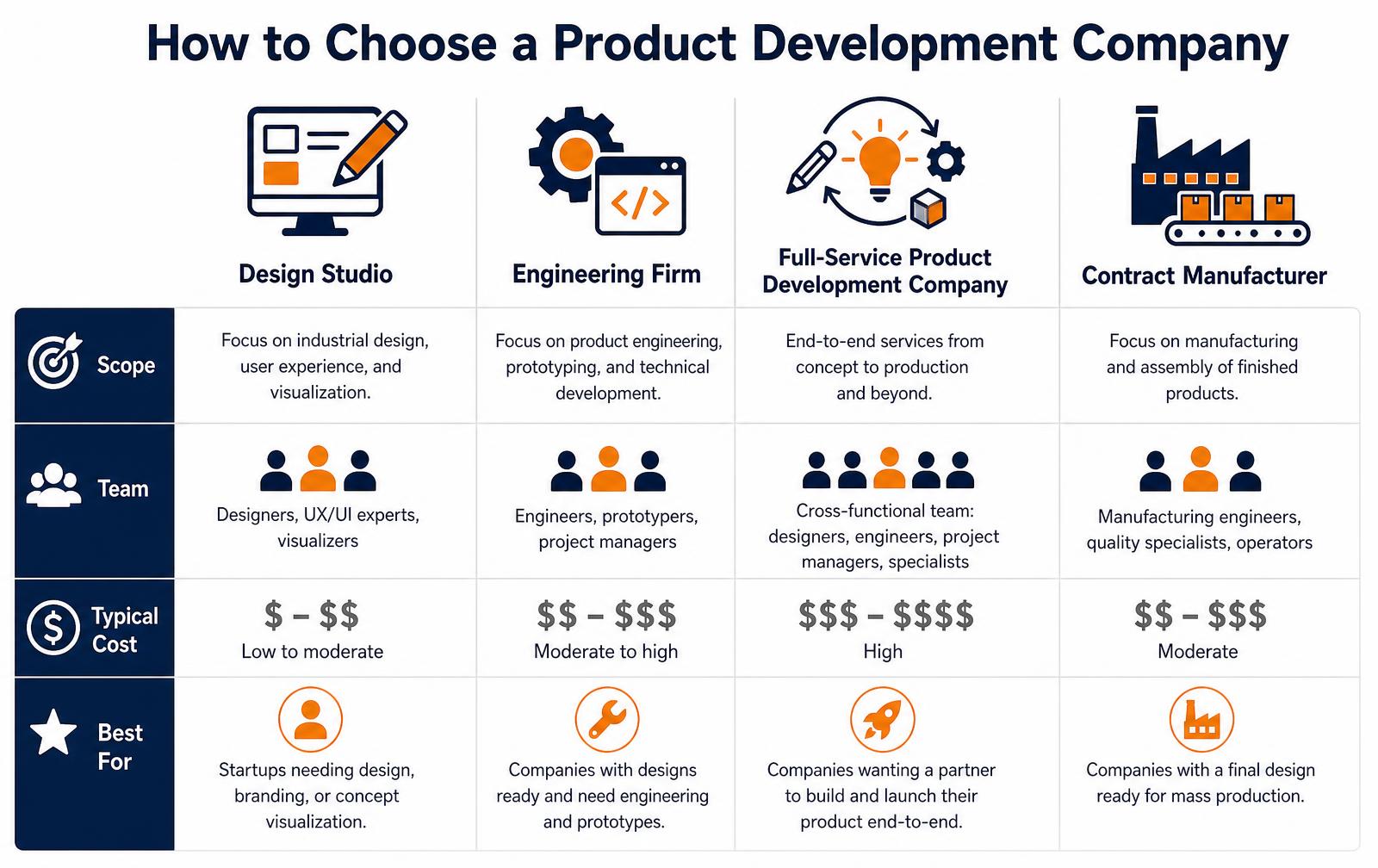
Most founders shop for a product development company before they know which kind they need. A design studio, an engineering firm, a full-service product development company and a contract manufacturer all say they will bring your product to market. They do very different work, at very different prices, and hiring the wrong one costs a year.
The four types compared
Type | What they do | Typical program cost | Best for |
|---|---|---|---|
Design studio | Research, industrial design, CMF, brand and renderings | $15k-$60k | A concept that needs form and identity |
Engineering firm | Mechanical and electrical design, firmware, prototypes, DFM | $40k-$200k | A validated concept that needs to work |
Full-service partner | Discovery through design, engineering, testing and production launch | $80k-$400k | Small teams that need one accountable owner |
Contract manufacturer | Sourcing, tooling and volume production | NRE $15k-$80k + unit price | A finished, documented design |
What a full program actually contains
- Discovery. Requirements, users, competitive teardown, target cost and a spec you can hold someone to.
- Industrial design. Concepts, ergonomics, CMF and a form the factory can actually make.
- Engineering. Mechanical, electrical and firmware development with tolerance and thermal analysis.
- Prototyping. Looks-like, works-like and finally looks-like-works-like builds used to kill risk early.
- Validation. Design verification, regulatory and safety testing, reliability and life-cycle runs.
- Production launch. DFM, tooling, golden samples, pilot run and process documentation.
Engagement models
Model | How it prices | Risk sits with | Use it when |
|---|---|---|---|
Time and materials | Hourly or monthly rate | You | Scope is still moving |
Fixed-fee phase | Priced per deliverable | The firm | Scope for that phase is clear |
Retainer | Monthly capacity | Shared | Ongoing roadmap work |
Fee plus royalty | Reduced fee, per-unit share | Shared | Cash-constrained launches |
How to vet a product development company
- Ask for products they took to production, not renders. Renders are cheap.
- Ask who does the work - the principal who pitched you, or a junior after signature.
- Ask for a phase plan with named deliverables, review gates and exit points.
- Ask how they handle target cost. A partner that never mentions unit economics will hand you an unmanufacturable design.
- Confirm IP assignment, tooling ownership and file handover in the contract, not in email.
Related reading: design for manufacturing principles, contract manufacturing models and our product discovery service.
Frequently asked questions
What do product development companies do?
They take a product from concept to manufacturable reality - research and requirements, industrial design, mechanical and electrical engineering, prototyping, validation testing, and the DFM and tooling work needed to launch production.
How much does a product development company cost?
A design-only engagement runs roughly $15,000-$60,000. A full concept-to-production program for a consumer electromechanical product typically lands between $80,000 and $400,000, plus tooling.
How long does a product development program take?
Nine to eighteen months from discovery to first production run is typical. Simple mechanical products can compress to six months; regulated or connected products routinely take two years.
Comparing product development companies?
Send us your concept and we will scope the phases, deliverables and budget.
Outsourcing product development versus building a team
Outsourcing product development makes sense when the work is bounded, the skills are broad, and the need is temporary. A single physical product typically requires industrial design, mechanical engineering, electrical engineering, firmware, design for manufacturability, regulatory guidance and supplier qualification. Hiring that spread costs seven figures a year and leaves you overstaffed the day the product ships.
Factor | In-house team | Development firm | Freelance network |
|---|---|---|---|
Time to productive work | 3-6 months hiring | 2-4 weeks | 1-2 weeks |
Annual cost for full coverage | $700k-$1.4M | Project fee, $80k-$500k | Hourly, high variance |
Breadth of disciplines | Whatever you hired | Full stack under one roof | You integrate the gaps |
Institutional knowledge retained | High | Medium, with good documentation | Low |
Manufacturing relationships | Must be built | Existing supplier network | Rare |
Best fit | Continuous roadmap, 3+ products | One to three products, hard deadline | Narrow, well-specified tasks |
Engagement models and what each one really costs
The commercial structure shapes behaviour more than the hourly rate. Fixed-fee work pushes a firm to protect scope; time and materials pushes you to manage it. Choose the model that matches how well the requirements are understood.
Model | Best when | Typical structure | Main risk |
|---|---|---|---|
Fixed-fee per phase | Scope is clear and documented | Milestone payments, defined deliverables | Change orders on every deviation |
Time and materials | Discovery or research-heavy work | Monthly invoicing against a cap | Budget drift without a cap |
Dedicated team retainer | 6+ months of continuous work | Monthly fee per allocated engineer | Paying for idle capacity |
Equity or royalty hybrid | Funding is tight, upside is real | Reduced fee plus 1-5% royalty | Long-term cost far exceeds cash fee |
What each phase should cost
Ranges below reflect North American firms working on a consumer or light industrial product of moderate complexity. Use them to sanity-check a proposal, not as a quote.
Phase | Typical duration | Cost range | Primary deliverable |
|---|---|---|---|
Discovery and requirements | 2-4 weeks | $8k-$25k | Product requirements document |
Industrial design | 3-6 weeks | $12k-$45k | Concepts, CMF, appearance model |
Mechanical engineering | 6-14 weeks | $30k-$120k | Parametric CAD, tolerance stack, DFM |
Electronics and firmware | 8-20 weeks | $45k-$200k | Schematic, layout, working firmware |
Prototyping and testing | 4-10 weeks | $15k-$80k | Functional units, test report |
Manufacturing transfer | 4-8 weeks | $10k-$50k | Released drawing package, supplier quotes |
Deliverables to demand in writing
The difference between a firm that hands you a product and one that hands you a dependency is the completeness of the release package. Specify it in the statement of work before the first invoice.
- Native CAD files, not just STEP exports — a STEP file cannot be edited parametrically by your next engineer.
- Fully dimensioned 2D drawings with GD&T for every custom part, at the revision that was actually built.
- Schematic and PCB layout in editable source format, plus the complete bill of materials with approved alternates.
- Firmware source, build instructions and the toolchain version that produces a working binary.
- Tolerance stack-up analysis and any FEA or thermal simulation reports behind the design decisions.
- Test procedures and the raw data from validation builds, not a summary slide.
- A supplier list with contacts, quoted prices, tooling status and who owns each tool.
Red flags in a proposal
Red flag | Why it matters | What to ask instead |
|---|---|---|
No named engineers on the project | Work may be subcontracted offshore | Who specifically will do the CAD? |
Fixed fee with no scope document | Every change becomes a change order | What exactly is excluded? |
Silence on IP ownership | Background IP claims can trap you | Send the assignment clause before we sign |
No manufacturing references | Design that cannot be built | Name three products you took to production |
Prototype-only endpoint | The hard 30% is after the prototype | What does manufacturing transfer include? |
Rate far below market | Junior staff or hidden change orders | What is the blended rate and seniority mix? |
Intellectual property terms that actually protect you
Assume nothing is yours unless the contract says so.
Three clauses do most of the work: a present-tense assignment of all foreground IP to you on creation, a perpetual royalty-free licence to any background IP the firm embeds in your product, and a warranty that the delivered design does not knowingly infringe a third-party patent.
Add a requirement that invention disclosures are filed with your counsel within 30 days of conception, so a provisional application is never blocked by a missing signature.
Managing the engagement
- Hold a 30-minute weekly review with a written status against milestones — not a monthly deck.
- Require that all files land in your repository or PLM system continuously, never in a handover at the end.
- Approve each phase gate formally; an unapproved phase gate is where budgets quietly double.
- Keep one internal owner with authority to make decisions in the meeting; slow decisions are the most common cause of overrun.
- Budget 15-25% contingency against change orders on any first-of-its-kind product.
Frequently asked questions
How much does outsourcing product development cost end to end?
For a moderately complex connected consumer product taken from concept to a released manufacturing package, budget $150,000-$500,000 with a North American firm. Simple mechanical products can land between $40,000 and $120,000. Regulated medical or industrial products routinely exceed $750,000 once verification and validation testing is included.
Is outsourcing product development cheaper than hiring engineers?
For one to three products it usually is. A full in-house team covering industrial design, mechanical, electrical, firmware and manufacturing engineering costs roughly $700,000 to $1.4 million a year loaded, and takes three to six months to assemble. A firm delivers the same coverage on week two and stops costing money when the project ends.
Who owns the intellectual property when you outsource development?
Only what your contract assigns to you. Default law in many jurisdictions leaves the creator holding rights to work that is not clearly work-for-hire, so the agreement needs a present-tense assignment of all foreground IP plus a perpetual licence to any background IP embedded in your product.
How do I evaluate a product development firm before signing?
Ask for three products they took all the way to production, not concepts. Ask to see a released drawing package they delivered, with the customer's details redacted. Ask which named engineers will work on your project and whether any work is subcontracted. A firm that has genuinely shipped products answers all three quickly.
What should be in the statement of work?
Phase-by-phase deliverables with file formats, explicit exclusions, the review and approval process at each gate, the change-order mechanism and rate, IP assignment, and the complete manufacturing transfer package. Ambiguity in any one of those is where disputes start. Work with LA NPDT: if you are moving from here to execution, start with our product development consulting or talk to us about end-to-end product development .
Filed under:EducationInspiration
Services related to this guide
- Best product development companiesHow the leading US firms compare, and which one fits your stage and budget.
- Best product design companiesDesign studios compared by scope, industry and what they hand off.
- Product engineering companiesEngineering firms for physical products compared by discipline, rigor and budget.
- Consultant vs firm vs freelancerWhat each option costs, what it delivers and where to find them.