
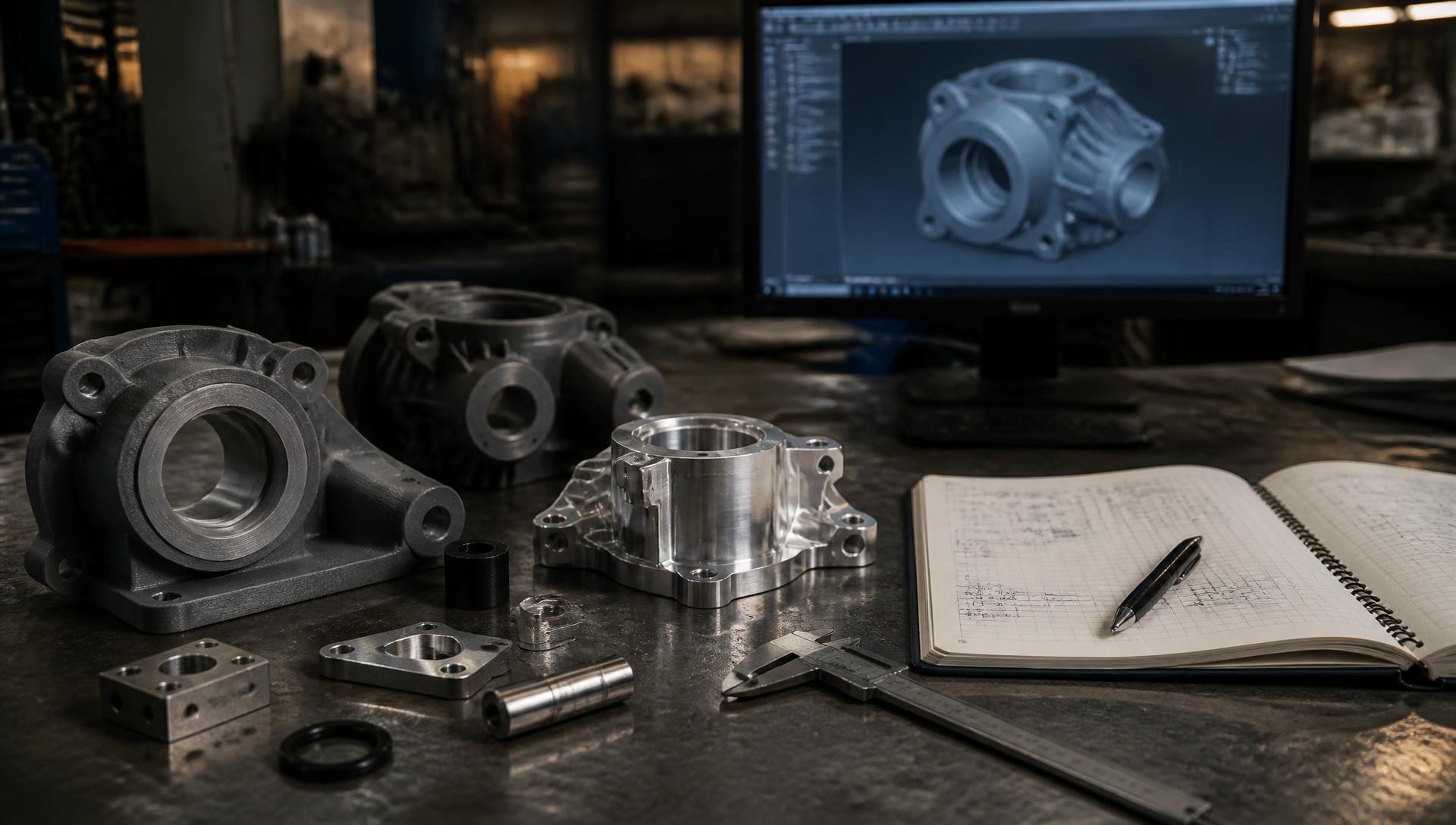
Prototype budgeting
Prototype Cost Calculator — Free Estimate in Under a Minute
Answer five to eight questions about what you are building and get an order-of-magnitude cost range for a first prototype, with the factors that moved the number shown alongside it. Free, instant, no email required to see the result.
Free tool
Prototype cost calculator — a real ballpark in about a minute
A first prototype typically costs $800–$6,000 for an appearance model, $6,000–$60,000 for a functional mechanical build (most land between $12,000 and $30,000), $50,000–$120,000 for a product with custom electronics, and $5,000–$60,000 for a software MVP. This free prototype cost calculator asks five to eight questions about what you are building and returns an order-of-magnitude range inside those bands, based on the cost model our own team uses to scope projects. It is built and maintained by the product development team at LA NPDT, who design, engineer and build physical and connected products for a living.
- A typical range and a full range, based on our own project history
- The specific factors pushing your number up or down
- An honest confidence level — design readiness changes it more than anything else
Question 1 of 6
What are you building?
This sets the baseline. Electronics and software carry very different cost structures from a mechanical part.
Design and engineering are not free, and they come first. Every figure on this page is for a prototype of a product that has already been designed and engineered — unless you tell the calculator the design is unfinished, in which case that work is added to the range. No shop can quote parts from a description alone.
Before the build
Where a prototype sits in the process
A prototype is stage three, not stage one. The two stages before it are what most first-time budgets forget, and they are the reason two people can get very different numbers for the same product.
Stage 1
Product discovery
Is it worth building? Users, market, feasibility
See the service →
Stage 2
Concept design
Sketches, directions, the form settled
See the service →
Stage 3
Engineering & CAD
Parts, materials, drawings, tolerances
See the service →
Stage 4
Prototype build
Parts made, assembled, wired
This calculator prices this stage
See the service →
Stage 5
Test & iterate
It fails, you learn, version two
Stage 6
Production
Tooling, suppliers, first run
See the service →
A prototype cannot be built from an idea. Somebody has to design it and engineer it first, and on a first prototype that work is routinely 40–60% of the total spend. The calculator includes design and engineering when you tell it the design is not finished, and leaves it out when you already have production-ready CAD — which is why the same product can return two very different numbers. See the full product development process.
Price a different stage
- Concept design costWhat sketches, directions and a chosen concept cost on their own.
- Product design costDesign and engineering through production-ready CAD, before anything is built.
- Product development costThe whole program — idea through first production run.
- Industrial design costForm, ergonomics, CMF and surfaced CAD, priced as a service.
Published figures
What a prototype costs, by build type
These are the bands the calculator works from. They come from our own completed projects rather than an industry survey, so they reflect US-based design, engineering and fabrication at one-to-a-few units.
| Build type | Full range | Most projects | Design & engineering | Lead time | What you get |
|---|---|---|---|---|---|
| Appearance model (looks-like) | $800 – $6,000 | Size and finish decide it | CAD must already exist | 1 – 3 weeks | 3D-printed (FDM or SLA) and hand-finished from a design that is already drawn. Proves form, size, grip and how it photographs. Nothing moves. |
| Functional mechanical prototype | $6,000 – $60,000 | $12,000 – $30,000 | Included when CAD is not ready | 4 – 12 weeks | Parts that fit, move and take load. Engineering, CNC-machined or printed parts, hardware, assembly and a round of iteration. Cast urethane is used where a production-like finish matters for user testing or a trade show. |
| Product with custom electronics and firmware | $35,000 – $250,000+ | $50,000 – $120,000 | Included when CAD is not ready | 3 – 6 months | Mechanical plus a purpose-built board, power, embedded firmware and bench validation. Board fabrication and firmware sit on the critical path; connectivity and certification push the top end. |
| Software or app MVP | $5,000 – $60,000 | $15,000 – $35,000 | UX and architecture included | 6 – 16 weeks | A working build real users can try: core flows, accounts, data, and the integrations the product depends on. |
US-based development and fabrication, 2026 figures, drawn from our own completed projects. They assume one to a few units. A pilot batch, an expedited schedule or a certification path moves every row upward, and most products need a second and third build before the design is right.
The four bands, side by side
- Appearance model$800 – $6k
- Functional mechanical$6k – $60k
- Custom electronics$35k – $250k+
- Software MVP$5k – $60k
Logarithmic scale. The bands overlap on purpose — a simple connected product can cost less than a complex mechanical one.
Cost drivers
The seven things that actually decide the number
Two products that look identical on a napkin can differ tenfold in prototype cost. These are the variables responsible, in roughly the order they matter.
1. Whether the design is finished
This is the biggest single driver, and the one people leave out of their budget. If there is no CAD, someone has to do concept design and engineering before a single part gets made — routinely 40–60% of the total spend on a first prototype. With production-ready CAD and drawings, a shop can quote the parts directly and the number drops hard.
2. What the prototype has to prove
A proof of concept only has to demonstrate one thing and can look terrible doing it. An investor demo has to look finished. A pilot unit has to survive real users. A pre-production unit has to be made the way the product will actually be manufactured. Same product, four different budgets.
3. Size, part count and motion
A pocket-sized part with no moving pieces is cheap in every process. Add ten parts, a mechanism, a seal, heat or fluid, and both engineering hours and fabrication cost climb faster than the part count does.
4. Electronics depth
Wiring up dev boards and off-the-shelf sensors is inexpensive and fast. A custom PCB with embedded firmware is a project of its own. Add wireless connectivity and you have inherited antenna design, power management, OTA updates and an FCC path.
5. Tolerance, finish, materials and process
FDM printing, SLA, SLS, urethane casting, CNC machining and short-run injection molding can differ by an order of magnitude for the same geometry. Loose tolerances and a visible print texture keep you in printing; tight fits and a cosmetic surface push you to CNC or cast urethane. Material choice is not cosmetic either: food contact, medical, outdoor UV and flame ratings each restrict what you can use.
6. Quantity and iterations
The first unit carries all the setup — programming, fixtures, first-article checks. Units two through five are much cheaper. Nobody gets one shot either: budget the second and third build, because that is where the design becomes manufacturable.
7. Schedule
Expediting buys back time on machine queues and shipping, at a premium of roughly 1.5x to 3x on the affected steps. It cannot buy back cure time, coating time, board fabrication or the physics of a test that takes two weeks. Compressed schedules also raise rework risk, because validation gets squeezed first.
Worked examples
Three of our projects, three different cost shapes
Consumer product, mechanical only
Burple
A baby-care product taken from concept to shelf: appearance models first to settle the form and ergonomics, then functional prototypes in production-like materials to prove it survived real use. Two very different budgets, in that order.
See the case study
Body-contact consumer product
Leia
A reusable menstrual cup, where material selection and comfort drove the prototype plan. Body-contact materials and repeated user testing rounds set the budget far more than the part count did.
See the case study
Software MVP
QMS2GO
An AI-assisted quality management platform, built as a working MVP real users could try before anyone paid for the full product. Scope was cut to the flows that proved the value, which is what kept it inside an MVP budget.
See the case studyBeyond the ballpark
What a real prototype quote from us contains
A calculator gives you a planning number. A quote gives you something you can commit to. Here is the difference.
A scope, written down
What the prototype must do, what it deliberately will not do, and how we will know it worked. Most budget overruns start with a scope that was never written.
Phases with their own numbers
Concept design, engineering, fabrication, assembly and test are quoted separately, so you can stop, change direction or re-scope between them instead of committing everything up front.
A parts and process list
Which parts are printed, machined, cast or bought, in what material, and why. This is where a ballpark turns into a number you can defend to a board.
A schedule with the long poles named
Board fabrication, custom seals, anodizing and certification testing set the calendar. Knowing which one is the constraint is worth more than the total duration.
How it works
How to get a number you can plan around
Step 1
Say what you are actually building
Mechanical, mechanical plus electronics, a connected product, or software only. These four have genuinely different cost structures, and the calculator branches from here.
Step 2
Be honest about the design stage
If there is no CAD yet, concept design and engineering are part of the cost — routinely 40–60% of a first prototype. Saying so widens the range but makes it truthful.
Step 3
Pick the purpose, not the ambition
A proof of concept, an investor demo, a pilot unit and a pre-production build are four different budgets for the same product. Choose the one you need next, not the one you need eventually.
Step 4
Read the range, then narrow it
Use the typical window for planning and the full range for risk. To turn it into a real number, send us geometry — a sketch, a photo or a STEP file.
FAQ
Prototype cost questions we get asked
How much does it cost to make a prototype?
For a physical product, a looks-like appearance model from a finished design runs roughly $800 to $6,000, and a functional mechanical prototype runs $6,000 to $60,000 — most land between $12,000 and $30,000. A product with custom electronics and firmware starts around $35,000 and most fall between $50,000 and $120,000. A software or app MVP runs $5,000 to $60,000, most often $15,000 to $35,000.
Why is the range so wide?
Because "prototype" describes a purpose, not a thing. The same product can be prototyped as a foam block, a 3D-printed shell, a working mechanism or a near-production unit, and those differ by more than an order of magnitude. Geometry, materials, tolerances and quantity then move it again.
Does the estimate include design and engineering?
Yes, when you tell the calculator the design is not finished. That is deliberate: design and engineering are typically 40–60% of what a first prototype costs, and leaving them out is the single most common budgeting mistake we see.
How much does a 3D-printed prototype cost?
The printing itself is often the cheapest line item — tens to a few hundred dollars for a small part. What costs money is the CAD that had to exist first, the finishing and painting that make it presentable, and the iterations after the first one does not fit.
Why do electronics cost so much more?
A custom PCB brings schematic design, layout, board fabrication, assembly, embedded firmware and bench validation — each a separate discipline. Add wireless connectivity and you inherit antenna work, power management, over-the-air updates and an FCC certification path.
How long does a prototype take?
A simple appearance model from finished CAD is usually one to three weeks. A functional mechanical prototype is typically four to twelve weeks including a round of iteration. Custom electronics generally run three to six months, because board fabrication, firmware and testing are sequential.
Can you rush it?
Partly. Expediting machine queues, printing and shipping is real and costs roughly 1.5x to 3x on the affected steps. Cure times, coatings, board fabrication and any test that takes two weeks cannot be shortened at any price, so a rushed schedule mostly buys risk.
How accurate is this calculator?
It is an order-of-magnitude tool built on our completed project history, not a quote. It has no idea what your part looks like. If your design is production-ready it will usually land close; if you are starting from an idea, treat the wide band as the honest answer and get the design scoped first.
Is the prototype cost calculator free?
Yes. No sign-up, no email required to see your range. We ask for contact details only if you want the breakdown emailed to you or want our engineers to quote the real thing.
What do you need from me to give a real quote?
Whatever you have: a sketch, photos of a mock-up, a requirements list, or CAD. With production-ready CAD and drawings we can usually quote parts within a business day. Without them, the first step is a short scoping conversation.
Why can't a calculator give me an exact price?
Prototype cost is driven by geometry, tolerance, material and how many iterations the design needs. Two products with the same one-line description can differ tenfold if one needs a sealed enclosure and certified components. That is why we scope a build before quoting it.
How can I reduce the cost of a prototype?
Prototype only what you are testing. Split one expensive all-in-one unit into a looks-like model and a works-like rig, use off-the-shelf components where nobody will look, and accept printed finishes anywhere the test does not depend on appearance. Getting the design and requirements clear first is the other big saving — vague scope is expensive.
Do I need a prototype before filing a patent?
No. A patent application requires a sufficient description, not a physical unit. A prototype is still useful before filing, because building one usually reveals the details worth claiming. This is general information, not legal advice.
These figures are planning estimates from our own project history, not a quote. Cost depends on geometry, materials, tolerances and quantity, none of which a calculator can see. Send us your design or a description and we will price the actual build.
Determine how much a prototype of your product idea may cost
Welcome to our prototype cost calculator! We understand that one of the biggest challenges when it comes to product development is determining how much it will cost to create a prototype. That’s why we’ve created this tool to help you get a rough estimate of your prototype cost based on a few simple factors.
Using our calculator, you can answer a few questions about your product idea and get a theoretical ballpark estimate of what it might cost to create a prototype. Please note that this is just an estimate and does not take into account the specifics of your project. There are many variables and nuances that can affect the cost of prototyping, so we recommend requesting a detailed review and quote if you decide to move forward with your project.
At our prototyping services company, we have years of experience working with a variety of clients to bring their product ideas to life. Our team of experts can help you navigate the complex process of product development and prototyping, and provide you with a solution that meets your unique needs.
To get started, simply answer the questions in our prototype cost calculator and fill out the form with your contact information and project details. If you decide to get a more accurate estimate, we would be happy to provide you with a detailed review and quote tailored to your specific needs.
Thank you for considering our prototyping services company for your product development needs. We look forward to working with you!
Free tools
The rest of our free inventor tools
- Invention idea analyzer
Score feasibility, novelty and commercial fit before you spend on prototyping.
- US patent search
Check whether the mechanism you are about to build already exists.
- Free US trademark search
Screen the product name against live and pending federal marks.
- Product name generator
Six name directions, each screened for domains and active marks.
See all free tools — every calculator, search and AI tool we publish, in one place.
Next step
You have a ballpark. Here is what turns it into a build
We are a cross-functional product development team in Ruston, Louisiana — concept design, engineering, prototyping and short-run manufacturing under one roof. Pick the one that matches where you are.
- Start with concept design
No CAD yet? This is the step that has to happen before anything can be quoted or built.
- Rapid prototyping
Fast iteration loops when the design exists and you need parts in hand.
- Prototyping services
Every process in the table above, and how we choose between them.
- Low-volume manufacturing
What happens after the prototype works and you need a pilot batch.
- How to estimate prototype cost
The estimating method behind the number: the five lines of a quote, honest contingency, and how to compare vendor bids.
- How much does a prototype cost to make?
Typical price ranges by prototype type, from printed appearance models to connected electronics.
Where to go next
- Rapid prototypingWorking prototypes in days, from 3D printing to vacuum casting.
- Sketches vs CAD vs prototypeWhich deliverable you actually need at your stage, and what each one costs.
- Order a prototypeSend a part or an idea and get a build quote back.
- Low-volume manufacturingFirst production runs without full injection-mould tooling.